
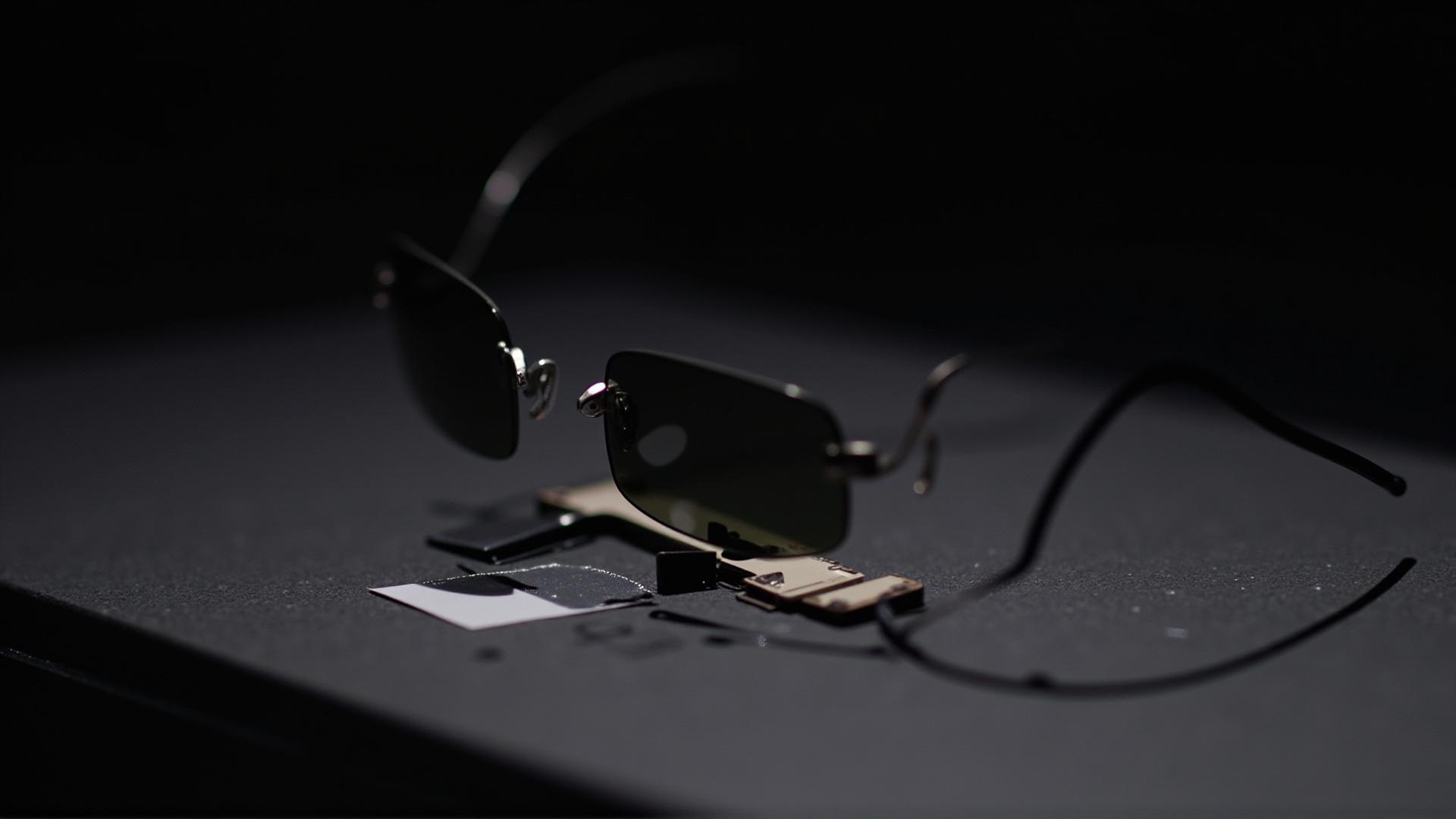
Smart glasses camera technology smart glasses limitations and drawbacks are not a list of defects, and treating them as a list of defects is what produces a channel that returns more than it expected. A camera in a pair of glasses is a small sensor, a short lens, a bounded angle and a moving frame, and every one of those is a deliberate trade against weight, cost and the ability to be carried on the head at all. The problem is that a product sheet in this category describes none of them, so a buyer compares on megapixels and finds out in the field.
The correction is this: the published resolution is the least informative figure on the sheet, and the limits below are the ones that decide whether the product works for the customer. They fall into four families — optical, capture, physical and operational — and each family produces its own characteristic complaint. A buyer who can name the family a complaint belongs to can decide, before the launch, whether it is a supplier problem, a listing problem or an inherent property of the format.
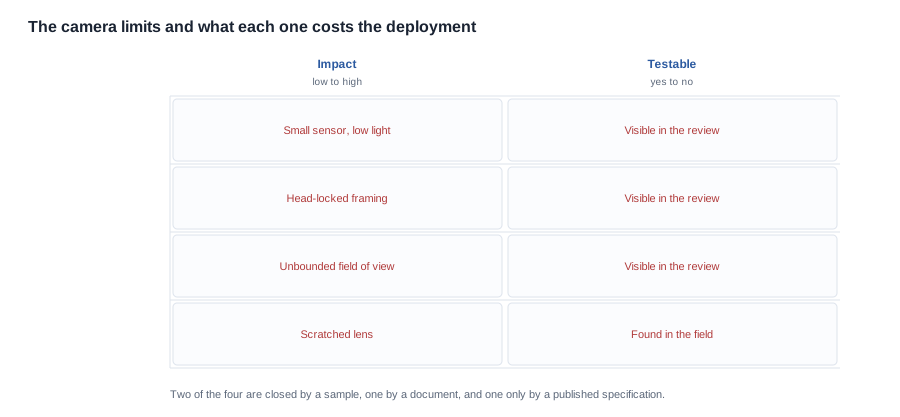
Smart glasses camera technology: the four families of limit a product inherits
The optical family: what the lens and the frame decide
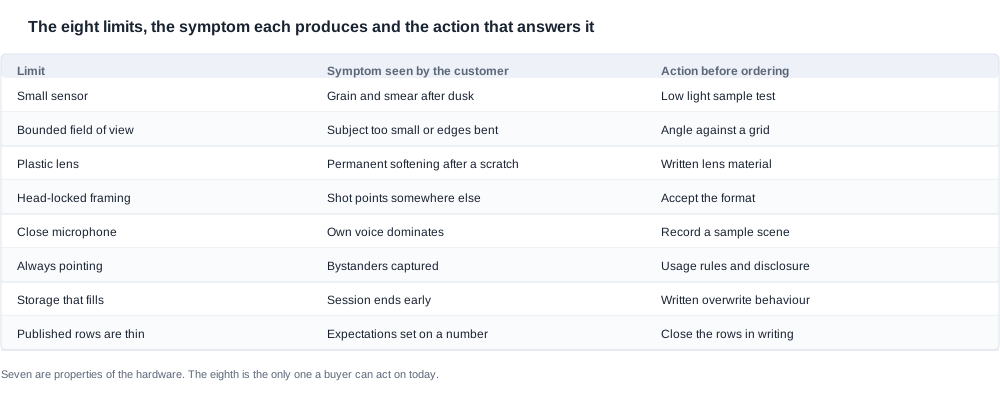
A bounded field of view. The lens has to work inside a frame, so the angle is moderate rather than wide, and the frame's own geometry occludes part of the scene. The product therefore has to be sold on that basis. A wider angle shrinks the subject at the centre and bends the edges of the frame; a narrower one leaves the operator out of the shot. The actual figure is not published for any camera model in our range, which means the buyer cannot even ask for it from a sheet and has to obtain it in writing.
A plastic lens. The lens is the part of the product that gets scratched, and a scratched lens degrades the image permanently and irrecoverably. Our catalogue publishes no lens material, no coating and no scratch tolerance for any camera model, so a buyer who wants to talk about durability in the listing is working from nothing.
The distortion profile. A short lens in a small assembly bends the edges, and the amount is a property of the combination of lens and frame rather than of either part. It cannot be corrected by a listing and it can only be corrected in software at the cost of processing power that comes out of the same cell as the sensor.
The capture family: what the sensor and the pipeline decide
A small sensor. The image quality ceiling is set by how much light the sensor collects, and the sensor in a pair of glasses is small. Daylight leaves the sensor with margin; dusk and any interior after dark is where the noise appears and the motion smears. This is the limit most often discovered by a customer in the evening rather than in a review, which is why it belongs on a buyer's list well before launch.
Head-locked framing. The camera points wherever the operator's head points, so the frame in the shot is whatever the head was facing a moment earlier. This is not a defect. It is the first-person format, and the reason it exists. It does mean the footage needs framing and stabilisation in editing, and a customer who expected a locked-off shot will be disappointed.
A moving sensor. A camera carried on the head moves with the operator, and the movement is head movement: larger in amplitude and slower in rhythm than hand movement. The rolling or global shutter behaviour and the stabilisation method both interact with it, and neither is published for any camera model in our range.
A close microphone. The nearest and loudest source in most recordings is the person carrying the device, arriving from a short distance and at an off-axis angle. Whether it comes out clean depends on the microphone placement and the processing, and our catalogue publishes no microphone specification for any camera model.
The physical family: what the assembly decides
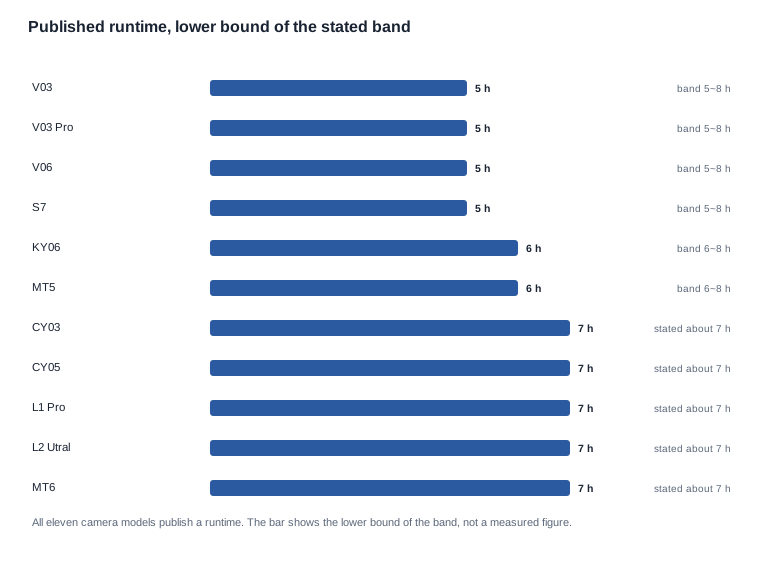
Mass at the end of a temple. The camera module sits at the front of the temple, which concentrates mass at the end of a lever and loads the hinge. It affects retention, the load on the hinge and the returns rate, which makes it a procurement row rather than a note about the wearer. The catalogue publishes a unit weight for exactly one model in the entire range, the MT6 at 158 g, and that is the weight of the glasses body including the battery and the camera and excluding the foldable charging case, whose capacity is published at 1200 mAh and whose weight is not published. For the other ten camera models the weight is not published and has to be requested.
A thermal ceiling. A module pressed against the head dissipates into a small thermal mass. A long continuous recording session can reach a thermal limit that changes the frame rate or the capture behaviour, and no published row in our range describes any of it.
The operational family: what the product does with the data
A device that is always pointing somewhere. A camera in glasses records what is in front of the operator without a deliberate act of pointing it. That is a privacy and an etiquette constraint rather than a feature, and it shapes where a product may be used: a changing room, a meeting, a restricted area. A brand selling into schools, offices or clinical settings has to think about it, because the person carrying the device will not think about it every time.
Storage that fills. A recording session ends when the storage ends, and the behaviour at that point varies. We publish no capacity, no file format and no overwrite rule for any camera model, and the export and backup path is a documented requirement in its own right.
A transfer path that can be slow. The gap between the shutter and a file in a gallery is where most perceived latency lives, and no transfer time is published for any camera model in our range.
What each family produces as a customer complaint
The practical value of grouping the limits this way is that each family has a characteristic signature, and the signature tells the buyer where the problem actually lives.
The optical family produces complaints about the picture's shape
A customer who says the picture reads as bent, or that the subject is too small in the middle, or that the edge of the scene is smeared, is describing the optical family. The response is not a firmware fix; it is either a specification of the angle and the distortion profile so the listing can describe the format honestly, or a decision to accept the format and set expectations before the purchase. What does not work is a listing that promises a wide-angle first-person view, because that promise is not deliverable with this form factor and the returns follow from it.
The capture family produces complaints about light and about movement
A customer who says the picture is fine outdoors and poor inside, or that fast movement turns to smear, is describing the capture family. Some of it is addressable by the exposure behaviour, which our catalogue does not publish and which therefore has to be observed and then described in the manual. Some of it is not addressable at all, because a small sensor gathers less light, and the correct response to that is a product decision about whether the deployment happens in daylight or not.
The physical family produces returns
A customer who says the product slips, or that the front feels heavy, or that the unit has come loose at the hinge, is describing the physical family, and this is the family that costs the most money because it comes back. It is also the family with the least published data: one weight in eleven models, no ingress marking on nine of them, and no drop rating anywhere in the camera tier.
The operational family produces support calls and lost footage
A customer who says the device recorded nothing, or who lost an afternoon of footage, or who is asking whether the product was recording, is describing the operational family. This is the family a support script can actually help with, because the causes are known and the answers are written down. It is also the family that a brand can pre-empt almost entirely by publishing the storage capacity, the overwrite rule and the transfer method in the manual, which our catalogue does not do for any camera model.
The documentation gap sits on top of all four families
The ninth limit is the one a buyer can act on today, and it is not a property of the hardware at all. For the entire range we publish the resolution tier, the cell capacity, the charge time and the rated runtime for every camera model, the charging method for seven of the eleven and the case capacity for five, and the unit weight for one model. We publish no sensor model, no field of view, no video format, no frame rate, no aperture, no stabilisation method, no low-light figure, no storage capacity, no overwrite behaviour, no transfer time and no microphone specification for any of them.
That is the ninth limit, and it is the only one a buyer can do something about immediately, because it means the questions have to be put to a supplier rather than found in a document. An unpublished figure is an untested one, and the rows that nobody has written down are the rows the customer discovers.
Why an unpublished row is worse than a bad row
A bad row is at least an argument with a number attached, and a buyer can evaluate it. An unpublished row is a gap, and a gap gets filled by whoever is closest to the customer, which in this category means the channel team writing the listing from a competitor's page. The eight limits above are properties of the hardware and they will be met whether or not the documentation acknowledges them. The documentation gap only decides who finds out first.
A hypothetical review of a camera product against a content brief
This is a hypothetical case rather than a client project, and it shows how the four families are used to test a product before a first order.
A brand has a content brief: first-person video, recorded outdoors during daylight, used in short clips for a trade channel, with a session of two hours or less. The review starts by matching each family against the brief.
The optical family is acceptable because the brief does not need a wide angle and because daylight avoids the low-light limit entirely. The buyer still asks for the angle with its convention, because the listing has to say what the customer will see, and because a competitor's page will say something.
The capture family is the one that has to be checked. The brief needs video rather than stills, and the published resolution tier describes the still path, so the video rows have to come from the supplier and then be confirmed on a sample by walking with the unit. The frame rate matters more than the pixel count here, because the content is movement.
The physical family is the one that decides the returns budget, and the brief's short sessions do not reduce it. The weight has to be requested for every candidate, and only the MT6 has a published figure, so the absence is itself a finding: the brand is choosing between models on a row that the catalogue does not hold.
The operational family is where the brief's two-hour session matters. Storage that fills mid-session is a real risk in a short session, and the overwrite rule has to be written down rather than inherited from a default.
The review then produces a short document: the four families, the limit that bites first, the four rows to close in writing, and the three measurements that will confirm them on the incoming units. The launch plan is built from that document rather than from the supplier's feature list, and the listing is written from the rows that were closed.
Which limits a sample can close and which need a written answer
The limits divide cleanly by how they can be closed, and this is the most useful thing to carry into a procurement conversation.
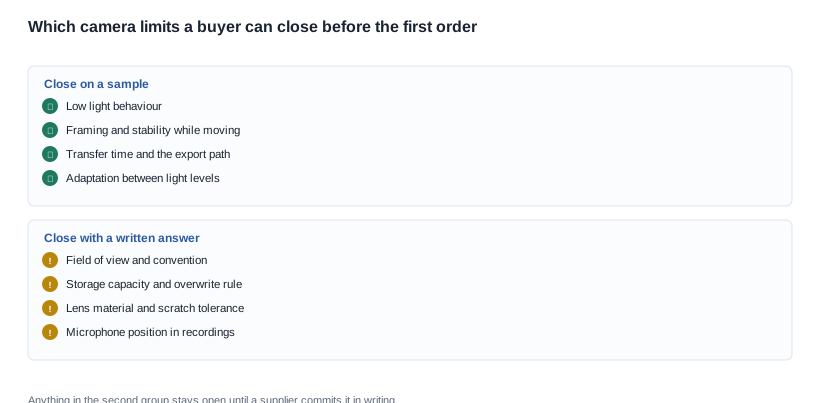
A sample closes these
Low-light behaviour, because a controlled scene in dim light answers it. Framing and stability while moving, because walking with the unit answers it. Transfer time for a full session export, because it can be timed. Adaptation between light levels, because it can be observed. The angle, because it can be compared against a printed grid even though the published figure is absent.
A written answer closes these
The field of view and its convention, because a sample gives you a measurement rather than a specification. Storage capacity and the overwrite rule, because the behaviour has to be described as a rule. The lens material and scratch tolerance, because this is a component fact. The microphone position in recordings. The Bluetooth version, which our catalogue does not publish for any camera model.
Nothing closes these, and that is the point
The small sensor, the bounded angle, the head-locked framing and the device that is always pointing are properties of the form factor. A buyer can decide to accept them, price them, or choose a different product, and the decision belongs in the content brief rather than in a supplier negotiation. Pretending that a supplier will close them is what produces the launches that disappoint in the field.
What to put in the agreement when a limit is accepted rather than closed
Three of the limits cannot be closed and can only be accepted, and a buyer who accepts one should record the decision rather than leave it implied. The total cost of the decision is not in the unit price; it is in the returns rate, the listing wording and the support cost, and it belongs in the commercial plan before the order rather than in a post-launch review.
For the bounded angle and the head-locked framing, the criteria are the content format itself. If the channel sells wide-angle action footage and the product cannot deliver it, the right decision before you order is not to negotiate the angle but to take the product out of the shortlist. If the channel sells first-person working footage, the limits are part of the format and the listing has to describe them, which means the listing copy is part of the agreement with whoever writes it.
For the always-pointing behaviour, the criteria are the deployment environment and the disclosure position. A product sold into offices, schools or clinical settings needs a recording indicator, a disclosure in the instructions and an internal policy on where it may be carried. Those are deliverables with owners, and they are much cheaper to settle before the tooling than after a complaint.
For the small sensor, in the deployments that need it, the criteria are the lighting of the deployment and the price of the returns that follow. If the deployment is daylight only, the limit is priced into the product choice. If it is not, the limit has to be priced into the returns allowance, the listing wording and the decision about whether a different product is cheaper.
The questions to put to a supplier about each limit
- What is the field of view, in which convention, at what focal length? The criterion for a usable answer is a number, a convention and a product-level figure.
- What is the lens material and what scratch tolerance has it been tested to? The criterion is a material and a test, not a word like durable.
- What is the behaviour at low light and what is the exposure behaviour? The criterion is a description of the mechanism, not an adjective.
- What is the storage capacity, the format and the overwrite rule? The criterion is that the rule is stated as a rule.
- What is the transfer method and what is the time for a full session export? The criterion is a method and a measured figure.
- What is the unit weight, and does it include the battery, the camera and the case? The criterion is the boundary of the figure, stated.
- What is the ingress position for this specific model, and what report sits behind it. Only the V06 and the S7 carry an IP54 marking in our range, and the marking appears without a published report number.
- What happens at the thermal limit, and how long does it take to get there? The criterion is a time and a behaviour.
The pattern across all eight is the same, and it is the pattern that separates a usable answer from a usable-sounding one: a number with its condition, a method, a boundary, or a stated rule. A limit that is described in adjectives cannot be accepted or priced, because there is nothing in the answer to accept.
Where we draw the line on camera claims
We publish the resolution tiers and the electrical rows because they are in our catalogue, and we publish the empty imaging rows with the same prominence, because that is the honest description of what we hold. We will not rank our 13 MP platforms against our 8 MP platforms on image quality, and we will not present an unpublished field of view as though it were a feature.
The boundary has a commercial consequence worth stating plainly. A brand that sells on the resolution tier is selling on the least informative row on the sheet, and a customer who knows the hierarchy will find it. A brand that sells on the format — on the hands-free first-person capture that a phone cannot do — is selling on the one property the product genuinely has and the one a competitor's dedicated camera cannot match. That is a narrower pitch and a defensible one.
What we can do is narrow the shortlist by workload and check a sample against the published rows, so that the limits which can be closed are closed before the first order and the ones that cannot are priced into the plan rather than discovered by the customer. The imaging detail is under AI camera glasses imaging, the models are on the AI camera glasses page, the comparison method is in how to compare camera platforms, the sample procedure is at how to test camera technology, the certification side of the same product is at camera glasses certification notes, and the format comparison is at how camera technology compares to alternatives.
Tell us the capture scenario and we will tell you which of these limits decides it for you.
Related reading
- The comparison itself — how camera technology compares to alternatives
- Establishing the behaviour on a sample — how to test camera technology
- The certification side of the same product — camera glasses certification notes


