
Most of the confusion in a compliance conversation is vocabulary. A supplier says "the product is CE certified" and a buyer hears "the model is covered", and those are not the same statement. A buyer says "we have the test report" and a supplier hears "we have a report that mentions the product". The nine terms below are the ones that carry a decision in this category, and each one comes with what to ask for it. Read them in order and a certification conversation becomes a document request, which is a conversation that can be completed.
Smart glasses certification checklist: nine terms that decide the conversation
Why most of the confusion in this category is vocabulary
The reason a supplier and a buyer can talk past each other for three emails and both leave believing they agreed is that the same word means a document to one of them and a claim to the other. "CE" is a mark on a product and a framework in law. "Test report" is a record of a test and a phrase that can cover a mention of a product in a summary. "Certification" is used by buyers to mean a clearance and by suppliers to mean a service.
None of this is anybody's fault, and all of it is expensive. The cost of a vocabulary mismatch is that a buyer believes a file exists when it does not, or that a file covers a model when it does not, and both beliefs survive until the moment they are tested by a third party.
The nine terms below are the ones that actually change a decision. Each is given as what it is, what it is not, and the request that resolves the ambiguity. They are ordered by how often they come up in a first conversation, not alphabetically, and the first two account for most of the trouble.
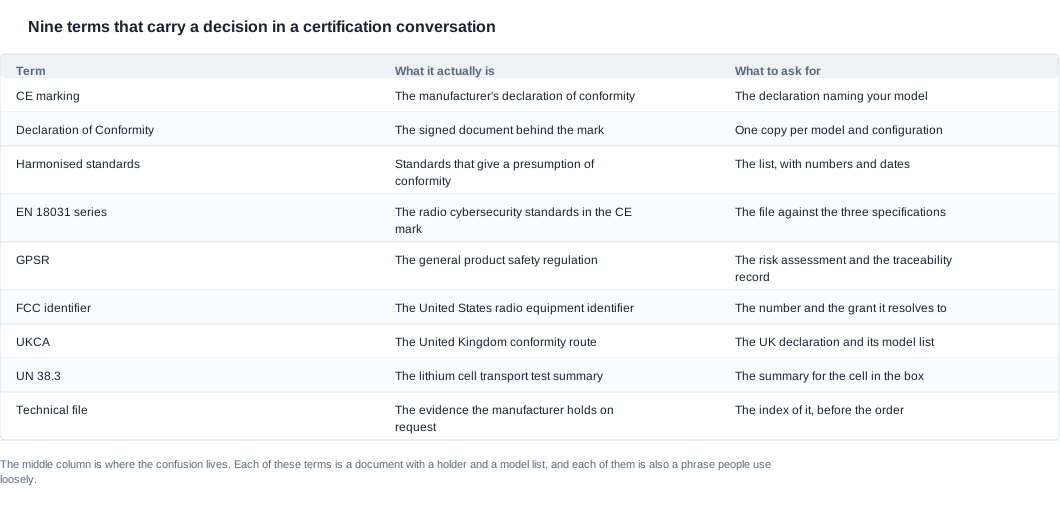
The nine terms and the document behind each one
| Term | What it actually is | What to ask for it |
|---|---|---|
| CE marking | The manufacturer's declaration of conformity | The Declaration of Conformity naming the model |
| Declaration of Conformity | The document behind the CE mark | A signed copy per model and configuration |
| Harmonised standards | The standards that give a presumption of conformity | The list, with the numbers and the dates |
| EN 18031 series | The radio cybersecurity standards, mandatory in the CE mark since 1 August 2025 | The technical file against the three specifications |
| GPSR | The EU general product safety regulation, applicable since 13 December 2024 | The product risk assessment and the traceability record |
| FCC identifier | The US radio equipment identifier, permanently marked on product and pack | The number, and the grant it resolves to |
| UKCA | The United Kingdom conformity route | The UK declaration and its model list |
| UN 38.3 | The lithium cell transport test summary | The summary for the cell in the configuration |
| Technical file | The evidence the manufacturer holds, to be produced on demand | The index of it, before the order |
Read the third column as a set of requests rather than as a set of documents. Four of the nine are documents that exist, three are frameworks that point at documents, and two are records that live in a database rather than on a piece of paper. A buyer who sends this table as a request gets a specific answer to each line, which is the only way to find out which of the nine a supplier has actually got.

The mark is not the file, and what to ask for instead
What a CE mark does and does not tell you
A CE mark on a product is the visible end of a process. The process is the Declaration of Conformity, which names the model, the applicable legislation, the harmonised standards used, and the signed body behind it. A product can carry the mark and the file behind it can still be incomplete, and the buyer who has only seen the mark has seen nothing.
There is a second thing the mark does not tell you, which is the date. A conformity position has a date on it, and that date is the one that has to sit before the launch date rather than after it. A mark on a product in a warehouse tells you nothing about whether the declaration behind it is still inside its validity period.
And there is a third, which is the holder. A mark does not say whose name is on the declaration, and that is the question that determines whether the file can be used by the party placing the product on the market.
The question that replaces "do you have CE"
The useful question is never "do you have CE". It is: send the Declaration of Conformity for this model and this configuration, with the model list attached, and let me check the coverage and the date.
The difference is not pedantic. A supplier answering "yes, we are CE certified" has told you that the company is capable of declaring conformity, which is a general capability. A supplier answering with a declaration has told you what applies to your unit, which is the only fact a buyer can act on.
This is the same discipline that applies to every other term in the table. The mark is a compressed claim, the file is the evidence, and the request has to be for the file.
Three terms that can be checked without the supplier
Three of the nine terms have a property that makes them worth prioritising, and it is a property of the evidence rather than of the term.
An FCC identifier is a number that resolves in a public database to a grant, and the grant names an applicant and a device. A buyer can therefore check a supplier's answer without asking the supplier anything, which makes it the fastest way to establish whether a United States launch is possible and whether the artwork is correct.
A Bluetooth qualification listing works the same way. The listing is a record in a public database, identified by a listing identifier and a qualified design or product number. Our catalogue publishes the radio version per model where the material carries a line for it, with version 5.3 on the K01 and the K02, and version 5.4 across the audio and motion models. The camera models carry no version line at all, which means the identifier has to be requested rather than derived.
A Bluetooth SIG qualification is a claim that a buyer can check in a minute, and a claim that nobody has checked is a claim that has not been verified. The point of starting with these three is that they convert an opinion about a supplier into a fact about a product, and a buyer who has two or three verified facts is in a much stronger position to evaluate the rest.
Harmonised standards carry dates, and EN 18031 is the case that matters
What a presumption of conformity actually gives you
Harmonised standards are the standards that give a presumption of conformity, and the word doing the work in that sentence is presumption. A presumption is a starting point for a regulator, not a guarantee, and it can be displaced. A buyer who treats a harmonised standard list as a shield has misunderstood what the list is for.
For a buyer, the useful facts about the standards are narrower than the marketing around them suggests. The useful fact is which standard covers which part of the product, because a product can be assessed against a radio standard and a safety standard and a cybersecurity standard, and each of those produces a piece of the technical file. A supplier who lists twenty standards for a product has told you very little. A supplier who maps five requirements to five documents has told you a great deal.
The second useful fact is the edition and the date, because the list of harmonised standards changes and because a list without a date cannot be checked against a launch window.
The three EN 18031 specifications and what they cover
EN 18031 is the case that matters most here. Three specifications in the series were published on 30 January 2025, covering secure communication, end to end encryption, secure storage and user consent, and the processes for handling and patching identified vulnerabilities, and since 1 August 2025 they have formed a mandatory part of the CE mark for radio equipment including Bluetooth devices.
So when a supplier says the product meets EN 18031, the useful question is which of the three specifications are covered, and against which document. The answer has to be per model, because the technical file is per model.
This is also the point at which a buyer should establish whether a product in the programme has a radio at all, because a product without a radio is outside this particular requirement, and a supplier who volunteers the whole series for a product that does not need it is either being thorough or is not answering the question that was asked.
What a buyer does with a standards list
Once the list arrives, there are three things worth doing with it, and all three are cheap.
The first is to check the dates against the launch window. A standards list is current or it is not, and a list that was correct when the assessment was carried out may not be current now, particularly where the mandatory framework changed. A standards list with a date on it and a list without one are not the same document, and only the first of them can be checked.
The second is to confirm that the list is per model. A technical file is per model, so a standards list that is presented at company level is either a summary or a template, and the request should be for the list as it appears in the model file.
The third is to ask what happens if a standard changes. A supplier who has a process for re-reading the applicable requirements when the framework moves is materially more useful than one who has not, and this is a reasonable question to put to a supplier that intends to be in the market for more than one order.

A certificate number and a report number are not the same kind of thing
The difference in practice, and the wrong document to ask for
A certificate number identifies a conformity assessment. A test report number identifies a set of test results. They are related, they are not interchangeable, and a buyer who asks for "the certificate" when they mean "the report" gets whichever one the supplier has to hand.
The two objects have different uses. A certificate is the formal output of an assessment and it is what a regulator is shown. A report is the underlying evidence and it is what a technical reviewer reads. A file that contains only a certificate is a file that asserts; a file that contains the reports can be checked.
The practical consequence for a buyer is that a document request should name which object is wanted. "Send the certificate" will produce a certificate, and if what the technical file needs is a report, the buyer has to go round again. The cost of the second request is a day of elapsed time, and it is paid at every step of the file.
The ingress marking as the clearest example
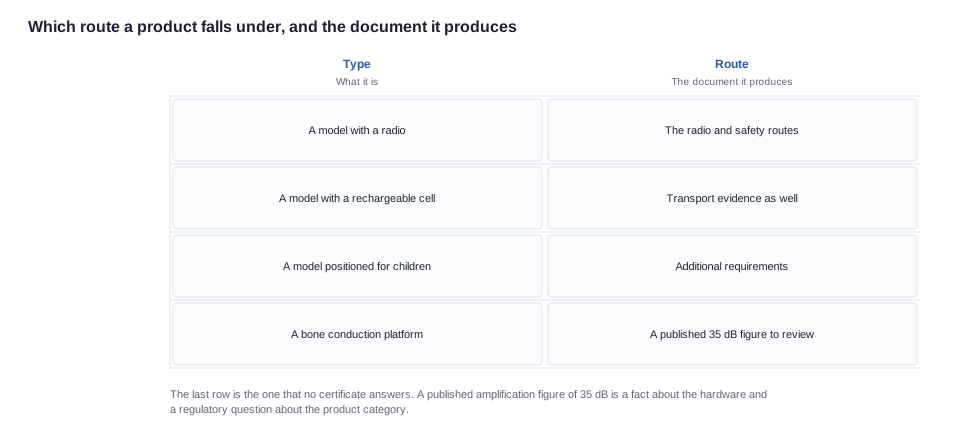
The clearest example in this category is the ingress protection marking. In our own documentation the IP54 marking appears on the V06 and the S7, and it is presented as a catalogue marking with no third party test report number published behind it. A buyer who needs the report has to ask for it, and a buyer who cannot get it should describe the marking as a marking.
That distinction is not pedantry either. The digit pair carries a specific meaning, and the meaning of the second digit in IP54 is protection against water spray rather than immersion. A listing that says "waterproof" for an IP54 model is making a claim that neither the marking nor a test report behind it would support, and a market control authority can act on it.
The weight figure, and why it is written the way it is
One more published figure in our own material is worth reading carefully, because it is the only unit weight we publish and it is frequently quoted more loosely than it should be.
The catalogue publishes the weight of the MT6 glasses body at 158 g, which includes the 265 mAh battery and the camera and excludes the 1200 mAh folding charging case. It does not publish a bare frame weight for any model in the range, because no frame weight has been published for any model. The two figures are different objects, and a buyer who quotes 158 g as a frame weight has quoted something that was never published.
The same discipline applies to the rest of the published specification set. The resolution class is published for every camera model, with eight of the eleven camera models at 8 MP and three at 13 MP, and the sensor part numbers are not published for any of them.

The transport document that is not a certification
UN 38.3, what it covers and what it does not
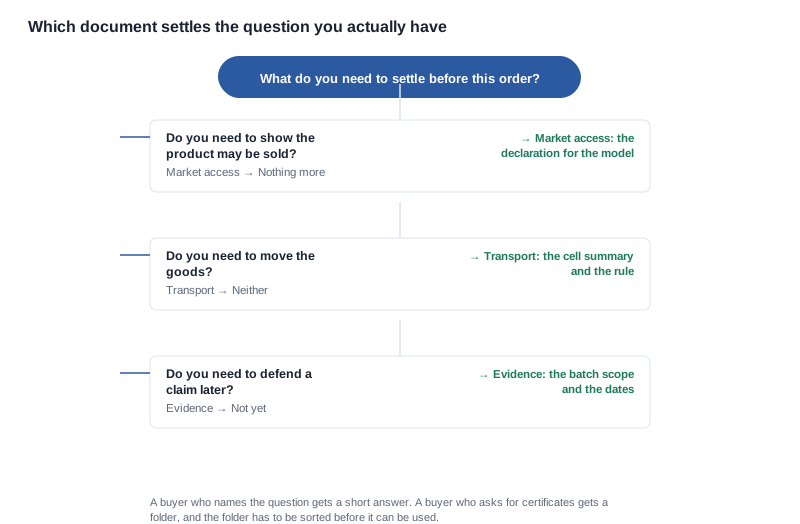
UN 38.3 is a lithium cell transport test summary, and it is not a conformity marking. That distinction catches people out because it sits in a compliance conversation and is answered like one, and because the consequences of getting it wrong are dramatic rather than gradual.
Every model in our catalogue runs on a rechargeable cell, so a forwarder will require the summary before the goods move. Ask for the summary for the cell in the exact configuration, and ask for the transport classification alongside it.
Why the case changes the answer
A configuration with a 1400 mAh charging case and one without a case do not have the same classification, because the case is a second cell in the consignment. The published range is a good illustration of why this needs to be asked per configuration rather than per model: the CY03, the CY05 and the L1 Pro are published with a 1400 mAh case, the L2 Utral with a 900 or 1400 mAh case, the MT6 with a 1200 mAh folding case, the KY06 and the MT5 with a case whose capacity is not disclosed, and the V03 Pro with no case at all.
The same logic applies to the charging interface, which is magnetic on seventeen of the twenty-eight models, Type C on seven, and not published for the L1 Pro and the CY05, and the MT6 and the CY03. Each of those is a fact that changes the transport position, and each of them is a fact that has to be in the file rather than assumed in it.
The glossary written into a request you can send
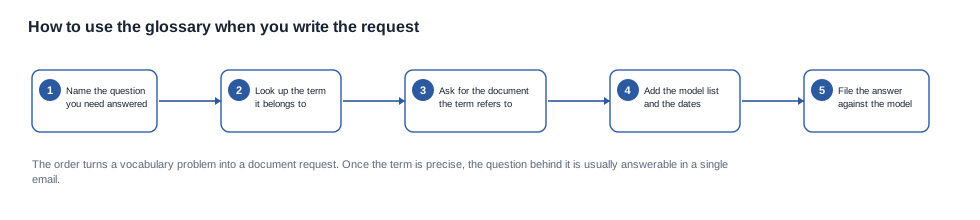
Turning each term into a document request
The glossary becomes useful when it is written as a request rather than as a definition list. Five lines, each derived from a term above, and each one answerable with a document.
- "Which model designations does the Declaration of Conformity cover, and what are its issue date and signatory?" This is the CE marking and the Declaration of Conformity collapsed into one answerable question.
- "Which harmonised standards were applied, with their numbers, editions and dates, and does the technical file cover the EN 18031 series for this model?" This is the standards list and the cybersecurity file in one line.
- "Where is the product risk assessment and the traceability record for the GPSR obligations?" This is the framework translated into the two documents it produces.
- "What is the FCC identifier for this model, and which grant does it resolve to?" This is the United States route, and it is one number that can be looked up in a public database rather than a file that has to be trusted.
- "Which UN 38.3 test summary covers the cell in this configuration, and does it cover the case cell if a case ships in the box?" This is the transport question, asked in the terms that will produce an answer.
A request built this way is short, and the answers come back in a form that can be filed rather than in a form that has to be interpreted.
The certification terms, and what our pages actually say
In our own documentation, the export-certification page carries ten patent certificates — eight appearance-design patents and two utility-model patents — and its content is images rather than text; the catalogue names no CE, FCC or RoHS marking, there is no per-model certification row anywhere, and no specific model coverage, certificate number, issuing body or validity date is published for any model, the applicable scope for a model and a market being written material to be requested and filed before the order. That distinction is the one this glossary exists to make: a company level declaration is not a model level file.
The rest of what the catalogue records is the specification set a technical file is built around: the resolution class, the cell capacity, the charging interface, the case configuration, the Bluetooth version where a line exists for it, and the customisation scope. The unit weight is published for the MT6 glasses body only, at 158 g excluding the folding charging case, and no bare frame weight is published for any model. The sensor part numbers, the ingress test report numbers, the certification numbers with their model coverage and the AI implementation details are all Not published.
Where we hold a document for a specific model, we will supply it. Where we do not, we will say so and tell you what has to be obtained and by whom, because a gap that is named can be planned around and a gap that is described as a strength cannot.
Related reading


