

Smart glasses sourcing risk becomes manageable at the moment it stops being a category and becomes a list of rows — each row attached to one order, one configuration and one date, and each row closed by an instrument somebody can point to. That is the whole method, and it is worth stating at the top because the category is where procurement time is quietly lost: a concern that is never written down cannot be priced, cannot be assigned to a person, and cannot be closed, so it survives every stage review and eventually arrives back as a claim. The six steps below are deliberately mechanical. They assume no specialist judgement beyond the ability to write a risk as a sentence and to look up whether an answer exists.
If you take only one thing from this method, take step five. A risk row without a named owner and a review date is not an open item — it is an absent one, and absent items are the ones that surface during a customs query or a defect dispute, at which point nobody can remember what was assumed.
Smart glasses sourcing risk: the six steps, in the order they run
What this method is for, and what it deliberately leaves out
This method is for the buyer who has a live programme in this category: a brand owner about to place a first order, a channel buyer opening a new model line, or an importer with a supplier shortlist and a date they cannot move. It is not a supplier-scoring model, and it does not score factories. Scoring produces a number that gets debated and then filed; this produces rows that get closed, which is a less satisfying artefact and a more useful one.
Three things are deliberately outside the method. It does not attempt to forecast what a supplier will do. It does not rank suppliers against each other, because a supplier comparison without a specification behind it compares the wrong things — a cheap model and an expensive one may be the same product with a different pack. And it does not replace the compliance work, because a risk register cannot make a market requirement appear.
What it does do is force every concern into one of two categories, and those two categories are closed in two different ways. A documentation gap is closed by obtaining an answer in writing and attaching a deadline to the request. An exposure — a thing that can actually go wrong with the goods — is closed by a decision: accept it, mitigate it, price it, or walk away. The confusion between those two closures is the most common reason procurement teams spend negotiation capital on paperwork.
The six steps in order

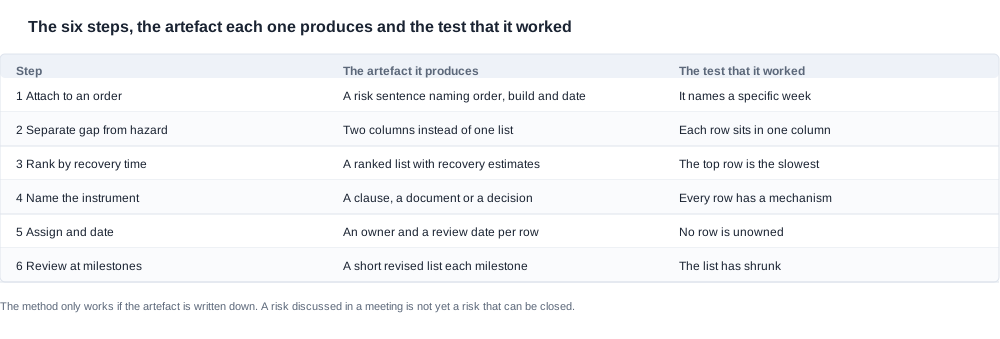
The sequence, in the order it has to run:
- Attach the risk to an order. Rewrite it as a sentence naming one configuration, one quantity range and one week.
- Ask whether an answer exists. Some rows have no answer anywhere; that changes the closure route immediately.
- Sort it into a gap or an exposure. Two columns, not one list. A row sits in one of them.
- Estimate the recovery time. How long until the affected units can be sold again if the item fires.
- Choose the instrument. A clause, a document request, a test, or a recorded decision — written next to the row.
- Write the owner and the review date. A row without both is not yet a row.
The order matters more than it looks. Ranking before sorting produces a list dominated by paperwork, because paperwork is easy to write down and easy to over-estimate. Sorting first means the recovery estimates are applied to the things that can actually stop an order, and the paperwork moves into a column where it costs a request rather than a decision.

Steps one and two: anchor the risk to an order, then sort gap from hazard
Step one: attach the risk to an order, not a category
Every risk worth carrying is attached to a specific order, a specific configuration and a specific date. Rewrite each risk as a sentence with those three in it. "Supplier might disappear" becomes a real question — what happens to this order if the factory cannot ship in week nine — and it now has an answer that can be checked.
Category-level risk has no owner and no test, which is why it survives in risk registers for years without changing anything. It is also the level at which a procurement team spends its attention least efficiently, because a category-level statement cannot be closed by any action available to the buyer. If a row cannot be rewritten with a model, a quantity and a week, that is a signal about the row rather than a reason to leave it as it is.
The anchor also does something quieter. It forces the specification to be written before the risk, because you cannot name a configuration that nobody has defined. In this category that is a productive discipline rather than an administrative one: the published catalogue already settles a large share of the rows a buyer would otherwise list as open. Cell capacity, charge time, rated use, Bluetooth version, charging method and charging-case capacity are published for the range, and the camera tier splits into eight models at 8 MP and three at 13 MP. A requirement sheet that carries those rows is already half written before the first supplier conversation begins.
Step two: separate a documentation gap from an actual risk
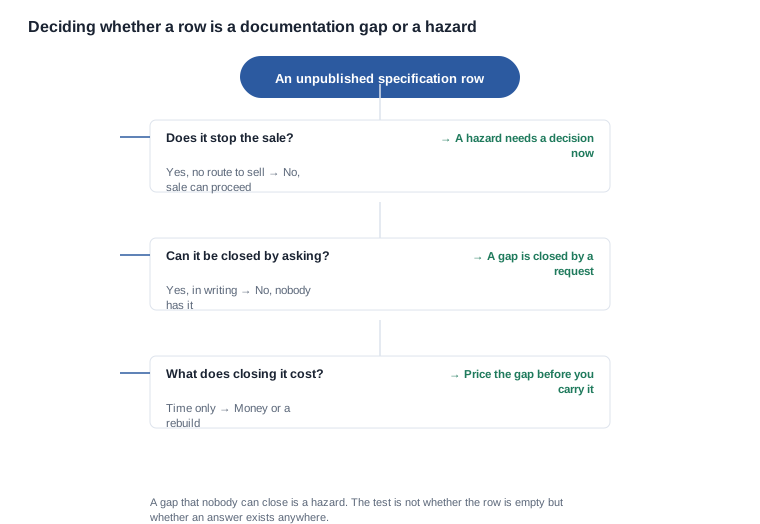
This category has more documentation gaps than genuine hazards, and treating them as the same thing produces a disproportionate response. Unit weight is published for exactly one model in the range, the MT6 eyewear body at 158 g including the 265 mAh battery and the camera and excluding the folding charging case, whose own weight is not published; the camera sensor model and field of view are not published at all. That is an inconvenience in diligence, not a hazard to the order.
The test is not whether the row is empty but whether an answer exists somewhere and nobody has asked for it. If an answer can be obtained in writing, the row is a gap. If no answer exists — because the specification was never fixed, because the requirement is genuinely impossible to evidence, or because the exposure is about something that can go wrong rather than something that can be described — then the row is an exposure and it needs a decision.
The distinction matters commercially because gaps are closed with a request and a clause, while exposures are closed with a decision — accept, mitigate, price, or walk. Confusing the two leads buyers to spend negotiation capital on a documentation request that would have been closed by an email, and to postpone the decisions that actually carry money. The certification position in this category is a good example of the second category: the catalogue has no per-model certification row for any entry, so the scope of certification for a specific model has to be requested in writing, and a supplier who offers a general statement has not answered the question you asked.
Step three: rank by recovery time and by who holds the decision
Why severity is the wrong sort order for a camera glasses order
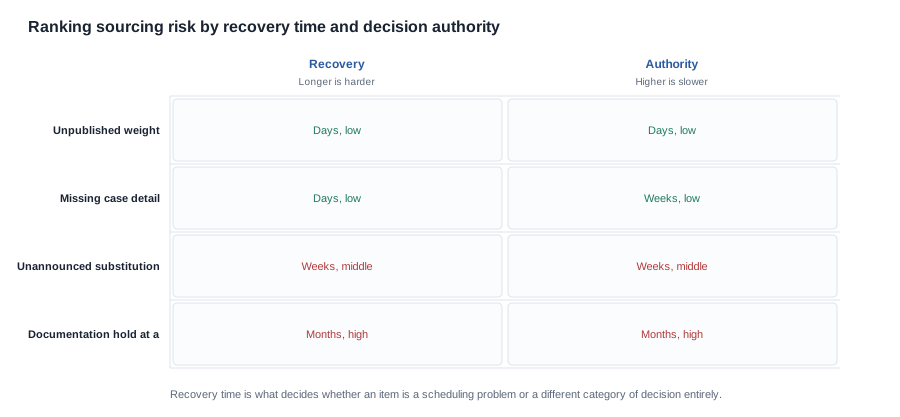
The question that sorts a list fastest is: if this happens, how long until I can sell again? A risk with a four-week recovery is a scheduling problem. A risk with no recovery is a different category of decision entirely, and in this category the no-recovery items are concentrated in compliance and in a claim you cannot make because a specification row was never written.
Rank by recovery time and the list becomes manageable, because most items cluster at the recoverable end. A specification row that is unpublished can be closed in days. A charge method that is not published can be requested once and attached to the order. By contrast, a unit that reaches a customer with an ingress marking the order never covered cannot be re-sold as the same product in the same market, and the recovery time on that item is not weeks — it is the length of the channel's memory.
This is also why the severity-first approach fails in practice. Severity is a judgement, and judgements get argued. Recovery time is an estimate with a unit, and estimates get improved. When a register is ranked by recovery time, the top of the list is a small, identifiable set of items that all need a decision from the same place, which is what makes the list usable inside a procurement calendar rather than a document for a committee.
Decision authority belongs in the ranking, not in a footnote
The second axis is who is allowed to close the row. An item that needs a decision only the brand owner can make — dropping a colourway from the first run, splitting the launch into two markets, accepting a specification gap on the camera tier — cannot be closed by a sourcing manager, and will sit open indefinitely if it is queued behind items the sourcing manager can actually close.
Separate the two axes on the register and the list becomes a scheduling tool. Items that need a fast decision and a high authority are the ones to escalate on the day they appear. Items that need a fast decision and low authority are the ones to close without a meeting. Items that need slow authority are not risks at all yet — they are decisions that have not been taken, and they belong on the launch plan rather than on the risk register.

Steps four to six: name the instrument, assign the owner, re-run the list
Step four: close each item with a specific instrument
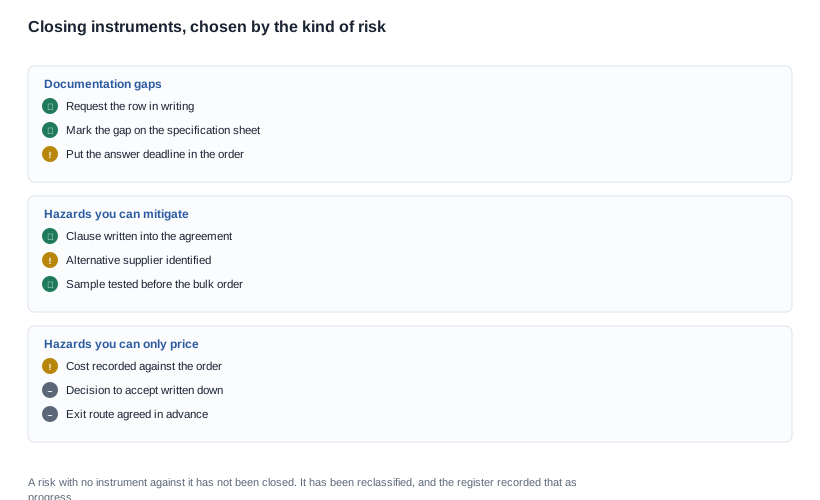
A closed risk has a named mechanism, and the mechanism is usually mundane: a clause in the contract, a document requested before the deposit, a sample tested before the bulk order, or a decision to buy only one colourway for the first run. Write the instrument next to the risk before moving on. Risks that survive without an instrument are almost always risks that were never actually closed — they were reclassified, and the register simply recorded the reclassification as progress.
The instruments differ by the type of risk, and a good register makes the difference visible rather than blending it. A gap is closed by a written request with a deadline attached, and by a clause that says what happens if the answer does not arrive by then. An exposure that can be mitigated is closed by a contract term — a written approval requirement for any component substitution, a remedy with a defined method and an inspection window measured from arrival, a notification duty before a configuration changes. An exposure that can only be priced is closed by a decision written down: the cost carried against the order, or an exit route agreed before the deposit rather than after the first complaint.
Step five: an owner and a review date, or the row does not exist
The owner is a person, not a team. "Procurement" cannot be chased for a document on a particular date, and neither can "the supplier". The owner is whoever will receive the answer and put it on the file — which in most cases is the person who wrote the request, because the request carries the deadline.
The review date is the part that gets skipped, and it is the part that makes the register live. Without a date, an open row is indistinguishable from an abandoned one at every review meeting, and abandoned rows are how a risk register becomes an archive. With a date, the row either closes, moves with a new date and a reason, or escalates. The date does not need to be a milestone date; a fortnightly date is enough, because the point is that the row is revisited rather than never mentioned again.
A useful discipline is to forbid one phrase on the register: the supplier will confirm. That row has no closure route, because the supplier's confirmation is not a document the buyer controls and not a decision the buyer made. Split it into the actual request — what is being asked, by when, and what happens to the order if there is no answer — and the row becomes actionable in a way it never was.
Step six: re-run the list before each milestone
A register that is built once and filed is a document. A register that is re-run at each milestone is a control, and the difference shows up in the shape of the list. Re-run it at quotation, at deposit, before the production run, and before the cartons are sealed. At each of those points the same six columns are filled again, and the list should be shrinking.
Re-running also re-ranks. An item that was a documentation gap at quotation may have become an exposure by the time the sample arrives, because the answer came back and the answer was not acceptable. An item that was an exposure may have become a gap, because a test settled it. If the re-run produces the same list every time, either nothing has changed or the method is not being applied — and in a programme where the build is genuinely still moving, some rows must change category at some point.
What a working register looks like at the end of the exercise
The six columns and the test that proves each one
The artefact of this method is short enough to keep on one screen and specific enough to be audited. Every row carries six fields: the order anchor, the item type, the recovery estimate, the instrument, the owner, and the review date. Each field has a test that proves it is real rather than decorative.
The tests are deliberately blunt, because blunt tests survive contact with a deadline. An anchor that cannot be quoted is not an anchor. A recovery estimate that is not a number is not an estimate. An instrument that is not named is not a closure. An owner that is a department is not an owner. A review date that does not exist is an absent row. When a procurement team runs these six tests against an existing register, the failure count is usually higher than expected, and that count is the real measure of how much of the programme is currently unmanageable.
Where programmes like this actually break
Three failure patterns recur. The first is the register that lives in a personal inbox, which means it does not survive the person leaving and does not survive a supplier changing the contact. The second is the register that is re-run but never re-ranked, so the list keeps its original order and the slow items keep their original dates. The third is the register where the rows are all category-level — supplier quality, certification risk, delivery risk — because writing a category-level row is faster and nobody has to say what would count as closure.
None of the three is a tooling problem, and none is solved by buying a risk management system. Each is a decision to write rows that a specific person can act on, with a date attached, and to re-rank them when the programme moves. Programmes that do that tend to discover that their largest exposures were never the dramatic ones; they were the rows that were sitting open without an owner while the dramatic rows were being discussed in meetings.
The boundary between what our catalogue publishes and what you still have to ask
Our position on running this method with our data
We will tell you, for a given configuration, which of our specification rows are published and which are not, so that a documentation gap is not carried as a risk on your side of the table. That is a narrow commitment and we keep to it deliberately: it is the one thing we can verify.
We will also say plainly where a risk cannot be closed from our side. Some of them genuinely cannot be. Whether a published configuration remains available after your programme ends, whether spare parts are stocked, unit prices, minimum order quantities, production capacity figures, defect rates and certificate identifiers are not published in our documentation, and the honest response is to write a notice period into the agreement rather than to imply a stock guarantee we have not stated. On certification, the catalogue carries a company-level export certification page and does not publish a per-model certification row for any entry in the range; the scope of any model's certification is a written request to be made and answered, not an assumption to be made from a company-level capability.
We will not reduce a risk register by reclassifying a real exposure as a documentation gap, which is the one shortcut in this method we consider unacceptable. If a row is a gap, we will say so and help you phrase the request. If it is an exposure, we will say that as well.
Where to start
Send the models, the quantities and the target markets, and we will tell you which configurations exist in the published range, which of your requirement-sheet rows are already settled by published data, and which have to come from a supplier as a written request with a date against it. That is enough to start steps one and two properly, and steps one and two are where the schedule is won.
The risk section covers the individual exposure points in more detail.
Related reading
- Certification checklist — the compliance risks
- Factory audit — the terms used on a visit
- Payment red flags — the commercial early warnings


