

Smart glasses charging: the two questions that settle a line
A smart glasses charging smart glasses faq gets asked in a specific order by the people who sign the purchase order, and it is not the order most catalogues are written in. The first question is which charging architecture the product uses — magnetic contacts or a Type-C port — because that decides what the customer has to own before the product works at all. The second is how much energy the cell holds, because that decides how long the product survives between charges and therefore how often it comes back to a buyer or a shelf.
Everything else a buyer asks about charging follows from those two answers, and most of the confusion in this category comes from answering the second while the reader assumes the first has already been settled.
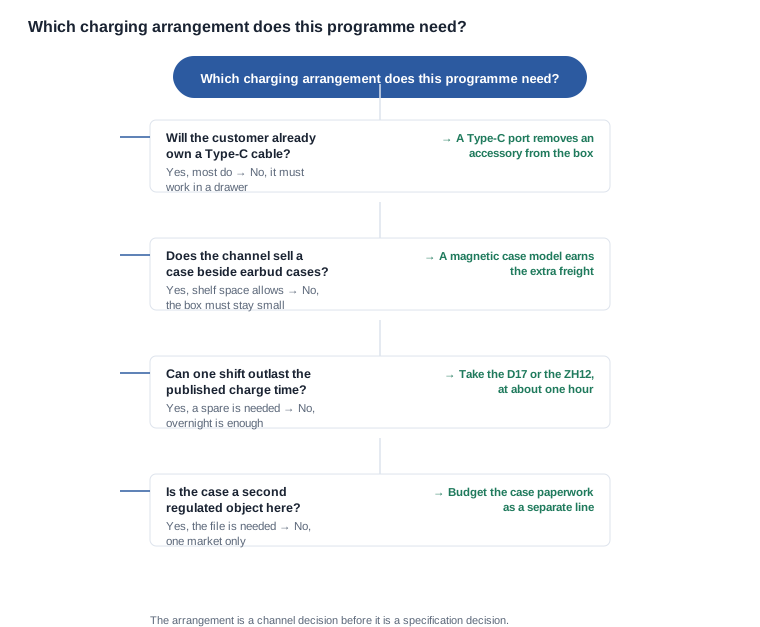
Which model you take depends on the channel you sell into, and the criteria are the same in every case: the interface decides the accessory programme, the cell decides how long the product survives between charges, and the condition behind the charge time decides whether you can publish that figure at all.
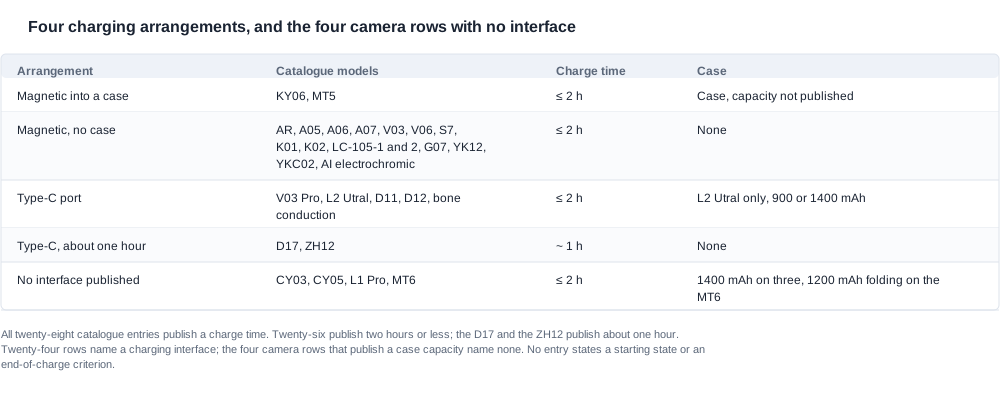
Here is the published position across our range, stated before the questions are answered. Every one of the twenty-eight catalogue entries publishes a charge time: twenty-six publish two hours or less, and the D17 and the ZH12 publish about one hour. Twenty-four of the twenty-eight publish their charging method as well — magnetic contacts across the audio, camera and sport tiers, and a Type-C port on the V03 Pro, the L2 Utral, the D11, the D12, the D17, the ZH12 and the bone conduction model. The CY05 and the L1 Pro, and the MT6 and the CY03 publish a case capacity but no charging interface, so the interface has to be asked for in writing. What no entry publishes is the condition behind the charge time, and that gap is discussed below rather than hidden inside the figure.
Who is buying this, and what they are afraid of
The buyer is usually one of three people, and they arrive with different anxieties. A brand-side product manager is opening a new model number and needs to know which rows on the specification sheet will be audited before the artwork is locked. A channel buyer is comparing two catalogues line by line and needs to know which differences are real and which are the same product described twice. An e-commerce buyer is selecting a range and needs to know which single feature will generate the returns.
What all three fear is the same thing in different clothes: a charge that does not behave the way the product page promised. The brand manager fears a certification gap that appears after the packaging is printed. The channel buyer fears a product page that says something the technical file cannot support. The e-commerce buyer fears a one-star review that says the customer plugged it in and nothing happened.
All three are cheap to prevent at the quotation stage and expensive to prevent afterwards, and the reason they are expensive afterwards is a scheduling fact rather than a technical one. The documentary work runs on the buyer's own timeline, not on the factory's, and packaging artwork sits at the end of it.

Magnetic or Type-C, and what each one commits a channel to
Neither interface is better in the abstract. They are different commitments, and the commitment is what a buyer is actually buying.
What the magnetic contact commits you to
Magnetic charging is easier at the moment of use, because the contacts align without the customer looking for them at the end of a long day. It also locks a cradle into your bill of materials, into your spare-parts strategy and into your packaging design. A cradle is a moulding, not a cable, so it carries tooling, a lead time and an obsolescence question that a USB cable does not.
The cost side of the interface is where the money hides. A magnetic model that ships without a cradle leaves the customer unable to charge the product at all, and that becomes a review within a week of launch. A magnetic model that ships with a cradle adds a second object to the carton, and the carton volume is what your freight model actually reads.
What the Type-C port commits you to
A Type-C port lets the customer charge from a cable they already own, from a power bank they already own, and from a laptop if they are in a hurry. That removes an accessory objection at the point of purchase. It also hands your support line a question: a laptop port delivers a fraction of a wall supply, so the customer will charge slowly and conclude the product is faulty.
The Type-C models in our range are the V03 Pro, the L2 Utral, the D11, the D12, the D17, the ZH12 and the bone conduction model. Note that the D17 and the ZH12 are also the two models publishing about an hour of charge time, and they are Type-C. In our catalogue those two facts travel together, but the catalogue does not say that the interface causes the charge time, and we would not repeat that claim to a customer without the engineering note behind it.
Why the same pair of glasses is quoted at two prices
Quotation differences in this category are rarely about the electronics. They come from four layers that sit between the catalogue and the invoice, and each of them is a decision you can make rather than a mystery you can solve.
- The interface choice. Magnetic and Type-C are different tooling, different assembly steps and different accessory programmes. A supplier quoting a magnetic cradle as an included item has priced something a competitor may have excluded.
- The case, if there is one. A case is a second product with its own cell, its own moulding and its own compliance obligations. It can be the largest single line of variation between two quotations for the same model.
- The documentation scope. A quotation that includes a per-model declaration of conformity and one that assumes a family-level document are not the same offer, and the second one carries a schedule risk that only appears at customs or at a marketplace listing review.
- The packaging configuration. What is in the box changes the carton, the carton changes the freight, and the freight changes the landed cost more often than the unit price does.
Your negotiating room is in items two, three and four. The unit price is the smallest of the four differences and the one most likely to be compared directly, which is why comparing it directly is so common and so unrewarding. The trade-offs in the other three are larger, and the checklist at the end of this section tells you which one to open first.
The case row, and why 900 mAh and 1400 mAh are not the same product
Seven models in the range are published as shipping with a charging case, and the case is where the published data is thinnest. The CY03, the CY05 and the L1 Pro publish a 1400 mAh case. The L2 Utral publishes a case at either 900 or 1400 mAh, which makes it the clearest case-model decision in the range: the platform is the same, and the case is the variable. The MT6 publishes a foldable case at 1200 mAh. The KY06 and the MT5 are published as shipping with a case, but no case capacity is published for either of them.
The V03 and the V03 Pro are published with no case at all, which makes them the two camera models where the customer has to bring their own cable or cradle.
Why a larger case is not a longer shift
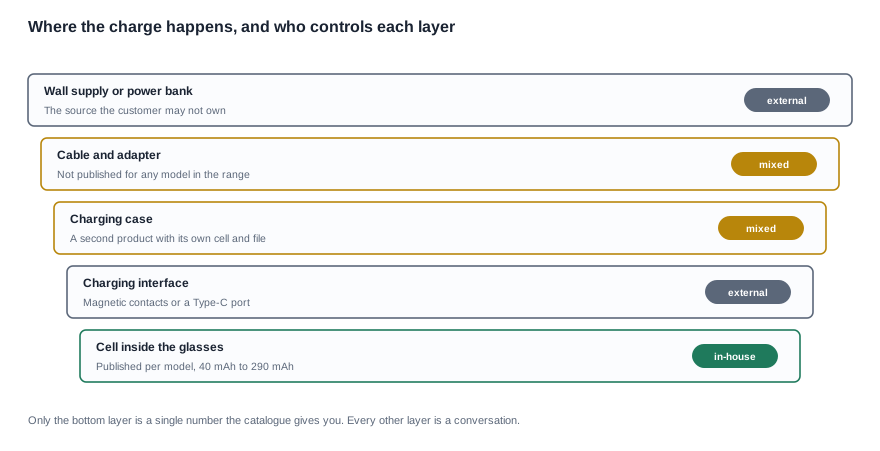
A case capacity is a number of milliampere-hours, and a buyer who wants to turn it into a schedule has to make a conversion that the catalogue does not make for them. The conversion requires three inputs the catalogue does not publish together: the usable capacity of the case rather than its nominal capacity, the efficiency of the transfer into the glasses, and the charge the glasses actually draw per hour of use.
None of those three is published for any model. So a 1400 mAh case and a 900 mAh case cannot be compared as a number of hours of extra operation without a measurement you have to run yourself, and a supplier who quotes you "three extra charges" has made a derivation on your behalf without showing the steps.
The five camera models with a published case capacity
The table below is the part of the range where a case capacity can be quoted as a published figure rather than requested as a document. Everything outside it is a request, not a fact.
- CY03, CY05 and L1 Pro — 1400 mAh. Identical case row across three models, which makes them the easiest comparison in the range.
- L2 Utral — 900 or 1400 mAh on the same platform. The choice is commercial, and it belongs in the channel brief rather than in the technical file.
- MT6 — 1200 mAh, foldable. The foldability is a packing decision with a freight consequence, not an electrical one.
- KY06 and MT5 — a case is published, the capacity is not. Ask for the number with the configuration attached.
- Everything else — no case published.
The charge time is published, and the two things it does not say
This is the section a buyer should read most carefully, because the figure is there and the conditions are not.
Every one of the twenty-eight catalogue entries publishes a charge time. Twenty-six of them publish two hours or less. The D17 and the ZH12 publish about one hour. That is a real, complete, published figure across the whole range, and it is one of the better-populated rows in this category.
What every one of those figures lacks is two conditions, and the absence of each of them changes what the figure means.
The starting state is not stated
A charge time is a statement about a journey from somewhere to somewhere. The catalogue does not say where. A charge from a flat cell and a top-up from half charge are different journeys, and a supplier quoting one while the reader assumes the other has produced a figure that is optimistic by an unstated amount.
The practical consequence for a procurement decision is narrow and specific: a published charge time cannot be used to plan a shift changeover, because the shift changeover is the case where the unit arrives part-charged. It can be used to plan a night of charging, where the unit arrives flat.
The end-of-charge criterion is not stated
The second missing condition is what "full" means. A device can stop drawing current at a voltage threshold, at a current threshold, on a timer, or when a fuel gauge estimates full. These produce different elapsed times from the same starting state and the same supply, and none of the catalogue entries says which is in use.
There is a second reason this matters commercially rather than technically. If you publish "fully charged in two hours" on a product page and a customer's unit sits on the cradle for two hours and still will not start a session, the customer concludes the product is faulty and you have a support ticket and a review. If you publish "up to two hours" and describe the indicator, you have a support answer.
What the two missing conditions cost you commercially
- A product-page claim. Write the published figure as a ceiling, and state the condition you measured yourself if you have one.
- A channel promise about recharge. Do not convert the charge time into "ready for the next shift" without measuring the top-up case.
- A comparison against a competitor. A ceiling compared with a ceiling is fair. A ceiling compared with somebody else's timed figure is not, and you will not know which way it cuts until you ask them for the condition.
- A spare-parts calculation. The number of spare units in a fleet depends on the charge window in the field, not on the catalogue ceiling.
Three ways a charging line goes wrong after launch
The pitfalls in this category share a shape: each one is a published figure being read as something it is not.
The customer charges from a laptop and concludes the unit is broken. The symptom is a support ticket that describes a slow charge as a fault. The root cause is that the product page gave a ceiling with no supply assumption, and the listing did not say that a wall supply is expected. The prevention is a line in the quick start guide and in the listing that says what the product expects.
The customer never charges the magnetic model because no cradle arrived. The symptom is a cluster of returns from one channel with the description "it does not turn on". The root cause is that the box contents were a configuration decision that nobody wrote down. The prevention is to publish the box contents per configuration, and to treat a missing cradle as a configuration error rather than a customer error.
The customer assumes the case is a second battery and buys the wrong one. The symptom is a customer who bought the cased model expecting two days of operation and then returns it after one. The root cause is that a case capacity was presented as runtime. The prevention is to state the case capacity as an energy reserve and to say how many charges it delivers only if you have measured it.
What the box contains decides what your listing has to promise
The charging rows of a specification sheet describe the product. The box contents describe the purchase, and the second is where the disappointment actually comes from.
So how to compare two quotations at this level is straightforward: take the product rows from both, then take the box rows from both, and treat the second set as a separate comparison. The questions to ask on the box rows are short, and the answers are configuration-specific, which is why two suppliers can both be right and still ship different products.
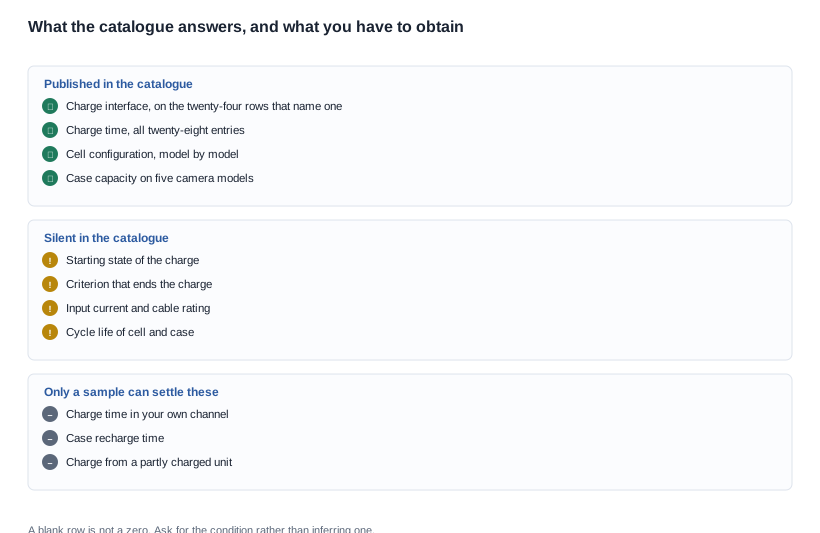
Four rows sit in the second group and none of them is published for any model in the range.
The cable. A magnetic model needs a cradle and a cable to power it. A Type-C model needs a cable. In neither case does our documentation state whether one is in the box. This is the single most common source of a one-star review in the category, and it costs almost nothing to fix by writing one sentence on the listing.
The adapter. Also not published, and it varies by market. A distributor shipping into several countries needs to know which plug configuration is in the carton, because a returned adapter is a returned product.
The case contents. Not published. A case that arrives with a cradle, a cable and an adapter is a different product from a case that arrives empty, and the second one generates a support call.
The paperwork in the box. Not published, and it varies with the destination market, because the regulatory content and the language set have to match where the product is sold.
What to ask a supplier before the sample ships
Send these as a list rather than as a question. A supplier who answers all of them has a documentation habit; a supplier who answers two is telling you something you need before the deposit.
- The charge time, with the starting state and the end-of-charge criterion attached.
- The input current the unit accepts, and the cable rating the figure assumes.
- The box contents, itemised, for the exact configuration you are ordering.
- The case capacity and the case charge time, where a case exists.
- Whether the case charges the glasses or only stores charge for them.
- The cell part number, and the transport test summary that names it.
The sixth item is the one that stops a shipment rather than a review. A lithium product without a transport test summary is a consignment a carrier will refuse, and the refusal arrives after the goods have been paid for, packed and shipped. The summary has been a mandatory document since 2020.
A constructed case that shows the sequence
A note on what follows: the case is constructed, it is not a client project, and it is written to show the sequence of choices rather than an outcome.
Assume a European e-commerce brand comparing two camera models for a new listing. The brand has no accessory programme and does not want to build one, and it has already had a listing rejected for an unsupported claim. The binding constraint is the accessory, not the battery.
Step one: the architecture. The brand rules out magnetic contact immediately, because a magnetic model in their box means a cradle in their accessory plan, a cradle in their packaging artwork and a cradle in their spare-parts list. That removes the cased camera models and narrows the shortlist to the Type-C options.
Step two: the charge time. The D17 and the ZH12 publish about an hour against two hours or less elsewhere, and both are Type-C, which makes them the shortlist. The brand asks for the starting state and the end-of-charge criterion. The answer arrives with the figures: the figure is a ceiling measured from a flat cell and the end condition is a voltage threshold. That is usable, and it is now written down.
Step three: the box. The brand asks what is in the box for the Type-C configuration. The answer is a cable and no adapter, which the brand can live with in a market where customers already own USB-C chargers, and which it must state on the listing.
Step four: the claim. The listing says "charges in about one hour" and adds the phrase "from a flat battery, with a USB-C supply". The brand has narrowed the claim to what the evidence supports, which is what the earlier listing rejection was about.
Step five: the commercial structure. The brand negotiates the per-configuration minimum against a committed configuration count rather than a unit count, because two colours and two box configurations are four configurations, not one. It moves the artwork approval earlier than usual, because the box contents difference is a visible build difference the packaging has to reflect.
The result is a programme with one written condition and a claim the brand can defend, rather than a programme with four unowned rows and a second listing rejection waiting to happen. The decisive decisions were all made before the sample order, and none of them was about the cell size.
The rows we publish, the rows we mark as not published
It is worth being precise: we publish the interface, the charge time, the cell configuration and the case capacity for each model, and we publish the empty rows next to them rather than filling them with typical values from the industry. A buyer comparing two suppliers needs to know which gaps are gaps in the industry and which are gaps in one supplier's documentation, and the only way to make that distinction is to publish the gaps.
We will not infer a chemistry from a milliampere-hour figure. We will not publish a fast-charge capability, an input current, a charge efficiency, a cycle life or a case recharge time for any model, because we do not hold them. We will not present a case that stores charge as though it were a case that charges. And we will not convert a published charge time into a shift-changeover promise, because the published figure does not carry the condition that would make that promise true.
What we can do is take a specific model and a specific channel, and tell you which published rows apply, which rows you will have to request, and which claims the published material supports without further work. Knowing when to publish a published ceiling and when to publish a figure you have measured yourself is the whole of the difference between a defensible listing and an undefendable one, and it is the due diligence a careful buyer runs before you order rather than after the first return.
Send us the models you are comparing, the quantities, the destination market and the configuration, and we will give you the published figures side by side with the gaps marked. The architecture behind these rows is under charging solutions, the specification rows are explained in smart glasses charging smart glasses why it matters, the omissions in a specification sheet are set out in what the spec sheet never tells you about charging, and the case as a separate regulated object is covered in does the charging case need its own report.
Related reading
- The specification fields nobody fills: what the spec sheet never tells you about charging.
- Transport documentation for the case as a separate assembly: does the charging case need its own report.
- The vocabulary behind the rows: the charging glossary.
Send us the models you are comparing and we will give you the published figures side by side with the gaps marked.


