
Charging is the function most likely to be accepted on a sample and then rejected by customers, because it degrades gradually rather than failing. A product that charges correctly at first and slowly after six months produces complaints that never arrive as a manufacturing defect — they arrive as "it stopped working properly", and they are indistinguishable from a customer who changed the charger.
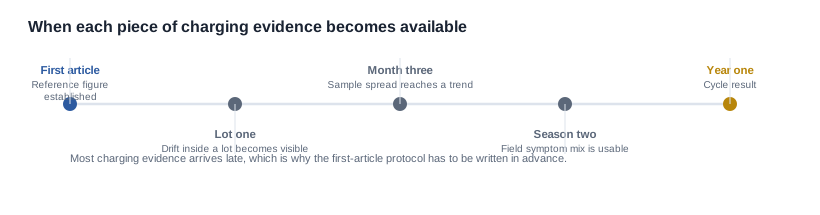
So a charging quality control plan is not mainly a set of incoming inspections. It is a drift-detection plan: it has to establish a reference figure early, sample the population against it, and then feed the field failures back into the criteria so that the next lot is judged against something better than the last one. The order below is ordered by when the evidence becomes available, not by when the stage is performed.

Smart glasses charging: where drift appears first in production
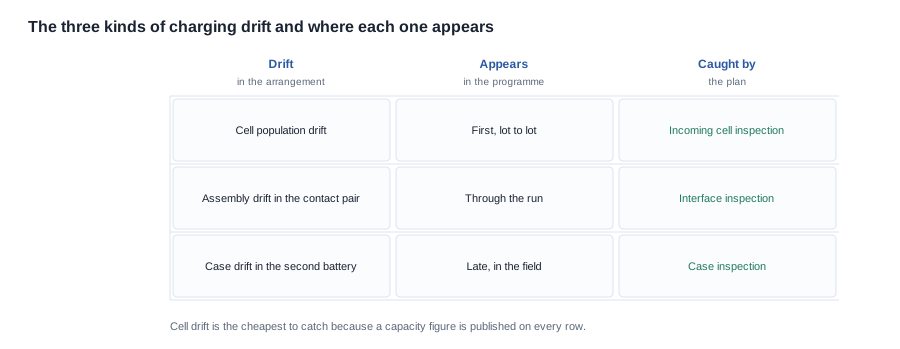
There are three kinds of drift in a charging arrangement, and they appear at different times and in different parts of the programme. A quality plan that cannot tell them apart will react to the wrong one.
Cell population drift appears first and is the cheapest to catch. Cells are bought as components, and a supplier can change cell within a specification window without telling anyone, because nothing in the order says the cell is frozen. The symptom is a lot whose charge time is slightly longer than the previous lot's, which nobody notices until the customer does. Our catalogue publishes a cell capacity for every model — 40 mAh on the A05 and the A06, 70 mAh on the A07, 220 mAh on the V03 and the V03 Pro and the MT5, 290 mAh on the CY03, the CY05, the L1 Pro and the L2 Utral, 265 mAh on the MT6, and 100 mAh, 115 mAh and 200 mAh on the rows that carry them — which means a capacity check against the published figure is available on every model in the range, at incoming inspection, for the cost of one measurement per unit.
Assembly drift appears in the contact pair or the connector. A magnetic interface that is seated correctly on the first article is not guaranteed to be seated correctly on the four-thousandth unit, because the magnetic alignment depends on assembly process rather than on a fixture. A Type-C receptacle is less sensitive to that, but the port can be deformed in packing. Both produce the same symptom: a unit that charges intermittently, which is read as poor battery performance and is diagnosed as a cell fault.
Case drift appears in the second battery. The case is a separate object with a cell, a housing and, on the MT6, a hinge, and none of those is visible in a sample test of the glasses. On the case-equipped rows — the KY06 and the MT6, the L1 Pro and the L2 Utral, and the MT5 and the CY05, and the CY03 whose case capacity is not published — the case is where a failure is most likely and where a quality plan is most likely to be silent.
Incoming inspection: the two checks worth doing on every lot
Two checks carry most of the value at incoming inspection, and both are cheap.
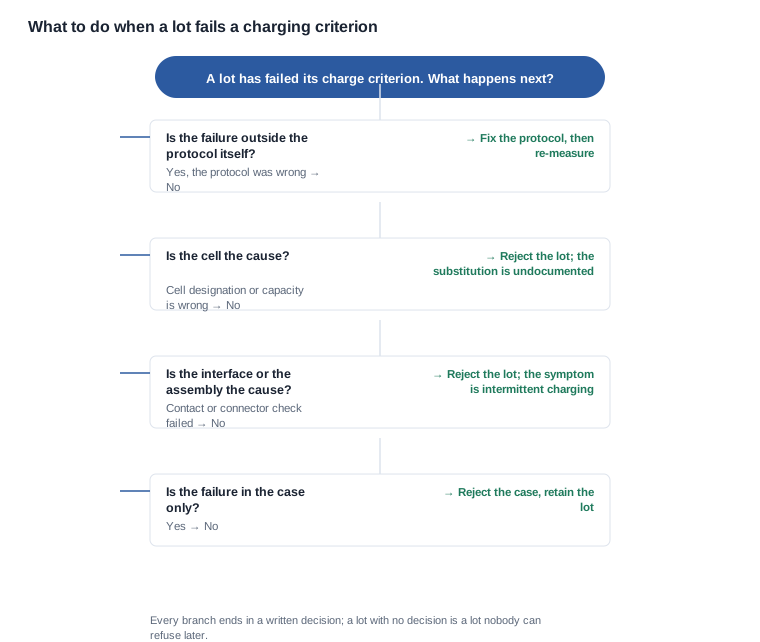
Check the cell against the published figure. Capacity is published for every model in the range, so the check is a comparison against a number rather than a judgement. The reason it matters is not the cell that fails the check — a cell that fails a capacity check is a visible problem — but the cell that passes it while having been substituted for a different chemistry or a different protection circuit. That substitution is the failure that appears months later as an unexplained battery complaint, and it is invisible at incoming inspection unless the cell designation itself is checked.
Check the interface, per interface. On a magnetic-charging model this is a visual and a tactile check at assembly: the pads are clean, the alignment is within tolerance, the seating action behaves. On a Type-C model it is a connector inspection plus a check that the port is not deformed. Both checks exist to catch the marginal connection that produces intermittent charging, which is the defect that most often presents as something else entirely.
A third check applies only to case-equipped models and is worth the effort precisely because it is usually skipped: check the case cell against the case, and check the case charging path as its own system. The glasses are not the product in this case; the glasses plus the case is the product, and only half of it is inspected if the inspection stops at the temple.
The seven stages and the evidence each one produces
-
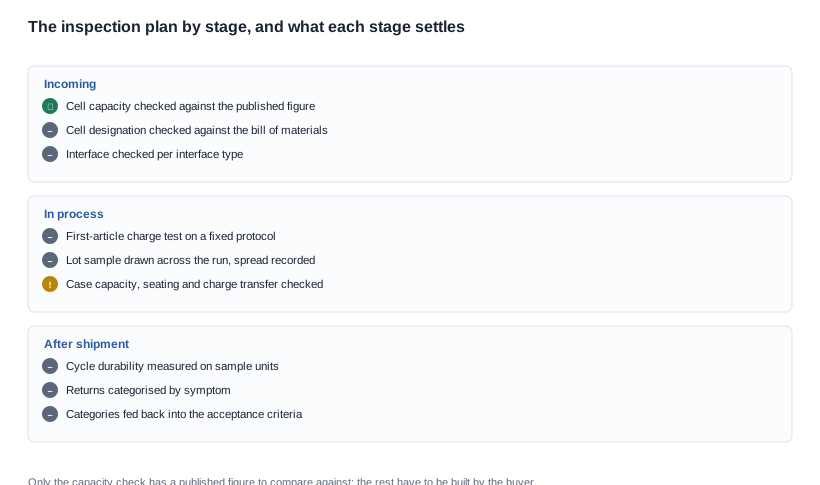
Incoming cell inspection. Capacity against the published figure, and the cell designation against the bill of materials.
-
Interface inspection. Contacts clean and aligned on magnetic models; connector seating and port geometry on Type-C models.
-
First-article charge test. From a stated state to a stated state, with the charger recorded, on a protocol fixed in advance.
-
Batch sampling. A sample drawn across the lot rather than from one end of the run, with the spread recorded.
-
Case inspection. Seating, contact alignment and charge transfer, on every case-equipped model.
-
Cycle durability. A defined number of cycles followed by a re-measurement, on sample units rather than on production units.
-
Field monitoring. Returns categorised by symptom, and the categories fed back into the acceptance criteria.
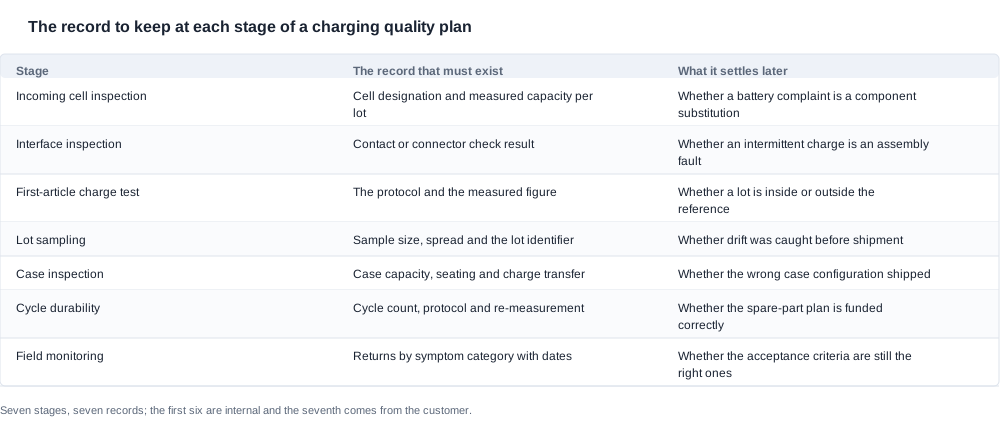
Each stage produces one artefact, and the artefacts together are what makes a charging claim defensible. A programme that keeps only the last one has a support log; a programme that keeps all seven has a quality system.
The sample size is the one parameter in a charging quality plan that is genuinely a commercial decision rather than a technical one, and it deserves to be negotiated explicitly rather than inherited from a template. A sample of three units catches gross failures — a unit that will not charge at all — and it says nothing about a drift in charge time across a lot of several thousand units. A larger sample catches drift, and it costs the factory inspection hours and the buyer a delay in the release of a bulk order. For a programme going into a channel with a long life, the cost of missing drift is paid in returns and in warranty claims, and the cost of the larger sample is paid once. Which side of that trade-off is right depends on the order value, the defect rate the channel can absorb and the margin the programme carries, and the buyer is the only party who knows all three.
A quality plan also has to survive an audit. If the channel, the retailer or a certification body asks how the product was controlled, the records from the seven stages are the answer, and they are worth more than a summary because they are dated, per-lot and tied to a stated criterion. In practice this is what separates a supplier that can quote a lead time from one that can commit to a quality position: the second can produce a capacity check, a sampling record and a defect rate for a named lot within a day, and the first has to go and look. A supplier audit, a quality control agreement and the acceptance criteria in the purchase order all depend on that capability existing on the other side of the table.

First-article charge testing and the protocol that makes it defensible
The first-article charge test is the stage that establishes the reference figure, and it is the stage most often done without a protocol, which is why it produces a number nobody can use afterwards.
Our catalogue publishes a charge time for all 28 model rows — 26 of them at ≤2 h, the D17 and the ZH12 at ~1 h — and publishes the starting state and the end criterion for none of them. That means the catalogue figure is an upper bound and cannot be the reference. The reference has to be your own measurement, under a protocol you wrote before you took the reading.
The protocol has five components and each of them exists to close a specific gap.
- A stated starting state. Usually the state at which a unit leaves the line, which is not the state at which a customer charges it. State which one you are measuring, and measure more than one if you can.
- A stated supply. A named adapter with a stated output current. A charge time achieved with one supply is not the figure a customer gets from a laptop port, and the difference belongs in your documentation rather than in a support queue.
- A stated end criterion. Either an absolute state of charge or a current threshold. Without one, the elapsed time is a property of the stopwatch.
- A stated unit count and a stated spread. One unit tells you one unit passed. The number of units and the spread are what make the figure a population statement.
- A stated environment. Ambient temperature matters for a lithium cell, and the category publishes no safe charging temperature range for any model.
Two rules follow. Write the protocol down before the first reading, because a protocol designed afterwards is a description of what happened. And change it only through change control, because a protocol that moves between lots makes the lot-to-lot comparison meaningless — which is the only reason to have it.

Lot sampling, case inspection and the field feedback loop
Lot sampling is where a charging quality plan earns its keep, because it is the only stage that catches drift inside a lot rather than at its edges. Sample size is a commercial decision: a small sample catches gross failures, a larger sample catches drift. Sampling nothing and relying on the first article means accepting that the first customer finds the problem.
Two practices matter more than the exact number. Sample across the lot rather than from one end of a production run, because a run's conditions drift along its length. And record the spread, because a wide spread is itself a finding worth escalating before the lot ships rather than a number to average away.
Case inspection is the stage most often missing, and it exists for a specific reason: a case that charges unreliably is frequently diagnosed as a product fault, because the glasses sit in the case and appear not to charge. The models where this matters most are the CY03 and the L1 Pro, and the CY05 — each at 1400 mAh, the MT6 with its 1200 mAh foldable case, and the L2 Utral, where the case is published as either 900 or 1400 mAh — an ambiguity that makes it easy for the wrong case to ship against the right product and turns a configuration error into a field failure.
Cycle durability is the stage that produces the only data most buyers will ever have on the charging arrangement's life, because we publish no cycle life for any cell or any case. Cycle a unit through a defined number of charges and re-measure. Even a partial result is useful for a channel planning spare stock, because the spare-stock decision depends on whether cases and cells degrade or fail, and absent data that decision is made blind.
Field monitoring is the stage that closes the loop, and it only works if the returns are categorised. Will not charge, charges slowly, charges intermittently, loses charge faster than expected, and the case does not hold charge are five different symptoms pointing at five different stages of the process, and a support team without the categorisation sheet cannot tell them apart. Send the categories with the returns instructions and the data becomes usable; without them, the channel accumulates free text that tells nobody anything.
Then feed the categories back into the criteria. Otherwise the process records the same complaint for a year and changes nothing.
| Stage | The record that must exist | What it settles later |
|---|---|---|
| Incoming cell inspection | Cell designation and measured capacity per lot | Whether a battery complaint is a component substitution |
| Interface inspection | Contact or connector check result | Whether an intermittent charge is an assembly fault |
| First-article charge test | The protocol and the measured figure | Whether a lot is inside or outside the reference |
| Lot sampling | Sample size, spread and the lot identifier | Whether drift was caught before shipment |
| Case inspection | Case capacity, seating and charge transfer | Whether the wrong case configuration shipped |
| Cycle durability | Cycle count, protocol and re-measurement | Whether the spare-part plan is funded correctly |
| Field monitoring | Returns by symptom category with dates | Whether the acceptance criteria are still the right ones |
A worked scenario: a quality plan for a case-equipped camera line
This is a hypothetical case rather than a client project, and it is written to show how the stages fit a programme rather than to report a result.
Assume a brand placing a first order for camera glasses with a bundled case, into a channel with a two-year life and a depot service model. The quality plan is built from the five pieces of evidence a charging claim needs.
The reference figure. Before the first article, the brand writes the charge protocol: a stated starting state at the end of the line, a named wall adapter, an end criterion expressed as a current threshold, a unit count, and an ambient temperature band. The catalogue figure of ≤2 h is recorded as an upper bound and not as the target, because the catalogue publishes no conditions and the brand would otherwise be measuring against a number with no meaning.
The cell check. At incoming inspection the brand verifies capacity against the published figure and checks the cell designation against the bill of materials, because a substitution inside the tolerance window is the one failure that would not show up at incoming but would show up in year two.
The interface check. The brand asks the supplier to state the charging interface for each model on the order. For the four case-equipped camera rows that publish none, the answer arrives in writing before the order is placed, and the inspection sheet is written around it rather than around an assumption.
The case check. The brand adds a case inspection stage with its own record: the capacity in milliamp-hours against the published figure, the seating, and the charge transfer from the case to the glasses. The L2 Utral's two published capacities mean the inspection sheet carries the capacity field, and a case that arrives with the wrong capacity is a rejection rather than an observation.
The sampling plan. The brand takes a sample across each lot, records the spread, and sets a rule for what a wide spread triggers: an escalation before the lot ships rather than an average.
The field loop. The returns sheet carries the five symptom categories, and a quarterly review compares the symptom mix against the criteria. The first review finds that the case does not hold charge category is large enough to justify a separate spare-part line, which is a decision the data made and a buyer could not have made from the catalogue.
The result is a programme that can refuse a lot, a returns model that can be priced, and a claim register that survives a retailer review.
The honest basis for a charging quality claim
It is worth being precise: we publish the charge time exactly as the catalogue states it, mark the test conditions as unpublished, and state that we hold no cycle life, charge efficiency, input current, contact cycle life, safe charging temperature range or case weight for any model in the range. Where a customer-facing charge claim is needed, the honest basis is a figure the buyer has measured under a protocol the buyer wrote.
The same boundary applies to the figures that do exist. We publish a cell capacity for every row in the catalogue's own form, including the dual-cell rows as cell values by count, and we do not publish a derived total in place of that form, because a total printed as though it were a catalogue value will be quoted as one. We publish 158 g for the MT6 glasses unit, which includes the battery and the camera and excludes the foldable charging case, and we publish no weight for any other model and none for the case itself. And we publish no model-level certificate numbers, because the export certification our catalogue carries is a company-level capability rather than a per-model row.
We also make no vision, health or eye-protection claim for any product in any market, and a charging quality claim is not a health claim, which is exactly why it needs a protocol behind it.
What to negotiate and what to write. The quality plan itself is negotiable in its sample sizes, its inspection frequency and its escalation thresholds, and those are worth negotiating because they cost the supplier effort. The criteria are not: the starting state, the end criterion, the cell designation and the acceptance limits belong in the purchase order, where a lot that fails them is a lot you can refuse. Put a change-notification obligation on the cell, the case, the connector and the firmware, with a re-issue obligation on the documentation package, because a substitution that was never notified is a substitution that will be discovered in the field rather than at incoming inspection.
The next step. Send us the models, the quantities and the target market, and we will tell you which charging arrangements exist for that requirement, which published rows are available to build a protocol against, and which rows you will have to establish on your own units. The arrangements themselves are described under charging solutions and interfaces; the same subject is covered from the field side in real world charging performance, and the published limits are set out in charging limitations and drawbacks.


