

Smart glasses charging: where published and field times part company
Charge time is one of those figures where the published number and the experienced number diverge for reasons that are entirely knowable before anybody buys a unit. The gap is rarely the product. It is the starting state, the supply on the table, the condition of the contacts and the rule that decides when the charge has finished.
So smart glasses charging smart glasses real world performance is best approached by identifying what the published figure assumes, and then noticing that it assumes nothing at all.
Before this article goes further it is worth stating the commercial reason to care. A charge figure that is optimistic by an unstated margin does not fail loudly. It produces a channel that believes a unit is ready sooner than it is, a customer who discovers otherwise at the worst possible moment, and a returns trend that nobody in the chain can attribute to anything. The cost of a wrong charge figure is paid in support time and in a lost account rather than in a rejected shipment, which is exactly why it is worth the effort to characterise it properly.
The published position across our range is better than most buyers expect. Every one of the twenty-eight catalogue entries publishes a charge time. Twenty-six publish two hours or less; the D17 and the ZH12 publish about one hour. What no entry publishes is the condition attached to that figure, and the condition is where the real-world number actually lives.
What every entry publishes, and what every entry leaves off
There is a distinction worth making precisely, because it changes how you read a supplier's quotation.
A published charge time is a figure the manufacturer states. Ours are complete across the range: twenty-six entries at two hours or less, two entries at about one hour. A characterised charge time is a figure with its starting state, its end-of-charge criterion, its supply and its ambient temperature attached. Nobody in this category publishes the second kind, and almost nobody asks for it.
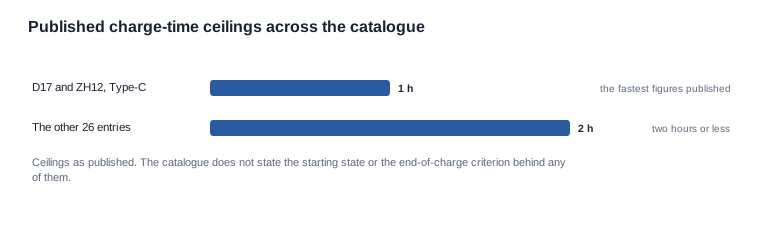
The gap is not an omission of effort. It is a category convention that nobody has broken, which is exactly why a buyer who starts demanding the condition gets a better answer than a buyer who does not.

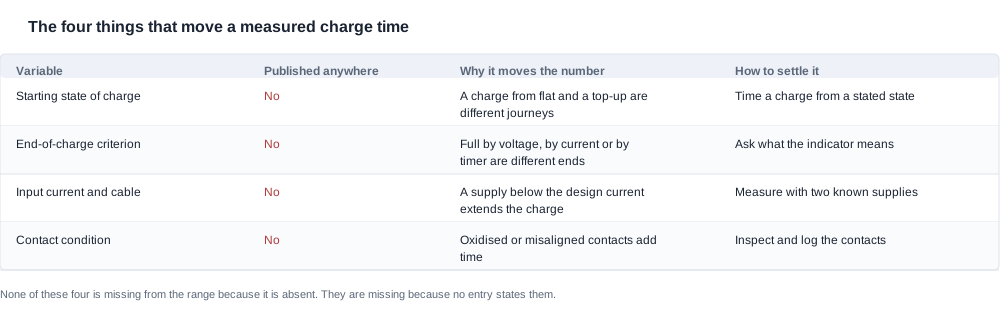
The starting state, which is the largest variable in the comparison
A charge time measured from empty and a charge time measured from a partly charged cell are not the same measurement. They are the same measurement under two different conditions, and the difference between them is large enough to change which model a procurement team shortlists.
For a buyer running a fleet, the operational question is rarely "how long does a full charge take". It is "how long does a top-up take, when a worker puts the unit back for five minutes before a shift". That figure is not published for any model, and it is not a number you can derive from the published one.
The magnetic contact adds a variable of its own
Magnetic charging has a failure mode that Type-C does not: the contacts. Contacts that have been in use rather than a pristine sample charge more slowly, and the degradation is gradual rather than sudden. That produces a specific and very common customer complaint — the unit that stopped charging quickly — which is filed as a battery fault when it is a contact condition.
The commercial consequence is that a magnetic model's charge time is a moving target across a product life, while a Type-C model's is closer to fixed. If your channel sells into a service environment where units are handled hard, that difference is a support-cost difference.
What you can legitimately infer from a published ceiling
A published ceiling is more useful than it first appears, as long as you read it as a ceiling and not as a duration. Three inferences survive the missing conditions.
The unit will complete a charge overnight. A unit left on a supply for longer than the published ceiling reaches full charge, whatever the starting state and whatever the end criterion, because the ceiling is stated as an upper bound. This is the inference that makes the figure usable for planning a fleet that charges overnight, and it is why a procurement team can build a spare-unit ratio on the published figure without characterising it first.
The unit will not be faster than the ceiling. Nothing in a charging system makes a charge complete in less time than the manufacturer claims unless the claim was conservative. The figure is therefore safe as an upper bound on the full-charge case.
Nothing follows about a partial charge. The ceiling tells you nothing about the top-up case, because the missing starting state is precisely what a top-up varies.
How to use the inference is a question of when to publish it. A channel that charges overnight can quote the ceiling as the recovery time for a full charge and be right. A channel that swaps units mid-shift cannot, and should measure before it commits to a recovery window in a contract. Which model to shortlist therefore depends on which of the three inferences the channel is entitled to make, and that is a channel decision rather than a technical one.
What a low-output supply does to a one-hour figure
A device with a defined maximum input current draws less from an inadequate supply and takes longer. Nobody notices this until a customer charges from a laptop port or a low-output adapter and concludes the product is faulty.
The question to ask before publishing a one-hour charge is what input current the device accepts and what supply the figure assumes. If the answer is that it depends on the supply, then the customer-facing claim needs that dependency stated, and a listing that says "charges in one hour" without it is a claim waiting to be tested by a customer with a laptop.
A case adds three variables the glasses figure never covered
For the seven models published with a charging case — the KY06 and the CY03, the MT5 and the MT6, and the L1 Pro and the CY05, and the L2 Utral — the charging path has more components, and therefore more places where the field number can diverge from the published one.
The first variable is the path itself. Whether the case charges the glasses, or the glasses charge the case, or both happen in sequence, is a design fact that no catalogue entry states for any model. A dock that only holds the glasses implies nothing about charging, and the difference is invisible until a customer writes in to say the glasses will not charge.
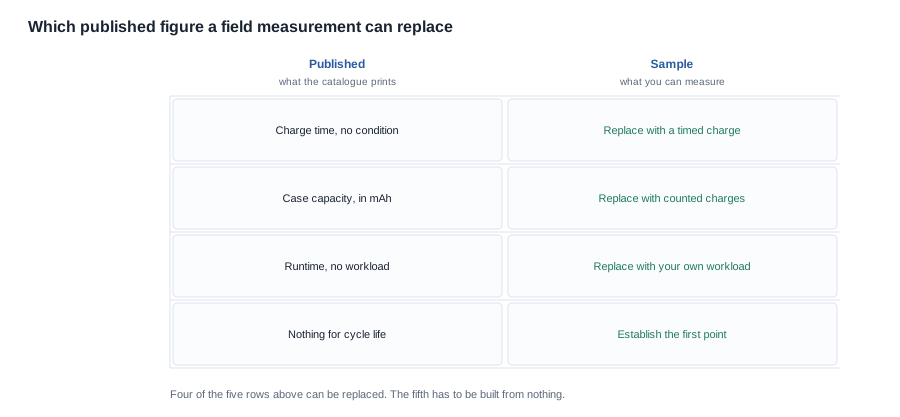
The second variable is the case's own charge time. The published case capacities are 1400 mAh on the CY03 and the CY05, and the L1 Pro, 900 or 1400 mAh on the L2 Utral, and a foldable 1200 mAh on the MT6. The KY06 and the MT5 have a case with no published capacity. For none of them is a case recharge time published, so the case may be the bottleneck in the chain rather than the glasses.
The third variable is the cycle count, and this is the commercially important number, because it is the one a channel needs. A case that delivers three full charges has a different service life from one that delivers ten, and the difference shows up as a returns trend two years later. It is not published for any model in the range, and it cannot be derived from the milliampere-hour figure without a measurement.
Why the runtime figure and the charge figure are not the same measurement
The two numbers that sit next to each other on a camera product row are routinely used interchangeably, and they answer different questions entirely. A runtime figure — five to eight hours on the 220 mAh camera models, about seven hours on the 290 mAh models — is how long the unit does something. A charge figure is how long the unit takes to become something again.
The distinction matters for a procurement team in three specific places. First, a runtime figure without a workload cannot be converted into a shift length, and the catalogue publishes runtime values without the workload behind them for every model in the range. Second, the sum of runtime and charge time is not a shift length either, because the charge window is a ceiling with an unpublished starting state. Third, a unit with a long runtime and a slow charge is not the same product as a unit with a short runtime and a fast charge, and a channel that cares about the second half of the day is buying a different requirement than one that cares about the first.
None of this is an argument against the published figures. They are useful, they are complete as ceilings, and they are the only ones available. It is an argument for using them as ceilings, and for measuring the top-up case yourself before you build a shift plan on them.
What a buyer can and cannot conclude from a case capacity
| Question | Answerable from the catalogue? | What to do instead |
|---|---|---|
| Does the model ship with a case? | Yes, for seven models | Use it as a channel decision |
| What is the case capacity? | Yes, for five of those seven | Quote the number as published |
| How many charges does it deliver? | No | Count them on a sample |
| How long does the case itself take to charge? | No | Time it on a sample |
| Does the case charge the glasses? | No | Ask, in writing |

The protocol that produces a number another buyer can repeat
A charge figure is worth what its conditions are worth. The protocol below is written so that another procurement team could run it and get a comparable number, which is the only test of whether your measurement is worth publishing.

The order of these measurements is not arbitrary. The first isolates the product, the second isolates the supply, the third isolates the duty cycle, and the fourth isolates the case. A team that runs them in a different order will usually end up changing the supply when the product was the variable, which is the most common way a measurement programme produces a wrong answer rather than no answer at all.
Charge from a stated state, and state it in the record. Record the state at the start and the state at the end, with the elapsed time between them. Repeat on at least three units so that you have a spread rather than a single reading, and publish the spread rather than the fastest one.
Measure the supply dependency. Measure with the supply you intend to recommend, then with a common alternative. If the two differ, that difference belongs in your product copy rather than in a support script.
Measure the top-up case. Start from a partly charged unit and time it. This is the figure your channel actually experiences, and it is the one most likely to be different from the catalogue ceiling.
Time the case. If the model has one, time the case's own recharge, count how many full charges it delivers from a stated state, and repeat on a second unit.
Log the condition, not just the result. The ambient temperature, the cable, the contact condition, and the cell temperature during the charge are the four fields that make a result reproducible six months later.
The record that makes a result repeatable
Eight fields, no more, and the result is comparable between suppliers and between years.
- The model and the exact configuration.
- The cell part number.
- The starting state and the end-of-charge criterion.
- The ambient temperature.
- The supply used and the cable used.
- The measured elapsed time.
- The cell temperature during the charge.
- The contact condition after ten insertions.
Without these eight, a result is a number and not evidence. With them, it is a row you can put in front of an approver.
Those eight fields also make the result auditable. When a second buyer asks how the number was produced, the answer is a record rather than a claim, and that is the difference between a figure that can be repeated and one that has to be taken on trust.
Recording the spread matters as much as recording the mean. A programme that charges at ninety-five minutes on one unit and one hundred and thirty on another has a contact or cell-consistency problem that a single average would hide, and that problem is a supplier defect question rather than a customer expectation question.
How to compare a supplier's figure with your own measurement
Two numbers for the same thing are worse than one number, and comparing them is where the disagreement usually happens. There are four questions to ask before you conclude that a supplier's figure and yours disagree.
- Was the starting state the same? Ask for it in writing before you compare anything.
- Was the end-of-charge rule the same? Two suppliers can use a voltage threshold and a current threshold and both be entirely correct.
- Was the supply the same? This is the question most often skipped, and it is the one that produces the largest apparent gap.
- How many units, and what was the spread? A single unit on a single day is an anecdote, and a supplier who publishes a bare number has told you the measurement was not repeated.
If the four match and the numbers still differ, you have a real difference and it is worth raising in writing before it reaches a purchase order. If any of the four does not match, you do not have a disagreement; you have two measurements of different things, and the honest conclusion is that neither is a specification yet.
To evaluate a supplier's measurement rather than only your own, ask for the eight fields listed above. A supplier who supplies them has run the test. A supplier who supplies a bare number has not.
A hypothetical field evaluation, worked through
This is a constructed scenario rather than a client project, and it is here to set out the decision sequence rather than to report an outcome.
Assume a distributor of AI camera glasses into a security channel, supplying a shift-based operation that hands the same unit to a different person every eight hours. The units are magnetic-contact models with a charging case, and the operation has no spare units — a unit off the charger is a unit not on duty.
Step one: the assumption being tested. The distributor has been quoting the published two-hour charge time to the customer as the recovery time. The customer's question is whether a unit that is half charged at the shift changeover can be back on duty within the window.
Step two: the measurement. Three units are charged from flat with the recommended supply and the temperature logged. The elapsed times come back close to the published ceiling, which tells the distributor the published figure is honest in the flat case. Then the same three are topped up from a partly charged state, and the elapsed times are materially shorter. The published figure is a ceiling and it is a fair ceiling, but it is not the number the operation is living with.
Step three: the case. The distributor times the case and counts the full charges it delivers. The count is lower than the case's nominal capacity would suggest, because the transfer is not lossless and the glasses draw current while they sit in the case. Nobody in the channel had assumed a loss, and the whole spare-unit calculation was wrong by that margin.
Step four: the commercial consequence. The distributor replaces the published figure with its own measured one, states the condition with it, and re-bases the spare-unit count on the counted charges rather than on the nominal capacity. The supplier is asked, in writing, for the case charge time and for whether the case charges the glasses. One of those two answers changes the operational assumption; the other changes nothing, and it costs nothing to have asked.
Step five: the claim. The customer-facing material now says "about two hours from flat" and "roughly half that from a top-up", which is a narrower claim than the one the distributor was making and a defensible one. The rejection risk that came from an unverifiable recovery promise is gone.
The decisive decision was the second one — measuring the case rather than reading its capacity — and it took an afternoon.
What our own charge figures stop short of saying
Concretely, we publish the charge time exactly as the catalogue states it and mark the test conditions as unpublished, rather than inferring a working figure and presenting it as a measurement. That is a deliberate choice with a commercial cost: a published figure with no condition reads more confidently than a measured one with a condition attached, and the second is harder to sell.
We will also say plainly what that means for the buyer. A catalogue charge time tells you the supplier believes the unit can be brought to full within that window under conditions they have not published. It does not tell you the top-up time, the case recharge time, the number of charges a case delivers, the input current the unit accepts, or the cell temperature during a charge. All five are not published for every model in the range, and each has to come from the engineering team or be measured on a sample.
We will not publish a cycle life, a charging efficiency, a partial-charge curve or a fast-charge protocol, because we do not hold them. We will not present a case capacity as a number of operating hours, because that conversion requires figures nobody in this category publishes.
If you tell us the model, the channel and the customer use pattern, we will say which published figures apply to your case and which rows you will have to measure or obtain before you publish a claim. A buyer who evaluates the four comparison questions above before signing has a defensible position in front of an approver; a buyer who compares two bare numbers against each other does not. The comparison method is set out in how to measure smart glasses charging, the failures that follow from skipping it are in charging problems and fixes, and the quotation-stage version of the same question is in charging red flags. On the other side of the same coin, the rated runtime figures are examined in battery life real-world performance.
Related reading
Read next, based on what actually goes wrong in the field:
- Charging problems and fixes — the failure modes customers report first, and what each one traces back to.
- Charging red flags — what to reject at the quotation stage.
- Battery life real-world performance — what the rated figures become once a customer owns the product.
Tell us your customer use pattern and we will say which published figures apply.


