

A smart glasses contract carries two kinds of cost, and only one of them appears on an invoice. The visible kind is the unit price, the deposit, the tooling charge and the freight, and it is the kind that gets negotiated. The hidden kind is everything the programme consumes while nobody is counting it: a reprint, a held consignment, a cycle of returned units, a season that closes before the goods arrive.
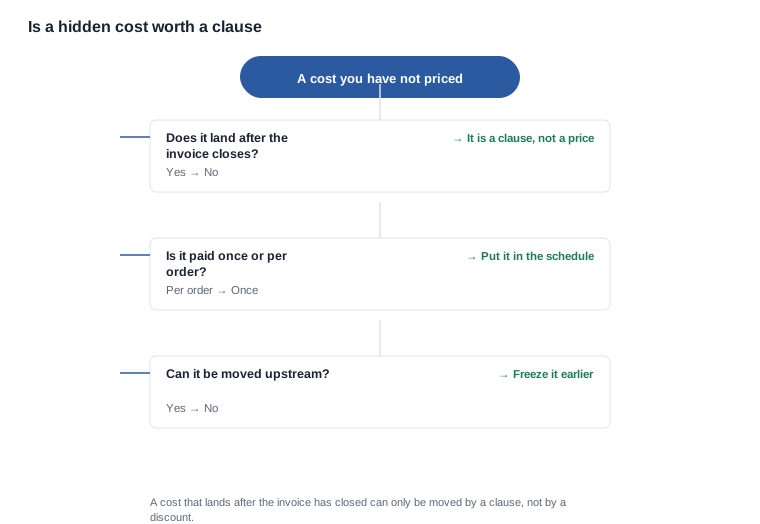
The reason these costs exist is not that suppliers hide them. It is that they are not costs in the accounting sense at the point they occur. A rework is a week, not a line. A delay is a lost window, not a payment. A return is a unit that came back, not a unit that was never sold. Each one lands somewhere other than the invoice, and each one lands after the invoice has been settled — which is precisely why it cannot be negotiated at the point where a buyer would think to negotiate it.
Four hidden costs recur in this category, and they are set out below in the order they appear. Each is described with the symptom, the root cause and the clause that prevents it. The fifth section works them through a first order and its second, as a scenario rather than as a client project, because the way these costs compound is much clearer in a worked example than in a list.
The conclusion for a buyer is this: the hidden costs are not priced by paying less, they are priced by moving work upstream. Every one of the four can be prevented by a decision taken before the order, and none of them can be recovered after it.
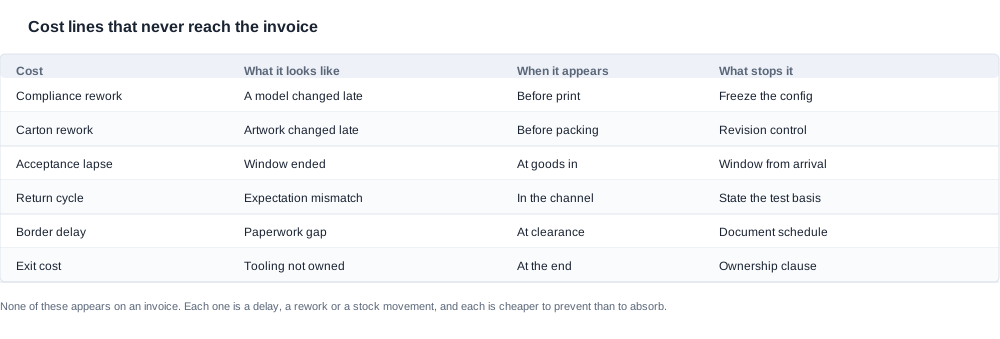
Smart glasses contract: the costs that never reach the invoice
The four recurring hidden costs are a delay, a return, a border hold and an exit. They look unrelated, and they are not — they share a structure. In each case, work that was supposed to happen before the goods shipped happens after they have, and the price of the reordering is paid in time rather than in money.
The delay is the one that hurts most in a seasonal programme, because the selling window is fixed and the goods are not. The return is the one that hurts most in a repeat programme, because it scales with volume and the volume is what the buyer grew. The border hold is the one that hurts most on a first shipment into a new market, because the documentation route is unproven and the stock is already paid for. The exit is the one that hurts most at the end of a relationship, because it is the only one with no remaining leverage.
What unifies them is that none of them can be settled by a discount. A supplier who has held a consignment for four days cannot refund the four days. A buyer who has sold a season's stock into a channel that is returning it cannot recover the channel. The only instrument that works is a clause that moves the decision upstream, and that is why the hidden costs are contract costs even though they do not appear as contract costs.
There is a useful way to size them, even without a supplier's figures. Each hidden cost has a driver that the published catalogue lets a buyer count, and each driver scales with something the buyer already knows: volume for the return cost, number of destination markets for the border cost, number of configuration changes for the delay cost, and programme length for the exit cost. A buyer who wants to know whether the hidden costs matter should ask how many returns a one percent return rate produces across the first year's volume, how many market additions the channel plan contains, and how many configuration changes the season is likely to see. Those are not supplier figures and they are not our figures; they are the buyer's own plan, and the plan is what determines whether the hidden costs are a rounding error or the largest line in the programme.
This is also why the hidden costs are not visible to a supplier's quotation. A quotation is produced per configuration and per quantity, and it has no way to express a cost that depends on what happens after delivery. The clause, by contrast, is written once and applies to the whole programme. That is the structural reason the negotiation belongs in the agreement, and the reason a buyer who asks a supplier to quote the hidden costs is asking for something the supplier cannot produce.
It is also worth saying what is not hidden. The unit price, the deposit, the tooling charge, the freight and the payment schedule are all visible, all quoted, and all negotiable in the ordinary way. Buyers who spend their negotiating capital on the unit price and then discover a hidden cost have spent it in the wrong order, because the hidden costs are typically worth more than the unit price difference they fought over.
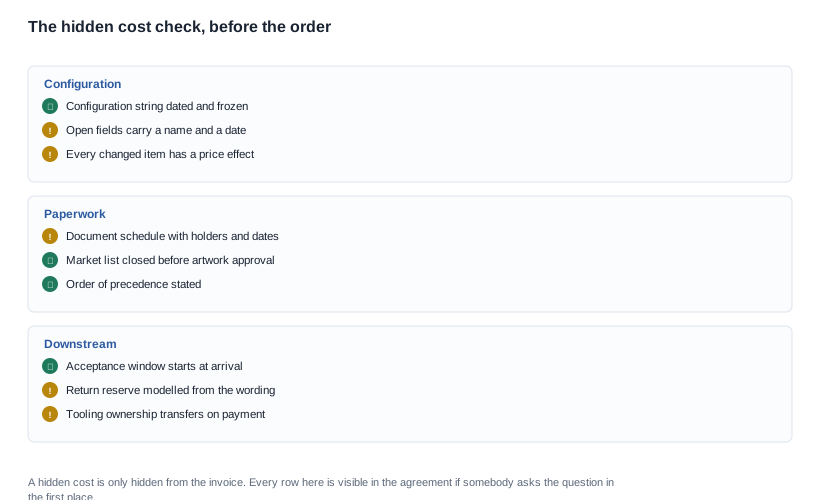

Cost that arrives as a delay
The most expensive hidden cost in this category is the one that arrives before the invoice, disguised as something else.
Compliance rework does not appear as a cost because it is a delay. A model designation is changed after artwork approval. A market is added after the technical file has closed. A responsible economic operator is left unnamed until the carton goes to print. Each of these stops the programme at a stage where the only way forward is to do the work that should have been done earlier, and the only way to pay for it is time.
In the European Union the paperwork behind this is the technical file under the Radio Equipment Directive (EU) 2014/53/EU and the traceability obligations under the General Product Safety Regulation (Regulation (EU) 2023/988, applicable since 13 December 2024). Both are documents with a schedule, and both can be closed before print. The cost of getting it wrong is not a compliance expense — it is a launch window.
Carton rework is the same shape with a smaller number attached. The artwork is approved at revision A, the specification changes at revision B, and the carton is printed against revision A because the print order was already placed. The reprint is a real cost in materials and freight, but the bigger cost is the serialisation: the carton has to be reprinted, so the packing waits, so the despatch waits, so the customs entry waits.
The prevention for both is the same clause, and it is the cheapest one in the document: a configuration freeze with a stated date, and a change control route that says what a change costs and what it moves. A programme with a freeze date and a change route absorbs a change; a programme without them absorbs a change as a rework, because there is nowhere to record that the change was priced and scheduled.
Cost that arrives as a return
The second hidden cost is the one that scales worst, because it is proportional to volume and volume is the thing a programme grows.
The returns reserve is not a hidden cost in the sense of being unpriced — it is more often a missing cost. Most buyers model returns as a percentage of revenue and take the percentage from a supplier's estimate or from a general impression. Both are worse than useless in this category, because the return rate is not a property of the product. It is a property of the description.
The catalogue makes the mechanism visible. The rated run is published for every entry — 5~8 hours for the V03 and the V03 Pro, and the V06 and the S7, 6~8 hours for the KY06 and the MT5, about 7 hours for the L2 Utral and the CY03, and the MT6 and the L1 Pro, and the CY05 — and none of those figures comes with a test condition. The charge time is published for every entry as well, two hours or less for twenty-six of them and about an hour for the D17 and the ZH12, again without a starting state or an end criterion. So the buyer has a band and no basis for interpreting it.
A listing that says "about seven hours, measured on a sample" and a listing that says "all day" describe the same hardware and produce entirely different return profiles. The first is a statement about a published band with its limitation attached. The second is a promise about a condition nobody measured, and the gap between the promise and the experience is exactly the returns reserve, arriving a quarter later as credit notes and freight.
There is a second return driver in this category that is even less discussed, and it is the case configuration. A 900 mAh case and a 1400 mAh case on the same model are different products to the customer, and the published catalogue supports both on the L2 Utral. If the retail listing and the shipped goods disagree about which one is in the box, the return is not a defect claim — it is a description mismatch, and it is entirely preventable by a single line in the specification annex.
The commercial term that prevents both is the change control clause, read together with the acceptance criterion. If the description the buyer will publish is part of the approved configuration, then a change to the product that changes the description is a change that requires a signature rather than a notification.

Cost that arrives at the port
The border hold is the hidden cost with the clearest arithmetic and the least predictable timing. A consignment that is held at the border is a delay measured in days for every unit of stock the buyer has already paid for, plus a demurrage line that nobody budgeted, plus a channel conversation with the buyer's own customer. It does not happen because anybody did something wrong. It happens because a document was missing, late or inconsistent with another document.
The three findings that cause it are routine. A model designation that does not match between the commercial invoice and the carton. A battery transport document that does not cover the consignment as packed — on a lithium consignment the battery transport test summary is the item that stops a shipment rather than delaying it. And a market whose documentation was never requested because the market was added after the paperwork was closed.
This is the hidden cost where the clause is most obviously worth writing, because the alternative is not cheaper, it is simply later. A document delivery schedule with a market, a requirement, a holder and a date against each line moves the whole route upstream of the print run, where it costs nothing, and out of the customs entry, where it costs everything.
There is a commercial dimension worth noting as well. A supplier who cannot produce the technical file on demand will usually still say the file exists, and the buyer will find out at the port rather than in the supplier's office. The question to ask before signing is not whether the file exists — it is whether it can be produced in a week, and whether a third party can read it.
There is one more port-side hidden cost that gets attributed to the wrong party, and it is worth naming because it changes who has to act. The boundary between the supplier's obligation and the buyer's is not the same as the boundary between the supplier's responsibility and the buyer's for the paperwork. The supplier builds to the configuration; the buyer is the party placing the product on the market and is the one that signs the declaration. That means the buyer needs the supplier's evidence in order to do its own obligation, and the schedule has to run against that dependency rather than against the production calendar. A document requested from the factory at the same time as the goods are being packed is requested too late.
The practical version of this is a single question with a single answer: which of the documents for this market can you produce today, without reference to this order? If the answer is a list, the route exists. If the answer is that it will be arranged once the order is confirmed, the route has to be built into the schedule and the schedule has to be dated before the artwork is approved.

A first order worked through to its second
This is a worked scenario, not a client project. No customer is described and no order is claimed; the model, the quantity, the market and the channel are assumed so that the reasoning can be followed.
The scenario: a brand is opening a camera line into a European market through a channel partner. The order is a first order, large enough to matter, on a model with a charging case and a branded retail carton. The buyer's stated concern is margin rather than schedule, because the channel has committed to a launch window and the buyer has assumed the goods will be there.
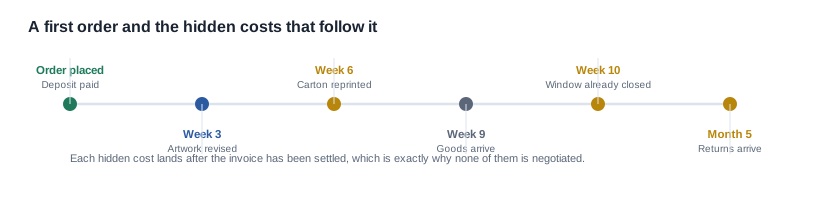
The first hidden cost arrives before the goods are made. The buyer's own product team asks for a darker colourway three weeks after the artwork was approved, and the change is treated as a request rather than as a change. Because the agreement has no change control route, nobody asks what the change costs or what it moves. The carton is reprinted, the packing slot slips by a week, and the launch window loses its margin. The cost of this is a single week of selling time and a reprint, and it is invisible on the invoice.
The second hidden cost arrives with the goods. The acceptance window was drafted from the production date rather than from arrival, so by the time the consignment reaches the buyer's warehouse the window has already closed. Two units in the first delivery have a visible fault on the case hinge. The buyer has paid the balance and cannot reject them, because the clause says the goods were accepted when they were produced. The cost is two units plus the freight on the replacement plus the rework, and the deeper cost is that the buyer's receiving team has learned that the acceptance clause is not worth enforcing, which changes how the next order is handled.
The third hidden cost arrives in the channel. The retail listing published "up to seven hours of use" because that is how the catalogue states the figure, and the catalogue does not publish a test condition. Within two months the channel is returning units from customers who expected an all-day product. The returns are not defects, so they are not covered, and each one is a unit that cost full landed price and produced no revenue. The correct answer is that the listing should have stated the band with its limitation, and the wrong answer is that the listing should not have been published — because the band was accurate.
The fourth hidden cost arrives at the end, and it is the one the scenario is really about. The programme is going well, the channel wants to double the volume, and the buyer decides to bring a second supplier in for resilience. At that point it turns out the mould was never transferred on payment, the artwork is held by the factory, and the firmware build sits with the sub-supplier that wrote it. Nothing was agreed badly. Everything was left unagreed. The cost of bringing the programme elsewhere is now a negotiation with a supplier who has no reason to help, and the cost of staying is a supplier who knows it.
Looking at the four together, the pattern is clear. Every one of them was preventable by a decision taken before the first order, and every one of them was made expensive by the absence of a specific clause: change control, an acceptance window running from arrival, a description that is part of the configuration, and exit terms. None of them required a better price.
What Cynrin will absorb, and what it will not
We will put a configuration schedule, acceptance criteria with methods, milestones with observable triggers, compliance ownership, change control, and the tooling and firmware ownership clauses into the agreement, and we will not sign an order that leaves compliance ownership unallocated. Where a clause cannot be agreed we will say so at quotation stage rather than let it surface at the port.
What we will absorb is the ordinary cost of doing the work: producing the configuration schedule, the approved sample, the test plan, the technical file for the markets in scope, and the shipping document set. What we will not absorb, and cannot, is the cost of a buyer's own change made after the freeze date and after the artwork approval, because at that point the work has been done and re-done.
Minimum order quantities, production lead times and our unit prices are not published, and neither are the certificate numbers, the sensor part numbers or the defect rates. A hidden cost cannot be priced without the published configuration, so the published configuration is where we will spend our effort, and the rest is a question for the supplier's own file.
For the clause detail, see contract terms. The contract reading guide works through a contract line by line, and the contract red flags is the shorter version for a review that has half an hour.
Related reading
- contract reading guide
- contract red flags
- contract terms and agreements
Send the configuration, the quantity and the market, and we will say which parts of the cost are settled and which are yours.


