

This is a composite account of a smart glasses factory audit, built from the patterns that recur in this category rather than from one named client. There is no customer here, no project, and no figure that we cannot evidence — those are commercial confidences and they are not ours to publish. What follows is a worked example of how an audit was run, what it found, and what the buyer changed afterwards. Every published specification figure used here corresponds to a row in our catalogue, and where a row does not exist we say so rather than filling it.
The value of a case like this is not the story. It is that each step of the audit can be checked against the method: if you were running the same audit, would you have taken the same action at that point, and would it have produced the same result?
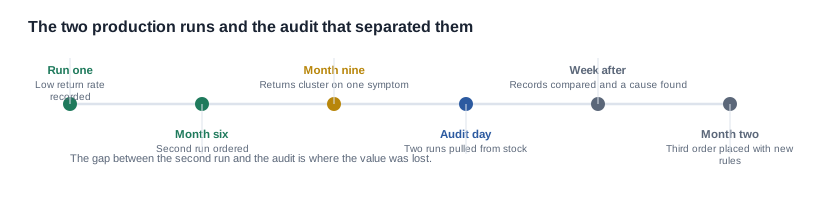
Smart glasses factory audit: the case as a composite account
What the buyer had, and what they did not have
A European channel buyer had received two production runs of an audio-glasses configuration from the same supplier. The first run had a low return rate. The second run, six months later, produced returns clustered on a single symptom: units that would not connect to a handset after they had been out of the case for a day. No hardware had been changed on paper, the order had not changed, and the supplier's explanation was that the connection behaviour depends on the phone.
That explanation is not unreasonable, and it is also not testable, which is exactly what made the conversation go nowhere. The buyer had no acceptance criteria and no inspection records from either run. There was no method, so there was no measurement, so there was nothing to argue about except two memories. The second order was already due.
Why the audit was scheduled at all
The audit was not scheduled because anything dramatic had happened. It was scheduled because the buyer had a symptom it could not explain and a deadline it could not move. That is a very common trigger for a factory audit in this category, and it is worth naming because the trigger determines the method.
An audit triggered by a quality question has a different shape from an audit triggered by a supplier-selection question. In a quality question, the sample is the centre of the day and the floor walk is supporting evidence. In a supplier-selection question, the floor walk is the centre and the sample is a footnote. This audit was the first kind, and the audit plan was built accordingly: units from both runs were requested in advance, and the walk was designed to produce records rather than impressions.
What the buyer brought, and what they should have brought
What the buyer brought was a good list of returns: the symptom, in plain words, and the dates they arrived. What they did not bring was the denominator — how many units had been sold, how many came back, and which batches those units came from. Without the denominator the list was a set of anecdotes, and without the batch references it could not be tied to a production period at all.
The audit plan was therefore built around producing the missing denominator rather than around the symptom. This is the practical lesson of the case: an audit is most valuable when it establishes what was actually measured, rather than when it identifies the thing that went wrong.

What the first two production runs had in common
The order read identically on paper
The two orders were, from the buyer's side, the same order. Same model, same quantity band, same supplier, same market. The specification sheet referenced in both was the same document. Nothing in the buyer's paperwork distinguished run one from run two, because nothing in the buyer's paperwork had to.
That is worth pausing on, because it is the normal state of affairs and it is the reason the failure was invisible for six months. A specification sheet describes a product. It does not describe a process, and it does not describe the decisions a factory makes between one run and the next — which cell supplier to use, which batch to start from, which firmware to load, which case to pair with which unit. Those decisions are recorded somewhere, or they are not recorded at all.
The published rows did not cover the question
It is worth being precise about what a catalogue can and cannot settle here, because the temptation to read a specification sheet as a process description is strong.
For an audio-glasses configuration, our catalogue publishes the Bluetooth version, the cell capacity and cell count, the charging time, the rated endurance and the charging method for most models — the audio tier carries published Bluetooth versions of V5.3 for K01 and K02 and V5.4 for the remainder of the published audio rows. Cell capacity appears in the published forms 90mAh2, 70mAh2, 55mAh2, 100mAh and 115mAh, and the endurance figure differs within the tier: roughly eight hours for most of the 55mAh2 models, roughly six hours for G07 and YK12, and roughly seven or eight hours for the 100 mAh and 115 mAh models.
None of that tells you which cell a particular production batch used. It tells you what the configuration was specified to use, which is a different thing. A same-capacity substitution is invisible on the specification sheet, because the sheet records the capacity and the substituted cell has the same capacity.
The two things that were never written down
Two records were missing entirely, and both of them turned out to matter.
The first was an incoming inspection record for the cell. Without it, the buyer could not establish that the cell used in run two had been inspected against any criteria at all, because there was no criteria list and no record of what arrived.
The second was a component approval rule. There was no written requirement for a supplier to obtain approval before substituting a cell or any other component, which meant the question of whether the cell had been changed was a question about what had happened rather than about what had been permitted.
The two questions the buyer had never asked
There is a detail in this case worth isolating, because it is the kind of thing that is easy to miss when the focus is on the component.
Nobody had ever asked whether the specification sheet was still the right description of the product. The buyer's assumption was that the sheet described the goods, because the sheet had been attached to the first order and had never been questioned. But a specification sheet describes what a configuration was specified to be, and it does not describe what the factory was told to build the second time. Two documents were needed and only one existed: the specification, and a purchase order that referenced it.
The second question was never asked because it sounds trivial: what has to be true, in writing, before a component can change. In most categories this is settled by the buyer's own procurement policy, and the policy never gets copied into the order. Here it was not settled at all, which is why a same-capacity cell could arrive without anybody signing anything.
Neither question is exotic. Both are the kind of thing that is answered by a clause, and a clause is free until the moment it is needed.
Where the published specification sat against the behaviour
The uncomfortable part of the case for any buyer is that every published row was still true at the end of it. The cell capacity had not changed. The charging time had not changed. The rated endurance had not changed. The Bluetooth version had not changed. The configuration was still the configuration that was ordered, and it still behaved differently.
That is the general lesson of a specification-driven purchase, and it is worth stating without softening: a specification pins down what the product is, and it says nothing about whether the product is made the same way twice. Rows that are stable are reassuring about compatibility and silent about consistency, and consistency is the property that a repeat programme actually depends on.
What the smart glasses factory audit actually did on the day
Step one: ask for the records rather than the explanation
The filled inspection sheets from both runs existed, and they were in a folder. Comparing them took about an hour and showed that the pairing test in run two had been performed once per batch rather than once per carton. The change, in other words, was in the inspection method rather than in the product.
This is the first thing worth copying from the case, because it is counter-intuitive. The buyer's problem was a field failure, and the natural response is to investigate the product. The audit investigated the measurement instead, on the reasoning that a method that changed silently between two runs of the same product can hide anything. The buyer could not have found this by asking the supplier what had gone wrong, because from the supplier's side nothing had gone wrong — the inspection had simply become less frequent.
Step two: pull units from both runs, and not fresh ones
Four units from the first run and four from the second were pulled from stock. Two of the second-run units reproduced the symptom within a day; none of the first-run units did. Fresh units assembled during the visit would have been worth much less, because the failure mode was a difference between two production runs rather than a property of the product.
Step three: establish what had changed between the runs
The cell supplier had been substituted between runs — a different cell vendor with the same nominal capacity. The published figures for the configurations in this category are cell capacity and count, charging time and rated endurance. They do not describe a cell vendor, and a same-capacity substitution leaves every one of those published rows unchanged.

It is not invisible in behaviour. Power management differs between cells of the same nominal capacity, and a unit that spends its day in a case and then has to reconnect behaves differently when the charge curve underneath it is different. That is a mechanism, not a coincidence, and it is the reason the audit found something where the correspondence had not.
Step four: write it down before the third order
Three things were put in writing before the next order was placed:
- Acceptance criteria with a defined method for the pairing test. The method, not the description. The description — units must connect reliably — is not testable, and the method is.
- A component approval rule requiring written sign-off for any substitution, including same-capacity substitutions that do not change any published row.
- Inspection records retained per carton rather than per batch, which is a change of minutes rather than hours and produces a record that can be attributed.

The symptom, the root cause and the control that replaced it
The pattern behind the case
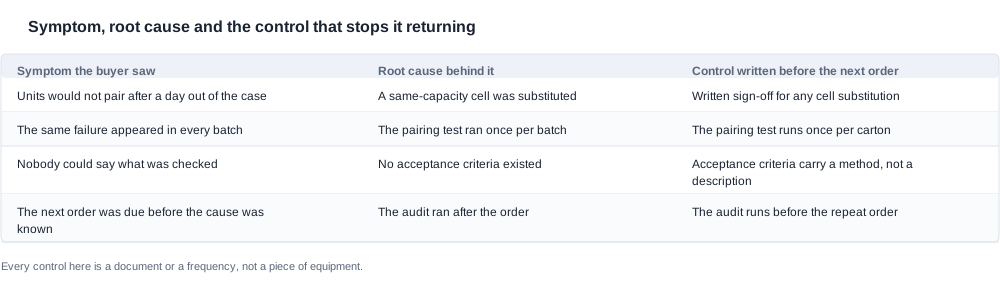
The case is worth reading as a set of general patterns rather than as one incident, because the patterns recur with different components.
The symptom was a field failure that appeared in one production run and not in the previous one, with no change on the order. That shape almost always points at a process difference rather than a product difference, because a product difference would be a design change and design changes leave marks.
The root cause was a substitution that no written rule prohibited and no inspection record captured. That combination is what made it survive for six months and produce a return rate rather than a single complaint.
The control was three documents rather than three pieces of equipment: an acceptance criterion with a method, a substitution approval rule, and a change in inspection frequency. All three cost almost nothing and none of them would have been written without the audit.
What the audit actually found
The most useful line in the audit report was not about the cell. It was this: the audit found the absence of a method, rather than a failure of a method.
That distinction has a practical consequence. A failed process can be corrected, and correction is cheap when the process is understood. A missing process has to be built, and building it takes longer than the audit that revealed it. In this case the buyer spent longer agreeing the pairing method with the supplier than the audit itself took, and that was the correct outcome — the audit had found a gap that the buyer had been operating around without knowing it existed.
What would have prevented this entirely
Three things, none of which required a visit:
- Acceptance criteria agreed before the first order, with a method for each test rather than a description of the desired result.
- A substitution approval rule in the purchase order, requiring written sign-off for any component change, and explicitly including same-capacity substitutions.
- Inspection records at a frequency that can attribute a failure to a batch, which for a per-carton effect means per carton.
All three are documents. The audit was still worth doing, because it is what made them specific to this configuration rather than generic.

What a smart glasses factory audit case teaches about acceptance criteria
The test that failed was a test, not a product
The transferable lesson is narrow and worth stating plainly. A repeated symptom across runs, with no change on the order, should be treated as a signal that the measurement changed rather than the product changed. The check is cheap: compare the inspection records from the two runs line by line and see whether the same tests were performed at the same frequency.
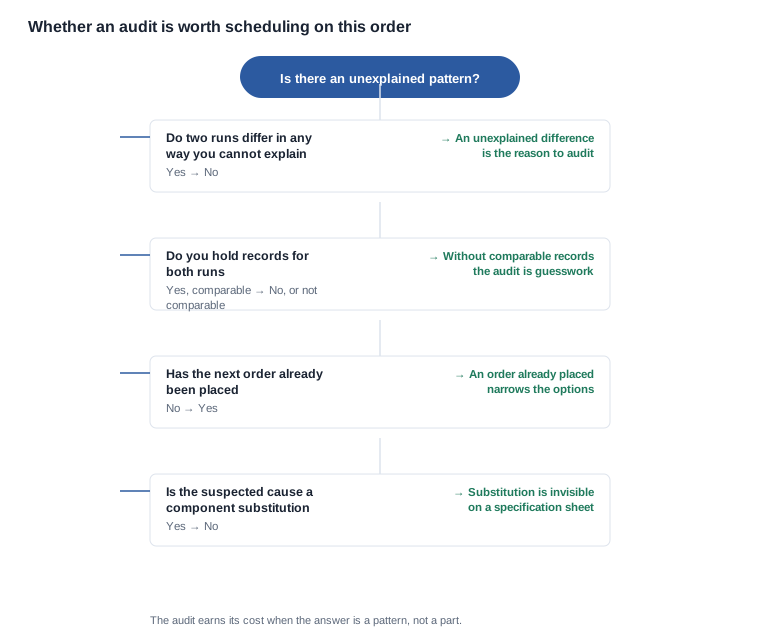
What makes acceptance criteria usable
The criteria that worked in this case had three properties, and they are the same three that any usable criterion needs:
- A method rather than an outcome description. "Connects within thirty seconds after thirty minutes out of the case, on the reference device list" is a method. "Connects reliably" is a description, and a description cannot fail in a way anyone can observe.
- A reference list. The handset list matters as much as the timing, because the behaviour that failed was specific to particular devices and an unstated reference list makes the criterion impossible to apply consistently.
- A frequency. A criterion tested once per batch cannot find a per-carton effect. The frequency is part of the criterion, not an operational detail.
Where this case sits against our published rows
This account is a reasoning walkthrough, and it is worth being explicit about which of its statements are drawn from published material and which are not.
Published and checkable: the cell capacity and count forms used across the audio tier; the rated endurance figures, which differ within that tier; the Bluetooth versions published for the audio models; the charging method published for twenty-four of the twenty-eight models in the range and absent for four camera models — CY03 and MT6, and CY05 and L1 Pro.
Not published, and therefore not used as evidence anywhere above: cell vendor identity, defect rates, yield figures, cycle life ratings, acoustic measurements, camera field of view and video specification, and the weight of every model except the MT6 glasses body at 158 g, which includes its 265 mAh cell and its camera and excludes its 1200 mAh folding charging case.
The documents to request first piece is the paper version of the first three of those controls, and the quality consistency checklist covers the change points where a batch can move without the specification moving. For the second-visit version of the same investigation, see the advanced audit guide, which covers what a repeat visit has to sample that this first visit could not.
What a buyer takes from this case is therefore not a technique but a habit: name the measurement before the shipment, and re-read it before the next one. A criterion that nobody re-reads quietly stops being applied, and the audit is what reminds you to open it. The habit costs ten minutes and it is the difference between a repeat order and a second surprise.
Where this composite account sits against our published rows
Our position on cases like this
Stated plainly: questions about documentation and process are a normal part of a first engagement and not an accusation. We publish cell capacities, charging times and rated endurance figures per model, and Bluetooth versions and charging methods for the models whose rows carry them — which excludes the camera models, where the Bluetooth version row is absent. We do not publish cell vendors, defect rates or quality-consistency figures, because those are not published in our documentation and any figure we supplied would be an estimate presented as a measurement.
When a component substitution is proposed, we will tell you what changes and what does not, in writing, and we will say plainly where the answer is that we do not know how the substituted part behaves in your customers' hands. That is more useful than a specification sheet that reads identical and behaves differently.
We will also say that a supplier verification is a relationship rather than a document, and that neither replaces the sample. What a sample settles is performance under a stated condition; what an audit settles is structure, capability and traceability. A buyer who understands which question belongs to which instrument buys less, waits less and argues less.
The factory audit section covers what has to be established before a first order, and it is the right starting point if the question is whether an audit is worth your time rather than what to do once you have one.


