

A consumer electronics brand that has decided to put smart glasses into its range will eventually ask one question that sounds simple and cannot be answered from anything published: what is the minimum order quantity for the configuration I want, and what does that configuration actually cost to land in a warehouse?
The question is not being avoided. It simply does not have a single answer, because a minimum order quantity in this category is not a property of a model. It is an output of a configuration — how many distinct builds the order contains, how many colours, which marking method, which packaging run, which markets need which document set. A supplier who quotes you one number for an undefined configuration is quoting a number that will change, and a brand that plans against it will discover the change at the point of ordering rather than at the point of reading.
So the honest answer to a budget question in smart glasses is structural rather than numerical. Our published range for this category carries twenty-eight entries across seven categories with their specification rows — cell capacities, rated runtimes, charge times, charging interfaces, charging case capacities, camera resolution classes, colour options, ingress markings, detachable parts and a single published weight. It carries no unit price, no price tier, no minimum order quantity, no lead time, no production capacity figure, no warranty period, no certificate number and no customisation charge. Nothing in this article supplies any of those from outside the published data, and the point of the article is not to work around that but to show what can be built from what is published.
What can be built turns out to be more useful than it first appears: the drivers that push a minimum order quantity up, the composition of a first-order budget, the sequence in which the commercial questions have to be put so the answers arrive in an order a procurement file can use, and the way to write a plan that survives a review six months later.
Smart glasses MOQ and budget: how to plan the spend before the quote
The first thing a buyer can establish today is what our published material does and does not contain, and the distinction is sharper than it looks.
What it contains is a specification document. Twenty-eight entries sit across seven categories: eleven camera models, eight audio models, three sport models, three children's entries, and one entry each for photochromic, bone conduction and AR, the last three of which carry no model name at all. Model pages carry rows — cell capacity, rated runtime, charge time, charging interface, and for a subset of the range a charging case row, a Bluetooth version row, a camera resolution class, a colour list, an ingress marking, a detachable-part note or a short feature line.
What no page carries is a commercial row. A buyer searching the published material for the unit price of a model, for a price tier, for a minimum order quantity, for a lead time, for a production capacity figure, for a warranty period, for a certificate number or for a customisation charge will finish that search empty-handed. That is not the same as saying these things are absent from a transaction; it says the catalogue does not publish them, and a brand that tries to read a budget out of the catalogue will find the line is simply not there.
Why one published figure would be a worse answer than none. A minimum order quantity is an output of a configuration rather than a property of a model. The same model sits under two entirely different numbers depending on whether the brand orders a stock colour in a generic box or a proprietary colour in bespoke packaging, and neither figure is more true than the other. Publish one number and buyers will anchor on it, because a number printed in a catalogue behaves like a fact even when the conditions behind it are unwritten. That number then travels from a working spreadsheet into a plan without the configuration that produced it, and the error surfaces at the point of ordering rather than at the point of reading. A buyer who cannot verify a figure against anything has no way to test whether the conditions behind it still hold.
The evidence that is missing, and where it belongs instead. Some of what a brand needs is not commercial but evidential, and the catalogue is equally quiet on it. There is no per-model certification row for any of the twenty-eight entries, and our export certification page carries images rather than text — ten patent certificates, eight appearance-design patents and two utility-model patents. A brand intending to place a product on a market is therefore dealing with a documentation request rather than a catalogue lookup, and the model-by-model coverage, the issuing body, the certificate reference and the validity period all belong in the written answer that a supplier owes a procurement file. The wider mechanics of why a minimum cannot be read off a catalogue sit in how MOQ affects your margin.
What changes when the figure is treated as a question. The shift is small and it restructures the whole procurement file. A buyer who expects a number begins with the number, works backwards to a budget, and then discovers that the lines underneath it are unknown. A buyer who expects a question begins with the configuration — what is being ordered, in how many builds, in how many colours, with what packaging, for which markets — and derives the budget from the shape of the order. The numbers then arrive later, attached to the things that produced them.
That is why this article does not resolve the question it is about. A minimum order quantity for an undefined configuration is not a number anyone can supply responsibly, and the answer to what the minimum is has to be a set of the conditions under which the minimum is computed.

Smart glasses quantity floors: the drivers that raise a minimum order
Four drivers sit behind most of the floors a buyer will meet in this category. Each is set by somebody, and the useful thing about each is that it is separately controllable — which means each can be asked about separately, and each can be traded against the others. Getting the criteria right at this stage is what keeps a first order from being quoted four different ways.
The number of distinct builds in the order. A minimum applied per configuration rather than per purchase order is the normal shape of this category, and it means an order for two colours in two packaging types is four lines for the purpose of any quantity floor, even though it is one purchase order for the purpose of the payment terms. The camera class alone shows how quickly that happens. Its published configuration splits in several places at once: three cell capacities across the 220–290 mAh band, three runtime bands between roughly five and eight hours, two resolution classes at 8 MP and 13 MP, and a charging interface published as magnetic on some models, Type-C on others and unpublished on the CY03, CY05, L1 Pro and MT6. Every one of those splits is a line in a build plan and a possible line against a floor.
Colours and finishes. This is where the published data stops and the sourcing conversation starts, and the two models that publish colours are the reason a brand can plan on this axis at all. The V03 Pro publishes three colour options and the V06 publishes four; no other entry in the range publishes a colour list at all. A brand that wants a third colour on a model that publishes none is not choosing from the catalogue; it is asking a factory to hold a dye batch, and a dye batch carries its own floor. The trade-off between the number of builds a brand wants to show and the floor it thereby creates is the first real commercial decision in the order, and it is a negotiation rather than a preference.
Finishes follow the same logic. A soft-touch or matte finish is a surface treatment with its own material batch behind it, and a metallised temple is a process change rather than a colour swap. Neither appears in the catalogue, so neither can be planned from it, and the sourcing lead time for either is a question that belongs in the first enquiry.
The marking method. Logo and marking is the one driver here that changes the shape of an order rather than only its size. A printed or applied mark sits on a surface that already exists; a moulded mark is part of the tool, which means a new tool, a first article approval, and a schedule attached to it. The catalogue publishes no branding or logo option line for any model and nothing about tooling, so the whole of this driver sits in the question column.
What the catalogue does publish is a hint about the mechanical reality a brand should expect: three entries carry a detachable component — an inner frame on the V06, an inner frame on the S7, and a temple on the G07. In this form factor, parts of the product are separately produced and separately identified, and a brand that assumes a single moulded body is designing for a supply chain that does not exist here. The options themselves are set out in logo and branding options.
Packaging and printed material. Packaging carries its own run length, separate from the product run. A print supplier works to a minimum run; artwork repeats per language and per market; inserts, manuals and warranty cards are separate print items with their own runs; and the number of languages in a launch is a commercial decision the brand makes before the first enquiry. Where the box is bespoke rather than generic, the packaging floor and the product floor are unrelated numbers, and a buyer holding only one of them has budgeted for half of the commitment.
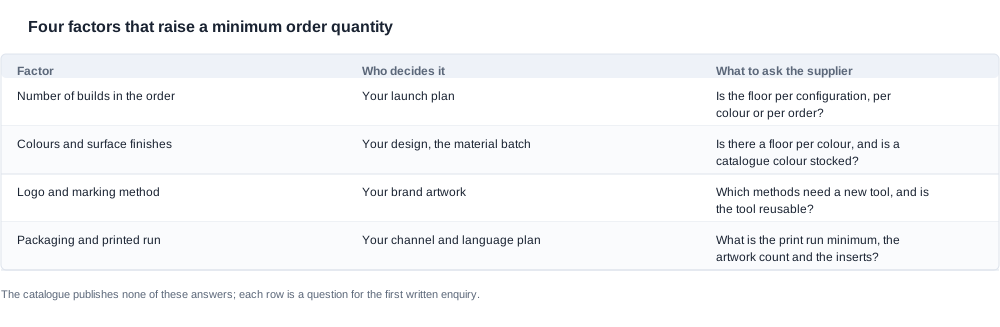
The catalogue publishes no packaging options and no artwork rules, which leaves every one of these as a question. The practical consequence for a budget is that packaging is a separate cost line and a separate quantity question, not an accessory to the unit price, and the total cost of a launch has to carry it as one.
Two drivers that set cost rather than quantity. Documentation scope comes first. Every model code, and every market whose file references it, has to be covered by a document set, and because no per-model certification row is published, a buyer cannot tell in advance how many documents a configuration generates. This does not usually set a quantity floor — it sets a per-variant cost and a schedule — but it belongs in the budget and it belongs in the first enquiry.
The second is the transport position. A lithium cell inside the product means the shipment is handled under dangerous goods rules, with the mode, the paperwork and the cost consequences of the cell format rather than of the finished device; the transport test summary commonly cited as UN 38.3 belongs with it. That belongs in the freight budget rather than in the unit price, and it is a question for the first enquiry rather than a surprise at the first booking.
Five questions name the driver rather than the symptom, and they are the ones worth sending first:
- Is the minimum applied per configuration, per colour or per purchase order, and how is a mixed order counted against it?
- For each colour in the order, is it a stocked variant or a material batch, and what floor applies to a batch?
- Which marking methods can be applied to this build without a new tool, and which cannot?
- What is the packaging print run minimum, how many artwork languages are included, and is a generic box available as a starting point?
- Which documentation set does each model code require in each launch market, and is that charged per model code or per file set?
The same four drivers are costed from the other direction in customization cost factors, and what customization does to the minimum works through how each option changes the floor.
Smart glasses budget lines: what the catalogue publishes and what it does not
A budget built on structure starts by listing what is already known, because a known row is a line that can be planned and a blank row is a line that has to be asked about. Across the twenty-eight entries the catalogue publishes every model's cell capacity, rated runtime and charge time, and it publishes a charging interface for twenty-four of them — magnetic on seventeen, Type-C on seven — while the charging method is unpublished on the MT6 and the CY05, and the L1 Pro and the CY03. Charge time is a ceiling rather than an exact figure: twenty-six entries publish a charge time of two hours or less, and the D17 and the ZH12 publish about one hour.
The camera class adds more rows than any other part of the range, and it adds the rows a budget most needs. Resolution is published for all eleven camera models in two classes, with 13 MP on the S7 and the L1 Pro, and the L2 Utral and 8 MP on the other eight. Five of the eleven publish a case capacity — 1400 mAh on the L1 Pro and the CY05, and the CY03, 900 or 1400 mAh on the L2 Utral, and a foldable 1200 mAh on the MT6. Two publish a colour list, two publish an IP54 marking, and one publishes a weight: the MT6 at 158 g for the glasses body, explicitly excluding its foldable case. Four publish no case row at all — the V03 and the V06, and the S7 and the V03 Pro — and two carry a case whose capacity is not published, the KY06 and the MT5, so the accessory budget for the camera line has to be built per model rather than per range.
What sits behind those rows matters for a budget. The catalogue publishes the resolution class of a camera model and nothing beyond it — no sensor model, no field of view, no frame rate, no video format, no stabilisation figure, no storage capacity. It publishes no frame dimensions and no weight beyond the MT6. It publishes no touch row for any model in the range, and no acoustic measurement for any of the eight audio models. Those blanks are not trivia; each one is a cost line that has to be sourced before it can be budgeted.
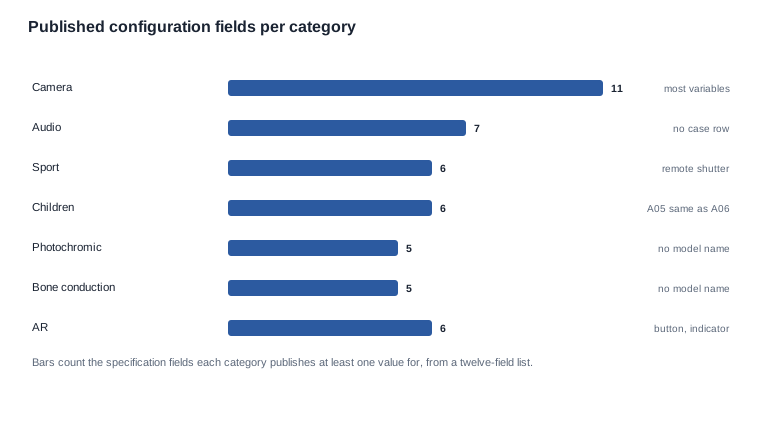
Grouping the range by category shows where the published configuration variables actually sit. The camera class carries the most, because it is the only class where a case capacity, a colour list, an ingress marking, a weight figure and a detachable-part note all appear somewhere inside it, and because its resolution class, cell capacity and runtime each split into several values. The audio class comes next with the Bluetooth version and the feature lines — the D11 publishes a surround sound row, the G07 a detachable temple — but none of the eight audio entries publishes a case row or an ingress row. The children's entries publish almost nothing beyond the five standard rows, and the A05 and the A06 carry identical published rows, which makes them one documentation job rather than two. The three entries without a model name publish the five standard rows and little else.
For a brand building a budget, this grouping is the practical point. The categories that publish the most rows are the categories where a first order can be planned without a single question, and the categories that publish the fewest are the ones where almost every line in the budget is a question. That is an argument for choosing where to start a shortlist, not an argument about which model to pick.
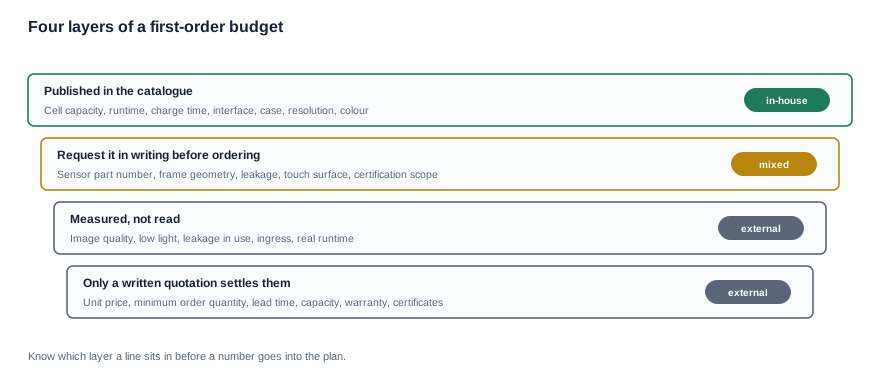
A workable first-order budget has four layers, and the discipline is to know which layer each line sits in before a number goes into the plan.
The first layer is published. Cell capacities, rated runtimes, charge times, charging interfaces, case capacities, resolution classes, colour lists, ingress markings, detachable parts and the single published weight all sit here. They are known today, they can be planned today, and no question is needed for any of them.
The second layer has to be requested in writing before the order is placed: the sensor part number behind a resolution class, frame dimensions and weights for the specific build, the acoustic leakage figure for an audio model, whether a temple carries a touch surface and how it is configured, the cell chemistry and cycle life, the material of the frame, and the certification scope for each model code in each launch market. These rows are not published, but they are not unknowable either; they are simply not in the document, and the questions to ask for them are on the smart glasses buyer checklist.
The third layer can only be measured. Image quality at 8 MP and at 13 MP, low-light behaviour, acoustic leakage in a real environment, ingress behaviour, and the runtime a product actually delivers under the duty cycle it will see in the field. No amount of reading produces these, and a budget that assumes a published resolution class predicts image quality has already mis-specified the product. These are the lines that a sample order and a quality control plan exist to answer.
The fourth layer can only be settled by a written quotation: the unit price basis, the minimum order quantity and the factors that set it, the lead time, the production capacity, the warranty period, the certificate references, and the one-off charges for tooling and for a sample build. These are the lines the first enquiry has to produce, and the whole of the first-enquiry checklist is about making sure they come back complete rather than in fragments.

Smart glasses first enquiry: the order to ask the commercial questions in
A quotation given without its conditions is not usable in a procurement file, however precise its wording. A number that arrives before the configuration is described cannot be checked, cannot be compared against a second supplier's answer, and cannot be defended in a plan review three months later. The sequence below is not a formality; it is the order in which answers stay usable, and it is the order in which the supplier can answer without guessing.
- The configuration. Which model, which build, how many colours, what packaging, which launch markets. Nothing commercial can be answered before this, and every later answer inherits its conditions.
- The basis of the quantity floor. Whether the floor is per configuration, per colour or per order, which of the four drivers is currently setting it, and what changes it if the order splits or merges.
- Payment and balance trigger. The payment structure, the point at which the balance falls due and the point at which title and risk pass, so that the working capital consequence can be modelled rather than assumed.
- The evidence. Documentation scope per model code and per market, the transport position for the cell, and the warranty scope, so that the lines which are not product rows are still priced.
- The re-order terms. What a repeat order of the identical configuration requires, whether the tools and the document set are reusable, and what a second order would have to renegotiate under a new contract.
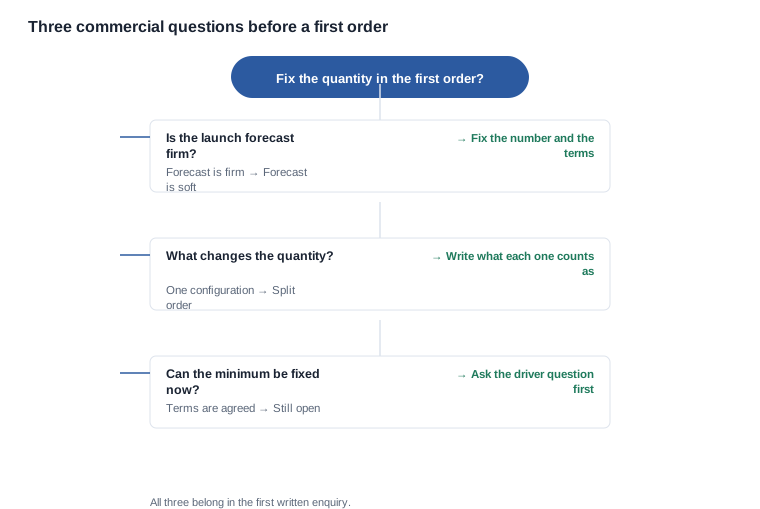
A quotation should name the configuration, the minimum, the factors driving it, the unit price basis, the payment structure and the scope of the documentation, and it should say which of those are fixed and which are conditional on a decision the buyer has not yet taken. A buyer who receives a price and nothing else has been handed a number to act on without the conditions that make it meaningful.
The quotation also has to be asked for against a target band, a volume and a launch market set, because a unit price without a volume and a market set has no meaning, and the same three inputs against two suppliers is what makes two quotations comparable at all. This is where a structured first enquiry earns its keep: the same questionnaire to both sides produces two answers in the same order, and the comparison becomes a comparison of assumptions rather than a comparison of adjectives. A buyer who wants to know how to choose between a stock configuration and a customised one starts here, because the answer is in the conditions attached to the quote, not in the quote.
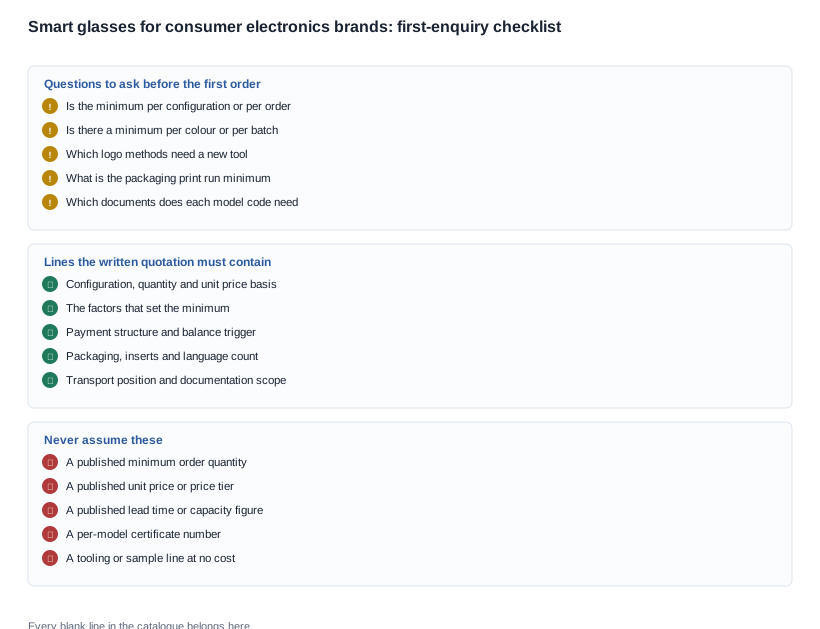
Three responses to an incomplete answer are worth having ready before you order. First, split the answer into the part that is unconditional and the part that is conditional, and plan on the unconditional part only until the conditional part is resolved. Second, keep the open items as named lines rather than as a general caveat, because a general caveat cannot be audited at the next order and a named line can be closed. Third, treat a repeated refusal to answer as information about the supplier rather than as an oversight: a factory that will not state whether a minimum is per configuration or per order is telling a procurement team that its order handling may not be systematic, which is itself a red flag in due diligence and a risk-management finding rather than a detail.
Smart glasses budget defensibility: how to write the plan you can defend later
There is a temptation here that should be named. A brand with a board deadline wants a figure to put in a plan, and a supplier who cannot produce one can look like a supplier concealing something. Nothing is being concealed: the catalogue publishes twenty-eight entries of product data and no commercial data at all, because every commercial figure in this category is conditional on a configuration the buyer has not yet fixed. A brand planning a first order needs the structure of the cost more than it needs a number it cannot yet act on, and we do not put a quantity in front of a buyer against a configuration that has not been defined.
What can be done now is structural, and it is worth doing now rather than later. Fix the configuration to the level of detail the catalogue supports: which model, which build, how many colours and where the published colour list stops, which marking method, which packaging, which launch markets. Everything in the published rows then becomes a plan line, every remaining line becomes a named question, and the first quotation becomes a comparison rather than a starting point. The commercial vocabulary for all of this sits in the MOQ glossary, the platform route for a brand with no forecast yet is on the OEM ready platforms page, and the standard customisation route is set out in standard OEM options.
The discipline that makes this defensible is to write the budget as four labelled layers rather than as one spreadsheet with mixed certainty. Published rows sit in layer one and can be planned today. Written-request rows sit in layer two and need a named question and a date. Measured rows sit in layer three and need a sample and a quality plan. Quotation rows sit in layer four and need the first enquiry. When a reviewer six months later asks where a number came from, each line has one answer, and none of them depends on a memory.
Two further items belong in that budget and are easy to leave out. The market-by-market compliance scope is on the certification checklist route, and the transport position is on the battery transport route; both affect cost and schedule rather than the product itself, and both are cheaper to settle at the enquiry stage than at the booking stage.
The trade-off worth naming is the one between a narrow first order and a wide launch. A single model in a stock colour with a generic box produces the fewest possible floors, the fewest possible document sets and the shortest path to a working shipment. A wide launch produces more units per line and better shelf economics, but it multiplies the number of lines that each carry their own floor. The decision is not a procurement judgement; it is a launch-plan judgement, and the right way to make it is to see the floors and the unit economics of each line side by side before committing, not after.
Related reading
- The models behind the platform route — OEM ready platforms
- The standard customisation route — standard OEM options
- The market-by-market compliance scope — certification checklist
- The transport position to settle before booking — battery transport
- The quantity driver in detail — what customization does to the minimum
Fix the configuration first and the budget for smart glasses for consumer electronics brands stops being a guess: every published row becomes a plan line, and every line the catalogue leaves blank becomes a question that has to come back written.


