

A pricing tier is a way of pricing a configuration, not a way of rewarding loyalty. In this category the distinction carries more weight than usual: the published configuration space is wide and a tier that is quoted without the configuration underneath it cannot be checked, replicated or compared. Twenty-eight catalogue rows divide into families with different charging methods, four different case states, published colour options on two models only, and three entries that carry no model number at all. Each of those is a pricing input, and each of them is settled per enquiry.
We publish no prices. That is not a commercial stance about disclosure; it is a consequence of the same discipline that governs the rest of the catalogue — a figure published without the configuration behind it would be a figure we could not stand behind on the second order. What this article sets out is the structure of a tier, the variables that move it, how to put two quotations on the same basis, and the red flags worth naming before an order is placed.
Smart glasses pricing tiers: what a tier is actually a function of
What a tier structure looks like in this category
Tier structures in this category tend to be built around four different thresholds, and they are not interchangeable. The first is the configuration threshold: a tier that exists because a specific set-up is amortised over a volume. The second is the artwork and packaging threshold, where a print run has to be bought in full, so the tier reflects the print quantity rather than the product quantity. The third is the component supply threshold, where an allocation of cells or boards determines what can be produced in a period. The fourth is the commercial threshold, where a break point reflects a negotiation rather than an operation.
A buyer can tell them apart by asking what actually changes at the break. If the answer is "the same configuration, more units", the tier reflects a set-up. If the answer is "the print run gets cheaper per unit", it reflects a packaging minimum. If the answer is "the components are available", it reflects supply. If the answer is "that is where we can go", it is a negotiation position and should be treated as one.
That last case is why a tier list is worth reading alongside a quotation rather than instead of it. A ladder with no operational reason behind a break will not survive a change in the buyer's plan, and a programme built around that break has to be rebuilt when the plan changes.
Six variables, and which of them the buyer controls
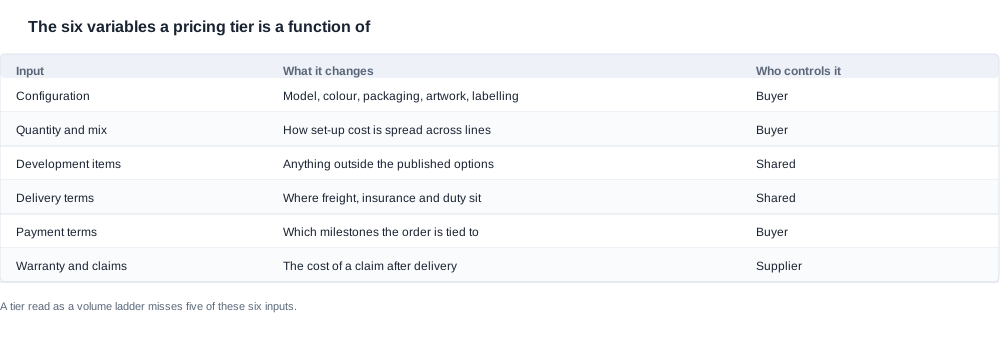
A quotation in this category is a function of six inputs, and only three of them are entirely within the buyer's control. Reading a tier as a volume ladder is what makes two quotations incomparable.
Configuration is the first input and the largest. The configuration is the model, the colour or option set, the packaging version, the artwork and label content, and the destination labelling. Configuration choices multiply: the CY03 and the L1 Pro, and the CY05 each publish a 1400 mAh charging case, the L2 Utral publishes a row reading 900/1400 mAh, and the MT6 publishes a 1200 mAh foldable case — four different accessory volumes behind four otherwise comparable camera models. Add colour and the count rises again, because only the V03 Pro and the V06 publish colour options.
Quantity and mix are the second input. A tier normally attaches to a quantity threshold, and the threshold is set against the supplier's own set-up cost, so the tier structure differs by configuration. A mixed order also introduces its own commercial shape, because the set-up cost is incurred once for the order and then divided across lines that may not be equal. The wholesale mixed orders discussion covers how that division usually works, and the category breadth discussion sets out why the mix question is a range-design question before it is a pricing one.
Development items are the third input. A configuration outside the published set — a colour that is not one of the published options, a packaging format, an artwork treatment, a branded app build — is a development item with a cost and a schedule attached, and it is priced separately from the product. Our own record states this rule explicitly: a requirement that is new to us is a development item, not a configuration switch. The OEM pricing factors discussion covers how these items are usually structured.
Freight terms are the fourth input, and they belong in the comparison rather than outside it. Two delivery terms decide where risk sits: free on board at the port, or delivered duty paid at the destination, and the freight, insurance and duty exposure ends up in different hands, and for a battery product the handling cost differs between the two as well. The stock availability discussion is useful on the replenishment side, because a tier that assumes a stock position the programme does not have is not a tier at all.
Payment terms are the fifth input, and they are usually attached to a milestone rather than to a price, which is why a tier list and a payment schedule are two different documents.
Warranty and claim terms are the sixth input. A warranty period and a claim route are commercial terms, they are confirmed per enquiry, and they belong in the comparison because the cost of a claim is a real line even when it is invisible in the quotation.
Asking for a ladder instead of a single number
A buyer who asks for one price gets one number, and one number is the hardest kind to plan against. A buyer who asks for three quantities gets a structure: a small quantity that establishes the set-up cost, a working quantity that reflects the normal programme, and a larger quantity that shows where the tier stops moving. Three points are enough to establish whether a break is operational or negotiated, and they are enough to forecast what happens to the margin when the plan changes.
The request is simple to write: the same configuration, three quantities, the same delivery term and the same payment schedule, with a note asking what changes at each break and why. The answer to the second half carries the information, and a supplier who answers it precisely has told the buyer how its operation scales — which is worth more to a channel programme than a discount.
Two rules keep the request clean. Do not mix configurations across the three points; a ladder that changes the configuration as well as the quantity cannot be read. And do not ask for the ladder before the configuration is settled, because the ladder will be quoted against whatever configuration the supplier assumes, and the assumption is exactly the thing that has to be named.

Smart glasses pricing tiers: the published position and the unpublished position
What we publish
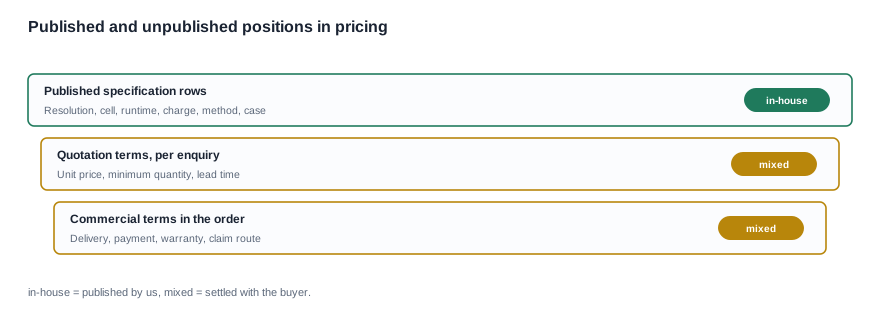
The published layer is the specification set, and it is the layer that determines whether a quotation can be checked at all. Resolution classes on eleven camera models, cell configurations across the range, rated runtimes, charge times written as ceilings, charging methods on twenty-four rows, case capacities on five camera models, Bluetooth versions on fourteen rows, colour options on two models, ingress markings on two, a weight on one. Those figures decide whether a quoted configuration is the configuration the buyer had in mind, and they are the basis on which a tier can be compared against another supplier's.
Why a tier is not published, and what that costs the buyer
Not publishing a tier has a cost, and it is worth naming rather than glossing over. A buyer who needs a budget number before a first conversation has nothing to anchor on, and the anchoring usually happens anyway — on a figure from a comparable product that was never checked against this catalogue's published rows. That is the failure mode this discipline is designed to prevent: a budget built on a number nobody can trace, which then has to be defended internally long after it was set.
Two things make the cost bearable. The first is that the published rows constrain the range of plausible figures more than a buyer expects, because the configuration, the cell, the case, the packaging and the documentation scope are all known before the price is. A quotation against a defined configuration is a short exchange rather than a negotiation, and the buyer can put the request in one message. The second is that a tier is only meaningful with the set-up logic behind it, and that logic is a property of a specific supplier's operation rather than of the product. A tier published without it would be a number that invites comparisons it cannot support.
The practical instruction to a supplier is short: quote a configuration, quote a quantity, quote a delivery term, and state what the tier reflects. A buyer who sends those four things and asks the fifth question gets an answer that can be used, and a buyer who sends only the first two gets a price for an object neither of them has defined.
What we confirm per enquiry
The commercial layer is not published, and the reason is structural rather than evasive: each of these numbers is set by configuration, quantity, mix and the schedule in force at the time, and publishing any one of them in isolation would be publishing a number that does not correspond to a shippable order. Price, minimum quantities, lead times, development charges, sample fees, packaging minimums, warranty terms, payment milestones and delivery terms are all confirmed per enquiry.
A buyer who needs a single reference number for a business case is not being obstructed; the number simply does not exist yet, and the fastest route to it is a defined configuration and a defined quantity. Two configurations, two quantities, two delivery terms — that is enough for a quotation, and it takes one exchange.

Smart glasses pricing tiers: how to compare two quotations on the same basis
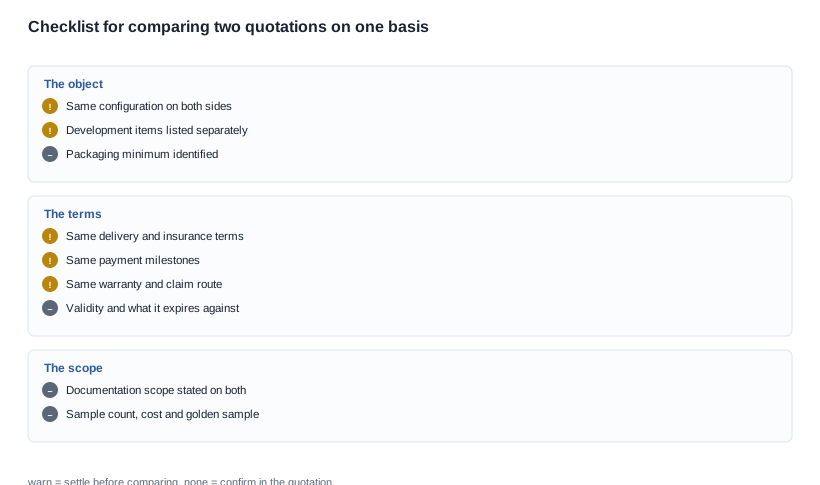
Two quotations for the same product are almost never comparable on their face, because each supplier prices a different object. The comparison becomes possible only after the same eight things have been established on both sides.
The eight normalisation questions
- Does each quotation name the same configuration? Model, colour or option set, packaging version, artwork and label content, destination labelling. If the two descriptions differ in any of those, the unit lines are not comparable at all.
- Do both quotations carry the same delivery terms? Freight, insurance and duty sit in different places under different terms, and the gap between the two unit lines is frequently smaller than the gap between the two landed positions.
- Are development items inside the unit line or beside it? A quotation that folds a development charge into the unit price cannot be compared with one that lists it separately, and neither can be compared with a third that excludes it because the buyer assumed it was in.
- Is the packaging minimum the same on both sides, and is it inside the quoted quantity? A print run that has to be bought in full is a cash exposure that never shows up on the product line, and it is the most commonly hidden number in a first programme.
- Do both quotations carry the same warranty and claim route? The claim cost is a real cost even when it is invisible on the order.
- Are the payment milestones the same? A tier that assumes payment on delivery and one that assumes a deposit are different commercial structures.
- What does each quotation commit to on documentation? A conformity set naming the model list is part of the product's cost of sale; a quotation that excludes it is cheaper because it is less complete.
- How long is each quotation valid, and against what does it expire? A quotation tied to an artwork version or a cell supply is not a quotation tied to a calendar date.
The wholesale pricing tiers discussion covers the same normalisation from the other direction, and it is the one to read alongside a first supplier comparison.
Total cost beyond the unit line
The unit line is one component of the cost of running a range, and in this category it is rarely the largest one over a year. Four others sit next to it: the freight and duty implied by the delivery terms; the packaging amortised across the units actually sold, which changes sharply if the programme does not sell through its first run; the stock carrying cost of a range that holds more configurations than it sells; and the claim cost that follows a warranty that is not matched to the documentation.
The way to handle these is not to estimate them but to name them, so that both quotations are assessed on the same set of lines. A line that neither supplier has quoted is a line that has to be estimated by the buyer, and an estimate is acceptable as long as it is written down as an estimate rather than folded into a unit price to make one quotation look tidier.

Smart glasses pricing tiers: the red flags in a quotation
Questions to ask when the tier structure does not match the plan
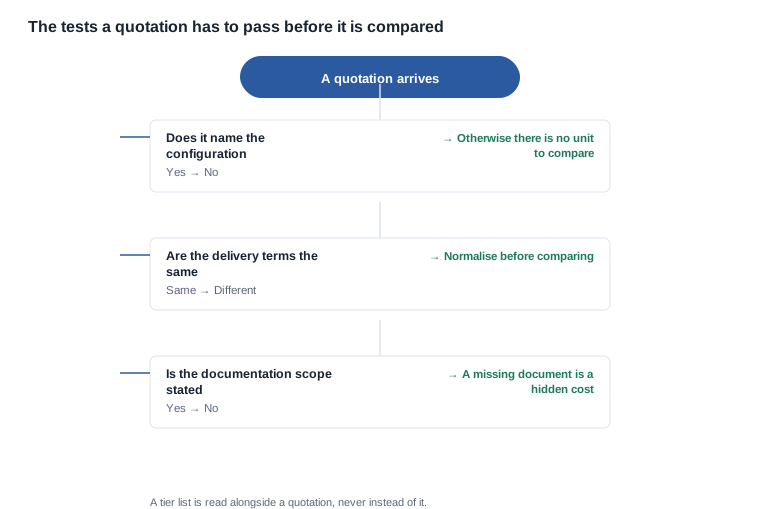
A tier list and a business plan rarely match on the first pass, and the mismatch is usually in the mix. Four questions resolve most of it.
What happens to the tier if the mix changes? A tier that assumes one dominant line will move when the mix moves, and the movement usually runs against the buyer, which is why the assumption has to be checked rather than accepted.
Which line carries the set-up? When an order contains several configurations, one of them absorbs the set-up and the others are priced against it. Knowing which one in advance avoids discovering it in the invoice.
Is the tier conditional on a stock position? A tier that depends on an allocation may not be available in the period the buyer needs, and the lead time becomes the operative variable rather than the price.
What is the alternative configuration at the same tier? If a configuration cannot be ordered at the tier the plan assumes, the plan has to move — and it is cheaper to know that before the artwork is frozen.
These are negotiation questions rather than technical ones, but they are answerable, and they are answerable in the same exchange as the quotation.
Eight red flags
A unit price with no configuration. The most common and the most dangerous, because it looks like the most helpful number in the document. It is a number for a configuration that has to be guessed.
A ladder whose breaks do not correspond to a configuration change. If the break points are at quantities that do not match any set-up logic, they are commercial rather than operational, and they will move.
A development charge inside the unit line. It makes the line incomparable and hides the fact that the configuration is not published.
Tooling or a one-off charged per unit with no ownership clause. The question of who owns the tool and where it sits is a contract term, and a per-unit charge without it means the second order carries the cost again.
A payment milestone tied to a certificate or a document that has not been issued. Milestones should be tied to events that happen; a conformity document tied to the supplier's own internal process is not an event the buyer can verify.
A packaging minimum that appears only in the notes. It is a real number, it is frequently the largest single cash line in a first programme, and it does not move with the order quantity.
A quotation valid for a very short window with no stated reason. Validity tied to a cell supply or an artwork version is a legitimate reason, but it has to be stated; a short window with no cause is a negotiation device.
A "no charge" for samples with no sample specification. The number of samples, their cost and which one becomes the golden sample are three separate terms, and a free sample that has not been specified is not a free sample.
None of these is a reason to refuse a quotation. They are reasons to put the question in writing, and the answers are usually given in one exchange.
Smart glasses pricing tiers: our position and the next step
What a quotation commits and what it leaves open
We will quote a configuration, a quantity, a delivery term and a payment schedule, and we will quote the development items separately from the product so that both lines can be examined. We will show the tier structure against the set-up cost it reflects, and we will state what a tier does not cover — a packaging minimum, a warranty, a documentation scope — so that the comparison has something to be made against. We will not publish a price list, and we will not quote a configuration that has not been defined, because a price attached to an undefined object is a number with no meaning.
The four inputs behind a comparable quotation
The fastest way to get a comparable set of numbers is to send four things: the models, the configurations, the quantity and the delivery terms. What comes back is a quotation with its configuration named, its development items listed separately, its terms stated, and the variables that would move it identified. The distributor and retailer solution describes the wider commercial frame, and the range category comparison note is a useful starting point for deciding which models to put into the enquiry at all.


