

Private label is not one thing. It is a set of decisions, each of which can be taken at a different depth, and most of the disappointment in a private label programme comes from treating them as a single decision with a single answer. A distributor can put its own brand on a supplier's carton and call that private label. It can also commission an app build, a firmware baseline and a moulded frame profile, and the second programme is not a bigger version of the first — it is a different kind of relationship with a different tail of obligations.
What this article does is separate the surfaces, define five levels a buyer can choose between, and set out what each level commits both sides to. It is deliberately written as a framework rather than as an offer: our own records note the customisation capability for each product category, and in three of them it is incomplete, unverified or undisclosed, so the honest position is the questions rather than a menu.
Smart glasses private label: what the term covers and what it does not
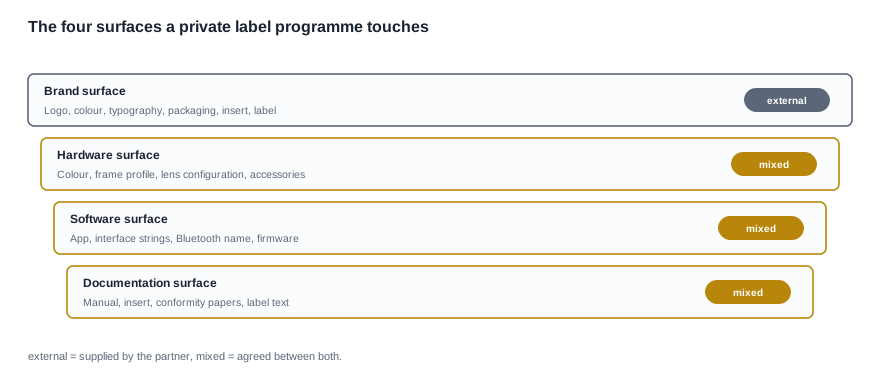
The four surfaces a private label touches
The brand surface is the printed one: the logo, the colour, the typography, the packaging, the insert and the label content. It is the surface most private label programmes start with, and it is the one with the shortest tail, because a printed asset can be retired when a model leaves the range.
The hardware surface is the product's own options: colour, frame or temple profile, lens configuration, and the accessories that travel with it. In this category it is constrained by what the catalogue publishes, and the constraint is sharp — colour options are published for exactly two models, the V03 Pro with three and the V06 with four, so every other colour on every other model is a configuration that has to be created.
The software surface is the app, the interface strings, the Bluetooth name and the firmware build. It is the surface with the longest tail, because it is the only one that obliges a supplier to keep maintaining something after the shipment has been paid for. The app branding discussion sets out the levels and what each one commits a supplier to, and it is worth reading before the app appears on a purchase order rather than after.
The documentation surface is the manual, the insert, the conformity paperwork, the label text and the instructions in the box. It is the surface that carries a distributor's legal exposure fastest, and the customization options overview covers why the four layers behave differently in a quotation.
The three entries that are not orderable yet
Any private label programme in this category has to exclude three rows, and the reasons are specific rather than general. The AR, electrochromic and bone conduction entries carry specifications but no model number, and our internal product record notes that all three require a formal model number added before they can be quoted individually. A private label programme cannot be built on a row that has no SKU, because the box, the label, the document set and the ordering system all need a model number to carry.
The AR entry is the most awkward of the three, because the figures it publishes match those of a standard Bluetooth audio pair: a 100 mAh cell, a charge time of two hours or less, roughly eight hours of run time, magnetic charging and Bluetooth V5.4 — with an indicator light and a button control, and the record marks its customer, its market and its differentiator as unknown, noting that the page may be an unfilled template, or a product that is not yet in production. A private label programme placed against an unconfirmed product is a programme with a re-print risk attached.
The electrochromic entry publishes no lens performance figure at all, which means a private label programme cannot print a lens claim for it. The bone conduction row publishes an amplification gain of 35 dB, which our own record treats as the most aggressive figure in the catalogue and the highest compliance risk of the three, because a hearing-assistance claim would pull the product inside medical device regulation. Neither claim is ours to make, and neither belongs on a distributor's artwork.
What our own records do and do not say
Our internal product record carries customisation capability per category, and the honest reading of it is uncomfortable for a brochure. The camera records carry seven axes, the audio records five, the sport records five, and the children's records two with an app and firmware entry explicitly marked as awaiting verification. The electrochromic record carries three, the bone conduction record discloses no customisation capability at all, and the AR record's capability is unknown.
The axis names for those three families cover different ground too, and no one of the three is contained in another. That matters commercially: a conversation about customising an audio model is not the audio version of a conversation about a camera model, and a buyer who assumes it is will discover the difference at the quotation rather than at the sample.
We do not publish those records as a capability list, and the record itself does not present them as one. Its own framing is the instruction a buyer should follow: anything new to us is a development item carrying a cost and a schedule, not a configuration switch. The OEM customization page sets out the commercial framework these questions sit inside, and the private label discussion for audio models covers the same ground for one family.
Smart glasses private label: the five levels a buyer can define
Choosing the level: four questions
The level a buyer should choose follows from four questions, and asking them in order prevents the common mistake of choosing a level for the branding it buys rather than for the obligations it creates.
Which surface carries the brand promise? If the promise is about the product's capability, the brand surface is a label and the hardware surface carries the programme. If the promise is about identity, price and shelf presence, the brand surface may be the whole of it. A programme that starts from the surface answer lands on a level by itself.
How long does the programme run, and who maintains it? A programme expected to run for a fixed season can be built to a frozen specification. A programme expected to run across catalogue updates has to accommodate the changes upstream, and that is what makes the software and documentation commitments expensive.
What happens to the assets at the end? The exit question decides the tooling and the software levels, because an asset that cannot be recovered cannot be amortised and cannot be re-used. "We will take the artwork and the product" is a real answer, but it has to be given before the work rather than after it.
How much of the product does the brand have to control? A distributor who wants to be able to say "our model" rather than "our brand on their model" is describing level three or above, and the published rows in this category make that narrower than it sounds: only two models publish colour options, and three of the entries cannot carry a model number at all.
Level one to level five
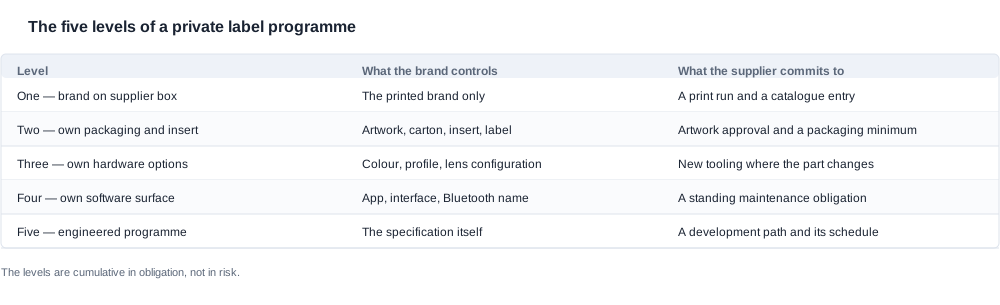
Level one — own brand, supplier packaging. Your name appears on the supplier's existing packaging, and the product is the published configuration in every other respect. The commitment on both sides is small and short: an artwork file on the supplier's template, a print run, a minimum for that print run, and a catalogue entry that points at the supplier's specification sheet.
Level two — own retail packaging and insert. The artwork, the carton, the insert and the label content become yours, with the product unchanged. This is where most programmes belong, and it is where the artwork freeze, the tolerances and the packaging minimum all arrive.
Level three — own hardware options. The programme extends to colour, frame or temple profile, lens configuration, or the accessory set. In this category the published options are narrow, and the questions about what exists and what has to be created matter more than the questions about what is possible.
Level four — own software surface. A branded app, renamed Bluetooth identifiers, interface strings, or a firmware baseline. This is the level where the relationship stops being a supply relationship and starts being a maintenance relationship, and the lifecycle support discussion is the relevant reading for what happens after the launch.
Level five — an engineered programme. Your specification rather than a published one, with tooling, a development path, a dedicated firmware baseline and a supply arrangement designed around the programme. The tooling requirements discussion is the reference for the ownership questions that this level raises, and they are the questions that decide whether the relationship survives its first year.
The levels are cumulative in cost and in obligation, but not in risk. A level four programme with a level two commitment on hardware is perfectly coherent, and it is often the right answer: the buyer takes on the recurring software obligation and leaves the manufacturing to the catalogue.

Smart glasses private label: what each level commits the supplier to
The cost shape of each level
Each level has a cost shape that differs in kind, and the difference matters more than the amount.
Level one and level two are working capital costs. They are paid up front, they are visible, and unsold print is an asset with a qualified value — print for a model that leaves the range is worth considerably less than what it cost. They also carry a minimum, and packaging minimums are the line in a first private label programme that most often surprises a buyer, because the packaging minimum is frequently larger than the product minimum and is frequently omitted from the summary.
Level three is a development cost with a tooling tail. The cost is paid once, and the tail is paid again at every reorder unless the tooling is amortised into the unit price — a term the buyer has to negotiate rather than infer. Level four is an operating cost that recurs for as long as the programme runs, and it is the level at which a distributor's cost of doing business changes rather than its one-off spend.
Level five is a programme rather than a project, and its cost shape is dominated by the development path: the number of iterations, the tooling, the documentation and the conformity work, all of which sit upstream of the first shipment and none of which is visible in a unit price until the programme is finished.
The practical consequence is that the questions to ask are different at each level. At level one and two they are about minimums and artwork. At level three they are about tooling ownership. At level four they are about maintenance and version control. At level five they are about the development path and the exit. A buyer who asks the level-two questions at level four will receive a level-two answer, and conclude that the level-four programme is simple.
Ownership, tooling, software and documentation
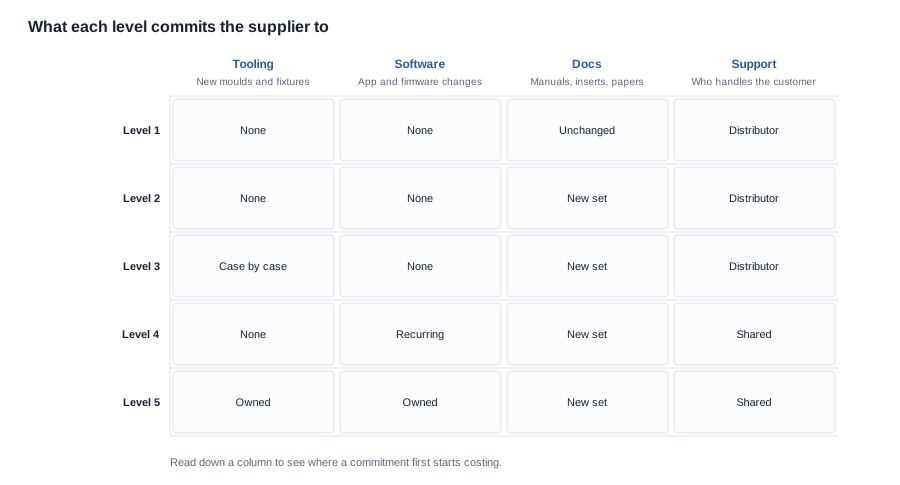
The matrix reads across a row to see what a level creates, and it is worth reading in both directions. Read across a row for a level and the commitment is clear. Read down a column and the level at which a commitment first appears is the level at which it starts costing something.
Tooling is the commitment people forget to price. A new temple profile, a new case shell, a new lens geometry and a new fixture are capital items, and a new colour in a moulded part frequently needs one. The tooling requirements page sets out the ownership and location options in full, including the amortisation question — the one that determines whether a second order from the same tool carries the cost again.
Software is the commitment that does not end. A renamed Bluetooth stack reappears on every connectivity or security update. A custom interface is a recurring obligation. An app build is a standing maintenance relationship, and each of those is a different commercial shape.
Documentation appears at level two and stays for the life of the programme, because a branded insert, a branded label and a branded manual are all documents that have to be re-issued when the configuration behind them changes.
After-sales is the commitment that decides the economics of a long programme. Whether a return comes back to the distributor or to the manufacturer changes the freight plan for every unit that comes back, and a programme that has not settled it is paying for a return path it has not designed.
What a private label programme costs the buyer in management time
A private label programme also consumes the buyer's own people, and that consumption is the cost least often budgeted. Somebody has to answer the artwork questions, keep the versions apart, chase the documents, check the samples, brief the retailer, and reconcile what arrived against what was ordered. The work is spread thinly across the programme rather than concentrated in a phase, which is why it is easy to underestimate and difficult to hand over.
Three practices make it manageable. The first is a single point of contact on each side, so that questions do not arrive from three directions and get answered three times. The second is a version register that records every artwork, label and document version with the date and the reason for the change — the same register that makes a claim defensible later makes the daily work shorter, because there is one answer to give. The third is a written decision log for the level itself, recording which level was chosen, which surfaces it covers, and what each commitment at that level requires, so that a change of personnel does not reset the programme.
The cost of the discipline is an hour a week and a register. The cost of not having it is a programme that cannot be handed over, cannot be audited, and cannot be re-quoted.
Smart glasses private label: the questions to ask at each level

The order matters, because the answers change the questions. A programme that starts at level three and works backwards to level one is a programme that has designed the answer before it asked the question.
Six levels, and the order a private label programme is settled in
- Start from the market and the customer, and decide what the brand surface has to achieve. Which surfaces actually carry the brand promise, and which are decoration. A programme that only needs a printed carton should not be sold a firmware baseline.
- Establish which of the levels the published catalogue already supports for the model in question. This is where the published rows earn their place: the colour options on two models, the case states across the camera models, the absence of any per-model certification row, the missing model numbers on three entries.
- Ask what each further level adds in tooling, in software, in documentation and in after-sales. The four commitments are the unit of comparison, and a level that adds nothing to any of them costs nothing to add.
- Settle the ownership questions before the first order. Who owns the design file, who holds the tool and where it sits, who owns the app code and the firmware image, what happens to all of it if the programme ends. The tooling and intellectual property discussions cover the commercial framework for these.
- Write the change procedure. What constitutes a change, who may raise one, what evidence is needed, and what happens to the schedule and to the open balance when a change lands after the artwork freeze.
- Agree the review cycle and the exit terms. A private label programme is a long relationship, and both of those are decided at the start or they are decided in a dispute.
Smart glasses private label: our position and the next step
The commitment each level carries
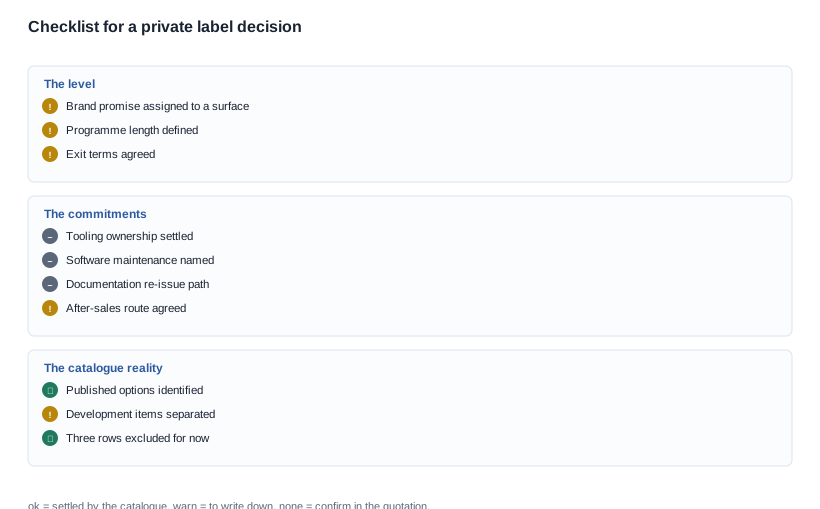
We will work to whichever level a buyer defines, and we will state plainly what each level requires: the artwork and the artwork freeze, the tooling and its ownership, the software and its maintenance tail, the documentation that has to be re-issued, and the after-sales route. We will identify which parts of a request fall inside the published catalogue and which are development items, and we will price the second group as development items with a cost and a schedule rather than as configuration switches.
We will not publish a private label menu that implies a capability the records do not support, and we will not quote a level we cannot resource. We will not make claims on the three entries that carry no model number, we will not print or publish a certification marking for which no per-model document exists, and we will not treat the children's app and firmware customisation entry — which our own record marks as awaiting verification — as a settled capability.
Matching a private label level to its commitments
Send the market, the models, the level you have in mind and the surfaces it has to touch, and ask for the four commitments at that level, the published rows that apply, and the questions the catalogue does not answer. A programme at level one is as legitimate as one at level five, and the exchange costs the same either way. The channel marketing support discussion covers what a branded programme needs on the marketing side, and the distributor and retailer programme sets out the commercial frame around it.


