

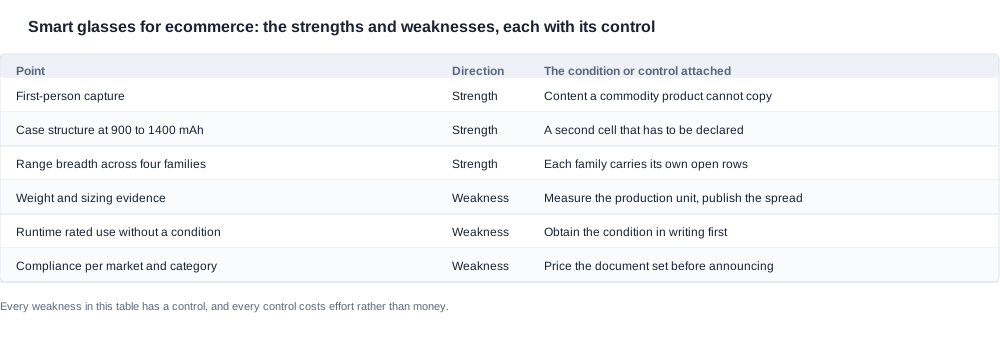
Smart glasses for ecommerce are genuinely strong on one dimension and genuinely weak on two others, and the reason the decision is not straightforward is that this category sells on specifications it mostly does not publish. The honest version of the argument: first-person capture is a real differentiator, the charging case and accessory structure is a real merchandising advantage, and the specification gaps create a listing risk that has to be managed deliberately rather than discovered through customer complaints.
Smart glasses for ecommerce: a strengths sheet backed by published catalogue rows
What is actually strong
The first-person content proposition is the strongest thing about this category and it is not a marginal advantage. The camera range publishes two tiers, 8 MP and 13 MP, across eleven models, and the proposition is genuinely demonstrable: a clip recorded on the product is more persuasive than any amount of listing copy, and it is content a competitor with a commodity product cannot replicate. For an ecommerce seller this is a structural advantage rather than a marketing one, because it changes what the listing can be.
The second genuinely strong feature is the charging case, and it is strong commercially rather than technically. Published case capacities run at 1400 mAh on three camera models, at 900 mAh or 1400 mAh by configuration on a fourth, and at 1200 mAh on a fifth with a foldable form. A case raises the basket value, creates an unboxing moment, and gives the customer a reason to keep the product in a bag rather than in a drawer. Ecommerce channels reward exactly this merchandising structure, and the accessory tier is the mechanism.
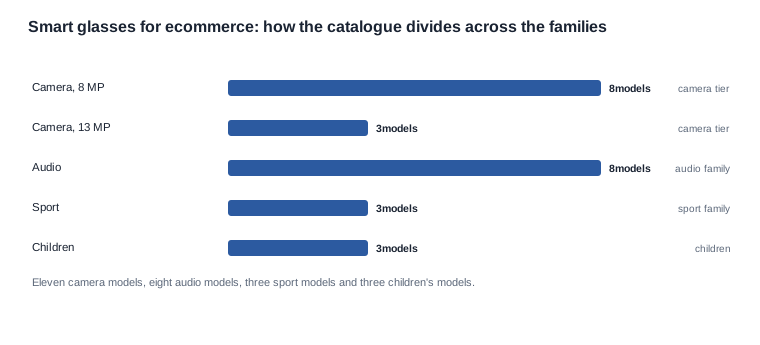
The third strength is range breadth, and it is what allows a storefront to cover several price points from one supply chain rather than three. The catalogue divides into a camera range of eleven models, an audio range of eight, a sport range of three and a children's range of three, with three further entries published without a model designation.
The fourth strength is quieter and is the one that affects due diligence most. The gaps in this catalogue are knowable. A buyer can read the documentation, identify the rows that are open, and price the work of closing them. That is not true of every category, and in a category where it is true, the due-diligence burden on a new entrant is lower than the marketing material suggests.
The argument that does not survive contact with the file
There is a version of the ecommerce pitch for smart glasses that relies on specification density: a long list of camera tiers, cell capacities, runtimes and charging times on the product page, reading like a specification sheet. That version fails, and it fails for a structural reason rather than an accident. In this category the published rows are exactly the rows that are cheap to publish — cell capacity, charge time, rated use, camera tier, Bluetooth version, charging method, case capacity — and the rows that decide whether the customer is satisfied are the ones the catalogue does not publish: sensor model, field of view, video specification, frame weight, storage behaviour, runtime test condition.
So a listing built on published rows alone looks well-specified and answers none of the questions a customer actually asks in week two. A listing built on the full specification sheet a competitor is quoting answers them, and cannot be supported by any document in your file. The resolution is not to find better copy. It is to accept a shorter page, say what is published, and state plainly which rows are not specified — a discipline that has a measurable effect on the return rate and a measurable effect on conversion, and which only one of those two numbers is measured by a marketplace dashboard.
What the catalogue settles, and what it leaves in your own file
The division between the two is worth stating exactly, because it is what a supplier's answer to a buyer's due diligence actually looks like.
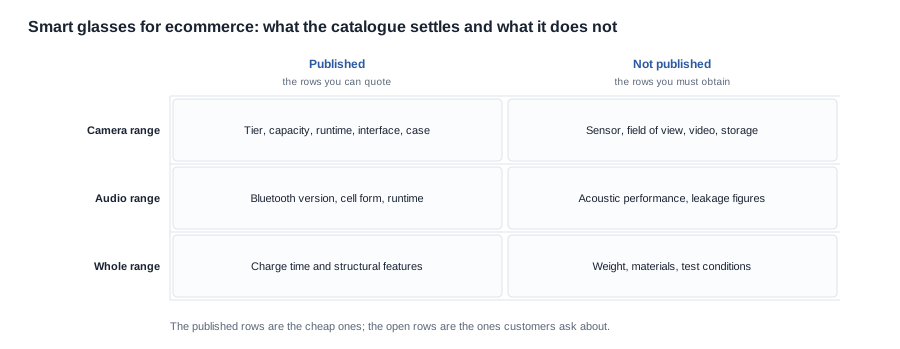
Settled by the catalogue: the camera tier at 8 MP and 13 MP across eleven camera models; cell capacities from 40 mAh on the children's models to 290 mAh on the camera range; a charge time published for every model as a ceiling of two hours or less, with approximately one hour on the D17 and the ZH12; rated use per model; the Bluetooth version on the audio range at V5.3 for the K01 and the K02 and V5.4 for the D11, the D12, the LC-105 pair, the G07 and the YK12; the charging method per model, magnetic on seventeen models, Type-C on seven and unpublished on four; the case capacities where they are published; and the structural features, including the detachable inner frames on the V06 and the S7, the ultra-slim detachable temples on the G07, the slim detachable temples on the YK12, the remote capture control on the D17 and the ZH12. The catalogue publishes no touch row for any model, so a temple control surface is a question to put to the supplier rather than a row a listing can settle.
Left in your own file: the runtime test condition, the cycle life rating, the standby draw, the camera sensor model, the field of view, the video specification and frame rate, the storage behaviour and overwrite rule, the firmware version and support window, the lens material and coating, the frame material, the hinge specification, the operating temperature range, and any unit weight beyond the single published figure.
That last item deserves its own sentence because it is the one most often got wrong. The only unit weight published anywhere in the catalogue is 158 g, and it belongs to the MT6, which is a camera model with a foldable 1200 mAh case. It is the weight of the glasses body including its 265 mAh cell and the camera, and it does not include the case. No frame weight is published for any model in the range. A listing that states a weight for any other model has been filled in from somewhere that is not our documentation, and in a category where the wrong weight is the highest-volume return reason in eyewear generally, that is an expensive sentence.
The three weak points, each with a control
Weak point one: the highest-return variable is invisible
Fit and proportion are the variables that decide eyewear returns, and neither can be predicted from a specification sheet. That is true of the category in general, and this range is more exposed than most because it publishes no frame weight at all beyond the single MT6 figure and publishes no temple or lens dimensions.
The control is procedural rather than technical, and it has three parts. Measure the weight and the geometry of the actual production unit rather than a sample, on several faces, and record the spread rather than an average. State the measurements on the page in whatever form the platform allows, because a stated measurement is defensible and an absent one is not. And accept that a proportion of sizing returns is the price of this category rather than a defect to be engineered out; the only lever a buyer controls is how the page describes the product.
Weak point two: the runtime claim has no condition behind it
Every model in the range publishes a rated use, and none of those ratings carries a published test condition. The children's models carry a figure of approximately twenty hours, which describes a duty cycle rather than a continuous session, and the camera models publish figures between five and eight hours. The gap between a rating and a customer's own measurement is where the expectation failures are born, because a customer who measures for four hours against a published seven-hour figure concludes that the page was wrong.
The control is to publish the condition, not just the number, and to obtain the condition in writing from the supplier rather than describing one. That request is not difficult; it is simply one that nobody makes until a complaint arrives.
Weak point three: compliance is per market and per category, and it is invisible on the box
The obligations for a Bluetooth wearable differ by market, and the radio position in the EU runs through the Radio Equipment Directive (EU) 2014/53/EU while the traceability and online-listing position runs through the general product safety framework. For the United States, radio authorisation for a Bluetooth device is required before the product can be sold lawfully, and without it the listing cannot be fulfilled. The online-listing requirements are the part that surprises sellers, because the information has to be displayed in the listing itself rather than held in a file.
The children's models make this longer rather than shorter. Our catalogue publishes no certification position for the A05, the A06 and the A07, and the applicable children's product requirements sit outside our documentation entirely, in the European and American regimes referenced at child product. A children's listing therefore carries a longer evidence chain than an adult one, and the extra chain has to be planned for rather than discovered when a marketplace reviewer asks.
The control is to treat the market document set as a per-market, per-model cost with a lead time, to attach it to the quotation, and to price the number of markets before the number is announced. A seller who assumes one document set covers every market discovers otherwise at the first market review, which is the most expensive moment to discover it.

The criteria that decide whether to enter at all
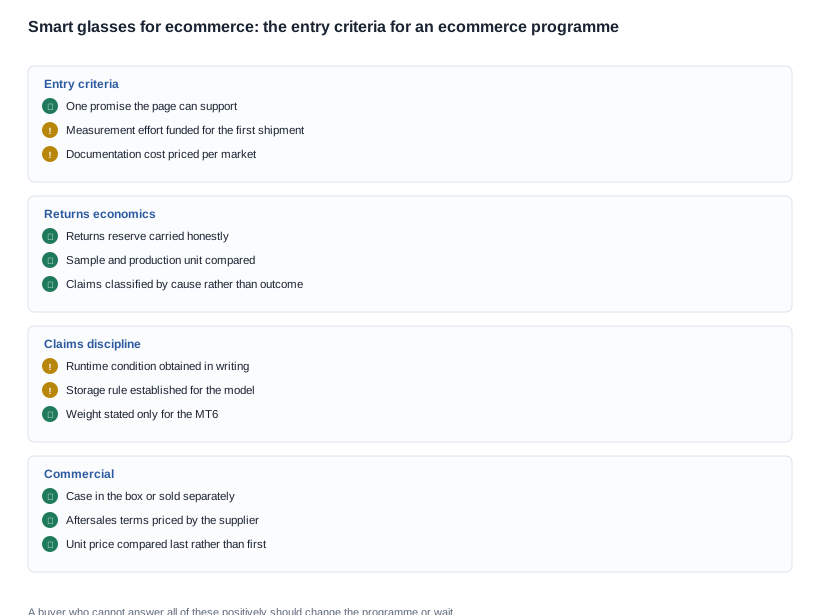
The question is not whether the category is attractive — it is whether your particular programme can carry it. Six criteria decide that, and a buyer who cannot answer all six positively should either change the programme or wait.
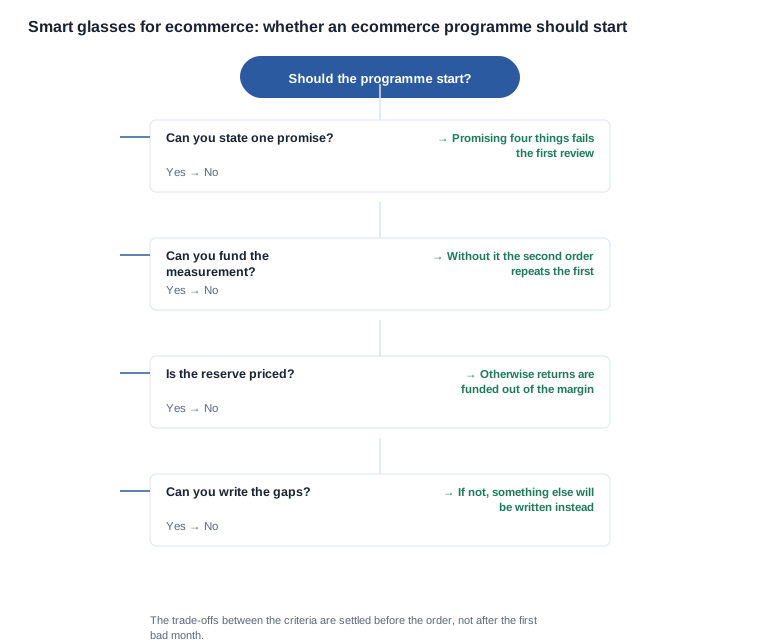
- Can you state one promise and support it? The criterion is whether the page can make a single capability claim backed by a published row or an established measurement. A programme that intends to promise capture, audio, translation and durability at once will fail on the first claim the platform reviews.
- Can you fund the measurement? The runtime condition, the storage rule, the weight and the firmware window are all obtained by asking and, in some cases, by measuring. A programme that will not spend the effort on the first shipment will not have the evidence for the second order.
- Can you carry the documentation cost per market? The document set is not compressible by ordering more units, and it has a lead time that competes with the production schedule.
- Can you price the returns reserve honestly? The reserve is a function of the claim rate, and the claim rate is set by the accuracy of the page and the packaging. A programme that cannot carry a reserve is funding returns out of the margin without knowing it.
- Can you source the sample and the production unit separately? A buyer who approves a sample and receives a different production build has no evidence route at all, and the difference usually shows up in the fields the catalogue publishes least often.
- Can you write the gaps? The final criterion is the hardest and the most decisive. A seller who can write "the storage behaviour for this model is specified on the insert card" will have fewer returns than a seller who writes nothing, and a seller who cannot write that sentence will write something else instead.
The trade-offs between these criteria are real, and they are the trade-offs a buyer should evaluate before ordering rather than after the first bad month. Which of them is weakest in your own programme decides where to spend the negotiating effort, and the criteria are worth assessing together rather than one at a time.
What you negotiate, and what you cannot
Most of the negotiating time in this category goes into the unit price, which is the one line that moves least once the configuration is fixed. The lines that actually change the total cost are elsewhere, and they split cleanly.
The lines that cannot move. The cell configuration and the charging interface, and therefore the charge time, the rated use and the case architecture. The camera tier. The certification cost and the lead time for each market. The battery transport documentation for the configuration as shipped. The mould and tooling charges, which are amortised across the first order and quoted as a separate line rather than folded into the unit price. These are arithmetic and design decisions, and a buyer who negotiates them is negotiating something that is fixed.
The lines that move, and are worth more than the unit price discount.
- Whether the case is in the carton or sold as a separate SKU. This is the largest single lever in the category because it creates one price point or two, and it changes the artwork, the freight weight and the transit file at the same time. The approach is set out in ecommerce accessories.
- The consumable quantities and their per-unit cost. A few cents each, and the highest-return line available. The quantity to negotiate is the quantity per device and the restock interval, not whether they are included.
- Whether an anti-glare film is included, and whether the factory applies it. On a product where a scratch becomes a claim, a factory-applied film is usually the cheapest reduction in claims anywhere in the bill of materials.
- The aftersales terms. A stated replacement turnaround, a claim route the customer can complete without a call, a spare part that can be bought separately, and an allocation of the two-way freight on a unit that arrives faulty. Four separate terms, each removing a category of cost, and each of them priced by a supplier who has priced them rather than assumed.
- The order bands, whether two configurations can share a single purchase order, and whether an opening order can be delivered in two instalments against staged payment. Where the commercial room sits is usually in the quantity a buyer leaves at pilot quantity.
The commercial structure of a first order is set out at pricing, the payment structure at payment terms, and the minimum order question at MOQ. We do not publish unit prices, minimum order quantities or lead times as fixed numbers; all three are confirmed per enquiry, because they are set by the configuration, the volume and the market rather than by the product.
The landed cost line that is not on the quotation
Four numbers sit outside the unit price and they are the ones that decide whether a channel programme works.
The freight weight of the configuration. A case is an object in its own right, and it is a second lithium cell. A configuration shipped with the 1400 mAh case and a configuration shipped without it are different freight weights, and on a large volume that difference is a visible line on the freight invoice rather than a rounding error. The catalogue publishes the case capacities but not the case weight, so the weight per configuration has to be requested with the quotation.
The declared value and the duty treatment. The declared value is a commercial decision rather than a formality, and it interacts with the incoterms. The route is worth deciding before the first order rather than correcting afterwards: a seller who fixes the term and the declared value early has one fewer variable when the second shipment is priced.
The payment structure. A deposit against a production run, a balance against the bill of lading, and a split first order against a staged payment are three different cash profiles for the same unit price. Which one a supplier will accept is a function of their own exposure rather than of yours, and it is negotiable at the point where the buyer's risk is lowest.
The documentation route per market. As noted above, this is the one line that cannot be compressed by ordering more units, and it carries a lead time that competes with the production schedule. Three markets means three document sets, and a buyer should know the cost of each before the market is announced rather than discovering it in the next quotation.
The four together are the total cost of a programme. A buyer who quotes unit price alone is comparing the smallest part of the number, and the part that moves least.
The balance we will stand behind
We will give a buyer the published specifications for a configuration and mark the gaps, because a listing built on acknowledged gaps survives a marketplace review and one built on assumed figures does not. For this range the gaps are substantial, and naming them is more useful than filling them.
We will also be direct about the parts of the case that argue against the category, because a supplier who only presents the strong side is not doing due diligence. The weight and the sizing evidence are the weakest link and will stay that way until per-model figures are published. The runtime conditions are the second weakest and the easiest to fix, because they are a request rather than a development. The storage behaviour on the camera range is the third, and it is the one that will decide whether the camera tier's return rate is acceptable for a particular programme.
What we will do is take the marketplaces, the price tiers and the volume you are working to, and tell you which published configurations exist at each, what documentation work each market requires, what the open rows are, and which claims we cannot support. The pre-launch claim-by-claim review is at ecommerce pre-launch checklist, the market access document set is at certification checklist, and the scenario entry point is smart glasses for ecommerce.
Related reading
- Every claim to check before the page goes live — ecommerce pre-launch checklist
- Market authorisation documents — certification checklist
- The commercial side before you compare prices — pricing checklist
Tell us the marketplaces and the price tiers you plan to list, and we will tell you which published configurations fit and which claims we cannot support.


