

Smart glasses for education troubleshooting is not a repair problem, and treating it as one is how a pilot turns into a supplier dispute. The fault list a school produces in the first month of a deployment falls into a fixed order — a unit that will not join the class account, a unit that will not charge, and a question about where the data goes — and each of the three points back at something the buyer did not settle inside the order. A buyer who settles all three in writing before the first box opens turns the month into an acceptance test. A buyer who does not turn it into a warranty claim, and the difference between those two outcomes is worth more than the device itself.
Smart glasses for education troubleshooting starts with the order, not the unit
The three symptoms a school pilot produces, in order
The first symptom is a unit that will not join the class account. In a shared deployment this is the most common cause by a wide margin, and it presents as a hardware fault because the unit simply does not appear. The second symptom is a unit that will not charge, which in a school environment is almost always a contact and rota problem rather than a cell problem. The third symptom is not technical at all: a parent asks where the data goes, and the buyer has no written answer to hand.
The order matters more than the individual items, because the first two are process failures and the third is a document failure. Only one of the three is ever a hardware defect. A support inbox that cannot tell them apart will spend the whole pilot arguing about the wrong one.
Who is buying, and what the buyer is actually deciding
The reader here is a brand owner supplying a school programme, a channel buyer, or an education procurement officer working through a district file. The decision in front of them is not whether the product functions — the function rows are published and they are short — but whether to run a pilot at all, with which model, and what goes into the pilot agreement. The fear behind that decision has three names: a pilot that ends in a policy discussion instead of a product decision, a defect rate attributed to the factory that was really an account-binding failure, and a bulk order that repeats the same broken process at forty times the scale.
That third fear is the one that determines the pilot size. A twenty-unit pilot is an experiment. A two-thousand-unit order is a commitment. The only lever a buyer has between the two is a documented process that survived a small deployment, which means the pilot is bought as much for the process evidence as for the hardware.
Why the fault list is a procurement asset, not a support cost
A pilot is the cheapest acceptance test available in this category. Twenty units, four weeks, real students, real accounts, a real school IT contact who will escalate on the third occurrence of anything. Nothing else in the supply chain gives a buyer that at that price.
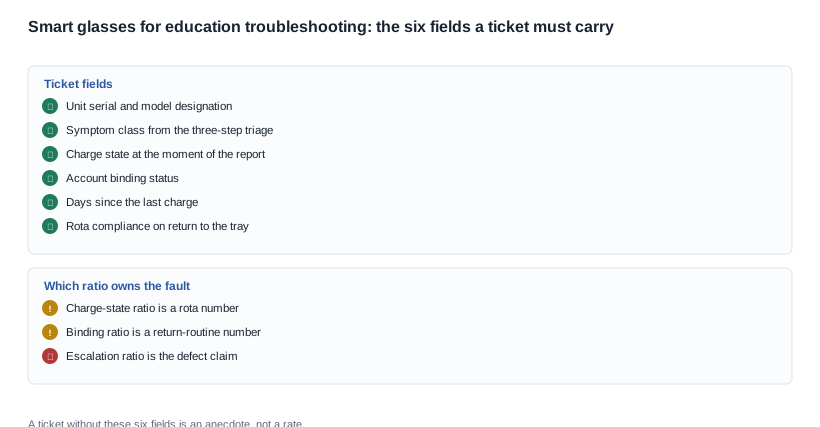
The output of the test is a ticket log, and the ticket log is worth keeping. Every ticket that arrives with a unit serial, a model designation, the charge state at the moment of the report, the account binding status, the number of days since the last charge, and a note on whether the unit went back to a charged tray can be turned into a rate. A ticket without those six fields is an anecdote, and an anecdote cannot be used to defend a price, a replacement schedule, or a re-order decision. This is the first place where the gap between a school pilot and a commercial programme shows up, and it is a document gap rather than a product gap.
The published rows that decide what a school pilot can survive
What the three children's models publish, line by line
Our catalogue carries three models positioned for education deployment, and each of them publishes the same five electrical rows: a cell capacity, a charge time, a rated use, a charging method, and a Bluetooth version where one exists. The A05 and the A06 publish 40 mAh, a charge time of two hours or less, about twenty hours of rated use and magnetic charging, and they publish a posture-and-distance behaviour together with an electronic lens fogging element. Neither of the two publishes a Bluetooth version. The A07 publishes 70 mAh, the same charge ceiling of two hours or less, about twenty hours of rated use, magnetic charging and Bluetooth V5.4, and it is the audio model rather than the behaviour model.
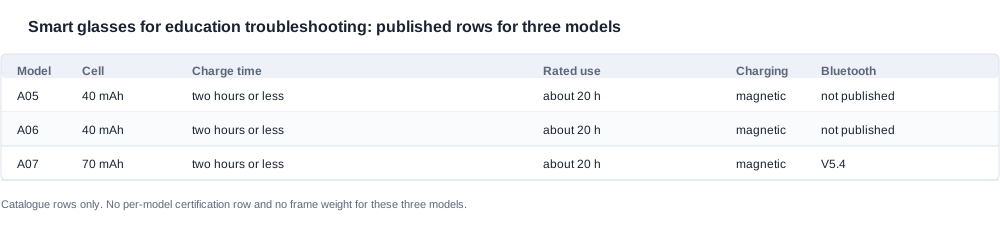
| Model | Catalogue name | Cell | Charge time | Rated use | Charging | Bluetooth |
|---|---|---|---|---|---|---|
| A05 | A05 children's smart protective glasses | 40 mAh | two hours or less | about 20 h | magnetic | not published |
| A06 | A06 children's smart protective glasses | 40 mAh | two hours or less | about 20 h | magnetic | not published |
| A07 | A07 children's smart audio glasses | 70 mAh | two hours or less | about 20 h | magnetic | V5.4 |
Read as a procurement table rather than a feature list, these rows settle three things and leave four open. They settle the charging architecture, because all three charge magnetically and a magnetic contact is a designed-in single point of failure that has to be in your tray procedure. They settle the daily rhythm, because roughly twenty hours of rated use means the recharge is a nightly event rather than a shift-length constraint. And they settle which model carries the Bluetooth requirement. What they leave open is everything a school or a district will actually ask: weight, materials, ingress, certification and data handling.
A charge time of two hours or less is a ceiling, not a promise
The catalogue publishes a charge time of two hours or less for these models. That is an upper bound, and it is worth being precise about what an upper bound can and cannot be used for, because the phrase is routinely misquoted in both directions.
The published claim permits a charge time of exactly two hours. It does not permit a claim of "under two hours", which excludes the two-hour case entirely, and the two are different assertions. Any procurement document that converts the catalogue row into a shorter English phrase turns a ceiling into a guarantee and loses the margin that made it safe. Our own wording stays at the ceiling, and so should the wording on your purchase order.
Beyond the wording, there is a second limit that matters more than the number itself. The catalogue publishes no start state for the charge cycle and no termination criterion — it does not say what charge level counts as finished. A charge time without a starting point and an ending point cannot be used to plan a break window, and it cannot be used to size a charging point's throughput either. Ask the supplier for the measured time from a flat cell, the termination criterion, and the method. If the answer comes back with a single figure and no method, you have a marketing number rather than an engineering one.
The rows that stay unpublished, and why that is the buyer's problem
No frame weight is published for the A05, the A06 or the A07. The only weight anywhere in our catalogue is 158 g for the MT6, which is a camera model, and that figure is the whole unit including its battery and camera and excluding its folding charging case. That is the only published weight we hold, and none of the three education models has one. A deployment therefore cannot be sized for a head, a tray slot or a charging dock from catalogue data, and any school that needs that number has to ask for it as a specification item.
The same holds for the lens material, the coating, the hinge, the operating temperature range, the cycle life rating, the runtime test condition and the standby draw. The standby draw is the one that bites hardest in a school, because a unit left in a tray overnight loses charge at a rate nobody has published, and the tray discipline is what substitutes for the missing number.
On certification, the position is specific and we would rather state it than leave it implied. Our catalogue carries a company-level export certification page whose content is images rather than text, and the catalogue text contains no reference to CE, FCC or RoHS. There is no per-model certification row anywhere. The export page carries ten patent certificates — eight appearance-design and two utility-model — and none of them is a conformity statement for a particular model. A buyer in this category will be asked for a children's product conformity file, and the frameworks a school or a district will name are EN 71 and ASTM F963; for the A07 the Bluetooth qualification behind the published V5.4 is the other document a school IT team will ask for. Both are supplier deliverables. Neither is a catalogue row, and a catalogue that is silent on them is not making a claim either way.
The application ownership, the firmware customisation capability and the data storage location are also not published. That third item is the one that ends pilots, and it belongs in the next section rather than in a list of gaps.
A triage order a school can run without a supplier escalation
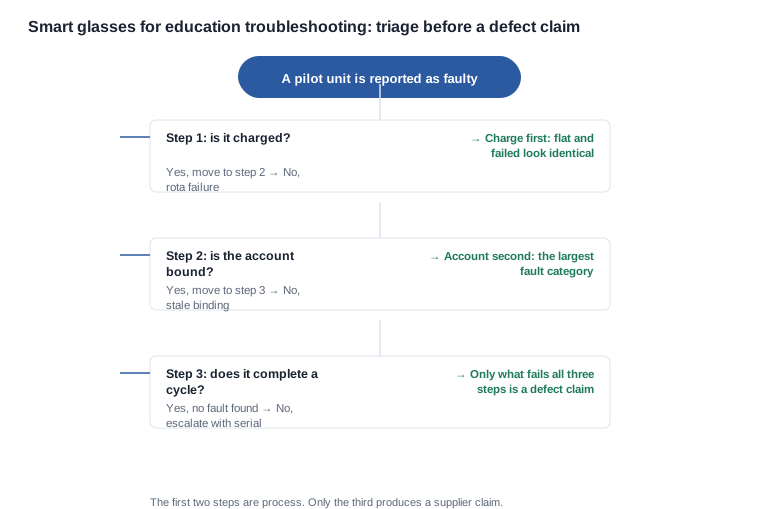
The three-step order below is the whole procedure. It is worth the school two pages of training, because the two most common causes of a reported fault are invisible from the outside and produce identical symptoms, and neither of them is a hardware fault.
Step one, the charge state
Check the charge before anything else. The A05 and the A06 publish 40 mAh and the A07 publishes 70 mAh, all three publishing about twenty hours of rated use, and a unit that has been sitting in an uncharged tray for a day reports exactly the same symptom as a unit with a failed cell. If the unit does not present a charge state at all, the problem is in the issue routine rather than in the hardware.
The procurement translation matters here. The recharge interval is a deployment parameter your factory cannot set for you, and because no standby draw is published, you cannot derive a safe tray time from the cell figure either. Negotiate the tray specification as part of the order — how many charging points per unit count, where they sit, who owns the routine — rather than assuming the published cell capacity covers the gap.
Step two, the account binding
In a shared deployment a unit that is still bound to the previous account does not appear in the class roster and will not respond to the application. The fix belongs in the return routine: whoever puts a unit back into the tray also clears the binding. It is a two-minute step that removes the single largest category of reported fault in this scenario, and it costs nothing.
A second failure mode sits underneath it. Where a full class shares one teacher phone, the number of units enrolled against a single handset becomes a design parameter in its own right, and a configuration that works with eight units can fail intermittently with twenty. The account capacity per handset has to be established before the deployment rather than discovered on the first morning.
Step three, the unit
Only after charge and binding are confirmed does the unit itself become the subject. What is worth checking is whether the unit completes a charge cycle, whether the magnetic contact is free of debris, and whether the published behaviour is reporting at the expected posture and distance. On the A05 and the A06, a lens that will not fog on demand points at the electronic fogging element rather than at the application, and a lens that fogs unevenly is often a lens with a smear on it rather than a failed element.
Stop the escalation at three steps. Anything that survives all three is a defect, and a defect is only actionable with a unit serial, a photograph and the six ticket fields from the next section. Without those, a supplier response is a question, and the clock runs while the question is outstanding.
Turning pilot tickets into acceptance criteria for the next order
The six fields every ticket has to carry
The ticket log is the deliverable of the pilot, and its schema should be fixed on day one rather than retrofitted when the first argument arrives.
- Unit serial and model designation, recorded at the point of issue rather than typed from memory.
- Symptom class, taken from the three-step triage so that the class is objective.
- Charge state at the moment of the report, not at the moment of the triage.
- Account binding status, recorded as a yes or a no.
- Days since the last charge, which converts a rota problem into a number.
- Rota compliance on return to the tray, which is the single field that separates a product problem from a store-room problem.
The three ratios that decide the re-order
Three ratios come out of that log, and they look identical in a support inbox while having three different owners.
- The charge-state ratio is the share of reported faults where the unit was below the deployment's minimum charge state at the moment of the report. This is a rota number, owned by operations.
- The binding ratio is the share caused by a stale account binding. This is a return-routine number, owned by whoever issues and collects the units.
- The escalation ratio is the share that survived all three triage steps. This is the only one of the three that belongs in a defect claim against the supplier.
Splitting the three is what makes the number usable. Unsplit, every ticket becomes a factory defect claim, and a supplier's rational response to a claim of that shape is to dispute the whole number rather than the small share that is genuinely theirs. Split, the claim is narrow, factual and hard to refuse, and the two ratios that belong to the buyer stay with the buyer.
Where the criteria belong in the purchase order
Incoming inspection criteria are the first place the numbers should land. What must a received unit pass before it enters the tray — function, charge, account reset state, serial labelling, packaging state — should be written as an inspection step with a stated method, not left to a receiving clerk. Warranty and returns language is the second place, where the definition of a defect, the replacement lead time, the allocation of return freight and the ratio threshold that triggers a commercial review all belong. The clause language is at contract terms, and the sampling and inspection process behind a first order is at quality consistency.
One item belongs earlier than either of them. The serial label format is a tooling matter, and it is much cheaper to fix at the artwork stage than to fix after the first shipment has landed with labels that cannot be read. Tooling and setup costs are quoted as a separate line rather than folded into the unit price, and the label belongs in that conversation.

What a pilot agreement has to settle before the first box opens
The terms worth negotiating
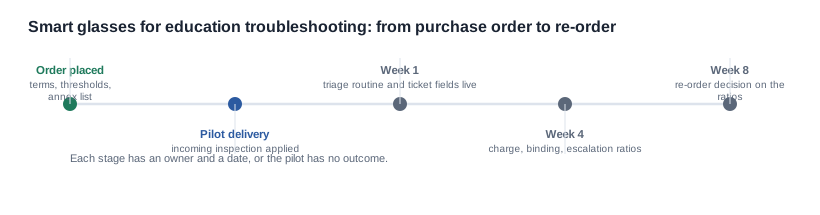
The pilot quantity and the conversion terms come first: what quantity moves from the pilot tier to the run tier, at which price tier, and against which minimum order quantity. The pilot tier is where the factory carries the most risk exposure, which is why most of the commercial room in a first order sits there rather than in the run tier.
Next come the review thresholds. A defined share of pilot units that triggers a commercial review is worth more than a subjective judgement at the end of the term, because it is the only mechanism that converts a fault rate into a commercial event while the pilot is still running. A sample order and its sample cost sit alongside this, and a sample is the cheapest way to see the published function rows on a physical unit before a classroom sees them. Payment terms follow the same logic: a staged payment against a pilot delivery protects both sides, and the deposit structure is set at payment terms.
Training is commercial too, in the sense that it carries a cost. The return routine is a one-page procedure. Asking the supplier to review the wording of that procedure before it is printed is a free quality check, because a supplier who has not read the procedure has not tested it.
The terms the catalogue fixes
The cell capacity, the charge time, the rated use, the charging interface, the Bluetooth version where it is published, the ingress position and the published function rows are catalogue facts, and they are not a negotiation surface. The A05, the A06 and the A07 carry no ingress rating at all — the IP54 marking in our catalogue belongs to two sport camera models and to nothing else — so a deployment exposed to water has no published protection to rely on and must ask for the position in writing.
The certification cost and lead time are a schedule item rather than a negotiation item, and the same is true of the child's-product conformity file, because the time belongs to the testing body rather than to either party. Tooling is a fixed cost amortised across the run, quoted separately so that the unit price stays comparable between configurations. Freight and incoterms belong in the same conversation as the accessories line, because a school order's freight weight is a function of the unit, the packaging and what is in the box, and what is in the box is a procurement decision rather than a packaging one.
The annex that answers the parent's question
The third symptom has one correct remedy, and it is a document. The answer has to contain three things: who operates the application, where the data is stored, and what the device records. None of the three is published in our documentation, which means the annex has to be written by the party able to write it, and it has to be signed before the pilot rather than drafted during it.
Two failure patterns are worth naming because they are common. The answer arrives after a parent has asked the question, which converts a technical enquiry into a policy escalation and puts the pilot at the mercy of someone else's timetable. Or the answer is vague enough that the school has to repeat it, which moves the burden of the explanation onto the pilot team and away from the party that holds the facts. The annex is a procurement deliverable with a due date, and the due date is before delivery.
Frame it in the language the buyer will use. A district officer wants a single page that can be attached to a guardian notice, not a technical appendix, and a supplier deliverable that arrives as a 40-page technical file is functionally the same as no answer at all. How a real deployment behaves is covered at real-world classroom experience, and the equipment side of the same question is at the gear checklist.
A twenty-unit pilot walked through, and what it changed
The scenario
Take a regional education group running an eight-week pilot with two secondary classes and twenty units, with a term-start deadline and a district procurement file to close. The budget tier is fixed, the charging happens in a locked cupboard overnight, there is one school IT contact, and guardian questions are expected inside the first term. This is a hypothetical scenario rather than a client project, and the point of walking it through is that the order of the decisions, not the size of the order, is what determines the outcome.
The decisions
The model choice is driven by the Bluetooth requirement rather than the cell, because the recharge is a nightly event either way and the published twenty hours of rated use makes it a store-room problem rather than a scheduling one. The A05 or the A06 covers the behaviour requirement; the A07 covers the audio requirement with its published V5.4.
The three triage steps are written into the tray routine before the first delivery, and the ticket log is configured with the six fields on day one. The data annex is requested as a pilot deliverable with a date, and the purchase order carries the incoming inspection criteria and the review threshold. The immediate cost of all of that is a page of procedure and a schema for a spreadsheet. The deferred cost of skipping it is a defect claim against a supplier for faults that are 90% operational, which is the number that ends a supplier relationship.
What we publish, and where our answers stop
We publish the rows a buyer can order from: cell capacity, charge time, rated use, charging interface, the Bluetooth version where it exists, the lens count, the published posture-and-distance behaviour and the electronic lens fogging element, and the structural facts on each model. We do not publish the frame weight for the A05, the A06 or the A07, and we would rather tell you that than quote a typical figure you cannot verify. The only weight in our catalogue is 158 g for the MT6, a camera model, and that figure covers the whole unit including battery and camera and excludes the folding charging case.
We will not state that any of these products is certified, because there is no per-model certification row in our catalogue, and we will not extend the IP54 marking beyond the two sport camera models that carry it. We make no clinical, vision-protection or myopia claim of any kind. The posture-and-distance behaviour is a published behaviour, and it should be described in a school document as a behaviour rather than as a health outcome, because in a public procurement context a health claim is a compliance problem rather than a selling point. We will not estimate the rows the catalogue does not carry, and we will not write a charge time as "under two hours" when the published row is a ceiling of two hours or less.
Starting a troubleshooting request
Send the unit count, the class or group structure, where the units will be charged overnight, whether there is a Bluetooth requirement, the target market, and whether a guardian-facing data question is expected. We will return the model shortlist with the published rows for each model, the triage order as a one-page procedure, the six ticket fields as a spreadsheet schema, the annex list, and the terms split into the ones the catalogue fixes and the ones a supplier can negotiate. The selection logic sits upstream at how to choose smart glasses for education, the product family is at kids smart glasses, and the deployment framework is at smart glasses for education.
Related reading
- The deployment framework — smart glasses for education
- The product line — kids smart glasses
- How a pilot behaves — real-world classroom experience
- The equipment side — the gear checklist
- What decides year one — long-term school use
Send the unit count, the charging location and the Bluetooth requirement, and we will return the model shortlist, the triage order and the ticket schema.


