
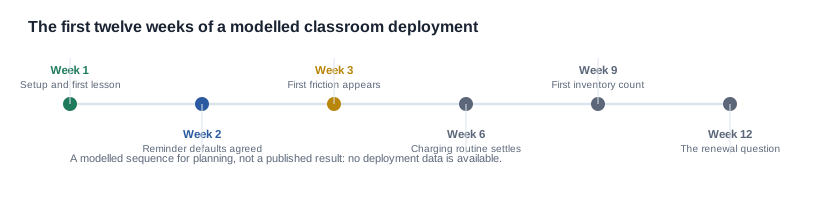
Smart glasses for education behave in a classroom in a pattern, and the pattern is more useful to a buyer than any feature description. The first week works, because a child is motivated by a new device and the adults are attentive to it. The third week is where the first friction appears, and it is almost never a hardware fault: it is a reminder firing at the wrong moment, a setup that was improvised from the box, or an adult who cannot answer a question about what the device is doing. By week twelve the deployment has either become a routine or has quietly stopped, and the difference between those two outcomes is decided almost entirely by decisions that were written down in week zero. This page is written for the buyer who wants to know what the first term will look like, and the sequence below is a modelled scenario rather than a client project — no customer deployment data is available to us, so the pattern is presented as a planning model built on the published rows.
Who this is for. The reader is a procurement officer planning a pilot, a channel buyer pricing a pilot tier, or a brand manager deciding whether to run one at all. Their question is the practical one: if I put a hundred units into a school this term, what will actually happen, and what do I have to prepare for each stage. The failure this page is written to prevent is a pilot that is judged on the first week and abandoned in the fourth, because the evidence that would have justified continuing was never collected. The education channel page covers the commercial context and the kids smart glasses range lists the three models whose published rows sit behind this sequence.
Smart glasses for education: because the first twelve weeks decide the renewal
The pattern a classroom deployment follows is more useful to a buyer than any feature description, and it is short enough to plan against. Five things have to be done in the first week, three things fail in the third week for reasons that are almost never hardware, and three questions in the twelfth week decide whether the programme continues. What follows is that pattern set against the published rows, with the gaps named where the catalogue does not answer.
What the published rows predict about a first term
The catalogue publishes enough about these models to forecast the shape of a term, even though it publishes nothing about how a term actually goes. The A05 and the A06 publish a 40 mAh cell, a charge time of two hours or less, a rated use of about twenty hours, a magnetic charging interface, a lens-based electronic fogging arrangement and posture and viewing-distance detection. The A07 publishes a 70 mAh cell, the same charge time, the same rated use, the same magnetic interface and Bluetooth V5.4. Those rows produce four predictions that a buyer can plan against.
Prediction one: the device will not be the reason a pilot stops. A rated use of about twenty hours is more than a school day, and the charge happens overnight, so the commonest reason a classroom device fails a pilot — running flat before the last lesson — is designed out. The published rows do not settle the charging routine, and the routine is not published, but the routine is a decision rather than a limitation.
Prediction two: the friction will be behavioural. The two models with published detection functions are the two whose behaviour a class reacts to, and the parameters that govern how they behave — the threshold, the delay, the false-positive rate, the alert format — are not published. A class that experiences a reminder as intrusive will react to it within a fortnight, and the first reaction is to turn it off rather than to complain. A class that experiences it as useful will ask for it to be tuned, which is a better outcome and a harder one to arrange.
Prediction three: the sizing question will surface early and be answered by hand. No frame weight, no frame dimension and no size range are published for this tier, so the first cohort will be fitted by whoever is in the room on day one, and the units that do not suit will be re-allocated or will sit unused. This is the most common early signal that a tier was specified on the wrong basis, and it is invisible in a return figure for the first month because the units are still in the building.
**Prediction four: the paperwork will be asked for before the end of the term, not at the start.Our product catalogue contains a company-level export certification page whose content is pictures rather than words, contains no reference to CE, FCC or RoHS, and has no per-model certification row. A school or a district therefore asks for the file at the point of acceptance rather than at the point of order, which is the worst possible time to start collecting it.

Week one: the version that works
The first week is where a pilot is won, and it is won by things that have nothing to do with the device. It is also the week in which the evidence that will be needed later is either collected or lost.
What works on day one and is never a problem again. The novelty of the device holds the attention of the class, which is the reason a pilot gets a fair hearing. The setup is quick, because the published charging interface is magnetic and the cell lasts a school day, so the hardware side of a handover is a dock on a table and a tray for the units. The adult in the room is paying attention, because the novelty is new to them as well, and an attentive adult is the difference between a pilot that is used and a pilot that is tolerated.
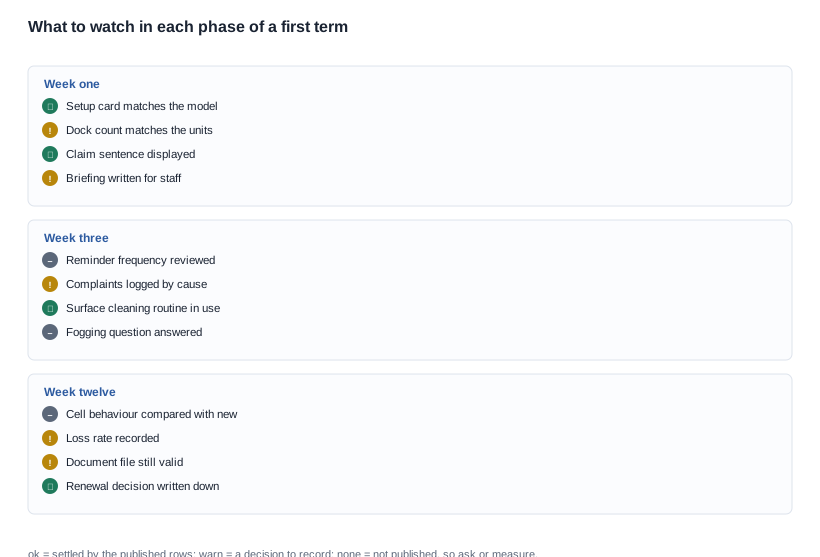
What has to be done in week one or it will not exist in week three. Five things, each of them a decision rather than a purchase, and each of them cheap:
- Display the claim sentence, in the staff room and in the parent information, using exactly the wording the supplier uses.
- Version the setup card against the model, because the two models with published detection functions need a card that explains the reminder and the A07 does not.
- Name the charging owner, with a backup, because a pilot that depends on one person's memory dies when that person is ill.
- Tag every unit at receipt, because a tag applied after the first loss is a tag applied to a reduced fleet.
- Agree the reminder frequency in writing, if the fleet includes a detection model, because the default that ships is not a setting anyone chose.
The mistake that is most often made in week one. The setup is done from the box. The catalogue publishes no setup steps, no pairings, no configuration procedure and no default settings for these models, so the person in the room on day one is improvising, and whatever they improvise becomes the programme's operating procedure by default. This is the single most consequential thing that happens in a first week, and it is also the cheapest to fix: the setup card should exist before the units arrive, and if the supplier has not supplied one, the buyer should write one and have it reviewed.
Week three: where the first friction appears
Week three is the point at which novelty has worn off and the device has become part of the room. Three failures dominate this phase, and all three are policy or paperwork failures rather than hardware faults.
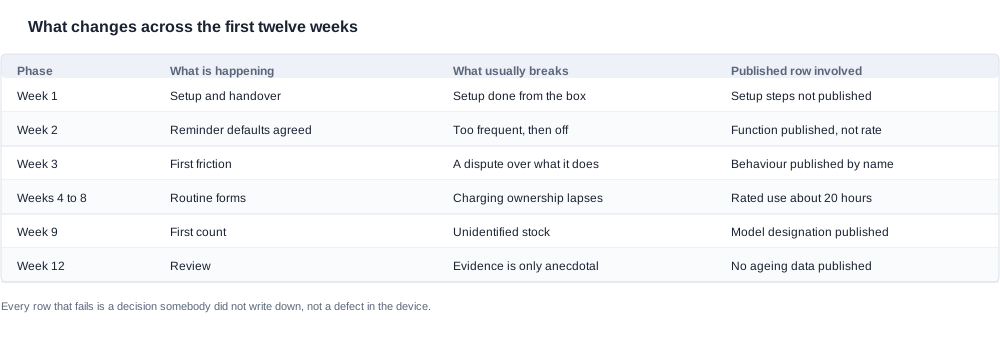
The reminder that was switched off. The most common week-three event in a pilot built on the A05 or the A06 is that the reminder gets turned down, then off, and that nobody writes down that this happened. The cause is usually a false-positive rate that was never measured, combined with a default frequency that was never agreed. The catalogue publishes the existence of the function and none of the parameters that govern it, so this cannot be prevented by specification — it can only be prevented by measurement: a written frequency agreed with the teacher, and a two-week trial at that frequency before the setting is left alone. A reminder that is deliberately tuned is a feature; a reminder that is switched off in week three is a silent cancellation.
The fogging question. The A05 and the A06 publish a lens-based electronic fogging arrangement by name. Nothing is published about how it activates, what it consumes, or whether it can be switched off. In week three someone asks, and there is no answer available other than what the catalogue says. The answer to give is the honest one, and it has to be given the same way in the staff briefing, the parent information and the answer to a direct question. An unanswered question about a published function gets repeated in a louder tone.
The charge that did not happen. A rated use of about twenty hours removes the in-day problem and leaves an end-of-day one. If the charging routine has no named owner, week three is when the first units start the morning flat, and the symptom is a complaint about battery life against a published figure of about twenty hours. The routine is the cheapest thing in the whole programme to fix and the most commonly omitted.
What should be happening at the same time. The complaint log should exist by week three, and it should separate causes rather than record impressions. A unit that did not charge, a unit that was too large for the child, a reminder that fired at the wrong moment and a unit that arrived damaged are four different problems with four different remedies and four different owners, and a log that does not separate them cannot be used to decide anything. The log is also the only evidence a buyer will have at the end of the pilot, because no published ageing data, no published defect rate and no published field data exists for this tier.

Week twelve: the state that decides renewal
By week twelve the pilot has produced one of two states, and the difference is visible in the room rather than in a report. A deployment that has become a routine has units that are charged every night, tags that match the register, a reminder that is set deliberately, and a staff member who can answer a parent's question about what the device does. A deployment that has quietly stopped has units in a drawer, a reminder that nobody turned back on, and a staff member who describes the pilot as something they tried.
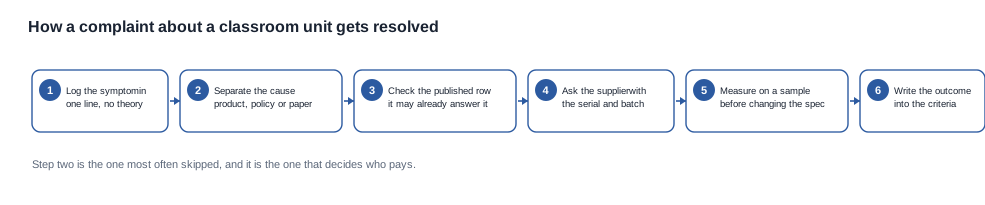
The three questions that decide which state you are in. The first is whether the reminder is still on, and if it is not, whether anyone wrote down when it was turned off and why. The second is whether the loss rate is known — a monthly count produces a rate, an annual count produces a story, and only the rate can be set as a procurement parameter. The third is whether the documentation file is still valid, which means the certificates current, the standards on the edition the file was prepared against, and the claim sentence still the one the listing uses. A pilot that fails any of the three has not failed on the hardware, and the remedy in each case is specific: a default-settings discussion, an identification routine, or a documentation project.
What a renewal decision should look like. Not a feeling and not an anecdote, but a short document with four lines: the measured loss rate, the reminder acceptance result, the cell behaviour compared against a new unit, and the pilot economics behind the rollout price. The cell comparison is the one a buyer has to run rather than read, because no cycle-life rating and no ageing data are published, so the only available measurement is the fleet's own. That comparison, run in week twelve on a handful of units, is what sets the replacement assumption for the following year, and it is the measurement that most distinguishes a buyer who is managing a deployment from one who is hoping.
What a renewal decision should not look like. Three substitutions are common and each of them hides the problem rather than solving it. The first is substituting the class's enthusiasm for a measurement: a pilot that children liked is not a pilot that will survive year two, because enthusiasm does not charge a unit or file a report. The second is substituting the unit price for the total cost: the landed cost of a deployment includes the docks, the tags, the consumables, the spare pool and the support time, and a renewal quote that omits those is not comparable with the first-year quote that included them. The third is substituting the absence of complaints for the presence of acceptance: a programme where nobody complains is often a programme where the devices have been put away and the adults have stopped counting, and the way to tell the two apart is a count and a reminder setting, not a quiet week.
The pilot economics, which are the fourth line of the renewal document. A pilot tier is usually bought at a different price from the rollout tier, and the difference is where most of the commercial room in a year-two negotiation sits. What a buyer should extract from week twelve is the measured quantities that the rollout quote depends on — the unit count in simultaneous use, the spare ratio that policy actually needed, the consumable consumption rate, the loss rate and the support volume per unit per term. A pilot that did not collect those five numbers cannot be converted into a rollout quotation, whatever the pilot price was, and the rollout will be priced on assumptions instead.

The procurement question a school will actually ask
Institutional buyers do not ask the question a retail buyer asks. The retail question is what it costs and whether it looks good; the institutional question is what happens when it goes wrong and who deals with it. That question has four parts, and none of them is answered by the catalogue.
The first part is the acceptance criteria. A school will want to know what a unit has to do to be accepted, and in a tier where the detection functions are published by name and the parameters are not, that question has to be answered before the order or it will be answered by argument. The second part is the defect route. What is a defect, what is a sizing problem, what is a policy issue and who pays for each. The third part is the documentation. Which file covers which model, for which market, and when it will be updated. The fourth part is the data position. Whether the device records, where anything is stored, and how long it is kept — a question the catalogue cannot answer for this tier because it publishes no recording row.
Why the procurement question is the one to prepare for. The classroom question — does the child like it, will they use it — is answered by the class and cannot be optimised by the buyer. The procurement question is the one where preparation changes the outcome, because each of its four parts has an answer that can be written down before the pilot rather than negotiated during it. The purchase order clause language is at contract terms, the sample and pilot route is at samples, and the wider education buying checklist covers the same ground as a list.
The medical question, answered plainly
The question that arrives in week two or three, usually from a parent rather than from a procurement officer, is whether the device does anything for a child's eyesight. It does not, and the answer has to be given plainly rather than deflected, because a deflection is what creates the complaint that follows.
The technical position. The A05 and the A06 publish a lens-based electronic fogging arrangement and posture and viewing-distance detection. That is a fogging arrangement and a reminder function. No published row in the catalogue relates to vision, to eyesight, to refractive change, to myopia or to any eye-protection outcome, and no parameter for the published functions is published at all. A device that detects a position or a distance and issues a reminder is not a clinical device, and describing it as one would put it into a regulatory framework it was not built for.
The regulatory consequence. In the United States, a device whose intended purpose is to diagnose, treat or prevent a disease falls within the medical device framework, and the marker for that boundary is 21 CFR 800.30. In Europe, the equivalent line sits in the medical device rules. A consumer device that crosses that line in its marketing creates a compliance problem that cannot be repaired after the artwork has printed, and the product name itself is where it starts: the English name of the two detection models uses the word protection, and that word must not be carried into listing copy as though it described a clinical effect. The medical boundary page is the reference for this line, and child product compliance covers the framework the products do sit in.
How to answer the question. Say what the device does — it detects a posture or a viewing distance and it reminds — and say what it does not do, which is to change eyesight. That answer is short, true, consistent with every published row, and identical in every market. It is also the answer that keeps the programme out of a regulator's attention and a parent's expectation, and it takes one approved sentence to put in the staff briefing and one to put in the parent information.
Our position. We publish the cell capacities of 40 mAh and 70 mAh, a charge time of two hours or less, a rated use of about twenty hours, the magnetic charging interface, Bluetooth V5.4 on the A07, and the published functions on the A05 and the A06. We do not publish the detection thresholds, the delays, the false-positive rate, the alert format, the fogging behaviour, the frame weight, the frame dimensions, the size range, the ingress marking for this tier or the certification status per model, and we will not estimate any of them. We make no vision, health, eye-protection or hearing claim for any product in any market, and we will not describe a reminder device as though it changed a child's eyesight. If your channel's proposition depends on that outcome, we would rather say so before the first order than after the packaging is printed.
What to send us. Send the model, the number of units, the number of rooms and the length of the pilot, and we will tell you which of the twelve weeks above our published rows already answer, which need a measurement from you, and which need a document from the supplier — and we will say plainly when the answer is that the pilot should be scoped down to one model. The selection logic is at how to choose smart glasses for education, the training and handover material is at training for the education channel, and the model-specific rows are on the A05, A06 and A07 pages.


