

Smart glasses for office deployments are frequently ordered before they are specified, and the questions that arrive in the first week afterwards are the ones a product catalogue is not built to answer. Below is the set of questions a procurement lead actually sends, answered with the reasoning rather than with a reassurance: which tier, what a first order really costs, whether the range works on an open-plan floor, whether recording is permitted, whether a wellbeing claim can be made, what support exists after delivery, and how many units the first order should contain. Three of the seven have no answer we can give, and those are marked as gaps rather than smoothed over with a typical figure.
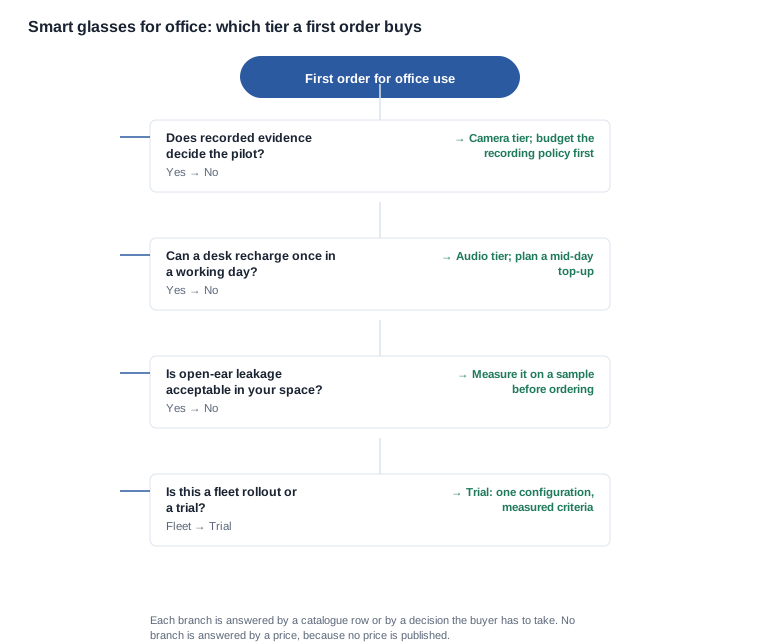
Smart glasses for office: the seven questions a first order turns on
The questions arrive in a fairly stable order, and the order matters more than the answers, because each answer narrows the field for the next one.
- Audio or camera? The single decision that settles the rest. Our audio configurations carry paired cells of 55 mAh to 115 mAh per temple; our camera configurations carry 220 mAh to 290 mAh. That threefold difference decides whether a unit survives a working day without a mid-day charge, and the mid-day charge is what ends adoption inside an organisation.
- What does a first order actually cost? The unit price is one line, and it is the line we can quote once you give us a configuration and a quantity. The other lines are larger and mostly internal.
- Will it work on our floor? This is a demonstration question, not a specification question, and the reason is that acoustic leakage, microphone pickup distance, driver unit size and frequency response are all not published in our documentation.
- Can we record in meetings? That is a question for your legal adviser, not for a datasheet, and we will explain why in detail further down.
- Can the listing make a wellbeing claim? No, and we would decline to support a listing that makes one.
- What support exists after the order? Scoped per programme rather than published as a standing table.
- How many units should the first order contain? A question with a defensible answer, and it is not the smallest number the supplier will accept.
| Question | Who actually owns it | Published row that helps | What is missing |
|---|---|---|---|
| Audio or camera | The buyer | Cell capacity, rated use | Nothing material |
| First-order cost | The buyer, internally | Nothing | Prices, MOQ, lead time |
| Works on our floor | A demonstration | Interface, radio version | Leakage, pickup, driver |
| Recording in meetings | Your legal adviser | Nothing | Policy, indicator |
| Wellbeing claim | Marketing and legal | Nothing | We decline to support one |
| Support after delivery | Both parties | Interface and cell rows | Warranty table, claim route |
| Size of the first order | The buyer | Nothing published | Sample policy, pilot criteria |
Why the sequence is the same on every project
The questions are not independent, and treating them as a checklist rather than a sequence is what makes a project expensive. The tier question decides whether a recording policy is needed at all, which decides whether the legal review happens in week one or in month three. The cost question cannot be answered without the tier, because the charging provision and the setup charges both scale with it. The floor question determines whether the pilot succeeds, and it is the only one of the seven that can only be answered by putting a sample in the actual room.
The three questions with no catalogue answer are questions three, four and five. They are worth naming separately, because a buyer who discovers them at deployment has already spent the money.
Which tier the desk can actually hold, and what decides it
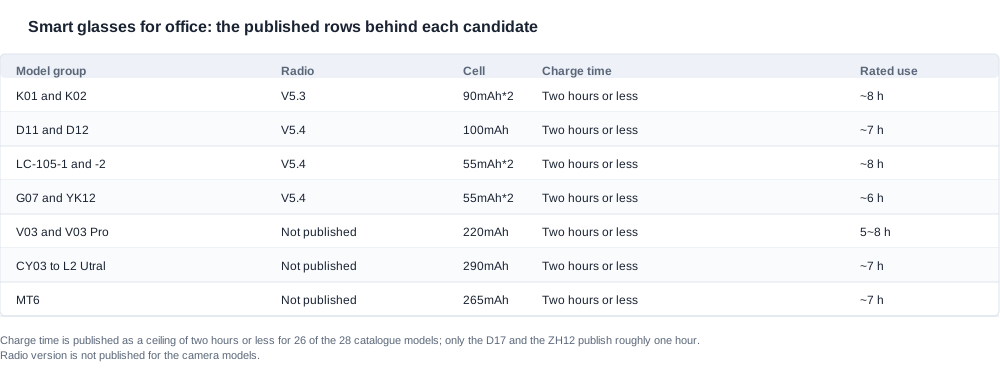
The tier decision is usually presented as a feature comparison and is actually a duty-cycle question. How long is the working day, how many charging points exist, and how many people are in scope? A team of four that charges at one shared point and a floor of forty that does not are two different products.
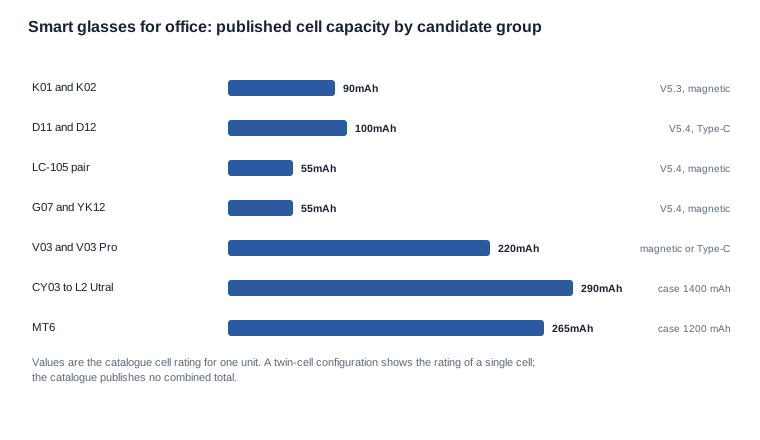
The published rows support a reasonable first cut. The audio configurations in our range publish 55 mAh to 100 mAh per temple on twin-cell and single-cell arrangements, with rated use between about six and eight hours depending on the model. The camera configurations publish 220 mAh to 290 mAh with rated use between five and eight hours. The chart above shows the cell rating per unit, and the twin-cell entries show the rating of a single cell because that is what the catalogue publishes; no combined total is published for any of them.
Two things about that comparison are worth holding on to.
The first is that a rated figure carries no published test condition. It does not state the volume level, the phone state, the light level or the workload. The correct way to use a rated figure is as a ceiling and not as a promise, and the correct way to plan a day is to assume the bottom of the published band.
The second is that a camera that is actively recording is the heaviest load in the range, not a typical one. A camera tier planned on its headline runtime will disappoint at exactly the moment it is being evaluated, which is the worst possible moment to discover it.
When to start from the camera tier. When recorded evidence is a stated requirement of the pilot — a documentation workflow, a field-inspection workflow, a hands-free note-taking workflow that a customer has already agreed to buy. In that case the recording policy is the first work package, not the last one, and a pilot that runs without one is a pilot that produces a compliance incident instead of a result.
When to start from the audio tier. When the task is communication rather than capture, and when the fastest route to a defensible first order matters more than the feature set. It removes the recording-policy approval from the critical path entirely, which is usually the slowest approval in an office rollout.
The interface decision sits underneath both. The charging interface is published per model, and it is the one published row that decides what your organisation buys twice: once for the deployment and once for the spares. Magnetic charging covers most of the range, including the K01, the K02, the LC-105 pair, the V06 and the YKC02, the G07 and the V03, and the YK12, and the S7. Type-C covers the L2 Utral and the D11, the ZH12 and the D12, and the V03 Pro and the D17. A desk that mixes tiers ends up with both interfaces in service, which is a stocking decision rather than a technical one, and it is cheaper to make it deliberately.
The camera tier carries one gap that changes how a pilot is run. Storage capacity, clip-length limits and overwrite behaviour are not published for any camera model in the range, which means the operator cannot predict when a recording will stop and has to be told the clearing procedure during onboarding rather than discovering it mid-task. In a pilot this is worth an explicit line in the onboarding script, because an operator who loses a take during the first week concludes that the product is unreliable, and that conclusion is very hard to reverse inside a large organisation.
The unit price is the line nobody in the chain can forecast
We do not publish a unit price list or a deployment price, and the reason is not opacity. It is that the same model in different configurations is a different product: the case configuration changes the carton, the freight and the customer's expectation, and a private-label programme adds artwork, packaging and certification to the same order.
What a quotation from us contains, per configuration, is the published hardware rows itemised, the setup charges separated from the unit price, and the payment milestones with their trigger events. That is the structure the pricing page describes, and the milestone structure is on payment terms.
The lines that usually turn out larger than the unit price are internal to the buying organisation, and naming them is more useful than trying to quote them:
- The recording policy and its review. Legal and information-security time, not equipment. It is the line most often omitted from an office budget and the one that most often delays a rollout.
- The charging provision. Charging points, cable stock, and the interface decision that determines which cable you stock. The interface is published per model, so this line is calculable before you order, which is unusual in this category.
- The person who owns the count. Someone has to reconcile, reissue and handle returns. In a floor of forty, that is a part-time administrative load, and if nobody is assigned, the deployment quietly stops after the pilot.
- The replacement reserve. A unit held at a desk rather than on a person is more likely to be damaged, lost or misplaced, and a reserve that is agreed at the start is cheaper than a replacement that is bought at the end.
The total cost of an office deployment is therefore a four-line argument: hardware, setup, internal approval, and reserve. Only the first is a number we can quote. What to ask before you commit is on MOQ and lead time, and the factory-side diligence that should precede a first order is at factory audit.
What a quotation should itemise. A quotation that gives one number for a configuration is not comparable against another supplier's quotation, and it hides the line that usually moves. What should appear separately is the unit price for the exact configuration, the tooling and artwork charge as a one-off line, the setup and certification charges with their own lead time, the freight terms and the incoterms used, and the payment milestones with the event that triggers each one. The contract terms page covers the clauses that belong alongside those numbers, and the distinction between a quotation and a valid offer is worth checking before anyone signs.
The comparison that matters is not price per unit. Two quotes for the same category are rarely comparable line for line, because one may include a case, the other may not, one may be a magnetic interface and the other Type-C, and one may carry a private-label artwork charge while the other is a stock configuration. The way to compare them is to build the same configuration sheet for both, list the lines that are included and the lines that are excluded, and then compare what is actually in the carton. A cheaper unit price on a thinner configuration is not a saving; it is a different product at a different cost, and the difference surfaces at the charging point in month two.

The acoustic and privacy questions that are policy, not specification
Leakage and pickup. Acoustic leakage, microphone pickup distance, driver unit size and frequency response are not published in our documentation. What can be said from the design principle is that open-ear designs exist to reduce leakage relative to open-back over-ear, not to eliminate it. The consequence for a buyer is that the answer on a floor is a demonstration in your actual room rather than a specification, and it must be booked in the open-plan area rather than a meeting room, because the two produce different answers. A book-on-board test with two colleagues talking is the cheapest acoustic test that exists, and it is the one most often skipped.
Recording. Whether your staff may be recorded is not a question our documentation answers and not a question the radio framework answers. The regulatory position that does exist runs through the Radio Equipment Directive (Directive 2014/53/EU) for radio equipment and through GPSR (Regulation (EU) 2023/988, applicable since 13 December 2024) for traceability, and neither of those tells you whether a colleague in a meeting room may be captured. That is a matter for your own legal adviser, and any supplier who tells you otherwise is answering a question they do not understand.
Where the answer is yes, the product question becomes where the recording indicator is implemented and what happens when the application is not running. We publish no recording-indicator specification for any model, so that question belongs in the sample session and in your acceptance criteria.
Data handling. Where the captured data goes, who can retrieve it and how long it is retained are not published for any model in our range. In a workplace these are the questions a colleague's privacy depends on, which is why they are answered with a policy rather than with a datasheet. The contrast with other buying categories is worth noting: a desk accessory rarely moves data off the premises, and a camera does.
Wellbeing and medical claims. We publish no clinical, therapeutic or workplace-wellbeing claim, and we will not support a listing that makes one. The prohibition is not a formality. A device that is marketed as having a health effect needs substantiation appropriate to that claim, and a factory catalogue is not a substantiation dossier. A listing that stays on task description, hardware configuration and the published rows is a listing we can support.
What a well-behaved first order looks like on paper
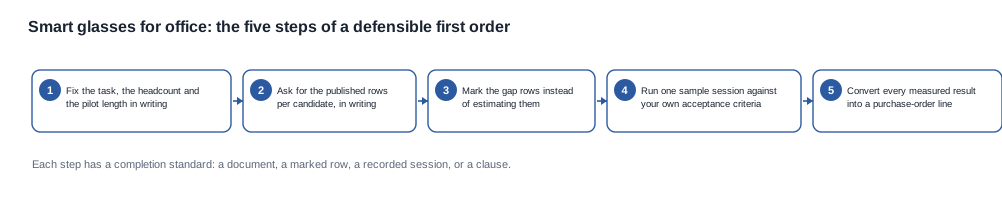
A first order that goes well has five artefacts, and none of them is a device.
- A one-line scope. The task, the tier, the team size and the pilot length, agreed in writing before any quote is requested.
- A specification sheet with the published rows copied per model and the gap rows marked as gaps. The configuration template is the version we use, and it exists because a specification with no gap rows is a guess with a header.
- A sample session with a written protocol and a written criterion per measured characteristic. Without the criterion, the session is a demonstration, and a demonstration is a document the buyer cannot enforce on a delivery.
- An acceptance line per characteristic, written before the first delivery, with the number and its condition attached.
- A support set the desk can quote from: a device card, a quick card and a fault card. Office support resources covers what those documents must contain.
The order matters. The scope comes first because it determines the tier, which determines the charging provision, which determines the internal approval workload. The acceptance line comes before the delivery because an acceptance criterion written after a cohort has been deployed is an opinion with a deadline attached.
A note on the size of the first order. The defensible answer is the largest number you can measure honestly in one cycle. Too small and the sample tells you nothing about consistency; too large and the first bad month is the whole order. A useful question to ask before you order is what result would make you repeat it, because if no result would, then the order is not a pilot and should not be priced like one. The sample-side trade-offs are set out on samples.
The intake that gets an answer fastest
Six items turn a vague enquiry into a specific one, and the order in which you send them decides how long the first reply takes.
- The task, in one sentence. Not the product, the task. A reviewer who needs a second opinion on a procedure, a technician who needs to record a measurement, and a warehouse picker who needs step guidance are three different tier decisions even though all three might be handled by the same model.
- The team size and the deployment length. Headcount sets the quantity and the replacement reserve; length sets whether a mid-day charge is acceptable.
- The charging provision. How many charging points exist, and whether the desk is shared. This decides the interface stocking and whether a case configuration is needed.
- The target market and the destination. Because it determines the compliance route, and because the questions a buyer asks in one market are not the questions asked in another.
- The published rows you already have. If you have copied the catalogue rows for your candidates, we can answer against them directly instead of restating what is already on your screen.
- The decision you need to make and by when. A question with a deadline gets a focused answer; a question with an open horizon gets a catalogue.
With those six, the first reply is usually a shortlist of two or three configurations, the published rows that apply to each of them, the gaps that remain, and the criteria the pilot should produce. Without them the first reply is a catalogue, and a catalogue is a document that answers no decision in particular.
The questions we answer and the ones we will not
Our published position is the set of rows you can order from, and we will not fill the gaps in that set with industry averages.
For this range that means the radio versions, the cell capacities and their cell counts, the case capacities, the charging interfaces, the rated use figures, the charge times and the published structural features where they are published, the camera resolutions, and the catalogue ingress marking on the two models that carry it. We publish the charge time as a ceiling of two hours or less for 26 of the 28 models in the catalogue, and roughly one hour only for the D17 and the ZH12, and we do not describe a ceiling as a shorter figure than it is.
What we do not publish, and will not estimate: acoustic leakage, microphone pickup distance, driver unit size, frequency response, the sensor, the field of view, the video specification, the low-light behaviour, the storage and overwrite behaviour, frame weight for any model other than the single whole-unit figure published for the MT6, the operating temperature range, the cycle life rating, the runtime test condition and the standby draw. A per-model certification row does not appear anywhere in the catalogue, so the certification scope of any given model is a document to request in writing, not a fact to read off a table.
We also do not publish an adoption figure, a productivity figure, a return rate for the category or a satisfaction rate. We do not hold those, and a number we cannot evidence is a number that will be discovered in an employee complaint rather than in a specification review.
On certification, one distinction worth holding. Buyers will ask for CE, FCC and RoHS evidence, and asking is correct: those are the documents a customs broker and a market-entry file will want. What our catalogue does not contain is any reference to them, and there is no per-model certification row anywhere in it. The catalogue carries a company-level export certification page whose content is images rather than text, so it cannot be read as evidence for a given model either. The practical consequence is that the certification scope of a specific model is a document to request in writing and to obtain before the first shipment, not a fact to assume from the fact that a supplier is an exporter. The certification checklist is the working list for that request, and the EU compliance route sets out the framework a buyer in that market is working to. A supplier who treats certification as a formality is a supplier whose paperwork will not survive a retailer audit; a supplier who tells you plainly what they hold and what they do not is a supplier whose paperwork will.
What we will do is take the task, the team size, the charging provision, the target markets and the deployment length, and tell you which published rows apply, which claims the documentation supports, which checks have to be run on a production unit rather than an engineering sample, and which criteria belong in the purchase order. The office application section covers the deployment framework, the gear checklist covers the physical kit, and the case against covers the objections worth taking seriously before you commit.
Related reading
- Pros and cons for IT — the case against
- IT gear checklist — the physical kit
- Configuration template — the specification rows
- Contract terms — the clauses a first order needs
Tell us the task, the team size, the charging provision and the target market, and we will tell you which of the seven questions our documentation answers and which three you have to answer yourselves.


