
Smart glasses for office deployment: what a twenty-unit order turns on
A twenty-unit office deployment is decided by three published numbers and three published absences, and both halves of that ledger have to be settled before a purchase order is signed. The decision a procurement team actually makes is not whether the product is good. It is which configuration to order, and what to write into the agreement so that the shipment matches the promise on the purchase order.
If first-person capture is the requirement, the eleven camera models are the only relevant set, and the boundary inside that set is a resolution class — eight of them publish 8 MP and three publish 13 MP — rather than an imaging specification. If the requirement is audio rather than capture, the eight audio models are the answer and the camera tier is the wrong shortlist entirely. And if capture is the requirement while the unit is issued to people who move between rooms, the charging case becomes the deciding physical object rather than the resolution, because the catalogue publishes no case row at all for the S7, the V03 and the V06, publishes a case without a capacity for the KY06 and the MT5, and publishes a 1400 mAh case for the L1 Pro and the CY03, and the CY05.
There is one condition under which an office order should not be placed from this catalogue at all: when the buyer needs a field of view figure, a video resolution, a frame weight, a per-model certification record or a stated battery cycle life. Those rows are not published for any model in the range, so the order has to be structured as an evaluation purchase with a written measurement plan, rather than as a specification purchase against a datasheet.
What the published rows settle before anyone discusses price
Three things are settled by the published rows before a commercial conversation starts, and a buyer who opens with a unit price instead of fixing them negotiates without an anchor.
The first is the resolution class. The camera tier publishes 8 MP on the KY06 and the MT5, the V06 and the MT6, and the CY03 and the V03 Pro, and the V03 and the CY05, and 13 MP on the L1 Pro and the S7, and the L2 Utral. Those are the only imaging figures published anywhere in the range, and no sensor model, field of view, video resolution, frame rate, stabilisation figure or low-light specification accompanies any of them. A buyer who reads 8 MP and 13 MP as a quality ranking is reading a class label as a performance claim. The way to protect against that is to make the class the thing being bought, and to attach a written measurement plan to it.
The second is the power architecture. Every model in the catalogue publishes a charge time, and twenty-six of them publish a charge time of two hours or less, with the D17 and the ZH12 publishing about one hour. A charge time is a ceiling rather than a duration: the catalogue publishes no starting state of charge and no end criterion, so a published figure cannot be converted into the length of a break, and it says nothing about how long a charging case takes to refill. A buyer who needs a reliable turnaround inside a working day has to ask for the test condition, not to multiply the published figure by anything.
The third is the case architecture, and it is the one most often missed. Across the eleven camera models the catalogue takes four separate positions: a case capacity is published for five of them, a case is indicated but its capacity is not published for two, no case row appears for three, and one model has no charging-case row. "Not published" and "explicitly without" are different facts, and conflating the two produces a purchase order that assumes a spare power source the catalogue never promised.
Why two quotations for the same requirement differ
Two quotations for the same office requirement can differ by a factor of two, and the difference is rarely the assembly labour. At this product level the cost of an order is assembled from the radio and imaging module, the cell and the charging path, the enclosure tooling, the packaging, the certification route, the test and the freight, and only one of those is negotiated per unit. The rest are negotiated once, per programme.
The module tier is the largest variable. A camera configuration carries a camera module and the processing around it; an audio configuration carries the audio path and the radio stack. The published rows let a buyer see that difference expressed as an outcome — an eight-model audio tier with cell configurations of 55 mAh × 2, 90 mAh × 2 or a single 100 mAh cell, and rated runtimes from about six to about eight hours — without exposing the price of any of it.
Tooling is the second variable, and it is the one that is genuinely amortisable. Private-label enclosure and packaging tooling is a one-time cost that a second run spreads across a larger quantity, whereas a certification cost and its lead time are neither amortisable nor negotiable, because they attach to the product and to the destination market rather than to the volume. The three camera models in the 13 MP group and the eight in the 8 MP group are not priced from the same stack, and the difference between them is decided before the quotation is written.
The third variable is where the buyer's room actually is, and it is not in the unit price. It is in the case decision, the packaging decision, the split of a first run across two deliveries, the defect remedy, the spare ratio and the payment milestones. A buyer who treats those as secondary discovers them after the deposit has gone out.
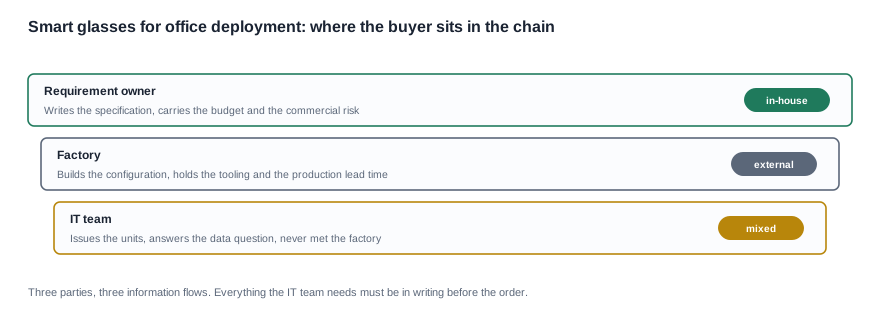
The chain in the diagram above is the reason the office deployment is the hard version of this purchase. The requirement owner writes the specification and carries the commercial risk, the factory builds the configuration and holds the tooling and the lead time, and the IT team that issues the units and answers the internal data question has usually never spoken to either of the other two. In a consumer channel all three are the same company and the information moves with the product. In an office deployment it does not, so everything the IT team needs has to be put in writing before the order rather than discovered after it.
The camera tier publishes a resolution class, not an imaging specification
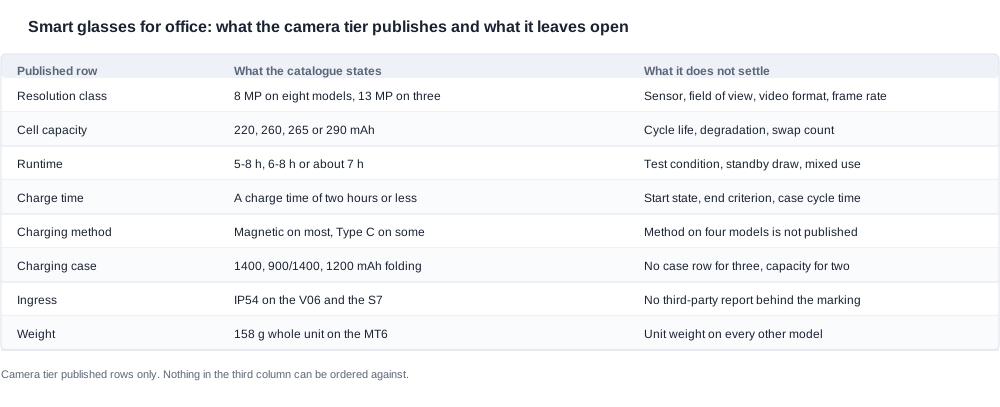
The table below is the whole of what the catalogue states about the camera models, arranged so that the published rows and the absent rows are visible at the same time. A buyer who reads only the left column will believe the product is better specified than it is; a buyer who reads only the right column will believe the product is unusable. The commercial decision is made in the middle column.
The 8 MP and 13 MP groups, and where the boundary actually falls
The boundary falls in a place that is easy to misread. The 8 MP group contains the MT6 and the V03 Pro, the CY03 and the MT5, and the CY05 and the V06, and the V03 and the KY06. The 13 MP group contains the S7 and the L2 Utral, and the L1 Pro. Two of the three 13 MP models — the L1 Pro and the L2 Utral — are cased camera models with a 290 mAh cell and a rated runtime of about seven hours, which is the same cell and the same runtime as the CY03 and the CY05 in the 8 MP group. The third, the S7, is a 260 mAh sport camera model publishing 5~8 h of runtime and carrying the IP54 marking.
That means the resolution step is not a step in the product hierarchy. It is a different module in a different product line, and a buyer who assumes the 13 MP models are simply better-specified versions of the 8 MP models is assuming a product line that the catalogue does not describe. The correct question is not "which class is better" but "which class matches the record the office has to keep, and which physical configuration the people issuing the units can manage".
On the first question, the honest answer is that the catalogue does not help. Resolution class matters when the image is reviewed later, enlarged, or used to identify a detail that a live reviewer would have caught. A meeting-note record that is read on the day it was captured does not need a 13 MP class, and a training capture that is reviewed months later for a specific step does. Since the sensor, the field of view and the video pipeline are not published, the 13 MP premium cannot be justified from documentation — it has to be justified by the retention and review workflow the office actually runs.
Reading the case, charging and runtime rows without over-reading them
The power rows are where over-reading does the most damage, because each published row is precise and the temptation is to compose them into a story the catalogue does not tell.
Take charging method. Magnetic charging is published on the S7 and the V06, the V03 and the MT5, and the KY06 and most of the audio tier, and Type-C charging is published on the V03 Pro and the L2 Utral among the camera models, and on the D11 and the D12 in the audio tier and the D17 and the ZH12 in the sport tier. But the charging method is not published for the CY05 and the CY03, and the L1 Pro or the MT6 — those four carry only the resolution class, the cell capacity, the charge time, the runtime and a case capacity. Their cases are published at 1400 mAh for the L1 Pro and the CY05, and the CY03, and at 1200 mAh for the MT6's foldable case. Describing those four as magnetically charged because most of the tier is magnetic would be a fabrication, and it matters commercially: a magnetic dock has to be installed, powered and maintained at every charging point, while a cable is a consumable.
Take runtime. All eleven camera models publish a runtime — 5~8 h for the V03 and the S7, and the V03 Pro and the V06, 6~8 h for the KY06 and the MT5, and about seven hours for the L1 Pro and the L2 Utral, the CY03, the MT6 and the CY05 — and none of the eleven publishes the test condition behind it. A runtime without a condition is a claim, not a measurement, and a buyer who puts it into a shift plan is modelling a number that was produced under a condition nobody has described.
Take weight. The catalogue publishes one weight in the whole range: 158 g for the MT6, which is the glasses body including its 265 mAh cell and its camera, and excluding the foldable charging case; the case weight is not published. No frame weight is published for any other model. A buyer sizing an all-day office issue therefore has exactly one data point for the entire range, and it happens to be the heaviest of the models that publish a case.
Choosing between the 8 MP and 13 MP groups when capture is the requirement
The three questions below are the ones that actually move the shortlist in an office capture programme. Each one is answerable by the buyer without any information from the supplier, which is precisely why they belong at the front of the evaluation rather than at the end of it.
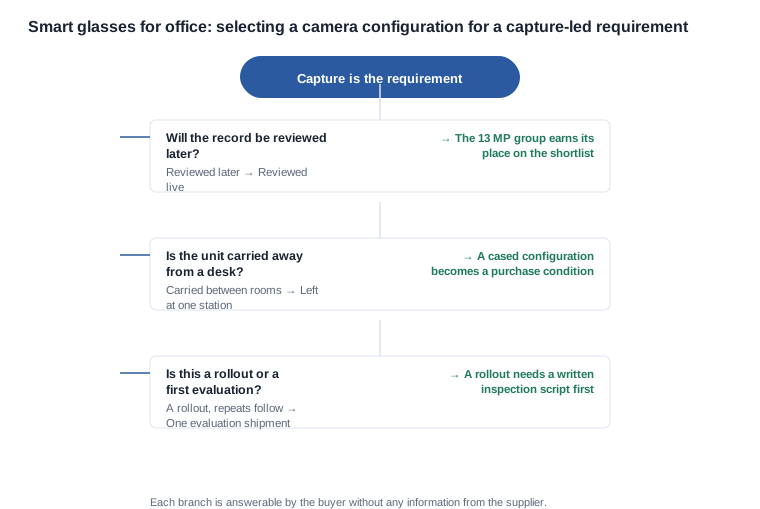
The first branch is the review-distance test, and it is the only branch where the 13 MP class earns its place. If the record is read back after the fact, the class is a defensible purchase. If the operator reviews the image live and acts on it immediately, the class is close to irrelevant, because the limiting factor is the operator's attention and the lighting in the room, neither of which is a resolution question.
The second branch is the case test, and it is the one most often skipped. A unit that is carried between rooms is a unit that has to survive a day away from a desk, and the only published way to do that in the camera tier is the case. Which means the shortlist is limited to the models for which a case is documented: the L1 Pro and the MT6, the CY03 and the L2 Utral, and the CY05 with published capacities, or the KY06 and the MT5 with a case indicated and its capacity unpublished. The V03 and the S7, and the V06 cannot be assumed to have one, and the V03 Pro has no charging-case row.
The third branch separates an evaluation from a rollout, and it changes what the first shipment has to prove. An evaluation shipment is a purchase with a hypothesis attached, and the hypothesis can survive a surprise. A rollout is an operational commitment, and the first shipment against a rollout has to be inspected against something written down, because the second order will be judged on the evidence the first one produced.
The twenty-unit scenario in this article resolves in the second branch, and that is why it is worth working through. The stated requirement is first-person capture for meeting notes, documentation walkthroughs and training material, issued to twenty people who work in an office and on site. The review-distance test lands in the middle — meeting notes are read back the same day, training material is reviewed later — so the class question is left open by the requirement itself rather than settled by it. The case test lands firmly on the cased side, because half the users are away from a desk during the day. The rollout test lands on the third branch, because twenty units is an operational commitment rather than an evaluation.
The result is a shortlist of the cased camera models, with the resolution class left as the variable to settle against the retention and review workflow. That is the honest answer the published rows support, and it is a considerably more useful position than a single model recommendation built on a resolution ranking the catalogue does not publish.

What has to be in hand before a twenty-unit purchase order is signed
Six steps, in order, each with a completion standard that can be stated in one line. The sequence matters more than the list, because a buyer who asks for the rows and the certification position in the same message usually gets the rows and a generic answer to the certification question.

Step one is the written requirement. The user count, the environments, the purpose of the record, the retention period and the target market go into the message in full, because each of them changes which answer comes back. The completion standard is a supplier reply that names a configuration rather than a product family.
Step two is the published rows for the shortlisted models. Resolution class, cell capacity, charge time, runtime, charging method and case capacity, per model, exactly as the catalogue states them. The completion standard is a document in which every figure can be traced to a catalogue row, including the four camera models whose charging method is not published and the three for which no case row appears.
Step three is the certification position for the exact configuration. Here the published position has to be stated plainly rather than assumed. The catalogue lists a company-level export certification page whose content is images rather than text, and the written catalogue carries no CE, FCC or RoHS reference. There is no per-model certification row anywhere, so the certification scope for any given configuration has to come as written material from the supplier. The Radio Equipment Directive is the framework most buyers will be working in, and it is the Radio Equipment Directive (EU) 2014/53/EU — the EMC directive (EU) 2014/32/EU is a different instrument and is not the one that covers the radio path. The completion standard is a document naming the certification held for the exact configuration, not for the company.
Step four is the conditions behind the power figures. The charge time with its start state and end criterion, the runtime with its test condition, and the case cycle behaviour for any cased model. The completion standard is that every power figure in the order is either published with a condition or explicitly marked as an unconditioned published claim.
Step five is the incoming inspection script. The acceptance criteria that the first shipment will be judged against, written before the shipment rather than after it. The completion standard is a signed document listing what will be checked, against which published row, and what happens when a unit fails.
Step six is the agreement. The defect remedy, the spare ratio, the support path, the delivery split and the payment milestones. The clause language is at contract terms, the commercial structure of a first order is at pricing, and the per-model certification records are requested against the certification checklist.
The incoming inspection script and the criteria it runs against
An inspection script is a short list of checks with a stated pass condition each, and it is written against published rows rather than against a reference unit. That distinction is the entire point: with only one published weight in the range and no published field of view, an inspection against a reference unit measures the reference unit, not the specification.
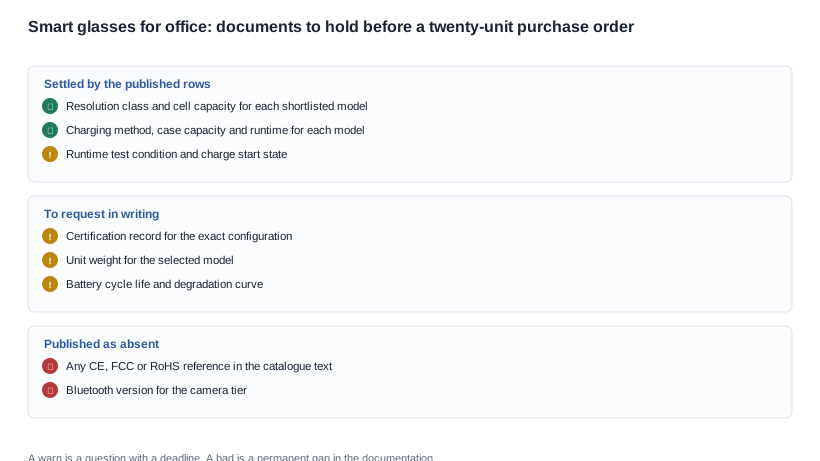
The checks that can be run from the published rows are straightforward. The model designation on each unit has to match the model on the purchase order, because a mixed shipment is how a configuration error becomes a fleet-wide problem. The case, where the configuration has one, has to be present, and its capacity marking has to match the published figure — 1400 mAh, 900/1400 mAh, or 1200 mAh for the MT6's foldable case. The charging interface has to match what the order assumed, which is the check that catches the four camera models whose charging method is not published. The runtime has to be observed against the published figure under a condition the buyer sets and records, which is the only way to turn an unconditioned published claim into a number the buyer can rely on.
The checks that cannot be run from the published rows are the ones that need a measurement plan written in advance — the frame weight, the field of view, the video output, the certification record — and the buyer should decide before the first shipment which of them are worth the effort. All six of them cannot be measured in a receiving bay in an afternoon. Choosing two, and stating why, is a better use of the receiving bay than attempting six and accepting all of them as approximate.
Where a twenty-unit office deployment actually fails
The realistic failure in an office deployment is not a hardware fault. It is an adoption failure that arrives looking like a hardware fault, and it is preventable at a cost of almost nothing.
The first failure is the drawer. A cased model such as the CY03, the CY05 or the L1 Pro, all publishing a 1400 mAh case, disappears into a desk drawer between uses, while an uncased Type-C model such as the D11 or the D12 has to be returned to a charger and is therefore more visible and therefore used more. In an office the risk is not that the battery runs out; it is that the unit is simply never issued. The symptom that appears in the second month is a deployment judged unsuccessful, with no return data to explain why, because nobody was tracking which units were used.
The second failure is the configuration mismatch. A buyer orders the 13 MP class because the record is reviewed later, and then distributes the units to people whose work does not produce a later review, and the class turns out to have been purchased for a workflow that exists for two people out of twenty. The prevention is to name the review workflow per role before the order, not per department.
The third failure is the charge time treated as a duration. The published figure is a ceiling — a charge time of two hours or less — and it is used in a rota as though it were a measured average. A rota built on a ceiling is optimistic by construction, and the resulting complaint arrives as a battery complaint rather than as a planning error.
The fourth failure is the certification gap discovered at the border. The catalogue publishes no per-model certification row, so a buyer who did not request certification material with the order discovers the position when the shipment is in transit. That is the worst possible moment for the discovery, because the remedy is a delay rather than a decision, and it lands on the buyer's schedule rather than on the supplier's.
The fifth failure is the missing unit count. A device that does not come back is a device that is bought again, which reads as a repeat sale in the accounts and is a loss in reality. Without a count, the loss rate is invisible and the first sign of it is a budget that does not reconcile at the year end.
The sixth failure is a claim set written by someone who has not worked in the office. The IP54 marking is published as a catalogue attribute on the V06 and the S7 — two sport camera models, neither of which is in this shortlist — and no third-party test report is published behind it. Writing an ingress claim into an office deployment document that is built on the V06 or the S7 would be a claim the documentation cannot carry.
The commercial terms a twenty-unit office order turns on
The unit price of a twenty-unit order is the smallest part of what gets negotiated, and the reason a buyer who only negotiates the unit price ends up with a worse programme is that the other terms are decided by default. Three of them can be moved substantially, and one of them genuinely cannot.
The movable one is the case. Whether a case is issued per unit or held as a pool at the receiving desk is a procurement decision rather than a packaging one, and it changes the bill of materials, the freight weight, the asset count and the second lithium cell that has to be declared in the transport file. On a twenty-unit order the case decision is worth more than any single discount the buyer is likely to be offered on the hardware, and it is the one that most often gets decided by whoever packs the box.
The second movable one is the delivery split. Twenty units is small enough to be one shipment and large enough to be two, and splitting a first run against staged payment suits a rollout that starts with one team and expands when the acceptance criteria have actually been met. The cost of the split is a second freight movement and a second inspection, and the benefit is that the acceptance evidence arrives before the larger commitment.
The third movable one is the defect remedy and the spare ratio, together with the support path. A twenty-unit deployment is small enough that a named contact and a stated replacement procedure are cheap for the supplier to offer and decisive for the buyer's internal sign-off. They are also the terms most often left unwritten, because neither side mentions them until the first unit fails.
What genuinely cannot be moved is the certification cost and its lead time, and the tooling nature. Certification attaches to the product and the destination market rather than to the volume, so it is neither amortisable nor a discount item. Tooling is a one-time cost that can be spread across a larger second run, but it cannot be removed, and a quotation that folds tooling into the unit price is a quotation that hides the one number the buyer needs for a second-order forecast.
A twenty-unit walkthrough from enquiry to first shipment
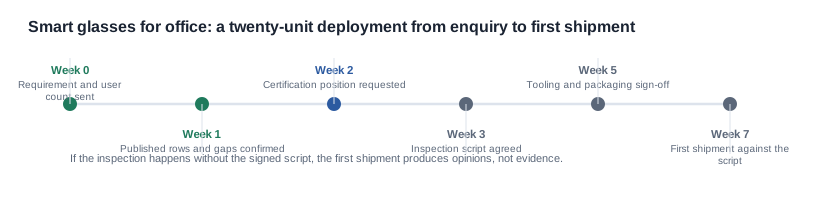
Working the sequence against the timeline above, the first week is spent fixing the requirement in writing and getting the published rows confirmed against it. The second week is the certification request, and it is the week most likely to stall, because the answer is a per-configuration document rather than a catalogue line. The third week closes the inspection script and the acceptance criteria, and this is the point at which the order stops being a purchase and becomes a commitment.
The fourth and fifth weeks are packaging and tooling sign-off, and the fourth week is where the case decision has to be made, because a case changes the box, the freight weight and the transport file simultaneously. The seventh week is the first shipment, and the only thing that matters about it is that it is inspected against the script that was signed in week three. If the inspection happens without the script, the first shipment produces opinions rather than evidence, and the second order will be argued on opinion.
The outcome of the walkthrough is not a product recommendation. It is a shortlist, a set of documents that have to arrive, an inspection script, and a set of commercial terms that were decided before the deposit rather than after it.
What we publish about the office tier, and what we will not estimate
We publish the rows a buyer can order from. For the camera tier that means the resolution class, the cell capacity, the charge time, the rated runtime, the charging interface where it is published, the structural features that are published — the removable inner frame on the V06 and the S7, the foldable case on the MT6 — the colour counts, and the case capacity where a case capacity is published. For the audio tier it means the Bluetooth version, the cell configuration, the charge time, the rated runtime, the charging mode, the absence of any published touch row, the surround sound published on the YK12, and the ultra-slim detachable temples published on the G07.
What we do not publish and will not estimate: the frame material, the lens material, the coating, the hinge specification, the unit weight beyond the single 158 g whole-unit figure for the MT6, the field of view, the video specification, the storage and overwrite behaviour, the operating temperature range, the cycle life rating, the runtime test condition and the standby draw. We will not state that any product in our range is certified to CE, FCC or RoHS, because the catalogue text contains no reference to those standards and no per-model certification row; where certification matters, it is a document to request for the exact configuration, and the certification checklist is where that request belongs. We will not extend the IP54 marking beyond the two models that carry it, and we will not describe it as waterproof.
Retention period and record purpose
Send the user count, the environments, the purpose of the record, the retention period, the target market and the review workflow, and we will return the shortlist with the published rows for each shortlisted model, the documents that have to be settled before the order, and the acceptance criteria the first shipment should be inspected against. The model comparison logic sits at how to compare models for office use and the selection entry point is how to choose smart glasses for office; the published power rows are at battery life, the camera configurations are listed under AI camera glasses, and the AI feature question an IT team will actually ask is covered in AI features and whether you need them. The hardware that has to accompany the order is set out in the office gear checklist, and the scenario entry point is smart glasses for office.
Related reading
- The scenario's opening — smart glasses for office
- The families on offer — AI camera glasses
- How the shortlist is made — how to choose smart glasses for office and how to compare models
- The published entries — battery life
Send us the user count, the environments and the review workflow, and we will return the shortlist with the published rows and the documents to settle before the order.


