Smart glasses for security: the four failures to rule out before a fleet ships
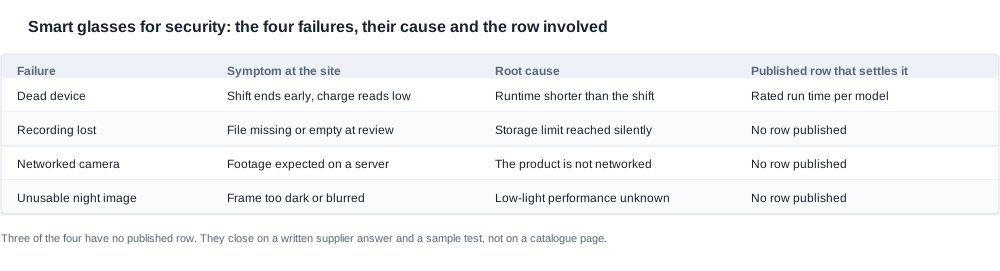
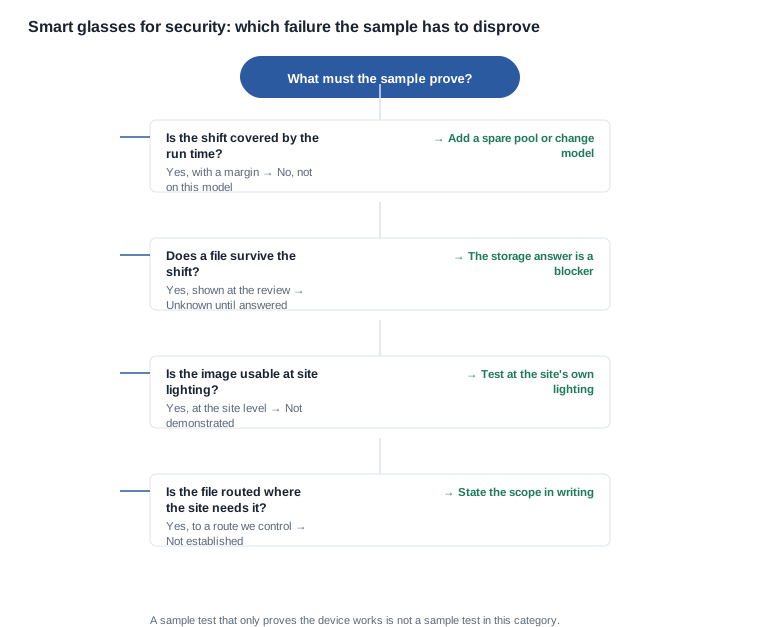
Security teams find out what a wearable device cannot do at the worst possible moment: at three in the morning, on an incident that mattered, when the record does not exist. That is the argument for treating troubleshooting as a pre-deployment activity rather than an operational one. The four failures described below are the ones that recur in this category, and three of them cannot be repaired in the field — not by the operator, not by the site's technician, and not by the supplier's after-sales team, because by the time they appear the evidence is gone and the decision has already been made in a review meeting. Each of them can be eliminated before the fleet ships, using either a published row or a written supplier answer, and the cost of eliminating them is a sample test and a question list. The cost of not eliminating them is a deployment that cannot be defended.

The conclusion, stated first. The useful question in this category is not "how do we fix it when it breaks". It is "which of these four failures have we ruled out, and with what document". Three of the four have no published row in the catalogue at all, so a buyer who expects to resolve them from a product page is going to be disappointed at the worst time. The fourth, the runtime, has a published row — but no published test condition behind it, which means the row can be read and still be wrong for a particular shift. The output of a pre-deployment troubleshooting exercise is therefore a short list of documents, one per failure, each with an owner and a date.
Who this is written for. The buyer or operations lead who is about to approve a shipment, and who has to decide whether the site is ready to receive it. That reader's question is narrow and practical: on the evidence available today, what could still go wrong on shift one, and can we find that out before we ship rather than after.
How the elimination is actually run, and why it is cheap. The method has four steps and it takes less time than most buyers expect. Name the failure and write its symptom as the site would describe it. Not "storage overwrite" but "the file was empty at the review meeting", because the site will report the symptom and not the mechanism, and a symptom written in the site's language is one that can be tested for. Identify what would have to be true for the failure not to occur, and then check whether that thing is known. If it is published, check it against the site. If it is not published, it becomes a written question with a number. Assign the check to a person, because a check with no owner is a check that quietly does not happen, and the operations team, the buyer and the supplier each hold a different part of it. Record the result against a document. The output is a file with four lines, and the value of the exercise is not the exercise but the file: it is the answer to a question raised six months later, and it is the evidence that the deployment was assessed rather than assumed.
The reason this is cheap is that three of the four failures close on a single written answer from the supplier. One question per failure, sent in one message, answered once, filed once. What makes it expensive is the alternative: shipping the fleet, discovering the failure on shift, and paying for it in an unusable record, a supplier dispute, a second order and a site that no longer wants the product.
Failure one, the shift that ends with a dead device
The symptom is familiar and it is not a hardware fault. A device issued at the start of a shift is charged at the start of the next one, on the assumption that the shift fits inside the published run time. When the shift is longer than the run time, the device dies an hour before the handover, and the operator has no way to recharge it in a corridor. The report reaches the base as "the battery does not last", which is read as a defect, which becomes a supplier claim, which is answered with the published run-time row. The row is not wrong. It was simply applied to a shift it does not cover.
What the published position actually is
The camera group publishes run times on every model — five to eight hours on the V03 and the V03 Pro, and the V06 and the S7, six to eight hours on the KY06 and the MT5, and about seven hours on the L2 Utral and the CY03, and the MT6 and the CY05, and the L1 Pro. The audio group publishes about six to about eight hours across its eight models, with the G07 and the YK12 at the shorter figure in their tier. The sport group publishes about seven to about eight hours across the YKC02, the D17 and the ZH12. What is published nowhere is the test condition behind any of those figures — what the device was doing, at what temperature, with what recording load — and no standby figure is published for any model, which is its own question when a device sits between patrols.
The three pre-deployment actions
- Compare the shift length to the published figure for the exact model, not to a group average, and write the difference down. If the shift exceeds the figure, the answer is a spare pool sized to the gap, a second model for that post, or a shorter shift there. It is not a bigger battery, because the battery is fixed by the model.
- Ask the supplier for the test condition behind the published figure, in writing, and ask whether a figure exists for a low-temperature or high-activity condition. This is a standard question and the answer is usually supplied.
- Run one device for a full shift at the site, on the actual duty, and record the runtime observed. That single measurement is more useful than any figure, because it is the only one that describes the site.
What the gap between the shift and the runtime actually costs. This is a costing decision rather than a technical one, and it is worth doing before the order because the answer changes the order. Three options exist and they are not equivalent. A spare pool sized to the gap is the simplest: if the shift is two hours longer than the published run time, the site keeps a pool of devices that can cover the overlap, charged and ready. It costs working capital and it costs a charging point, and it is the option that does not change the hardware. A second model for that post costs more in unit price and in management complexity, and it is the right answer when the gap is large enough that a pool would be most of the fleet. A shorter shift or a different duty pattern costs nothing in hardware and everything in operational terms, and it is the option most often overlooked because it is not a purchasing decision. How to choose between them is a question of total cost: the pool against the extra units against the staff cost of the change, over the annual volume the site actually runs. The commercial structure of a first order is at pricing, and the terms under which a spare pool sits in the agreement are at contract terms.
Failure two, the recording that was never kept
This is the most expensive failure in the category and the one a buyer is least equipped to anticipate. The symptom is that a file is missing from the review, or that it is present and empty, or that the oldest recordings are gone and the newest are intact. The root cause is almost always the same: a storage limit that was reached without a warning, combined with an overwrite behaviour the site did not know about. And the catalogue publishes nothing about it — not the storage capacity, not the overwrite behaviour, not whether a notification arrives before the limit, and not the transfer route.
Why this one cannot be repaired in the field
By the time the gap is discovered, the missing footage is missing permanently, and the question becomes whether the loss was the device's fault, the operator's, the software's or the site's — a question that cannot be answered after the fact because the device does not record its own state in a form anyone can read. That is why this failure has to be closed before the shipment rather than debugged afterwards, and why the closing document is a written supplier answer rather than a test. A sample test can demonstrate that a file exists; only a written statement of the behaviour can bound what happens when the limit is reached.
The three pre-deployment actions for a recording that was never kept
- Ask for the storage capacity, the overwrite behaviour and the notification before the limit, per model, in writing, and require the answer to state what happens when the limit is reached rather than only what the capacity is.
- Ask where a file goes after capture — whether it is held on the device, transferred automatically, or requires a manual action — and whether the transfer can fail silently. This determines whether the site's weekly review is even possible.
- Put the storage behaviour into the incoming inspection criteria. A device whose storage behaviour does not match the written answer is a failed unit, and the acceptance criteria are the only place where that can be enforced.
The consequence beyond the device, which is the reason this failure is worth the most attention. The storage answer is not only a technical input; it is the constraint on a policy the site has not written yet. A retention period of a week, a review cycle of one week, a shift of twelve hours, and a storage limit that is not published — those four numbers have to be compatible, and the buyer cannot demonstrate that compatibility until the storage answer arrives. This is why the storage question has to be answered before the policy is drafted, and why the policy has to be signed before the first shipment rather than after the first incident. A buyer who sequences it the other way — device, then shipment, then policy — acquires an obligation that the documentation cannot show is being met. The compliance sequence for the same decision is at the certification checklist and the policy-side questions are at security legal considerations.

Failure three, the expectation of a networked body camera
The third failure is an expectation failure rather than a device failure, and it is the most expensive one in administrative terms because it involves the supplier's own marketing, not the buyer's project. A security buyer reads a product page, sees a camera, and assumes the footage lands on a server, in a management system, in real time. The published catalogue position is that there is no networking row for the camera models at all — no connectivity specification, no stream, no upload route is published — and the Bluetooth version for the camera group is likewise not published.
What the published position supports
The camera group publishes the resolution class, the charge time, the cell capacity, the run time, the charging interface and, on five models, a charging-case capacity. It publishes structural features — a removable inner frame on the V06 and the S7, the foldable case on the MT6, the charging case on the KY06 and the MT5. It publishes no connectivity row, and for the camera models it publishes no Bluetooth version either. The honest statement for a deployment sheet is therefore that the recording is held on the device and retrieved by whatever route the supplier describes in writing, and that no real-time feed to a management system is claimed.
The three pre-deployment actions for a networked-camera expectation
- Ask the supplier to state, in writing, what the device does with a captured file and where it goes. Not whether it is possible — what it does. This is a short answer, and it is the one that prevents a procurement team from selling a capability the product does not have.
- Ask what the retrieval route requires at the device — a connection, a cable, a companion application, an action by the operator — because that route has a cost at the base and a training requirement, and it affects the operating procedure.
- Correct the deployment material before it ships. A tender document that says "live feed to the control room" is a commitment nobody can meet, and it is far cheaper to fix the document than the expectation.

Failure four, the night image that cannot be used
The fourth failure is the one that reaches the review meeting with a file that exists and cannot be used. The frame is too dark, or blurred by movement, or washed out by the site's own lighting. The root cause is that the catalogue publishes no low-light figure, no stabilisation figure, no field of view, no video output format and no capture latency for any model in the range, and the two models in the sport group that publish a remote photo control do so without a published sensor figure.
Why a sample at the site is the only test that counts
An evaluation performed in a supplier's demonstration environment will produce a usable image, because the demonstration environment is lit. The site's own lighting is the condition that matters, and the only way to find out whether an image is usable there is to take one there. This makes the site lighting test the most valuable single hour a buyer can spend in this category, and it is worth doing with the sample unit rather than with a catalogue assumption.
The three pre-deployment actions for a night image
- Test the sample at the site's own lighting level, at the post where the images will actually be taken, in the hours they will actually be taken. Record the result as a pass or a fail, and write the condition into the acceptance criteria so the result is comparable with the next order.
- Ask for the field of view, the output format, the frame rate and the capture latency in writing. These four determine whether an image can be reviewed at all, and none of them is published.
- Ask what the image pipeline does in low light, and whether there is a documented behaviour for backlight, for headlights, or for a doorway. A site knows which of those it has.
Writing the acceptance criteria so they can actually fail. The result of the site lighting test is worth nothing unless it is written as a criterion that a unit can fail. The difference between a usable criterion and an unusable one is specific. A criterion written as "the sample produces a usable image" is unusable, because nobody can decide what usable means and nobody can enforce it. A criterion written as "a still capture taken at the site's own lighting at the north gate is reproduced by a reviewer who has not seen the site, with the time of day and the light source recorded" is enforceable, because a second reviewer can repeat it and reach the same conclusion. The same shape applies to the other three failures: the runtime criterion is a duration measured over a full duty, the storage criterion is a file that still exists and still plays back at the end of the shift, and the routing criterion is a named route that the site's own people can follow without a supplier on the telephone. Criteria written this way are what a buyer uses to reject a unit that does not conform, and they are the mechanism that makes the pre-deployment work enforceable rather than advisory.
The boundary we place on what a deployment can claim
We will not publish a figure that the catalogue does not contain, and that includes the figures a troubleshooting document would find most useful. We do not publish the storage capacity, the overwrite behaviour, the notification behaviour, the transfer route, the capture latency, the field of view, the video output format, the frame rate, the stabilisation, the low-light performance, the standby draw, the runtime test condition, the operating temperature range or the thermal behaviour for any model.
What we do publish is the resolution class on every camera model, the cell capacities and cell counts, the charge time as a ceiling of two hours or less with about one hour published for the D17 and the ZH12, the rated run times, the charging interface per model including the four camera models whose interface row is absent, the charging-case capacity and case status per model, the IP54 marking on the V06 and the S7 stated as a catalogue attribute, the Bluetooth version on the audio models, the group composition of eleven camera models, eight audio models and three sport models, and the published structural features. We will not write that a device is tested to IP54, because no test report is published behind that marking, and we make no medical, hearing-aid or corrective-lens claim for any product.
The published power rows are at battery life, the ingress reading is at IP ratings, and the product families are at AI camera glasses and Bluetooth audio glasses.
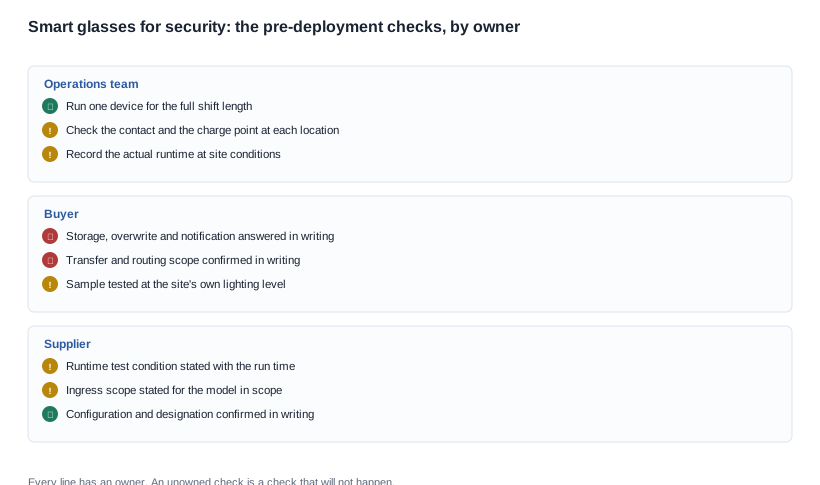
The closing document, and why it is worth more than a troubleshooting manual. A troubleshooting manual describes what to do after a failure. What a security deployment needs is a one-page record that names the four failures, states for each one what document or test rules it out, and carries the date and the owner of that document. That page is what a later question — "how did you know this would work at night" — is answered with, and it is the same page that tells a supplier, months later, exactly which configuration and which question numbers it applies to. It is a small document and it is the difference between a deployment and a hope. The scenario entry point is smart glasses for security, and the related procurement articles are at security pros and cons and the deployment template.
Related reading
- The four checks this article closes — security deployment template
- The policy constraint behind the storage answer — security legal considerations
- The base plan the runtime gap creates — how to charge smart glasses for security
- The commercial treatment of a returned unit — warranty and returns planning
Send the shift length, the lighting condition and the recording purpose, and we will return the published rows, the questions that close the four failures, and the acceptance criteria they become.