

Frame material buying mistakes in this category share a pattern: they are all mistakes about the difference between a number and a description. A buyer treats a marketing term as a specification, or treats an unpublished row as an absence of risk, and both errors cost money in the same way — a product that looks correct on paper and performs badly on a head.
Our published position is the reason these errors are so easy to make. The frame material is not published as a range-level fact. A whole-unit weight is published for one model in the entire catalogue, 158 g for the MT6 glasses unit, and not published for everything else. The frame dimensions, the temple length and the temple curve are not published for any model. The published colour options are three for the V03 Pro and four for the V06.
So smart glasses frame materials smart glasses buying mistakes to avoid is a list of the specific substitutions that cause them.
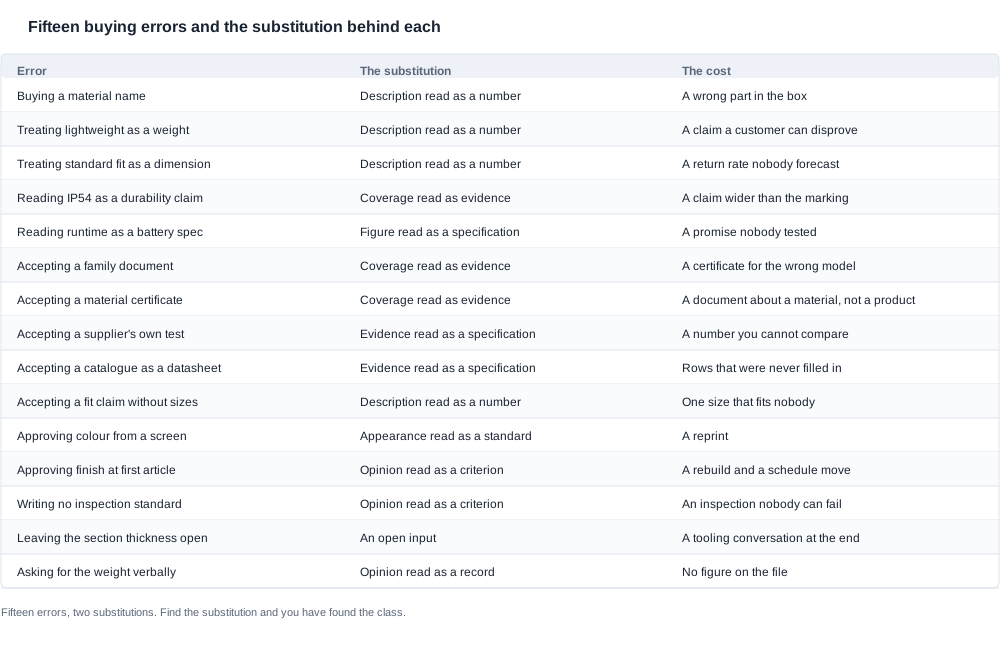
Smart glasses frame materials: five errors where a description replaces a number
1. Buying "premium acetate" as though it were a specification. A material name is not a component identity, and a material with no part number cannot be traced to the unit in the box. Ask what the material is, in what form, from which supplier, under which grade.
2. Treating "lightweight" as a weight. The whole-unit weight in this range is published for one model, and the frame weight is not published for any. A lightweightness claim on any other model is an assertion, and a customer who weighs the product will find out.
3. Treating "medium" or "standard" as a dimension. The frame dimensions are not published for every model, so a sizing claim is a description and the range has to be established across a size set rather than assumed from a word.
4. Treating "IP54" as a durability claim. The IP54 marking appears on two models in this range, the V06 and the S7, as a catalogue marking with no third-party test report number published, and no marking at all on the rest of the range or on any charging case. It describes protection against water splashing and nothing else.
5. Treating a published runtime as a battery specification. The cell configurations and the runtime figures are published; the test conditions behind them are not, and the difference is the whole of the comparison.
Reading the IP54 marking correctly
Two models carry the marking and the count is worth being precise about, because a supplier who claims a range-wide ingress position is claiming something the catalogue does not say. In our catalogue the IP54 marking appears on the V06 and the S7, both sport-tier camera models that are also published with a detachable inner frame.
The marking covers protection against splashing water from any direction and does not cover immersion, a shower, a hose or sustained rain. A catalogue that says IP54 and a product page that says waterproof are making two different claims, and the second is not supported by the first. There is also no published test report number, no standard reference, no sample size and no laboratory behind the marking in our documentation, so it is a marking rather than a document.
And the marking does not extend to anything else in the box. No charging case in the range carries a published ingress marking, so a cased variant of a marked model is not a marked product in its entirety.

Five errors that substitute coverage for evidence
6. Accepting a family-level document as cover for one model. A certificate that names a product family says nothing about a single stock-keeping unit inside it. The model designation on the document has to be read against the model on the purchase order, character for character, because that is the check that catches a substitution.
7. Accepting a material certificate as product evidence. A material certificate covers a material. The product's RoHS declaration covers the product, and the two are different documents with different scopes and different uses.
8. Accepting a supplier's own test as a specification. A supplier's test on a supplier's unit, under a supplier's protocol, is evidence about a product and not a specification a buyer can compare against another supplier. It is useful, and it is not comparable.
9. Accepting a catalogue page as a datasheet. A catalogue describes a range; a datasheet describes a model. The rows that distinguish them are exactly the ones that are unpublished in this category, which is why the distinction matters here more than it does in categories with complete datasheets.
10. Accepting a sizing claim without a size range. A product that suits one person is a product that will not suit a market, and sizing is among the largest drivers of returns in this category.
Five errors that cost the programme time rather than money
11. Approving the colour from a screen. The colour matching discussion sets out the sequence, and the short version is that a physical sample in the final finish is the only reference that works. A screen approval is a decision that has not been made yet.
12. Accepting the cosmetic approval during the first article. It is the most common first-article rejection in this category, and it costs a rebuild and a schedule move. Approve against a physical sample before the first article ships, which is cheap, rather than at it, which is not.
13. Not writing the inspection standard. Without a finish standard and a viewing condition, the inspection is an opinion, and an opinion is not a rejection criterion. This is the cheapest fix in the list and the one that most often gets skipped.
14. Leaving the section thickness open. The temple has to carry the cell, and the cell configuration is the input to the thickness. An open thickness at the first article is a tooling conversation, and tooling conversations happen at the worst possible time.
15. Not asking for the weight in writing. It is the most requested figure in the category, it is published for one model, and a verbal answer is not a figure. It also has to be clear which figure is being given, because a whole-unit weight and a frame weight answer different questions.
The catalogue rows behind these errors
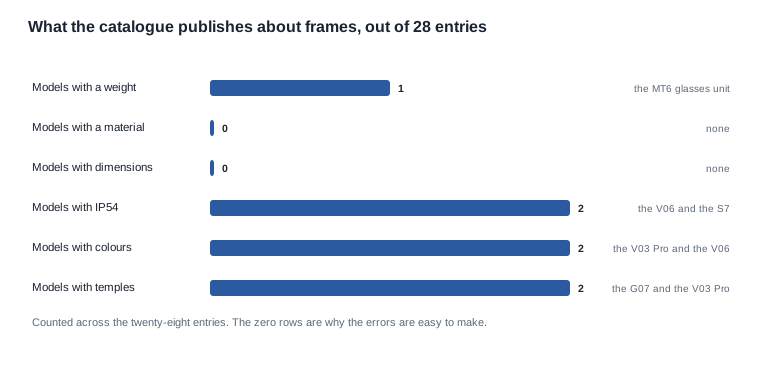
The counts above are taken from the catalogue rather than estimated, and the two zero rows are the whole explanation for why these mistakes are so easy to make. One model in the range has a published weight, and it is a whole-unit weight for the MT6 glasses unit that includes the battery and the camera module and excludes the foldable charging case, whose own weight is not published. Two models carry a published ingress marking. Two carry published colour options and two carry a published temple construction.
Nothing carries a published material name or a published frame dimension. That is not an omission in the documentation; it is the published state of this category, and a buyer who knows it can recognise the moment a description is being asked to do the work of a number.

The four questions that catch most of them
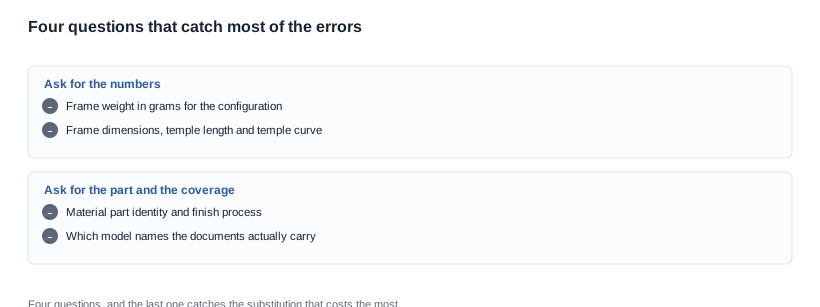
These four, asked in writing before you order the first article, catch the large majority of the fifteen errors above. The first two catch the description-for-number substitutions, the third catches the coverage-for-evidence substitutions, and the fourth catches the errors that arrive after launch, when they are most expensive.
The criteria that separate a specification from a description are easy to state and easy to apply to any material answer from any supplier. The discipline is in the wording. Ask for the weight "excluding the battery and the camera module" rather than asking for "the weight". Ask for "the material's part identity and the finish process with its inspection standard" rather than asking what the frame is made of. Ask which model designations the documents carry rather than asking whether the certification is in place. Each of those four questions asks for something that can only be answered with a number, a part number or a document reference.
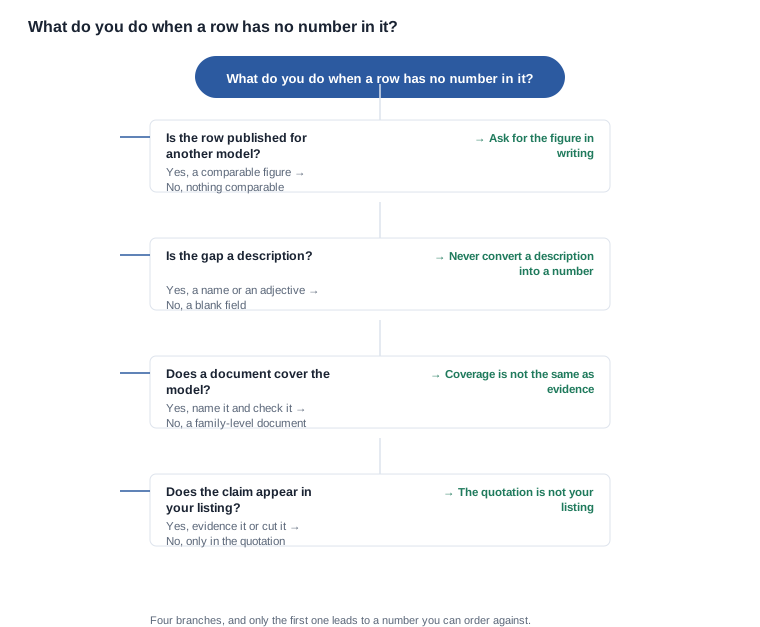
The errors that arrive after launch
Five of the fifteen errors above cost nothing at the quotation stage and everything at the retail stage, because they are errors about what happens to a claim rather than about whether the claim is true.
The listing claims a fit that the product does not deliver across a population. The symptom is a return rate concentrated in one size or one body shape, which is usually diagnosed as a product defect rather than as a sizing problem. The root cause is that the sizing statement was written from a sample rather than from a range. The prevention is to publish the sizing range, and to publish the sample size behind it.
The listing claims a durability that only one configuration has. This is the ingress case, and the symptom is a customer who bought a cased variant on the strength of a marking that belonged to the uncased model. The prevention is to write the marking against the exact model and to state that it does not extend to the case or the accessory.
The warranty promise exceeds the published data. The symptom is a warranty file that a supplier cannot settle, which usually means the claim was made against an expectation rather than against a figure. The prevention is to write the warranty against a measured criterion rather than against a published ceiling.
The finish drifts between batches. The symptom is a complaint from a second production run that the product arrived lighter than the sample. The root cause is that the approval was made against a sample and there is no inspection standard behind it. The prevention is to write the finish standard and the viewing condition into the purchase order, which is the cheapest clause in this article.
The documentation does not match what shipped. The symptom is a compliance query at a distributor or a marketplace, at the point where the goods are already in the channel. The root cause is a model designation that was updated after the documentation was issued. The prevention is a notice obligation before any model, material or supplier change, and a change-control rule that the factory actually runs.
The pattern across all five is the same, and it is the reason these are procurement errors rather than marketing errors: each one is a row that was settled by a person rather than by a document. The due diligence that prevents them is four questions, and the first of them is free.

Why these errors are easy to make with this catalogue's thin rows
The honest reason is that the descriptions are good descriptions. "Premium acetate" sounds like a specification, "lightweight" sounds like a measured property, and "medium fit" sounds like a dimension. A buyer's professional instinct is to read a well-written description as if it were a well-sourced number, and in a category where the numbers are published the instinct is correct.
Here it is not, for one specific reason: the published numbers are the product numbers rather than the frame numbers. The cell capacity, the runtime and the charge time are published for every model, the interface is published for twenty-four of the twenty-eight, magnetic or Type-C, and the case capacity for five, and every one of them is a property of the electronics rather than of the frame. The rows that would settle a frame decision are the rows that are not published, which is why the substitution feels safe and is not.
There is a second reason, and it is the one that makes this a procurement problem rather than a reading problem. A description travels between suppliers. A number does not. A material name copied from a competitor's datasheet arrives in your quotation without the supplier ever having measured anything, and it reads identically to one that was measured.
A hypothetical pre-purchase audit, worked through
Consider a constructed case rather than a client project, and read the steps below as the decision sequence rather than as an outcome.
Assume a channel buyer comparing three camera models from two suppliers for a European marketplace listing. Neither supplier has published frame material, and one of them has quoted a "premium lightweight frame with medium fit" on the summary sheet.
The first error surfaces immediately. The buyer asks for the frame weight excluding the battery and the camera module. Supplier A returns a number with a tolerance. Supplier B returns "lightweight, around 40 grams". The first is a specification and the second is the description standing in for one, so the comparison between the two cannot be completed on this row, and the buyer now knows that any comparison they make elsewhere on the range is equally unsafe.
The second error surfaces on the documentation. Supplier A's declaration names the exact model. Supplier B's names a family with the model listed as a member. The buyer asks for the model-level coverage and receives it in two days, which is a reasonable answer from a supplier who has the file.
The third error surfaces on the marking. Supplier B's summary sheet says the range is IP54-rated. The catalogue says the marking appears on two models in the range and on no charging case. The buyer asks which model carries it. The answer names one, and the listing copy changes from a range statement to a model statement.
The fourth error surfaces at the right time. Because the buyer asked for the finish standard and the viewing condition before the first article, the cosmetic approval was made against a physical sample in the final finish. The first article arrives and there is no rejection, because the decision was already taken.
The decision. The buyer does not reject Supplier B on the strength of the errors; suppliers make them. They reject the listing copy that was built on them, and they keep Supplier B for the model where the numbers are clean. The commercial result is a shorter audit, one listing that can be defended, and a supplier who now knows exactly which rows they have to be able to answer.
The decision that follows. Because the four questions produced a clear answer from Supplier A on the weight and a clear non-answer from Supplier B, the buyer's shortlist becomes one supplier per model rather than one supplier overall. That is a better outcome than it looks, because the two suppliers' capabilities are not interchangeable: the supplier who can produce a frame-level weight with a tolerance can also produce the capability data behind a section thickness, and the one who cannot produce the first will not produce the second either.
What the buyer does with the findings. The audit produces four reusable artefacts rather than four corrections: a request list that goes out with every future enquiry, an acceptance standard that replaces the informal cosmetic approval, a listing rule that every range claim has to name the model it applies to, and a written record of what was asked and what was not answered. Three of those four cost nothing to produce and all four remove work from the next programme.
The decisive step was the first question, because the answer to it told the buyer how much of the rest could be trusted.
What we publish and what we refuse to fill in
Every mistake in the list above comes from the same move, which is reading a description as though it were a number. Our position is that we publish the whole-unit weight where we hold it — 158 g for the MT6 glasses unit — and not published for the rest, and that we will not fill a material, a dimension or a finish row with values taken from the optical industry, because the vocabulary travels and the measurements behind it do not. A description that reads correctly on a datasheet is exactly the mechanism by which a wrong number reaches an order.
We will also say plainly that most of these mistakes are made because the published data is thin, and that the answer is to request the numbers rather than to assume the product has them. If you ask us for a frame material and we do not hold it, we will say so, and we will tell you whether it is a row we can obtain from the tooling programme or a row that has to be measured by you.
The practical version of that position is a rule we hold ourselves to, and it is worth stating because it is the rule that makes the rest of the catalogue usable. When a figure exists, we print it in the units it was published in, and when the published form is a cell value and a cell count we print both rather than the total. When a figure does not exist, we write that it does not exist, in the row, where the buyer will see it — not in a footnote and not in a promise to supply it later.
That rule is worth more than it looks, because a catalogue that marks its gaps is a catalogue that can be used to build a comparison sheet. A catalogue that quietly omits the rows it cannot fill is a catalogue where the buyer cannot tell a missing row from a row that was simply not asked for, and that ambiguity is where most of the fifteen errors above begin.
What we can do is answer these fifteen for a specific model where our documentation holds the answer, and tell you plainly which ones have to go to the factory. If you want to know how to compare two suppliers on this row, the answer is a request list rather than a spreadsheet, and we will build the first draft of it with you. The material context is under materials and ergonomics, the questions buyers ask most often are in frame materials what buyers ask most, the standard options are in standard OEM colour options, and the starting point for a new reader is in frame materials for beginners.
Related reading
- Materials and ergonomics
- Frame materials what buyers ask most
- Standard OEM colour options
- Frame materials for beginners
Tell us the model and the use case and we will say which rows we can answer.


