

A case study template for frame material work is worth having for a reason specific to this category: the frame is where the electronics meet the product's most visible surface, and the interesting part of a frame project is almost never the material.
The material is the input. The interesting part is the sequence of decisions that connects a cell capacity to a section thickness to a weight to a sizing outcome to a return rate — and that sequence is what a second buyer can actually learn from.
Our published position gives the template its content. The frame material is not published as a range-level fact. A whole-unit weight is published for one model in the entire catalogue, 158 g for the MT6 glasses unit including the battery and the camera module and excluding the foldable charging case, and not published for everything else. The frame dimensions, the temple length and the temple curve are not published for any model. The published colour options are three for the V03 Pro and four for the V06, and the cell configurations run from 40 mAh up to 290 mAh with dual cells at 55, 70 and 90 mAh per side.
So smart glasses frame materials smart glasses case study template is a template for documenting a design decision in a category where the inputs are unpublished and the outputs are the buyer's own measurements.
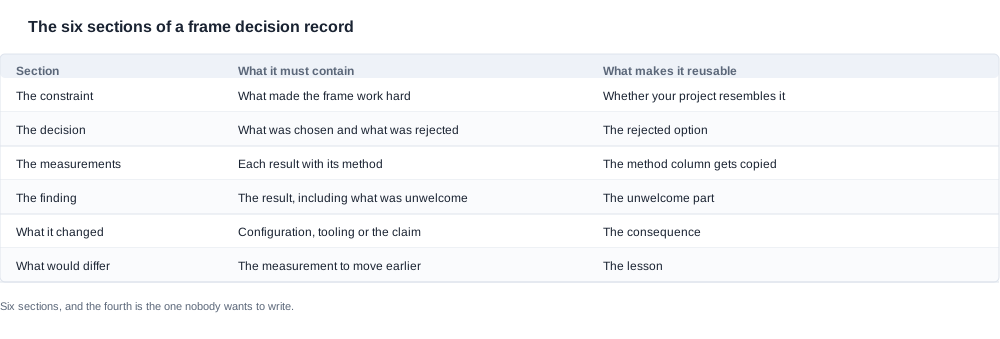
Smart glasses frame materials: the six sections a decision record needs
1. The constraint that made the frame work hard. Usually a cell that did not fit the existing section, a weight target, or a sizing range across a population. This is the sentence that tells a reader whether their project resembles yours, and it is the only sentence that decides whether the rest of the document is worth reading.
2. The decision, with the alternatives. Which cell configuration, which temple construction, which material and finish, and what was rejected. The rejected option is the transferable part; a document that records only what was chosen is a specification and not a case study.
3. The measurements that were taken, and how. The weight, the dimensions, the section thickness at the electronics bay, and the method for each. Every method column is a column another reader can copy, which is why the method is not optional and why a measurement without a method should not appear in the document at all.
4. The finding, including the unwelcome part. The weight came in above target, the sizing needed a different temple curve, the finish varied more than the standard allowed. This is the most valuable paragraph in the document and the one that is most often removed before publication.
5. What the finding changed. The configuration, the tooling, the acceptance criteria, or the claim that could be made. Without this section a reader cannot tell which of the findings mattered and which were noted and filed.
6. What would be done differently. The measurement that should have been taken earlier, the criterion that should have been written first. This section is what makes the document a template rather than a history.
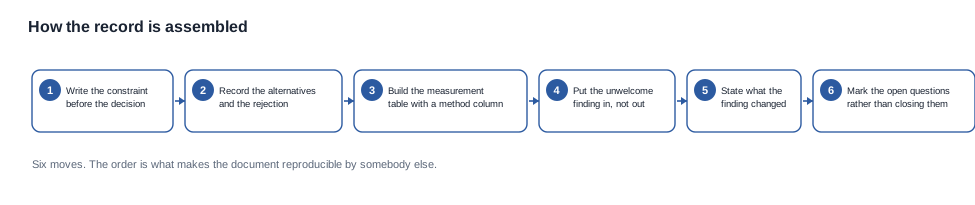
Why the constraint has to come first
The first section is the one that gets skipped, and skipping it is what turns a case study into a brochure.
A constraint is the physical fact that made the design hard: a cell that would not fit the existing section, a mass target that the electronics had already consumed, a market that needed a size range wider than the current temple curve could offer. It is specific, it is verifiable and it is the sentence that lets a reader decide in ten seconds whether the rest of the document applies to them.
Written badly, the constraint becomes a restatement of the brief. "The customer wanted a lightweight product" is not a constraint; it is an objective, and every project has one of those. Written properly, it is a number with a limit attached: "the section had to stay under 3.2 mm at the hinge while carrying a 290 mAh cell and a 13 MP module".
That difference decides whether the document is reusable. An objective applies to every project and therefore tells a reader nothing. A constraint applies to a family of projects, and a reader who recognises their own constraint can skip the rest of the document and go straight to what the project did about it.
There is a second reason it belongs first, and it is a matter of sequence rather than of presentation. The constraint is the only part of the record that was true before anybody chose anything. The decision follows from it, the measurements test it, the finding contradicts it, and the lesson generalises it. Put the constraint at the end of the document and the reader has to reconstruct it, which is the work the document was supposed to save them.
What a record actually buys the next programme
The value of a case study in a category with unpublished inputs is not that it describes a finished product. It is that it shortens the decision the next buyer has to make.
Three things shorten it, and all three come from the tables rather than from the narrative.
The open questions table removes the search. If a previous programme asked a supplier for a capability figure and did not get one, the next programme does not have to find out again. That is the cheapest saving in this category and the most reliably overlooked, because a question that was not answered does not look like an asset.
The before-and-after table sets the expectation. If a previous programme assumed a frame-level weight and the measured figure was different, the next programme can start from a better assumption rather than repeating the first one. The saving is not only in the number; it is in not having to discover that the assumption was optimistic.
The measurement table saves a test day. A recorded method means the next programme does not have to design its own protocol and argue about whether the two results are comparable. It is the difference between re-measuring a known quantity under a known method and measuring it for the first time under a method you invented.
There is a commercial consequence to all three, and it is the reason a record is worth writing even when the programme itself was not interesting. A frame programme is expensive because the decisions are expensive: tooling, a non-recurring cost amortised over the volume, and a schedule that has to hold while the artwork is finalised. A decision made correctly on the second programme rather than the fifth is worth more than the engineering that produced it, because the engineering was going to happen either way.
The four tables that make the record reproducible
1. The published rows, quoted exactly. The cell configurations, the interface, the published colour options where they exist and the published weight where it exists — with the absences marked as absences rather than left blank. A table that says "not published" in a cell is doing its job; a table that leaves the cell empty has hidden a fact.
2. The measurement table. Each row a measurement, each column a method, a condition and a result. Weight, dimensions, section thickness and sizing across a size set. The method column is the one that makes the table transferable and it is the one most often left out.
3. The before-and-after table. The published or assumed values against the measured ones, and whether the difference matters for the use case. The third column is what stops the table being a list of differences: a difference that does not matter is a useful thing to record and an unhelpful thing to highlight.
4. The open questions table. What remains unestablished and what it would take to close it, with the cost and the lead time for each. This table is what a second buyer inherits, and it is the reason a case study is worth more than a brochure.
The four tables and the one column that makes the difference
The measurement table is the one that decides whether a record can be used by anybody else, and the deciding column is the method. A weight measured on a bench scale, a weight measured on a postal scale and a weight measured on a sample of five units are three different numbers that will be quoted as the same number, and the reader has no way to tell them apart unless the method was recorded.
The same applies to a dimension. Temple length measured along the curve and measured in a straight line are different numbers, and a record that omits the method will be cited for whichever conclusion the reader wanted.
A worked structure for a cell-to-section decision
The template is easier to use when it is shown against a decision that recurs, so this section works one through.
The constraint. A camera model in the range already carries a 290 mAh cell and a 13 MP module, and the frame section that houses them has to accommodate both without pushing the temple mass forward. The constraint that made the frame work hard is a section thickness budget, not a style.
The decision. Two options were evaluated: keep the existing cell configuration and accept a thicker section, or move to a doubled cell of a lower per-cell capacity to hold the same energy in a different package. The second option was rejected at the first-article stage because the doubled configuration changes the temple cross-section in the region that carries the hinge load, and the supplier's capability data on that section was not inside the tolerance band the frame needed.
The measurements. The section thickness at the electronics bay, measured at three points across the section, on five units, with the method recorded as a micrometer reading taken at a stated distance from the moulding datum. The total mass, measured on a bench scale, reported as a spread across the five units rather than as a single figure. The temple mass distribution, recorded as a section split.
The finding. The rejected option was rejected on capability data rather than on judgement, and the accepted option came in slightly over the weight target. The unwelcome part is that the weight target had been set from a whole-unit figure that included the electronics, so the frame-level target had been optimistic before the first measurement.
What the finding changed. The weight target was rewritten at frame level, the inspection standard was given a tolerance rather than a nominal figure, and the programme added a capability requirement to the acceptance criteria for the section thickness.
What would be done differently. The capability data should have been requested before the option was evaluated, and the weight target should have been set from a frame-level figure at the start rather than derived from a whole-unit figure later.
When the record is good enough to publish
How to evaluate a record before it leaves the building comes down to three criteria, and the third one is the one most records fail.
Can a reader outside the project reproduce the measurement? If the method is recorded well enough to be repeated by somebody who was not there, yes.
Can a reader predict what would have happened in a similar decision? If the constraint and the rejected option are both stated, yes, because those are the two inputs that determined the outcome.
Can a reader disagree with the finding? If the unwelcome part is in the document, yes. And this is the criterion that separates a case study from a brochure, because a document with no unwelcome part reads as a brochure and is treated as one. A record where everything went according to plan is not more impressive than one where something did not; it is less useful, because the reader cannot tell whether the process worked or the project was simply easy.
The commercial test is simpler than the editorial one. A record that saves the next programme a test day and a round of questions to a supplier is worth writing, even when nothing about the programme itself was remarkable. The questions to ask a factory are the ones already listed in the tables, and a buyer who has asked them once has already paid for them.

The four things the record must not claim
1. It must not publish a weight as a manufacturer specification if it was measured by the buyer. It is the buyer's measurement of its own units, and the distinction matters because a manufacturer specification and a buyer's measurement travel differently: the first can be quoted in a tender, the second cannot.
2. It must not present a single unit as a production figure. A weight spread across a batch is more useful than a point, and a point presented as a production figure is a defect in the document rather than a simplification.
3. It must not quote a dimension without a method. As above: a dimension without a method is a number without a definition.
4. It must not invent a client, a quantity or a result. A fabricated case study is a liability, and in a category where buyers talk to each other it will be found. The limitations discussion sets out why the distinction between a documented project and a plausible story matters.
A hypothetical record, written in the template
This is a hypothetical scenario rather than a client project, and it is here to show the template's structure rather than to report an outcome.
Assume a distributor who has just qualified a camera model and wants to write up what they learned for their own next programme. The material is unpublished, the frame weight is unpublished, and the only published figure in the whole area is 158 g for the MT6 glasses unit — which is not the model they qualified and is not a frame weight either.
Section one. The constraint was a section thickness budget driven by the cell and the camera module, and a requirement that the product be usable for a full working session in a warm vehicle. The reader can immediately tell whether that resembles their own project, and one reader will recognise it.
Section two. Two cell configurations were evaluated, and the doubled-cell option was rejected against the supplier's capability data for the hinge region. The rejected option is recorded with the reason, which is the sentence another buyer can use.
Section three. Four measurement rows, each with a method column: section thickness, total mass, temple mass distribution and the time the product stayed on during a working session. The session result is recorded as a range across a small group, with the group described, because a number without a population is not a finding.
Section four. The finding includes the unwelcome part, which is that the first programme's weight target had been derived from a whole-unit figure and was therefore wrong at frame level.
Section five. The finding changed the acceptance criteria, which are now written as tolerances rather than nominal figures.
Section six. The lesson is that the capability data should have been requested before the options were evaluated, and that is the sentence the next programme acts on.
The distributor publishes it with the client name anonymised, the quantities removed, and the model and configuration named. It is a document about a decision and a set of the buyer's own measurements, not a claim about a manufacturer's product.

Who may publish it, and what has to be marked as anonymised
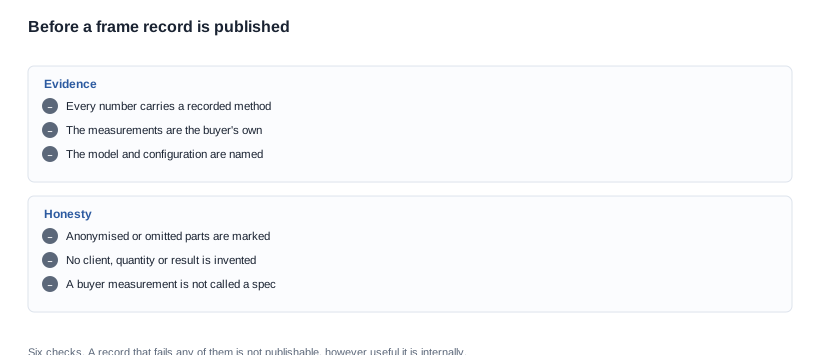
Three questions have to be answered before a record leaves the building, and all three are answered by somebody other than the author.
Is there a real project, and is there the right to describe it? If the project involved a counterparty's design, the counterparty's approval may be required even when the counterparty's name is withheld. The safest arrangement is an agreement at the start of the project that the buyer may describe the decision and the findings without naming the other party.
Were the measurements taken with a recorded method, well enough to reproduce? If they were not, the record is a set of observations rather than a set of measurements, and it should be written as such rather than upgraded in retrospect.
What did the buyer do with the finding? That is what makes a record transferable. A finding that changed nothing is still worth recording, but it belongs in a project note rather than in a case study.
Anything omitted or anonymised has to be marked as such, because an unmarked omission reads as a complete record. A buyer who reads "the section thickness was measured" will assume it was measured across a production spread rather than on one unit, and the document has to prevent that assumption rather than rely on the reader not making it.
The boundary between a measurement and a specification
Stated plainly: we will publish a case study only where the work happened and the figures came from it, that we will mark anything anonymised or omitted as such, and we will not present a buyer-run measurement as a manufacturer specification. A measurement belongs to whoever ran it, and calling it something else is how a case study becomes a claim.
We will also say plainly what this category can currently produce. The published frame data is one whole-unit weight, so a case study here documents a design decision and a set of the buyer's own measurements rather than a product's published performance. That is a narrower output than a brochure, and it is a more useful one, because the next buyer's question is never "what does this product weigh". It is "how do I decide, and what will it cost me if I decide wrongly".
The category context is under materials and ergonomics, the cost side of a frame decision is in frame materials cost factors, and two templates for adjacent categories are in the kids case study template and the photochromic case study template.
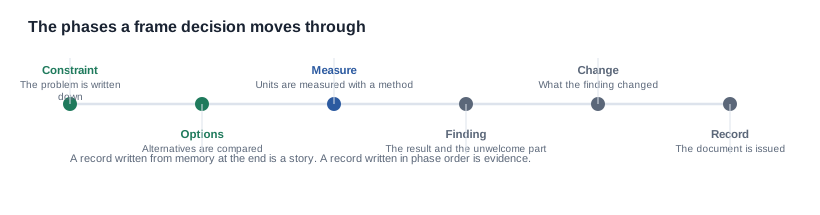
If you are building a template for your own category, the practical sequence to copy is the one above: decide the constraint first, evaluate the options against it, record the measurement method before the measurement is taken, write the finding before the conclusion, and state the open questions rather than closing them. The questions to ask a factory are the ones in the tables, and a buyer who asks them once and files the answers does not have to ask them again on the next programme.
Related reading
- Materials and ergonomics
- Frame materials cost factors
- Kids case study template
- Photochromic case study template
Ask us and we will send the table structure we use.


