

A frame material checklist for a procurement team is not really a checklist. It is a list of the rows that are missing from every supplier's datasheet, and in this category the missing rows are the ones that decide whether the product works for the people who end up paying for it.
Our own published position is the reason this matters more here than it does in most categories. The catalogue lists twenty-eight product entries. It publishes one weight figure in total, and that figure needs its exact terms: the MT6 glasses unit at 158 g including its battery and its camera, excluding the foldable charging case, whose capacity is 1200 mAh and whose weight is not published. The weight of a bare frame is not published for any model. Frame dimensions, temple length and temple curve are not published for any model. Material composition is not published for the range. The published colour options sit within single models — three on the V03 Pro, four on the V06 — which tells you that colour is a finish decision rather than a new moulding, but it tells you nothing about what the frame is made of.
The cell configurations are published, and they are published in the catalogue's own form: 55mAh×2, 70mAh×2, 90mAh×2 and single-cell entries at 100mAh, 115mAh, 200mAh, 220mAh, 260mAh, 265mAh and 290mAh. Eleven of the twenty-eight entries carry a camera. That set of numbers is the input to the section thickness, which is the input to what the material has to be stiff enough for.
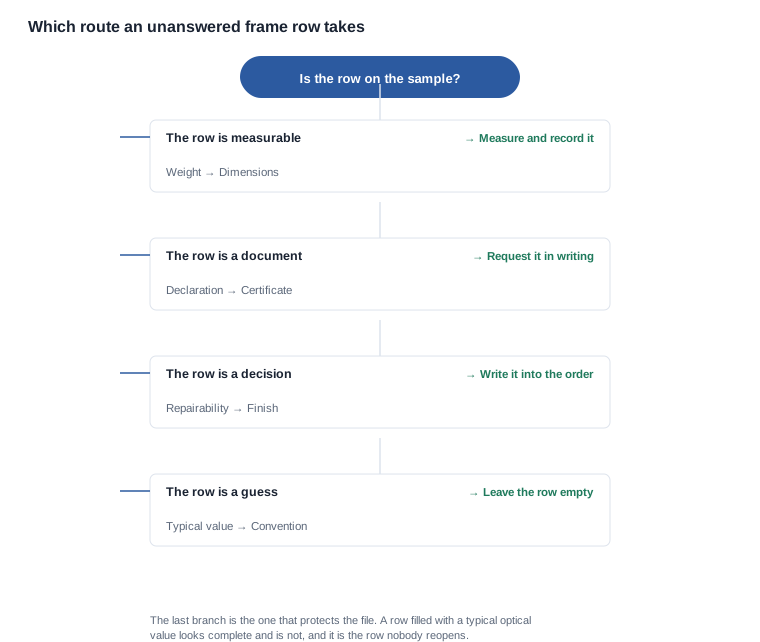
So smart glasses frame materials smart glasses checklist for procurement teams is a checklist for turning an unstated structure into a stated one — and for deciding, row by row, whether a missing number is something you can measure, something you can request, or something nobody should have guessed.
Smart glasses frame materials: nine rows to request before the sample order
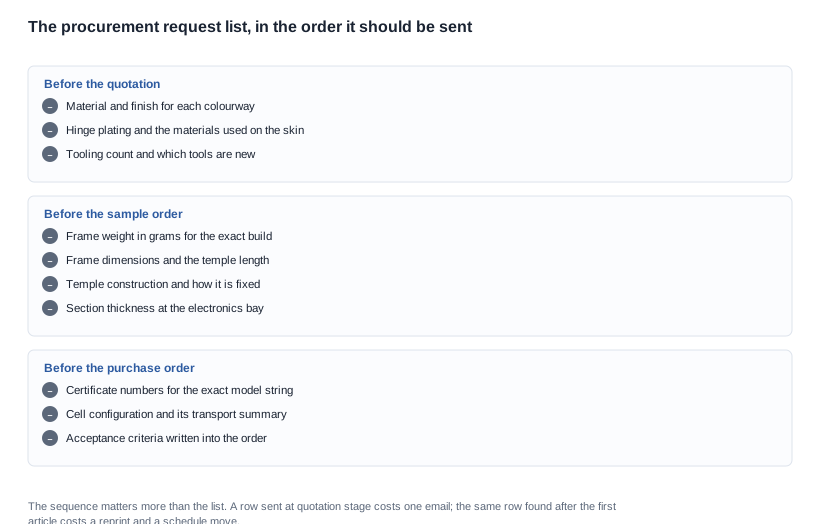
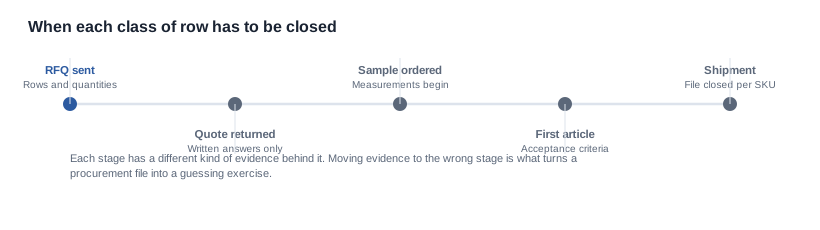
The nine rows below are ordered by the stage at which they can realistically be closed, because that ordering is what makes the list usable. A row requested at the wrong stage either comes back too late to matter or comes back as a number nobody can defend.
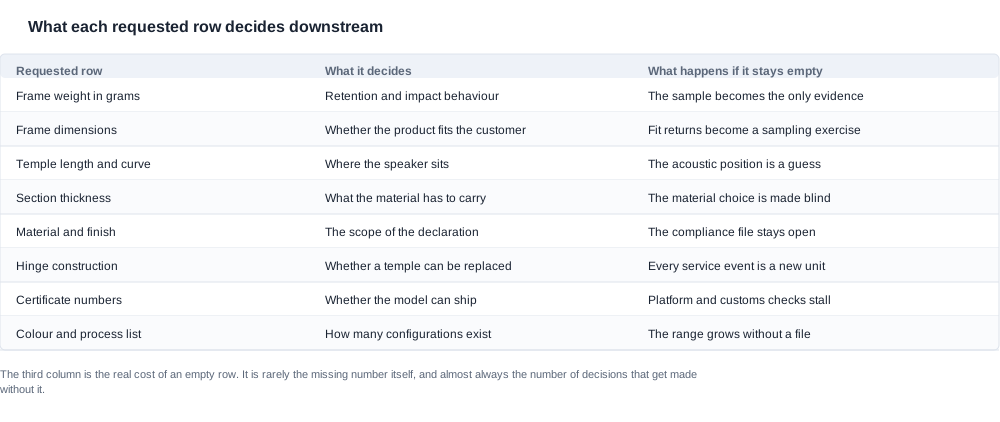
Row one: the frame weight in grams, for the exact configuration. Name the configuration, not the model. The weight of a unit with one cell is not the weight of a unit with two, and the weight of a unit with a fitted lens is not the weight of a unit without one. If a supplier quotes a single figure for a platform that ships in three builds, ask which build it describes. This is the single most requested figure in the category and the least available, which is why it has to be asked as a written row rather than treated as a courtesy.
Row two: the frame dimensions. Total width, lens width, bridge width, temple length. This row decides whether the product serves the customer at all, and it is the row with the largest direct effect on returns in this category. It is also the row most often replaced by a size label, and a size label cannot be evaluated by anyone outside the supplier.
Row three: the temple construction. Solid moulding, or an acetate temple with a wrapped core. This row decides what the temple can carry, and in a smart glasses product the temple carries the cell, the protection circuit and the board. Our range publishes some temple descriptions and not others: the G07 is listed with an ultra-slim and detachable temple, the YK12 with a slim temple, and the V03 Pro with flexible temples. For every other model, the construction is not published.
Row four: the section thickness at the electronics bay, and how it is stiffened. This is the number that connects a material choice to a cell configuration, and it is the number a material decision is really made against. A supplier who will not state it has not settled the design.
Row five: the material and the finish process. Matte, gloss and soft-touch are three different process steps with different consumables, different cycle times and different inspection standards. A gloss surface shows tool marks and a matte surface hides them, so the inspection standard follows the finish, not the reverse. Ask for the process and the inspection standard together, because they are one decision.
Row six: whether the temple is user-replaceable, and how it is fixed. Riveted, screwed or bonded. This decides whether a service event is a spare part or a whole replacement unit, and it is the row that determines whether your after-sales budget is a parts line or a returns line. The G07's published detachable temple is the precedent in the wider range.
Row seven: the certificate numbers for the exact model. The catalogue's export certification page carries images rather than text and states no certification position in words; there is no per-model certification row anywhere in it. So the numbers have to come from the supplier, with the issuing body and the validity dates. Ask before the sample ships, because the answer takes weeks.
Row eight: the cell configuration and its transport summary. In the catalogue's own notation, so that the cell specification and the transport documentation refer to the same thing. Ask which cell sits in which temple.
Row nine: the change notification undertaking. What the supplier must tell you before they change a polymer, a pigment, a coating, a plating or a seal, and how long you have to respond. This is the row that protects the other eight, because every one of them can be reopened by a change made in good faith.
How to write the request so that it actually gets answered
The content of the nine rows matters less than the way they are sent, and this is where most procurement teams lose a cycle. A list of questions sent as a paragraph produces a paragraph back, and a paragraph cannot be tracked, audited or attached to a purchase order.
Three habits fix it.
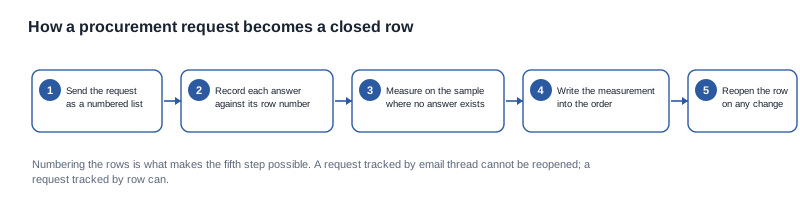
Number the rows and quote the number back in the answer. A reply that says "the weight is 48 grams" cannot be attached to a model. A reply that says "row one, build A, 48 grams including the fitted cell" can. The numbering also makes the fifth stage possible later, when you need to reopen a single row without reopening the relationship.
Name the configuration in the request, not just the model. Our range publishes several models in more than one build: the LC-105-1 and the LC-105-2 are separate entries, the K01 and the K02 are separate entries, the CY03 and the CY05 are separate entries, and the camera tier runs from 220mAh through 290mAh across eleven camera models. A request that names a model without a build will get an answer about whichever build the supplier has most paperwork for.
Separate what you need from what you would like. A request of nine rows with no priority gets nine soft answers. A request that marks rows one, four and seven as blocking and the rest as useful gets three specific answers and a conversation about the others. Blocking rows are the ones you cannot proceed without; the useful rows are the ones that improve a decision you can already make.
The test of a good request is simple: after the reply arrives, can you tell which rows are closed and which are still open, without reading the reply twice? If not, the request was not structured well enough, and it is worth sending again before the sample order rather than after it.
The six checks that only a physical sample can settle
Rows one to six of the table above cannot be closed by a document in any category we know of, and the reason is that the frame is a structure whose behaviour only appears when something is carried in it. A sample is not a confirmation step here. It is the measurement.
Check one: the sizing across a range, not a single head. Because the dimensions are not published, the only way to establish the coverage is to try several sizes and to record which sizes the frame genuinely accommodates. A frame that works on the person who arranged the sample is not a frame with a size range, and this is the check that most often converts into a returns problem in the eyewear channel.
Check two: the temple's stiffness under load, and how it behaves at the end of a session. A temple carrying a cell and a board is a structural member, and its behaviour under a sustained load differs from its behaviour when new. Flex it and release it and see whether it returns to the same position, because that return is what the audio alignment and the retention both depend on.
Check three: the pressure points, and where the electronics bay sits relative to them. A bay that lands where the head presses is a bay that produces a complaint that reads like a pressure issue and is actually a design issue. This check is where the section thickness from row four becomes visible.
Check four: the finish under the lighting the product will actually be sold in. A gloss finish shows tool marks and a matte finish hides them, and the inspection standard follows the finish. Approving the finish against a physical sample under retail lighting before the first article is the cheapest cost control available in this category.
Check five: the consistency of the finish across the frame, the temple and the case. The case is a separately moulded component with its own batch, and a colour mismatch between the frame and the case is a returns driver that no specification catches. The G07, the YK12 and the YKC02 all ship with a case, and the case is a separate colour-matching problem from the frame.
Check six: the controls, and where they sit relative to the lens mount. This is the check that decides whether the product can be offered through an optical channel. A capacitive touch control, where a build carries one, and an optician's hands at the temple mount are in the same place, and a buyer who is going to offer prescription lens service needs to know where the controls are before they commit to the channel — and because no model in the range publishes a touch row, that position has to be established with the supplier before the channel is committed to.
There is one more thing to do with a sample that is worth more than its cost: record your own measurements on your own equipment, in a note, with the date and the unit. A number with a source is a specification. A number without one is a recollection, and a recollection is what a customer argues with.
Two further checks belong on the same visit, because both are cheaper to do while the sample is in your hand than to arrange afterwards.
Check seven: the charging case and the interface. Where the product ships with a case — and the MT6 and the L1 Pro, the L2 Utral and the KY06, and the CY05 and the CY03, and the MT5 all have a published case, with the L2 Utral listing 900mAh and 1400mAh and the MT6 a 1200mAh foldable case — the interface between the unit and the case is a mechanical fit, and a mechanical fit has tolerance. Check that the unit seats fully, that the contacts align without force, and that the case holds the unit the way the packaging will hold it in transit.
Check eight: the electronics bay under movement. Run the unit through the handling it will actually see. A bay that survives a bench test can still rattle in a pocket, and a rattle is both a noise complaint and a connector fatigue risk. This is the check that catches a unit whose section is adequate on paper and marginal in the hand.
Neither check takes more than a few minutes. Both of them catch failures that would otherwise surface through the returns channel, where the unit has already been bought, shipped and paid for.

The five questions that decide the compliance position
These are the questions that determine whether a frame change is a document or a qualification, and they are the ones where a soft answer in an email becomes expensive later.
Question one: does the material and finish affect the substance position? A coating, a pigment or a surface treatment alters the composition, so a declaration written before the change does not cover the change. The question to ask a supplier is not "is it compliant" but "does the declaration for the shipped finish name this colour and this temple build".
Question two: does the seal material interact with the frame material? Our range carries a published ingress marking on the V06 and on the S7 and on no other model, and it is published as a catalogue marking with no third-party test report number behind it. The seal material itself is not published for any model. So for any sealed programme, the question is whether the supplier can evidence the tested configuration, not whether the catalogue shows a marking.
Question three: does a different frame material require a different conformity assessment? In most frameworks a material change is a product change, and the answer is usually yes. The useful thing to establish is not the legal answer but the supplier's process for handling it, because that is what tells you how much freedom you have once the programme is running.
Question four: is the material a specified material or an available one? A specified material has a component identity — a grade, a supplier, a batch route. An available one is a substitution waiting to happen, and a substitution changes the declaration, the traceability and the qualification at once. This is the question that separates a supplier who has designed the frame from one who has assembled it.
Question five: what is the material's traceability? A material that cannot be traced back to a supplier and a batch cannot be shown to be the material in the shipped unit. Ask where the resin comes from, who holds the batch record, and how long that record is kept.

The five lines to keep off the request list
There is a second list, and it matters as much as the first. These are lines that appear on procurement requests in this category, read like criteria, and settle nothing.
Weight as an adjective. "Lightweight" is not a criterion. A number in grams, with its configuration named, is.
Material as a brand. "Premium acetate" describes a marketing position, not a component. It cannot be ordered, inspected or re-supplied.
Sizing as a label. "Medium" is not a measurement. It may be a perfectly good medium, but nobody outside the supplier can evaluate it, which makes it useless for a shortlist.
Durability as a claim. No drop, impact or vibration figure is published for any model in our range, and a supplier quoting one without a test method is quoting a marketing claim rather than a specification.
Subjective feel as a criterion. It is a consequence of weight, section geometry and finish, all of which are measurable. Leaving it as a criterion means leaving the measurable parts unmeasured.
There is a sixth item that belongs on this list rather than on the request list: a certification requirement for a market you are not shipping into. Adding scope you do not need costs documents, lead time and money, and the decision about which markets you are in belongs to the brand.
An unanswered row is a request in disguise
A checklist that cannot be answered is not a failed checklist. It is a document request, and the value of the whole list depends entirely on whether you treat it that way.
The short answer: we publish the figure we hold — the MT6 glasses unit at 158 g including the battery and the camera and excluding the foldable charging case — and not published for every other model, and we will not fill a material, a dimension or a finish row with values borrowed from the optical industry. The terms transfer and the values do not. A temple length taken from an optical catalogue is a number that describes a different product, and it will be held against you the first time a customer returns a frame because of it.
We will also be direct about the limit of this list. Nine rows is a request list, not a measurement plan, and the rows that decide how the product behaves in a customer's day — weight, geometry, section thickness — are not closable with a document at all. They have to be measured on a sample, which is why the sample order in this category is a measurement event rather than a formality.
Turning the list into a schedule
A checklist that sits in a folder closes nothing. The version that works has a calendar attached, and the calendar is short enough to be plausible.
Week one: the request. Send the nine rows with rows one, four and seven marked blocking. Ask for a reply against a stated date, and say what you will do with a partial answer, which is usually to proceed on the rows that are closed and hold the rest.
Week three: the sample order, with the measurement protocol attached. By this point the blocking rows should be closed or visibly refused. If a row has been refused, that is a useful answer, and it changes the programme — a supplier who will not state the section thickness has a design they have not settled with you, and you should price that risk rather than ignore it.
Week four to six: the sample evaluation. Eight checks, recorded on your own equipment with dates and units. This is where the unclosable rows are closed, and it is the only stage where a buyer is the primary source of evidence rather than a recipient of it.
Week six: the acceptance criteria. Everything you measured becomes a written criterion, attached to the purchase order. A weight becomes a weight range, a temple length becomes a tolerance, a finish becomes an inspection standard with a sample board. This is the stage that converts the checklist from a request list into a contract, and skipping it is why the same rows have to be renegotiated at every reorder.
Every reorder: reopen only what changed. If the supplier has honoured the change notification undertaking, only the affected rows need to be revisited. If they have not, the entire list is open again — and that is the real measure of whether the first nine requests were worth making.
What we can do is tell you, for a specific model and build, which rows we can answer from what we hold today and which have to be obtained or measured. If you send us the models, the quantities and the target market, we will say which configurations exist, which do not, and which of these nine rows we can close for you now.
Related reading
- Materials and ergonomics
- Frame materials supplier verification
- Bluetooth audio glasses comfort and fit
- Frame materials what buyers ask most
- How to find your size
Tell us the models and the use case and we will say which rows we can answer directly.


