

Smart glasses frame materials: where the schedule breaks
Lead time discussions in this product category centre on electronics, which is usually wrong. The electronics are a purchased part with somebody else's cycle time, and their cycle time is visible to everybody. What repeatedly stops a build is the frame, because the frame is where tooling, sizing, finishing, inspection and the conformity file all converge on the same date.
The reason frame schedule problems are so often mispriced is that they do not look like schedule problems until they are already schedule problems. A change that looks like a small adjustment in a meeting is, mechanically, a tool question, a documentation question and an inspection question at the same time. The three of them are owned by three different organisations and they do not share a queue.
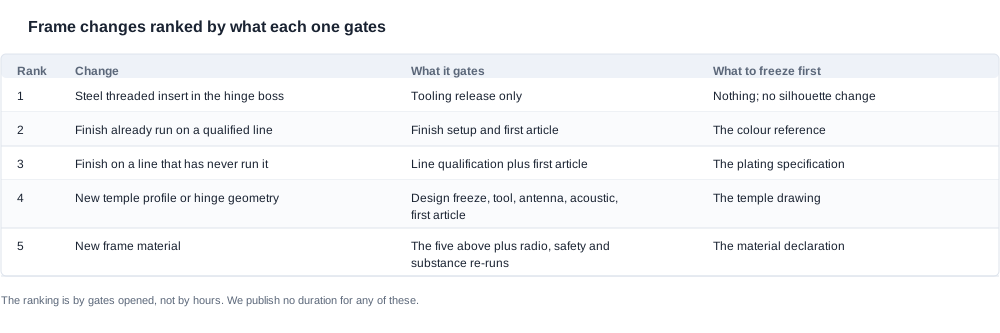
So frame materials and lead time is a short list of changes, ranked by how many gates each one opens, with the gating question stated for each. The ranking is the useful part, because the ranking tells a buyer which change to try first and which change has to be scheduled around rather than negotiated.
We publish no lead time in weeks for any configuration, and no production schedule, and the reason is stated at the end of this article. What we do publish is the structural fact that drives most of these numbers: every model in the catalogue publishes a charge time, twenty-six of them at two hours or less and two at about one hour, and every model publishes a battery capacity. Those two rows are the inputs that set the temple section, and therefore the inputs that set the tooling.
That last point deserves more attention than it usually gets, because it is where a procurement decision and an engineering decision meet. The battery capacity is published, so the bay volume is knowable, so the section is knowable, so the tooling requirement is knowable — and a programme that has already fixed the cell configuration has already fixed most of the schedule. A programme that intends to change the cell late, for a better runtime or a different supplier, is not making a component substitution. It is re-opening the tooling question, and it should be scheduled as such rather than as a purchase order.
There is a second use for the ranking, which is portfolio planning. A programme rarely has one frame change in it; it usually has a finish change, a colour addition, a case decision and a request from the channel for a new temple option, all arriving within the same quarter. Sorting them by gates rather than by request date tells a buyer which of them can run in parallel and which of them are really one change wearing four costumes. A colour addition and a finish change on the same line are frequently the same gate seen twice, and merging them is worth more schedule than negotiating either one harder.

The cheapest change available: a threaded insert in the hinge boss
Minimal schedule impact, and the first thing to try.
A steel threaded insert into a reinforced boss requires no tooling, no silhouette change, no acoustic retuning, no antenna relocation and no new declaration for the frame stack. It is a component change in an existing mould. If the reason for a structural review is hinge strength or temple cracking, this addresses it at a fraction of the cost and time of anything else on the list.
The reason buyers skip it is that it does not appear in a photograph and does not sound like a frame improvement. It is invisible in a product listing and it is the most efficient single change available in this product class. There is also a second-order benefit that buyers rarely ask for: a reinforced boss changes the tolerance stack around the joint, so it tends to make the hinge torque more repeatable across the production run, and repeatable torque is what makes an inspection standard enforceable.
The commercial point is that this change is negotiable in a way the others are not. It does not reopen the file, it does not require a new first article in most cases, and it can be introduced on an existing line. If a supplier quotes a long schedule for a structural hinge improvement, ask whether a reinforced boss with a steel insert would achieve the acceptance criterion instead. That question alone routinely removes a gate from the schedule.
Finishes and temple profiles, ranked by the gates they open
Rank two: a finish change on an already-qualified line. Low impact, with one condition: the finish must be achievable on a plating line that is already qualified for it.
A colour matched to a line that already runs that colour is a setup. The same colour on a line that has never run it is a line qualification, which is a different project with a different queue and a different risk. The question that separates them is simple and worth asking early: is this colour run on a qualified line, or does it need qualifying? A supplier who cannot answer that question does not know the answer and will find out during the programme.
Rank three: a new temple profile, a new hinge geometry or a new lens mount. High impact, and the reason projects slip.
A new profile means tooling. Tooling means the design has to be frozen before the tool is cut, which means the design has to be manufacturable, which often means a first article that reveals the moulding was not achievable as drawn. Beyond the tool itself, a profile change moves the antenna keepout, the battery volume and the acoustic cavity. Each of those can force a re-test of connectivity, runtime or audio, and the change that supposedly affects only the frame frequently affects three things, and those re-tests sit on the critical path too because they are queues at a test laboratory rather than factory slots.
Rank four: a different frame material. Wider again than a profile change, because it re-qualifies the whole mechanical set — flex behaviour, hinge tension, finish adhesion and drop performance all have to be re-established — and because it reopens the substance declaration for the frame stack and, where the geometry moves with it, the radio assessment.
Why a gate count is a better ranking than an estimate
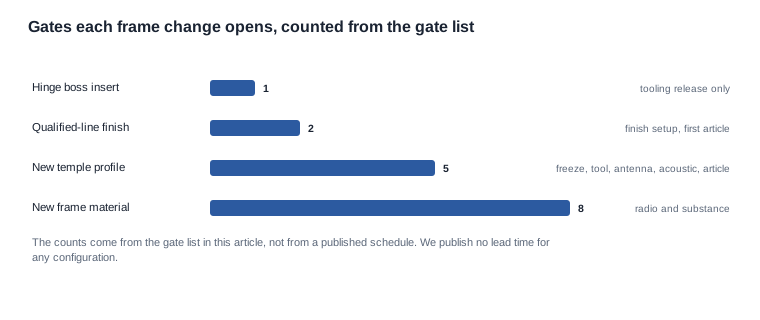
Ranking changes by gates opened rather than by an estimated number of days is deliberate. A day estimate from a supplier is a guess dressed as a commitment, it changes depending on who is asked, and it cannot be checked. A gate count is derived from the programme's own structure, and it can be argued about on the facts: if the change does not move the antenna keepout, then the radio assessment is not a gate, and the count drops.
The counts in the chart come from the gate list below, and they are the ones we would defend:
- A threaded insert in the hinge boss opens one gate: the release of the production tooling with the boss modification.
- A finish on an already-qualified line opens two: the finish setup and the first article.
- A new temple profile opens five: the design freeze, the tool release, the antenna keepout check, the acoustic cavity check and the first article.
- A new frame material opens eight: the five above, plus the radio assessment, the safety re-test and the substance declaration.
A buyer using this ranking should be able to say, for any proposed change, which of these it is — and a supplier who argues with the count is usually arguing with the structure of the programme, which is a useful conversation to have before the purchase order rather than after it.

What a new frame material re-opens across the file
Because a material change is a product change, the eight gates are not all inside the factory, and it is worth separating them before the schedule is committed.
Inside the factory: the design freeze, the tool release, the first article, and the production tooling release with the modified boss. These are the gates a supplier owns and can usually commit to a slot.
Inside the test programme: the radio assessment, the safety re-test and the substance declaration. These are queues, not slots, and they belong to a laboratory's capacity rather than to the supplier's. Their duration is not something a supplier controls, which is why a programme that changes material close to a launch date is gambling on a laboratory's calendar.
Outside both: the acceptance criteria in the purchase order, and the retained-sample baseline. If the material changes, the baseline unit you were comparing later deliveries against may no longer be representative, and the first article of the new material is a new baseline rather than a comparison against the old one. Programmes that treat the new first article as a comparison against the old unit spend weeks discovering differences that were always going to be there.
When a cosmetic route is enough, and when it is a trap
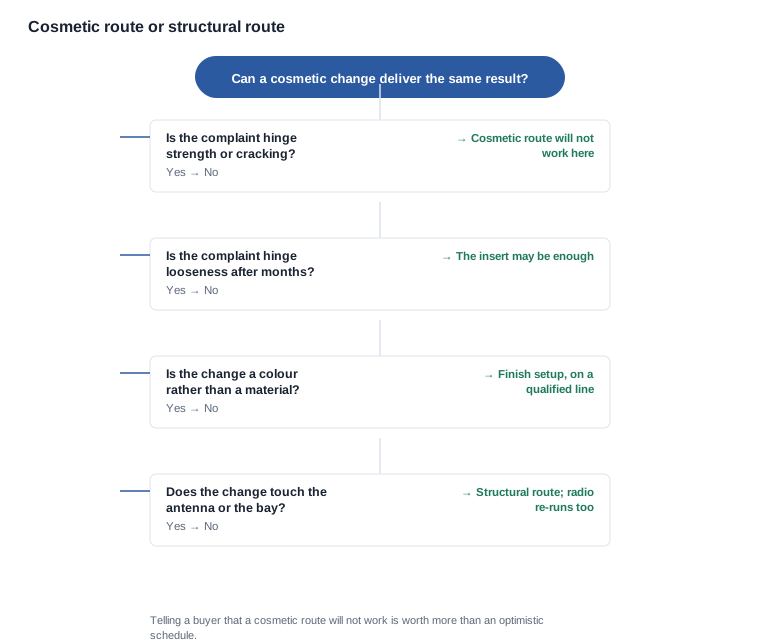
Telling a buyer that a cosmetic change will not achieve the result is worth more than an optimistic schedule, and it is a question a supplier should be asked to answer explicitly.
A hinge strength or temple cracking requirement cannot be met by a finish, a colour or a decal. If the acceptance criterion is a cycle count or a load, the change has to be structural, and the schedule should be built around that.
A hinge looseness after months in service may be met by an insert, and may not be met by an insert if the geometry itself is the cause. The question to ask is whether the looseness is a fastener problem or a geometry problem, and the answer is observable in a counted cycle test.
A colour or appearance change is cosmetic, and the gate is a finish setup — provided the line is already qualified for that colour. If it is not, the change is a qualification and the schedule should say so.
A change that touches the antenna keepout or the cell volume is structural no matter how cosmetic it looks, because it moves the radio environment and the bay, and both of those have their own gates.

Finding the longest single item and naming who owns it
The question to ask is never "how long does a frame change take". It is "what is the longest single item on this schedule, and who owns it".
A tooling change is usually the visible answer, and it is frequently not the binding one. The invisible items that more often dominate are a plating line qualification, a first-article failure that requires tool modification, and a re-test triggered by the frame change itself. Each of the three belongs to a different organisation, and a schedule that lists them together without owners hides the fact that the programme is only as long as its slowest and least controllable item.

Six steps turn that question into a schedule a buyer can accept.
- Name the single longest item and the party who owns it. Not the average item and not the factory's item; the one that sets the date.
- List every gate the change opens, from the gate list in this article, and mark the ones that need a document rather than a factory slot.
- Mark the gates that sit after the design freeze, because those cannot be compressed by adding factory capacity. They can only be moved by moving the date.
- Agree the longest item in writing before the quotation is accepted, including who is accountable for it and what happens if it slips. A schedule with no remedy attached to its critical item is a hope rather than a plan.
- Separate the factory schedule from the document schedule, and require both. A supplier quoting a factory date against a programme that includes a laboratory queue has quoted half the schedule.
- Hold the change-control obligation against the party who owns the longest gate. This matters because the longest gate is often not the factory's, and a contract that places every obligation on the factory places the obligation for a laboratory queue on a party that does not control it.
The commercial point underneath all six steps is that the negotiating capital in a frame programme is not in the unit price. It is in the gate list, in the design freeze date, in the number of configurations you commit to and in the retained-sample baseline. Those are the numbers a supplier can actually move.
The questions to ask for a schedule that can be verified
A schedule is only useful if the buyer can check it later, and most frame schedules fail that test because they are a list of activities rather than a list of commitments. Seven questions turn a schedule into something checkable, and they are the questions to ask in the same email that asks for the date.
- Which single item sets the date, and who owns it? If the answer names an activity rather than an owner, the schedule has no critical path yet.
- Which items are laboratory queues rather than factory slots? The two are scheduled by different organisations and quoting them as one number hides the risk.
- What has to be frozen before the tool can be released? Design freeze, cell configuration, colour count, case inclusion and the model designation.
- Which gates can be compressed, and which can only be moved by moving the date? A supplier who says everything can be compressed has not counted the gates.
- What is the acceptance criterion at each gate, and who signs it? A gate with no criterion is a date with no meaning.
- What happens to the date if the first article fails and the tool has to be modified? This is the single most common cause of a slip in this category, and it is rarely in the original schedule.
- What is the unit of account for the schedule — per configuration, per colour, or per model? A programme with four colours and two configurations has eight schedules, not one, and a supplier quoting a single date has quoted the easiest one.
The trade-off to negotiate around is the classic one: a shorter schedule bought with a looser first-article criterion transfers risk from the date to the defect rate. That trade-off should be made explicitly, in writing, by the buyer — and it should be made once, at the programme level, rather than discovered one gate at a time.
A negotiation checklist for the frame schedule
Before the quotation is accepted, six items should be settled, and each of them is a question whose answer changes the price or the date.
- The design freeze date, and what it locks. Cell configuration, colours, cases, model designation, temple option.
- The number of configurations committed, and the minimum per configuration. A committed combination count moves the per-configuration minimum in a way that a committed unit count does not.
- The ownership of the longest gate, with a remedy attached to it.
- The first-article failure remedy, and whether a tool modification is inside the quoted date.
- The document schedule, quoted separately from the factory schedule, with the re-assessment scope named.
- The change-control rule, so that a later material change is a priced event rather than a surprise.
When to raise these is itself a negotiation. Raising all of them before the first quotation typically produces a longer quoted date and a lower programme cost; raising them after the design freeze produces a shorter quoted date and a higher programme cost, because by then the only lever left is money.
What we can and cannot tell you about frame specifications and dates
We publish no frame material composition, no wall gauge, no hinge construction detail and no temple dimension for any model in our range. The one mechanical figure in the whole catalogue is a weight of 158 g for the MT6 glasses unit, which includes the 265 mAh cell and the camera and excludes the foldable charging case; the charging case holds 1200 mAh and its own weight is not published.
We also publish no lead time, no minimum order quantity and no unit price as fixed numbers on this site. That is not a policy of concealment. A lead time quoted without a configuration behind it is not information: the frame material, the section at the electronics bay, the number of colourways, the number of configurations and whether a case is part of the product all change the answer, and two programmes with the same model number can sit at opposite ends of the range.
That means a frame-related lead time conversation has to start with information we do not hold, and the honest way to handle it is to request the mechanical specification from the manufacturer rather than to plan against an assumption. Our position is that we will categorise the change, state what it gates, identify the longest item and name who owns it, and tell you when a cosmetic route achieves the same result as a structural one — because that is the most valuable thing a supplier can offer in the first month of a programme.
If you send us the frame change and the configuration, we will tell you what it gates and what has to be frozen first. The engineering route and where a material change travels are set out under engineering customisation, and the rows we do hold for every model are set out under materials and ergonomics.
Related reading
- frame materials problems and fixes
- frame material specifications to compare
- engineering customization timeline
Tell us the frame change and we will say what it gates and what must be frozen first.


