
A delivery date in smart glasses is moved by six things, and they are not equally powerful. The most common mistake in a schedule negotiation is to argue about the one factor that is usually least binding — the factory's available capacity — while the factor that is actually binding sits on the buyer's own desk, unowned and undated.
The pattern holds across this category because the published specification already removes most of the manufacturing uncertainty a buyer would normally worry about. What is published for the twenty-eight models in the catalogue — the battery capacity and rated use, the charging time for every model, the charging method for the twenty-four where it is stated, the Bluetooth version for the fourteen where it appears, the case capacity for the five models where it is published, the camera resolution tier of eight 8 MP models and three 13 MP models — describes the product, not the date. The date is moved by what is not published: the readiness of a part, the state of a decision, the opening of a file, the terms of a booking.
The conclusion is practical and slightly unwelcome: two of the six factors are entirely the buyer's, and they move the date by weeks while costing nothing. The order of attack matters more than the intensity of the negotiation. Before you argue about capacity, work down the list — configuration, artwork, parts, documentation, slot, shipment — and find the first one that is not ready.
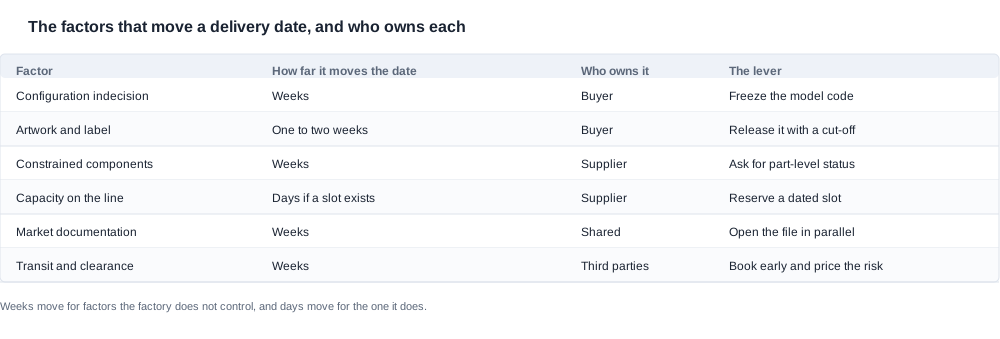
Smart glasses lead time: the six factors that move a date
Here are the six, described by what they are rather than by where people say they belong.
Configuration indecision. The model code, the colourway, the feature set and the packaging variant. Until all four are fixed, the factory cannot buy a part, cannot book a line setup and cannot write a document, and a programme waits on a decision rather than on a machine. This is the factor buyers most often do not recognise, because the waiting feels like supplier delay while the queue is actually in the buyer's own meeting calendar.
Artwork and label release. The final artwork, the packaging proof, the label content with the importer's identity and address, and the approval of each. The label in particular is on the critical path for any market where the manufacturer's or importer's identification has to appear on the product.
Component readiness. Which purchased parts are physically on hand, which are on order, and what each sub-supplier's own lead time is. This is the factor that usually turns a nominal production window into a longer one, because the quoted window describes the line and the line waits for its material.
Line capacity and the production slot. Whether a slot exists, and whether it is held in writing with a date. This is the factor everybody argues about, and it is real — but it only binds when everything else is ready, and a slot in a busy factory does not shorten the wait for a missing part.
Documentation. The conformity file for the destination market, the declaration, the battery transport summary, the test reports. The route can run in parallel with production or after it, and the choice between those two orders is worth several weeks.
Transit, clearance and consolidation. The booking, the mode, the consolidation window, the destination clearance and the free time at the port. This factor moves the arrival date rather than the build date, and it is invisible to a factory whose commitment ends at the loading bay.

Ranking the factors by how far they move it
Ranked by the distance a factor typically moves a delivery date, and by whether the buyer can do anything about it:
| Rank | Factor | Typical effect | Owner | Can the buyer move it? |
|---|---|---|---|---|
| 1 | Configuration indecision | Weeks | Buyer | Yes, immediately |
| 2 | Component readiness | Weeks | Supplier and sub-suppliers | Partly, by substituting |
| 3 | Documentation route | Weeks | Shared | Yes, by opening it earlier |
| 4 | Artwork and label | One to two weeks | Buyer | Yes, with a cut-off date |
| 5 | Transit and clearance | One to three weeks | Third parties | Partly, by booking early |
| 6 | Line capacity | Days, when a slot exists | Supplier | No, but it can be reserved |
The ranking is worth holding onto because it inverts the usual negotiation. Capacity sits last on the list not because it is unimportant but because it only bites once the first five are ready, and arguing about it while a configuration is open is a negotiation about something that has not started.
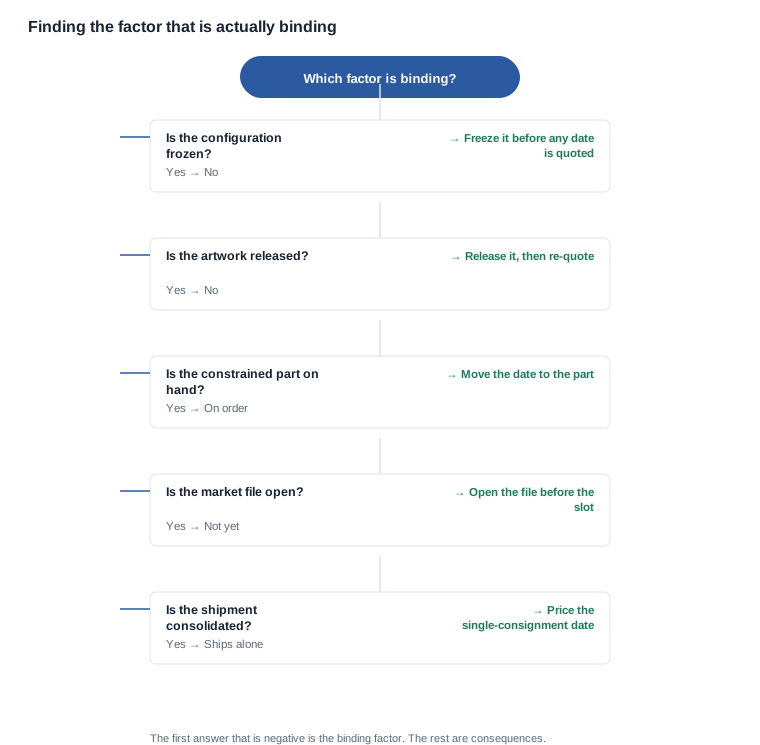
How to rank a factor you have never seen before
A buyer will meet factors that are not on the list above, because every factory has its own way of working and every programme has its own shape. There is a repeatable way to rank an unfamiliar factor, and it uses three questions in order.
How far does it move the date? Estimate the range, not the point. A factor that moves a date by two to three days belongs near the bottom of the list; a factor that can move it by three weeks belongs at the top regardless of how technical it sounds. The estimate does not need to be accurate. It needs to separate days from weeks.
Who can move it? A factor that only one party can move is either a lever or a fixed point, and the distinction is worth making explicitly. A configuration decision that the buyer can take today is a lever. A sub-supplier's material schedule is a fixed point, and the only management technique available is starting earlier and monitoring.
Will the buyer notice it happening? This is the question that separates the visible factors from the dangerous ones. A factor that produces a daily status update is easy to manage. A factor that reveals itself on the delivery day — a missing document, a substituted part, a missed consolidation — is dangerous precisely because it is silent, and it should be ranked higher than its magnitude suggests.
Applying those three questions in order turns an unfamiliar factor into a decision: whether to move it, monitor it or price it. The third answer is the one buyers forget, and it is the one that prevents a surprise from becoming a commercial event.
Why capacity is usually not the binding factor
A factory with idle capacity and a missing component arrives later than a full factory with the component on the shelf. This sounds obvious and it is still the argument most often lost, because a buyer has leverage over capacity — the order is worth having — and has almost none over a sub-supplier's material schedule.
The way to settle it is not to ask about peak output. It is to ask what the critical path for this specific order is, and to require the answer to name the constraint. A supplier who answers "the line" has answered about the wrong part of the schedule. A supplier who answers "the camera module, four weeks from the supplier's date" has answered about the right part, and has told the buyer which date to monitor.
The two factors that move the date for free
Configuration and artwork are the two factors a buyer controls completely and pays nothing to control. Freezing a model code is a decision. Setting a cut-off date for the artwork is a decision. Publishing the internal approval deadlines so the factory can see them is a decision.
Together they account for more schedule movement than any commercial concession a buyer is likely to obtain, and they cost a meeting and a note in the order file. The reason they are neglected is that they are invisible in a quotation: no supplier will quote them, because they are not theirs to quote.
Attributing each factor to the party who owns it
Every factor has an owner, and the owner's identity decides what the buyer can do about it. A factor owned by the buyer is fixed with a decision. A factor owned by the factory is fixed with a reservation. A factor owned by a third party is fixed with an early start and a plan for when it moves.
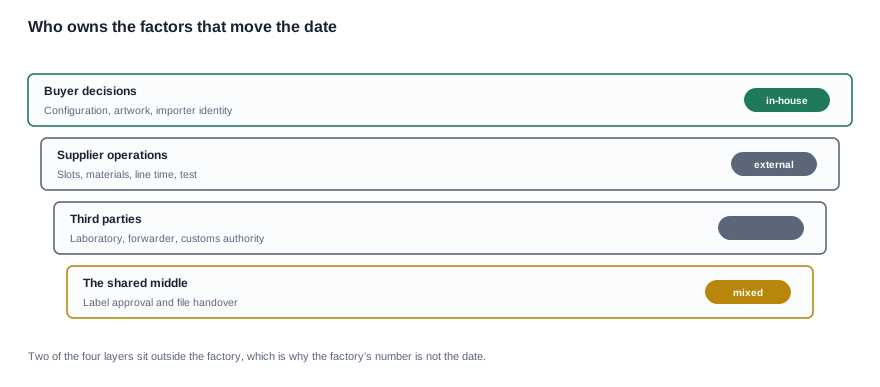
The three layers and the mixed middle
The buyer's layer holds the configuration decision, the artwork release, the importer identity and the internal approval calendar. The supplier's layer holds the material readiness, the slot, the line time and the test plan. The third-party layer holds the laboratory, the forwarder and the customs authority, none of whom will prioritise a single order.
The mixed middle is where most schedules are lost: the label approval, the file handover, the artwork release. Each of these is jointly owned, and a jointly owned item has no deadline, because nobody is accountable for the handover between the parties. The remedy is procedural and cheap — one name, one date, one consequence — written into the order so that it exists in both sets of documents.
Assigning a factor to the wrong party is expensive
The most common error in attribution is booking the artwork under the factory's schedule. A factory asked to chase artwork will chase it, but it cannot chase a decision that is waiting on a design review, and every day of that review is a day the factory is idle rather than a day the factory is late.
The test is simple and it is worth applying to every line of a schedule: who can make this happen faster without asking anyone else for anything? If the answer is nobody, the line belongs in the risk register rather than in the action list.

The order of attack when the date is too long
When a quoted date will not meet the launch requirement, the sequence below is the one that produces the largest movement for the smallest effort. It is deliberately ordered from the cheapest and fastest lever to the most expensive and slowest.

Freeze the configuration and release the artwork. This is a day of work and it removes weeks. It also fixes the scope of every subsequent step, because the file, the label and the parts can finally be written against a specific model.
Ask which single part is constraining the run. A part-level answer converts a general schedule into a monitored one. It is also the point at which a substitution question should be asked, and the point at which the quality consequence of that substitution becomes visible — which is the subject of a separate discussion, but the question belongs here.
Open the market documentation in parallel with the build. A file opened at the configuration freeze is nearly free. A file opened after the goods are built costs the schedule a slot it cannot recover.
Reserve a production slot in writing, with a date. A verbal reservation is a hope. A written one is a plan, and it is the only way to know that the factory has actually scheduled the work rather than acknowledged an enquiry.
Book the shipment and price the single-order case. Consolidation is decided by readiness, so the booking has to happen early, and the buyer needs the rate for a consignment that travels alone.
Re-plan backwards from the launch date. Every date has to be tested against the one date that cannot move. A date that cannot be met is better known on Monday than in the month of despatch.
Why working down the list beats negotiating on capacity
Negotiation works on things the other party owns. Capacity is one of those things, and it is also the most expensive to move and the least likely to be binding. Working down the list is faster because the first two steps are free, and because each step either removes the factor or proves it is not there.
The practical outcome is that a buyer who has run the list can usually say which factor binds and who owns it. That is the sentence that changes a negotiation, because it moves the conversation away from a number the factory controls and towards a date that somebody can be held to.

Reading a real schedule link by link
The example below is an invented scenario used to reason through the factors. No customer, order or shipment is described; the model, the quantity, the durations and the destination are assumed so that the factors can be traced.
The scenario. A brand orders a camera model for a European market. The quotation gives eight weeks from the order date, with the documentation route described as included and the freight assumed to be consolidated. The launch requirement is a stock availability date nine weeks after the order.
The first factor checked is the configuration. The brand has not fixed the colourway, and the packaging variant is still open. Neither is expensive, but the artwork cannot be released and the label content cannot be finalised while either is open, so the documentation route cannot start. The eight-week figure assumes a documentation route that cannot begin.
The second factor checked is the artwork and label. The importer identity is undecided, and in this market the label must carry it. This is the buyer's own work, and it is the reason the route is sequential rather than parallel.
The third factor checked is component readiness. The supplier is asked what the critical path is for this order and answers with the camera module and its sub-supplier date, four weeks from the supplier's own order date. The camera resolution tier is fixed by the model code, so the module is not substitutable within the same tier without a decision the buyer has not taken.
The fourth factor checked is the slot. The factory has capacity in the relevant week, which confirms that capacity is not binding here. What is missing is a written reservation with a date.
The fifth factor checked is the shipment. The order is small and will travel alone, so the consolidated freight assumption in the quotation is wrong, and the arrival date is later than the dispatch date by more than the buyer assumed.
The result. The schedule was not eight weeks. It was nine weeks of work that the buyer's own decisions had added to a five-week production and documentation path, plus a transit assumption that had never been tested. The binding factor was the artwork handover, and it belonged to the buyer.
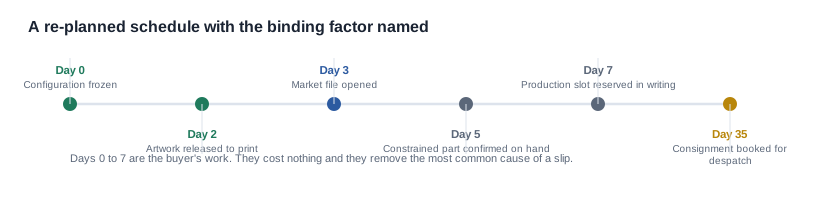
The two numbers to write on the re-planned schedule
Once the factors have been traced, two numbers are worth writing on the re-planned schedule and carrying through to the order.
The first is the free-start date: the day every input the factory needs has arrived. It is almost always earlier than the order date, because buyers place orders to trigger work rather than to record a decision they have already made. A schedule that runs from the order date while the free-start date is two weeks later is not a schedule, and the gap between the two is the first thing to close.
The second is the single longest link in the chain, expressed as a range rather than a date. This is the number to monitor weekly, because it is the one that can move without warning, and it is the one that should carry the float in the plan. If the longest link is a sub-supplier's material schedule, the float belongs there; if it is the buyer's own artwork, the float belongs to the factory's slot.
Together these two numbers turn a list of factors into a managed plan. The first says when the programme can genuinely start, and the second says what to watch. A buyer who has both can explain the date to a colleague, which is the practical test of whether a schedule is real.
What the re-plan changed
Two days of work on the buyer's side — freezing the configuration, settling the importer identity, setting an artwork cut-off — moved the date by two weeks and cost nothing beyond a meeting. Opening the documentation route at the freeze rather than after approval removed the sequential dependency. Writing the slot reservation and re-checking the freight assumption removed two uncertainties that would otherwise have surfaced at despatch.
None of this was a negotiation with the factory. All of it was a negotiation with the buyer's own calendar.
What we can and cannot state about our own factors
Stated plainly: the published catalogue is the part of this discussion we can stand behind, and a factor which we do not publish should be treated as a question to ask rather than as a figure to accept.
What we publish is the specification: the twenty-eight models and their rows — the battery capacity and rated use for each, the charging time for every model, the charging method for the twenty-four where it is stated, the Bluetooth version for the fourteen where it appears, the case capacity for the five models where it is published, the ingress rating on the two models that carry one, and the camera tiers of eight models at 8 MP and three at 13 MP. The camera range is listed on our AI camera glasses page with the models that make it up.
What we do not publish: production lead times, production capacity, daily output, line counts and the stage durations behind them. We will not quote a factory capacity number to close a conversation, because a capacity claim without a configuration and a quantity is not a claim a buyer can check.
What we will do is take a model, a quantity, a destination and a required date and tell you which configurations exist, which published rows the schedule has to be built around, which of the six factors is currently binding for that configuration, and which factor on the list the buyer should attack first. We will also tell you plainly when a date cannot be met.
The surrounding material is at the lead time section, the benchmark question is at industry benchmarks, the capacity factor is examined at how capacity affects lead time, and the warning signs are at production capacity red flags.
The action to take now. Put the six factors against the last schedule you were given, in order, and find the first one that is not ready. Then ask the supplier which factor binds for that order. If the two answers agree, you have your programme. If they do not, the disagreement is the next conversation.
Related reading
- Lead time section — the schedule these factors move
- Industry benchmarks — how to compare quotations
- How capacity affects lead time — the factor buyers argue about most
- Production capacity red flags — warning signs in a capacity claim
- AI camera glasses — the models in the camera range