

Microphone quality is worth an afternoon of testing when it decides whether the product works, and worth nothing when it does not. Buyers routinely over-invest in audio testing for products where audio is incidental, and under-invest for products where voice is the entire value proposition. Both errors are expensive, and the first one is the more common because the second one is invisible until a customer complains.
So the useful question is not how good the microphone is — that cannot be answered from any datasheet in this category — but whether it decides your purchase. That is smart glasses microphone quality smart glasses do you need it reframed as a decision rather than as a measurement, and the answer is a branch rather than a number. Some branches end with a full acoustic test programme, and one of them ends with a note in your own records saying that the microphone was not tested, which is a perfectly respectable outcome.
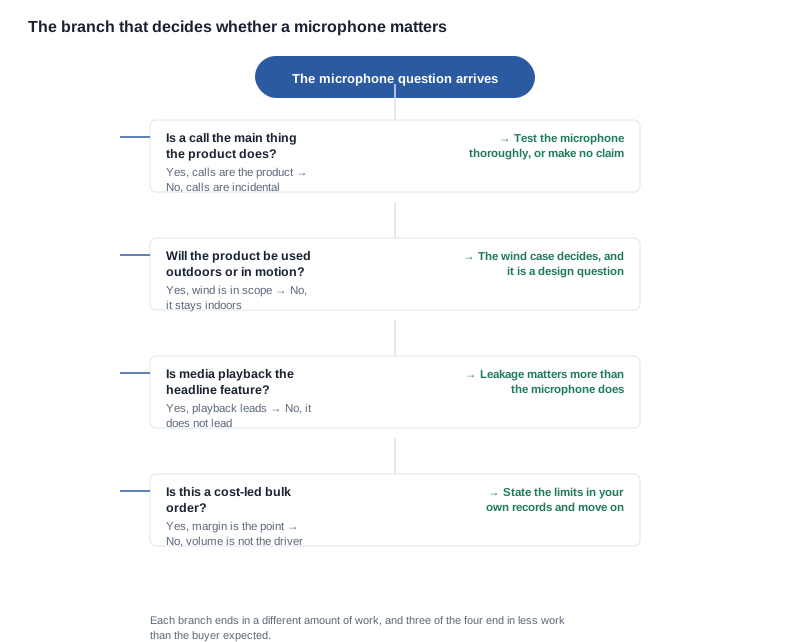
Smart glasses microphone quality: the question behind whether it decides a purchase
Where voice sits in the programme, and what goes in the listing
The reader here is a brand-side buyer, a channel buyer or a product manager who has been handed a product brief and a budget, and who has to decide how much of both goes into voice. The decision is rarely about the microphone itself, because nobody can compare two microphones on paper in this category. The decision is about where in the programme voice sits, and it has a specific commercial shape.
If voice is the product, then the microphone is the product and the cost of getting it wrong is a support stream, a review that says nothing precise, and a channel that stops using the headline feature without ever telling you why. If voice is incidental, then the cost of getting it wrong is an afternoon and a unit, and the cost of getting it right is an afternoon and a unit. That asymmetry — the failure mode of the wrong branch is much more expensive than the failure mode of the right one — is why this question is worth answering before the specification is written rather than after the first delivery.
The second thing the buyer is deciding is what goes in the listing. In every branch, the outcome has a claim attached to it, and the claim has to match the work that was actually done. The branch where you conclude that voice does not matter produces a narrower listing, and that is the point rather than a disappointment.
The two questions that settle the branch
Two questions settle it, and both are answerable from information the buyer already has.
Is a call the main thing the product does? If the customer is buying the product to stop holding a phone, then the microphone is the product. If the customer is buying it to capture video and the call function is a convenience, then it is not.
Where will it be used, and at what background level? A desk, a vehicle, a plant floor and a windy street are four different products, and the microphone requirement follows the environment rather than the feature list.
Everything else in this article is a consequence of those two answers.
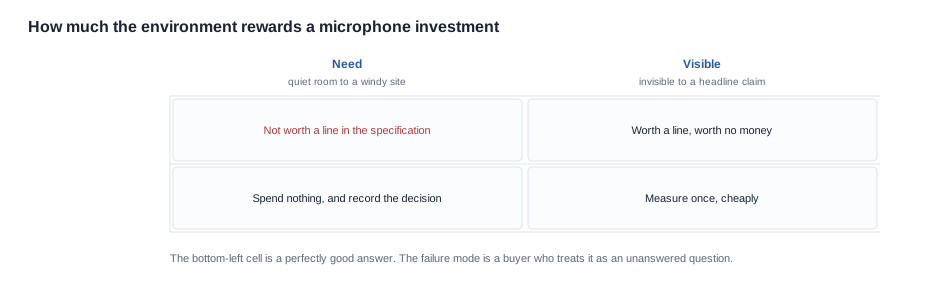
When the microphone is the product and when it is incidental
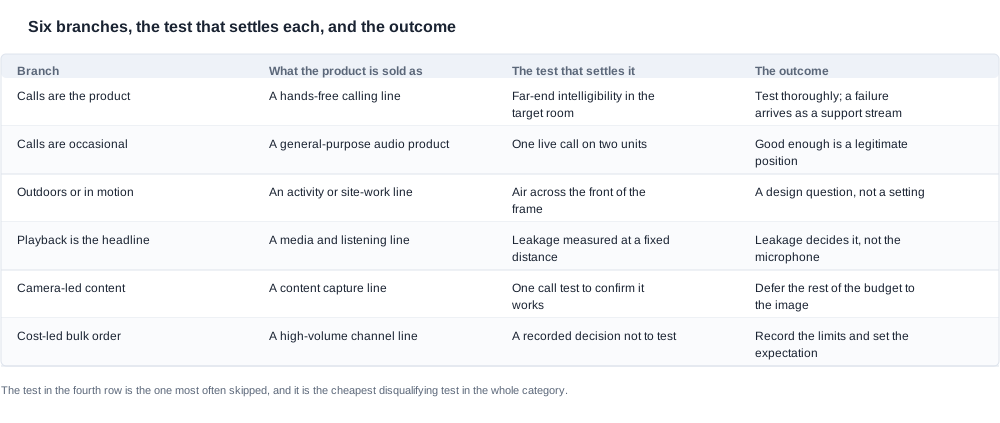
Branch one: calls are the product
If the value proposition is that nobody holds a phone any more, then the microphone is the product and its quality decides whether the proposition is true.
This is the branch where testing matters most and where the cost of not testing is highest, because the failure arrives as a support stream and a review problem rather than as a return. A customer whose calls sound bad does not necessarily return the product — they stop using the feature, which is worse, because nothing surfaces it. The symptom is a product with a good return rate and a falling feature-usage rate, and the two resemble two separate problems until somebody connects them.
Test thoroughly: three-metre intelligibility, a live call on a real network, and the environment the product is actually sold into. Two units from the same batch, not one, because a single unit cannot tell you whether the product is a product.
The three questions to ask before you decide which branch you are in
Whatever branch you land in, three questions are worth asking a supplier before the decision is written down, and they are worth asking together rather than one at a time.
How many microphones are fitted, and where are they positioned on the frame? This is a hardware answer with a one-line reply, and it tells you whether the product in front of you is built for calls or built for a demonstration. If the answer is per family rather than per model, that is a finding rather than an answer, and it should be recorded as one.
What does the noise processing act on, and what is its documented behaviour on a voice at conversational distance? A named signal and a described behaviour is a specification. A technology name is a label, and the distinction is the whole basis on which a premium can be assessed.
Is any microphone figure published for this model, and if so under what test condition? A figure with a condition is a number you can use. A figure without one is not a figure, and the correct treatment is to record it as absent rather than to carry it into a comparison table as a low score.
The three questions together decide the branch in most cases, because a supplier who can answer all three with specifics has a product designed for a voice use case, and one who cannot has a product designed for a listing page. Neither of those is a bad outcome; both are just different programmes with different budgets, and the mistake is to buy one and brief it as the other.
The questions to ask in a fuller form are listed at microphone specifications to request, and the criteria that sit behind them are in how to read a microphone datasheet.
Branch two: calls are occasional
Good enough is a legitimate position, and it is worth saying so plainly because buyers in this branch tend to over-test and then treat the result as a specification when it is not.
What is not legitimate is assuming good enough without checking, because the spread between suppliers in this category is wide and much of it is invisible until a customer uses the product. One test — a live call at conversational distance on two units — is enough to separate a product that works from one that does not, at minimal cost.
The reason one test suffices here is that the bar is low and the environment is controlled. A quiet room and a desk are the conditions a platform microphone handles, so the test is a sanity check rather than a discriminator, and there is no reason to spend more on it.
Branch three: outdoor or in use while moving
This is the branch where microphone quality stops being a specification question and becomes a mechanical one.
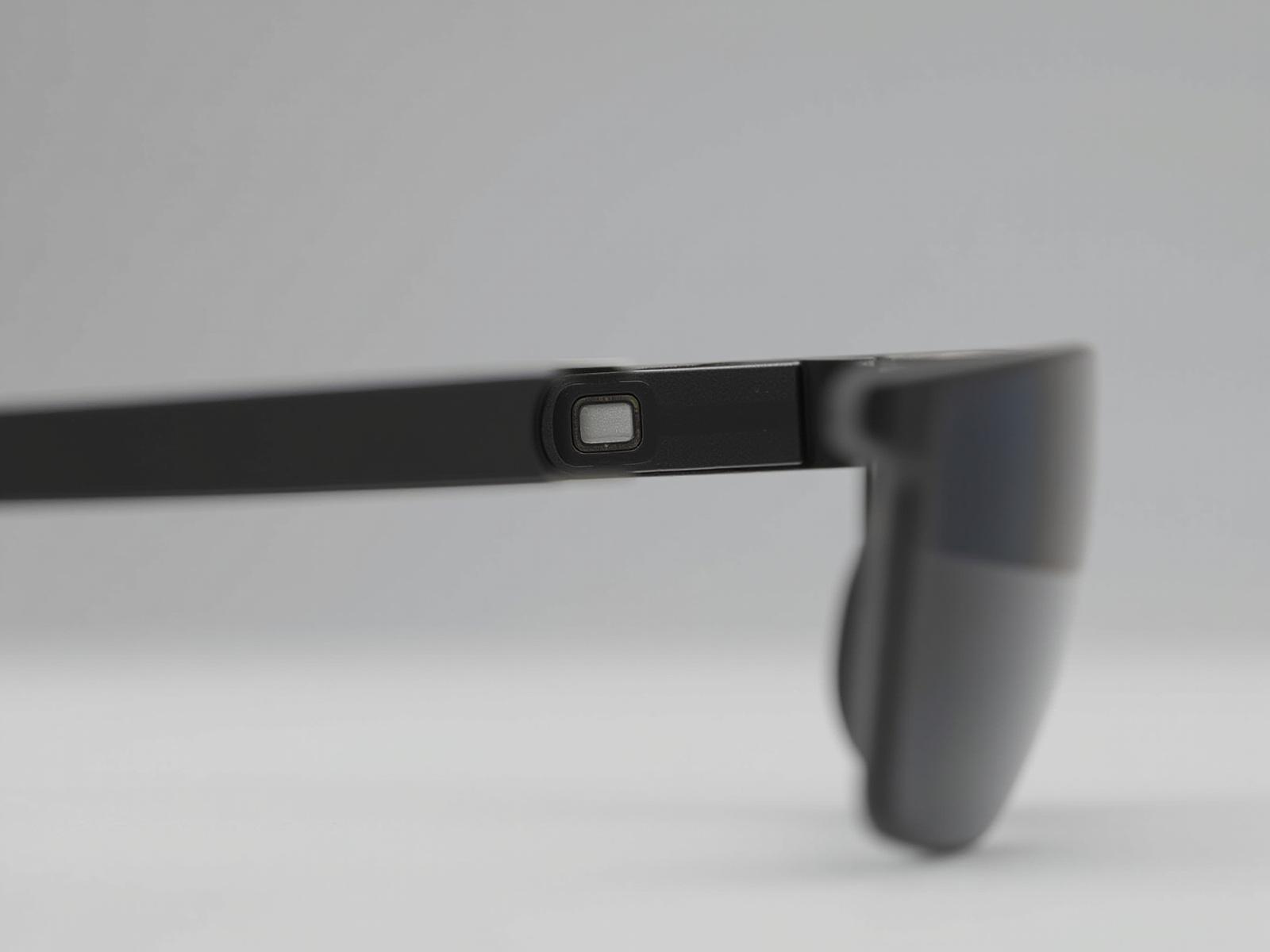
A temple-mounted microphone sits directly in the airflow, and wind noise is low-frequency, which is the range basic filters handle worst. Software reduces it; it cannot remove it, because the acoustic information is contaminated before the signal reaches the transducer.
If the product will be used outdoors, run the wind test with air blown across the front of the frame. If the product fails it, no firmware change will rescue it, and the design decision has to be made before the order rather than after the first returns. This is the branch where the answer to whether you need microphone quality is not really about the microphone at all — it is about whether you are prepared to accept a product that does not work outdoors, and if you are not, the routing and the chamber have to change.
The branch where leakage, not pickup, decides the outcome
Branch four: media playback is the headline
Here leakage matters more than the microphone does, and buyers regularly get this backwards because they spend the budget on the parameter that is easy to test rather than on the one that produces the complaint.
Leakage is how much transmitted sound escapes into the environment. For someone in an office or a public place, high leakage is a courtesy problem, and in some professional contexts it is an exposure question for the people nearby. The complaint it generates is not a microphone complaint and it does not get counted as one, which is why it survives into the channel.
We publish no leakage figure for any model, and neither does most of the category. A quick check is to play audio in a quiet room and stand a measured distance away: if the sound is clearly audible, leakage is significant for that use case. A distance has to be fixed before the test rather than chosen after it, because "clearly audible" is not a measurement and a fixed distance is.
The practical consequence for the buyer is that a leakage test is cheaper and more decisive than a microphone test in this branch. It takes five minutes, it needs no script and no judge, and it disqualifies a product that a microphone test would have passed.
Branch five: camera-led content creation
Audio is secondary, and there is a good reason not to test it exhaustively: the buyer will not hear the difference between two microphones when nobody is listening for it, and the budget spent on that difference would be better spent on the image.
Defer to the sample. Do one live call to confirm the microphone path works, and spend the remaining time on image quality, field of view and storage behaviour, which are the parameters that determine whether the content is usable at all. Note the decision in your records, so that the expectation in the channel is set correctly when a customer asks.
Branch six: cost-led bulk ordering
On a large order where margin is the whole point, spending a day per stock keeping unit on audio testing does not pay.
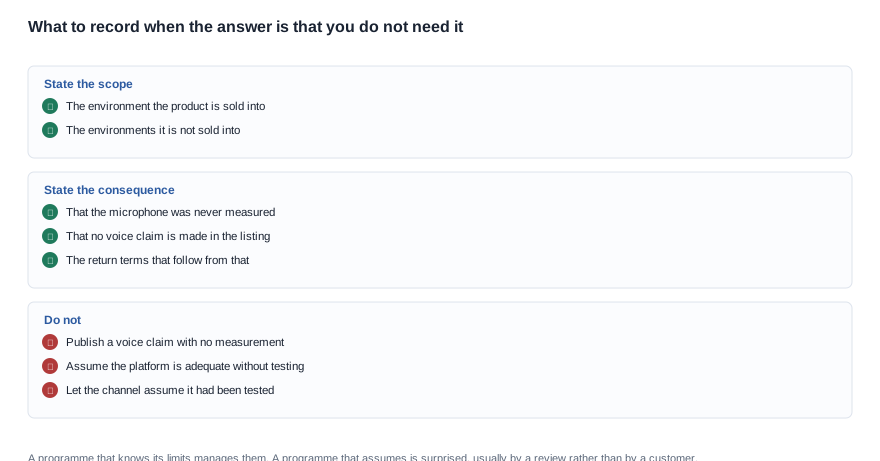
What does pay is stating in your own records that microphone performance was not tested, and that no voice claim is made in the listing. The commercial value of that note is not obvious, and it is worth spelling out: a channel that has been told that voice performance was not tested will route voice complaints to support rather than to returns, and a channel that has not been told will route them to returns, where they are far more expensive.
A programme that knows its limits manages them. A programme that assumes is surprised, and it is usually surprised by a review rather than by a customer, which means the information arrives too late to be useful.

The branch where the answer is to defer to the sample
When the decision is not yours to make
There is a fourth category of outcome that is easy to miss because it is not a branch of the feature tree at all: the cases where the answer cannot be produced internally.
Three situations produce it. The first is a buyer with no engineering function and no access to a test bench, which is common in a channel business where the product is bought rather than developed. The second is a market with a fast turnaround, where the window between deciding and shipping is too short to run a protocol and the product has to go out on the supplier's evidence alone. The third is a product with no voice requirement stated anywhere, which is a sign that nobody has decided yet.
In all three, the correct action is the same: defer to the sample, and make the deferral explicit. That means asking the supplier to run a specific protocol on production units and to supply the raw recordings, rather than asking for a conclusion. It means specifying the protocol in the purchase order so that the result is a record you own. And it means not making a voice claim in the listing beyond what the returned record supports.
The alternative is to accept a feature name as a specification, which is the route that produces a product that works in the demonstration and fails in the customer's environment, and that failure is an expectation failure, which is a category of return that is almost never counted as a defect.
How to make a deferral defensible
Four things turn a deferral into a defensible position, and none of them requires a test bench.
The protocol, written down. Even if you never run it, the written protocol is what makes the supplier's result comparable with a future one and what makes your request legitimate rather than a complaint.
The units asked for. Ask for production units rather than engineering samples, and ask for the raw recordings rather than a conclusion. A conclusion is a summary; a recording can be re-judged by someone you did not choose.
The inspection clause. Specify that the same protocol applies to incoming deliveries, with a tolerance. This is what stops a deferral turning into a surprise in month three.
The claim boundary. State in the listing and in the channel material that the voice performance is specified for a stated condition, and nothing beyond it.
The branch where a microphone is not worth a line in the specification
Deciding that voice does not matter, and saying so
Sometimes the honest answer is that the microphone does not need a line in the specification at all, and that is a real answer rather than a failure of diligence.
The test of that answer is simple and it is uncomfortable for a buyer who has spent a week on this topic: would any customer in the target channel tell a colleague not to buy the product because of the voice? If the answer is no, then the microphone is not a purchase criterion, the budget belongs somewhere else, and the specification should not carry a row that nobody will ever use to make a decision.
Recording that decision matters more than the decision itself. A programme that has decided not to test voice and has written down that it decided not to test voice is in a completely different position from one that has simply never tested it. The first can answer a customer who complains about a call; the second cannot.
The commercial terms that follow a "no"
A decision not to test voice is not a decision to stop managing voice commercially, and the terms that follow it are different from the terms that follow a full test programme. Four of them are worth negotiating at the point the decision is written.
The claim boundary, in the agreement rather than only in the copy. A clause that no voice claim may be made beyond the tested condition protects the buyer as much as the supplier, because a claim made in a channel listing is a claim somebody else has to honour.
The inspection and the retained unit, at a reduced scope. If voice is not a purchase criterion, the incoming inspection does not need the acoustic protocol — but it does need the retained unit, because drift in the acoustic arrangement is what changes the product's position in a channel.
The return terms. This is where a decision not to test actually pays. A voice-led line and a general audio line have different return economics, and the difference is expressed in the return terms rather than in the unit price. Knowing which line you are on, and writing the terms to match, is a commercial decision that follows directly from the branch.
The price tier and the minimum order quantity. If voice is not being differentiated, the programme's commercial logic is elsewhere — usually volume, margin or a different configuration count — and the negotiation should be spent there rather than on a microphone premium that nothing will recover.
The total cost of a "no" is not zero; it is the cost of the claim you will not be able to make and the cost of the returns you will absorb instead. Knowing that number is what makes the "no" a decision rather than an omission, and the criteria for setting it are the ones above.
The three ways a "no" turns into a problem later
The claim creeps in. The specification says nothing about voice, and then the listing says the product has intelligent noise reduction, because the phrase came from the catalogue. The claim now exists without a measurement behind it, and the risk moves from a return to a compliance question.
The channel assumes. Nobody told the channel that voice was not tested, so the channel's own copy implies that it was. The expectation arrives before the product does.
The product changes. The model list is extended, a new market is opened, or the supplier offers a voice-enabled variant of the same platform. None of these triggers a review of a decision that was never written down, because there is nothing to review.
Each of these three is prevented by one line in an internal record, and each of them is the reason a "no" is worth documenting.
What a do-you-need-it answer becomes in your own records
The note, and the four lines it should contain
A useful record of this decision is four lines long, and it is written before the purchase order rather than after it.
The environment. One sentence naming where the product is sold and what the background level is there. Without this, nobody can reconstruct the reasoning later.
The scope of the decision. What was decided about voice — tested, partially tested, or not tested — and what the resulting claim is limited to.
The consequence. What the channel and the listing may say, and what they may not.
The trigger to review. The condition that would reopen the decision: a new environment, a new market, a change of platform, or a complaint pattern.
That fourth line is what turns a note into a control. Most programmes record the decision and never set the trigger, and then the decision silently expires and the product ends up in an environment it was never specified for.
The commercial answer, once the branch is settled
The branch determines the programme, and the programme determines which commercial terms are worth negotiating. Four of them move with the branch, and the pattern is consistent enough to be worth stating.
The supplier's own evidence is the contract, not the demonstration. Whichever branch you land in, the request for a measured result on production units, with the raw recordings supplied, is the term that makes every later claim enforceable. It is worth more than any unit price difference.
The price tier and the minimum order quantity follow the branch. A product whose voice performance is differentiated is a product whose value depends on a channel with a high volume of voice use, and a pilot tier is worth taking on such a line. A product whose voice performance is deliberately unremarkable is a product bought for scale, and the negotiation belongs in the volume terms rather than in the specification.
The sample order and the unit price are separate decisions. A sample order on a line where voice is not being tested is a short piece of work, and the supplier's willingness to run a protocol on it is worth more than a discount on it.
The warranty and the return terms are where a "no" actually gets paid for. A programme that has decided not to test voice and has written the decision down can set warranty and return terms that match the scope it has actually specified. A programme that has not decided anything cannot.
The lead time, the unit price, the landed cost, the tooling and the certification scope are all confirmed per enquiry, because each depends on the configuration, the quantity, the documentation scope and the current schedule — and a quotation that does not say which acoustic configuration it covers is a quotation for a different product.
What we will and will not tell you
It is worth being precise: we publish no microphone specification because we hold none, and we will not estimate one. Where microphone quality is decisive for your use case, we will run the tests with you on a sample and report what we hear — including where the result is worse than you expected. Where it is not decisive, we will tell you that as well, because a programme that spends a week proving something does not matter has spent a week it could have spent on the parameter that does.
The design questions behind these branches are covered at noise control and microphone pickup, the acoustic arrangement that decides several of them is at open ear audio, and the plain-language version of the rows this article assumes is in smart glasses microphone quality for beginners.
Tell us the use case rather than the product, and we will tell you whether the microphone is the parameter that decides it.
Related reading
- Noise control and microphone pickup — how pickup behaves in an open-ear frame, where the person's own voice is the loudest competing sound.
- Microphone quality for beginners — the plain-language version of the rows this article assumes.
- Open ear audio technology — why the acoustic arrangement changes what a microphone test has to control for.
Tell us the use case and we will say whether the microphone decides it.


