

The same microphone is a non-issue in one use case and the whole product in another, and the difference is not the hardware — it is the background level the customer works in. In a quiet office, intelligibility is a solved problem and no microphone investment is warranted. At a site, in a vehicle, or outdoors in wind, the microphone requirement becomes the primary specification and the microphone becomes the product. The practical conclusion for a buyer is to identify the environment first and treat the microphone as a scoping decision rather than a component decision. A buyer who treats it as a component buys a product that works in the demonstration and fails in the customer's environment, which is an expectation failure and returns as one.
The buying task behind this article. The reader is a brand buyer, a product manager or a channel buyer who is choosing a platform and has been shown noise cancellation and beamforming as features. The specific task is to map each target use case to the microphone requirement it actually creates, so that the shortlist reflects the environments the product will be sold into rather than the environments that are easy to demonstrate. The commercial risk being managed is a product that works beautifully in a quiet room and is unusable in the place the customer's work actually happens.
Smart glasses microphone quality: what each use case actually demands
The five rows, and the remedy column
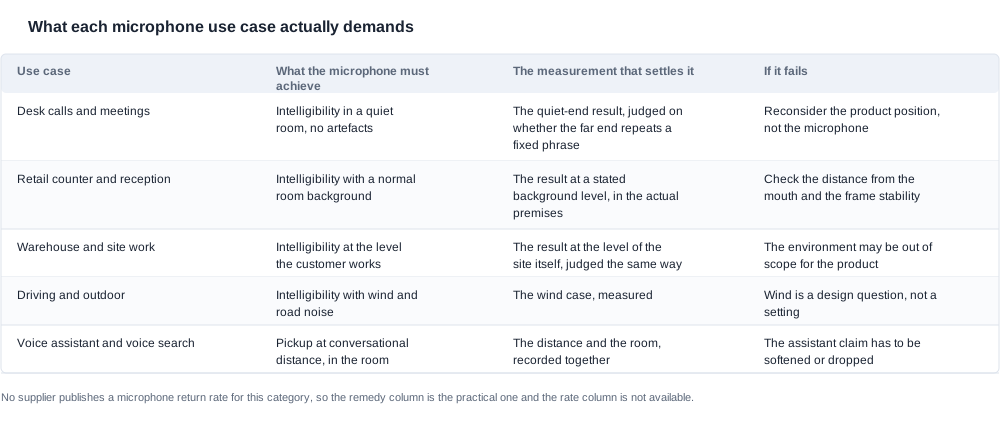
The table below is a scoping tool rather than a comparison, and it is arranged so that the last column does the work. Each row states what the microphone has to achieve, the measurement that settles it, and — the part most scoping tables omit — what to do when the requirement is not met.
| Use case | What the microphone must achieve | The measurement that settles it | If it fails |
|---|---|---|---|
| Desk calls and meetings | Intelligibility in a quiet room with no processing artefacts | The quiet-end result, judged on whether the far end repeats a fixed phrase on the first attempt | Reconsider the product position, not the microphone |
| Retail counter and reception | Intelligibility with a normal room background | The result at a stated background level, in the actual premises | Check the distance from the mouth and the frame's stability |
| Warehouse and site work | Intelligibility at the level the customer is working | The result at the level of the site itself, judged the same way | The environment may be out of scope for the product |
| Driving and outdoor | Intelligibility with wind and road noise | The wind case, measured | Wind is a design question, not a setting |
| Voice assistant and voice search | Pickup at conversational distance, in the customer's room | The distance and the room, recorded together | The assistant claim has to be softened or dropped |
The remedy column is what separates this from a table of requirements. A row that only states a requirement leaves the buyer with a failure and no decision; a row that states the remedy gives a decision that can be taken before the purchase order.
Three of the five remedies point away from the microphone, which is the general pattern worth carrying out of this table. In a quiet room, a failure is usually a product-position problem. In a vehicle or on a street, a failure is usually a design problem that no amount of processing will fix. And a voice assistant that cannot reach across a room is a claim problem, and the remedy is to narrow the claim rather than to keep spending on the hardware.
How the background level sets the requirement
The table works because the background level does most of the work, and it is worth making that mechanism explicit before the rows are read as a list of separate requirements.
A background level sets a requirement in three steps. It determines the signal that has to compete with the voice, which determines the ratio the microphone has to work at, which determines whether processing is enough or whether the acoustic arrangement has to change. That is why the same product can be adequate in one environment and unusable in another without anything about the product having changed.
It also determines the direction of the remedy. A low background level means the requirement can be met with processing alone, and the remedy for a failure is usually a setting or a claim. A high background level means the requirement is acoustic, and the remedy for a failure is a design change, which is a decision that has to be made before the order rather than after it.
And it determines how much of the test protocol a buyer needs. A low background level needs the phrase, the distance and a judge. A high background level needs a reproduced source at a measured level, a fixture for the distance and head angle, and the same receiving device on every run.
The commercial reading of the table is in the remedy column, and the pattern across the five rows is consistent: three of the five failures are cured by narrowing the scope rather than by changing the hardware. A buyer who expects the microphone to be the thing that gets fixed is budgeting for the wrong remedy in most of the rows above.
The distance variable, which is specific to a frame
A microphone in an earbud is at the mouth. A microphone in a temple is on the side of the head, at a distance that changes as the person moves their head, which is exactly what happens during a call. That distance is a property of the frame geometry, and it is why a frame that works in a static test can disappoint in motion.
Two consequences follow for a buyer, and both of them are test-design decisions rather than product decisions. The first is that the head angle has to be fixed in the protocol, because a measurement at a stated distance with an unstated angle is a measurement of a posture. The second is that the distance has to be recorded together with the room, because "two metres" means something different in a quiet office than it does in a vehicle.
The geometry of the frame is treated further at bone conduction frame geometry, and the measurement procedure is at how to measure microphone quality.
The two mechanisms, and why their results do not transfer
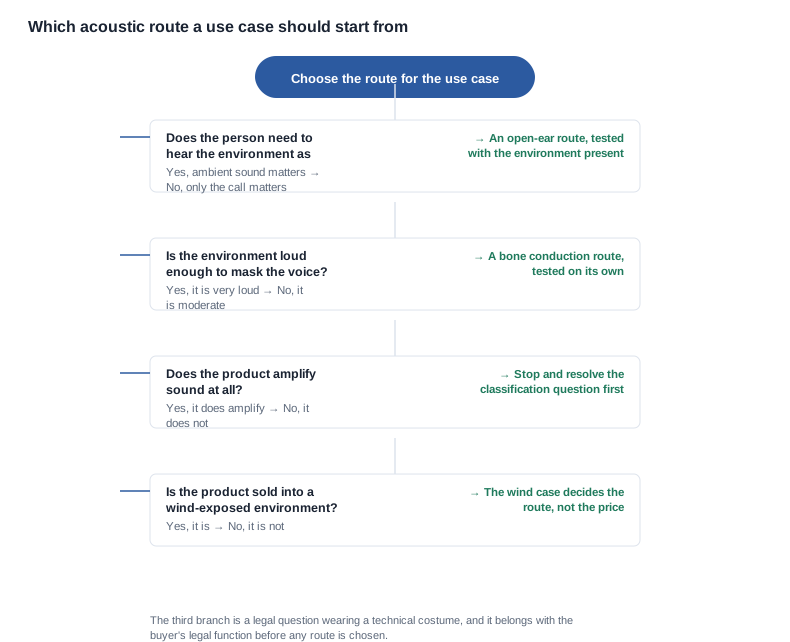
Open-ear and bone conduction are not variations of one result
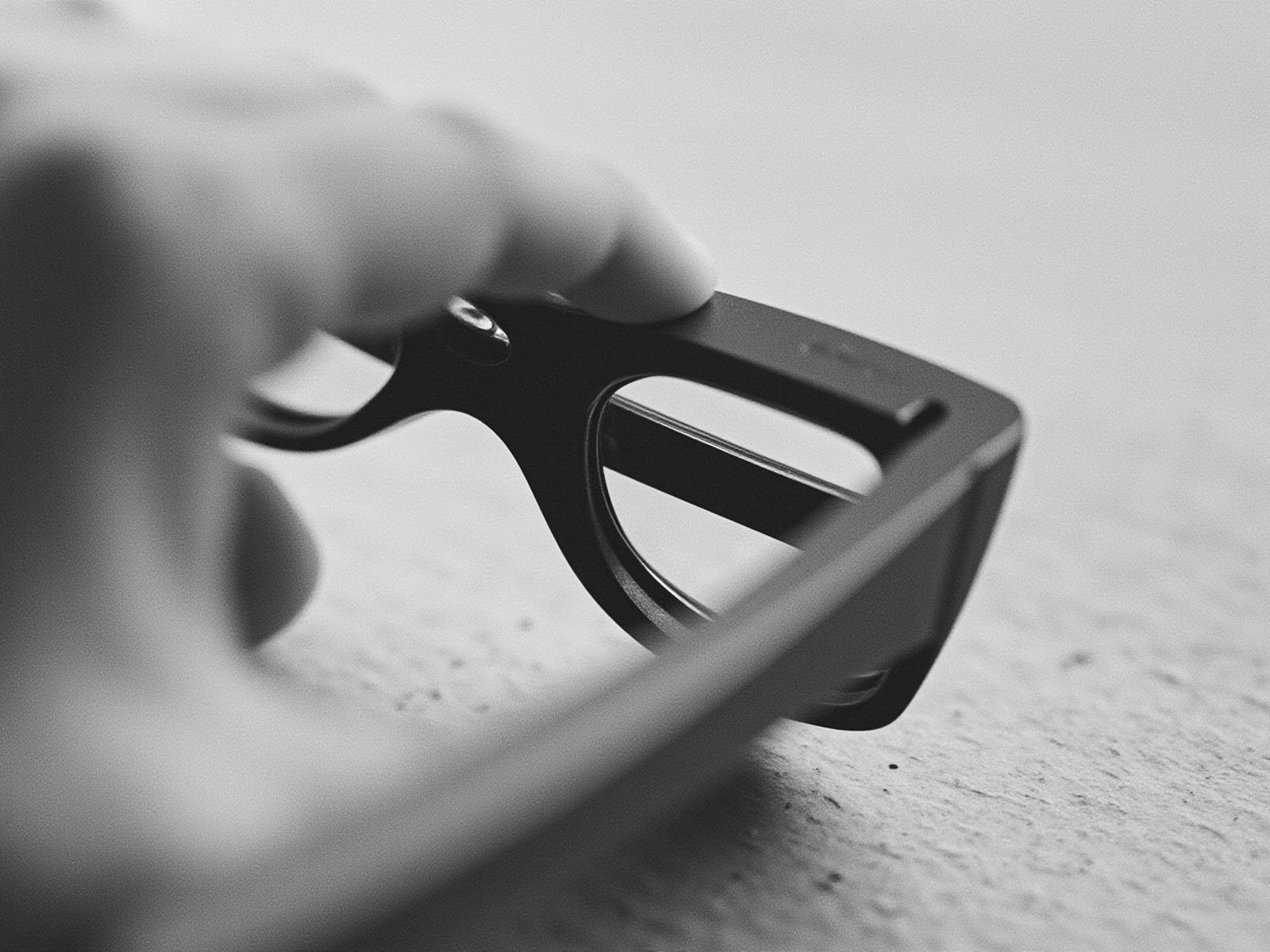
A bone conduction product does not capture through the air at all. It transmits through the skull, and the microphone arrangement is different in kind. In a very noisy environment this changes the answer about what the far end hears, because the path to the microphone is different and the person's own voice arrives as a different signal.
A buyer choosing between open-ear and bone conduction for a site-work product has to test the two mechanisms separately, because a result from one does not transfer to the other. This is the single most common error in this category, because the two are usually compared on a specification sheet that has one column for each mechanism's headline figure and nothing at all about transferability.
The comparison is set out at bone conduction audio, and the call use case is at is there a microphone for calls.
A third path that is not a microphone route at all
Before choosing between the two, there is a branch that stops the whole question. A product that amplifies sound is making a claim about what the person hears, and in the United States the over-the-counter hearing aid classification at 21 CFR 800.30 covers air conduction devices, which places a bone conduction product with an amplification gain in the hearing range near a regulatory boundary.
Our catalogue entry for the bone conduction product in this range publishes an amplification gain of 35 dB, a 200 mAh cell, roughly seven hours of rated runtime, charging in two hours or less and Type-C charging. That 35 dB figure is the most aggressive published parameter in the catalogue, and the certification status for that entry is not published to us.
The branch is worth putting first in any use-case discussion, because it is the one where a technical route decision is premature. The classification question belongs with the buyer's legal function, and it has a long lead time. A buyer who reaches it in week three has already paid for a design decision that might not be shippable.
The test that settles a use case without changing the product
A five-step protocol, and the step that invalidates the rest
The method has to be identical across candidates, or the result is a property of the tester rather than of the product.
- Fix the phrase, the distance, the head angle, the background level and the number of attempts before the first run. A fixed phrase, a stated distance, a defined background level reproduced with a reproduced source, and a stated attempt count, with the far end judged by whether it repeats the phrase correctly.
- Run it in the target environment, not a quiet room. Every microphone works in a quiet room, so the quiet-room result is a sanity check and the target-environment result is the decision.
- Run the wind case if the product is sold outdoors, because it is the condition that most often defeats a microphone on a frame.
- Use the same receiving device and network for every candidate, and record them, because the far end has as much influence on the result as the microphone does.
- Run it on two units from the same batch, so that a manufacturing inconsistency is separated from a design characteristic.

The step that invalidates the most comparisons is the first one, because a protocol written after the first run is a description rather than an instruction, and two results produced under different protocols are not comparable however similar they appear.
The six documents that close a use-case scope
Six documents, and each one closes a specific part of the scope.
The measurement results with their conditions — the environment, the background level, the distance, the unit count and the batch. The microphone count and placement, per model designation. The model designation table, so that the certificate register has something to point at; the register itself is in the format set out at certification checklist. The packaging artwork proof, checked against the model designation rather than approved in isolation. The agreed incoming inspection criteria, with the tolerance stated and the unit count fixed. And the battery transport documentation for the fitted cell, which is at battery transport.
Where to look next: the clause language is written out at contract terms, and the commercial outline of a first order at pricing.
What to do when a use case fails its microphone requirement
Five ways use-case selection fails commercially
A product is scoped to an environment it cannot serve. A microphone that fails at a stated background level is not a defect; it is a scoping error, and it is cheaper to make before the purchase order than after the first returns.
The demonstration environment is used as the specification environment. Every demonstration happens in a quiet room, and every specification written from a demonstration inherits that assumption.
The wind case is skipped for an outdoor product. It is the condition a customer hits in week one, and it is the one that turns a microphone quality question into a does-it-work-outdoors question.
The assistant claim is written without the distance test. A voice assistant that works across a desk does not necessarily work across a room, and the listing usually implies the second.
One platform is used for two environments. A quiet-office listing and a site-work listing built on the same microphone design inherit the same limit, and only one of them is commercially viable.
The remedy in each case is to change the scope rather than the product, and in three of the five the change is to the listing copy rather than to the hardware. That is the general finding of this article: in this category most use-case failures are specification failures, and the cheapest remedy is a narrower claim.
The commercial consequence of narrowing the scope
Narrowing the scope is a commercial act, not a documentation one, and it has three parts that a buyer should price before deciding to do it.
The listing copy. A product specified for a quiet office and sold into a plant floor produces complaints that are indistinguishable, from the outside, from a product with a defect. Narrowing the environment in the copy — naming where the product is intended to be used — converts an unbounded expectation into a bounded one, and the difference shows up in the return rate rather than in the complaints.
The channel conversation. A channel that has been told the product is specified for a stated environment routes voice complaints to support. A channel that has not, routes them to returns. This is the cheapest commercial decision in the whole subject, because it costs one email and it changes where the cost lands.
The price the scope implies. A product with a bounded environment can be priced against a different set of competitors, because the comparison a buyer makes stops being "which microphone is better" and becomes "which product is right for this environment". That is a comparison a buyer can make with a page of published rows, and it is the one that usually settles a shortlist in this category.
The trade-offs run the other way as well, and they should be stated rather than assumed. A narrowed scope reduces the addressable market, and a product aimed at a single environment competes with a different set of alternatives than a general one. The total cost of a narrow scope is therefore a volume question, and it belongs in the same calculation as the measurement programme rather than after it.
The remedy in each case, and who signs it
| Failure | The remedy | Who signs it |
|---|---|---|
| The environment is out of scope | Narrow the environment the product is sold into | The product owner and the channel |
| The demonstration was used as the specification | Re-run the protocol in the target environment | The engineer who runs the protocol |
| The wind case was skipped | Run it, and treat the result as a design constraint | The engineer and the supplier |
| The assistant claim exceeds the distance | Soften or drop the claim | The product owner and the compliance function |
| One platform, two environments | Split the listing, or split the platform | The product owner |
The use case that decides which model family you shortlist
From use case to shortlist, without stopping in the middle
The step from a use case to a shortlist is where most of the work in this category is usually done badly, because the shortlist gets built from the technology descriptions rather than from the use cases.
The route runs like this. A use case implies a background level. The background level implies a measurement. The measurement implies a set of models that could plausibly pass it, which is a much smaller set than the catalogue. And the models in that smaller set have different published rows, different chamber designs and different costs, which is where the comparison finally becomes possible.
The families differ in ways that matter to this decision. The Bluetooth audio family has no camera module and no AI voice assistant, which means a shorter data path and a different conformity scope; the AI camera family has both, which means a microphone path with a processing path attached to it and a different set of questions. The bone conduction entry is a different mechanism entirely, with a 35 dB gain published and an unpublished certification status. And the AI electrochromic entry, with 100 mAh, roughly seven hours of rated runtime, magnetic charging and V5.4, is a route that is not a microphone route at all and belongs in a different conversation.
The point of walking the route in that order is that it stops the shortlist from being decided by a technology description. A shortlist built from descriptions will contain models with different mechanisms, different data paths and different regulatory questions, and the comparison between them will be meaningless. A shortlist built from use cases contains models that are being asked to do the same job.
The use case boundaries we will not price for you
What we can and cannot tell you
The short answer: we publish no microphone specification — no sensitivity, no capture frequency response, no noise floor, no cancellation depth and no beamforming pattern — and we will not present a processing feature as a measured result, because the published documentation does not support one. We will also tell a buyer plainly when an environment is out of scope for the product, because that is a cheaper answer than a launch that discovers it.
What we will do is take the use cases, the environments and the price band, and tell you which of them the microphone requirement actually decides, which measurements have to be run on a sample, which claims have to come out of the listing copy before a purchase order is signed, and where a use case you have named is one this form factor cannot serve well. The background is at noise control and microphone pickup.
Two boundaries are worth stating separately, because they are the two that cost the most when they are discovered late. The first is the regulatory boundary for any product that amplifies sound, which belongs with your legal function and should be the first conversation rather than the last. The second is the difference between an open-ear mechanism and a bone conduction mechanism, whose results do not transfer to one another and which therefore have to be tested separately rather than compared on paper.
Send us the use cases, the environments and the price band, and we will say which of them the microphone requirement decides and which of them your product should stay out of.
Related reading
- The background technology — noise control and microphone pickup
- The measurement procedure — how to measure microphone quality
- The call use case — is there a microphone for calls
- The distance variable — bone conduction frame geometry
Tell us the environments and the price band, and we will say which of them the microphone requirement decides.


