

"There is a microphone for calls" is a phrase that sounds like a yes-or-no question and behaves like a four-part one. A device can contain a microphone and still be useless for a call, and the reason is that a call is carried by a chain rather than by a component. Something has to capture the voice, something has to carry it, something has to decode it, and something has to render it at the far end. A buyer who asks only about the microphone is asking about the first quarter of the problem, and the answer to that quarter is the same across this entire range: no model in the catalogue publishes a microphone row, and the silence covers every family — the audio models carry a Bluetooth version, the camera models a still-image resolution class, the sport models an acoustic descriptor, and the three entries without a stock keeping unit carry their own standard rows. Twenty-eight entries, zero microphone specifications.
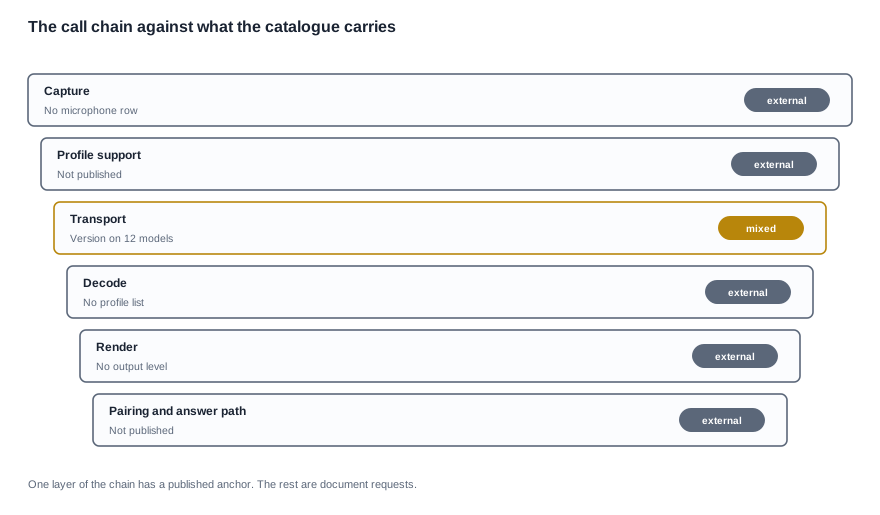
That is where the interesting part of the answer lies, because the rest of the chain is not empty in the same way. Twelve of the twenty-five named models publish a Bluetooth version — all eight audio models, all three sport models and the A07 — and two of the three entries without a stock keeping unit publish one as well. So the transport leg of a call has a published anchor on roughly half the range, while the capture leg has none on any of it. That asymmetry is what turns this question from a yes-or-no into a set of specific requests, and it is what this article is for.
is there a microphone for calls: what the catalogue publishes and what it does not
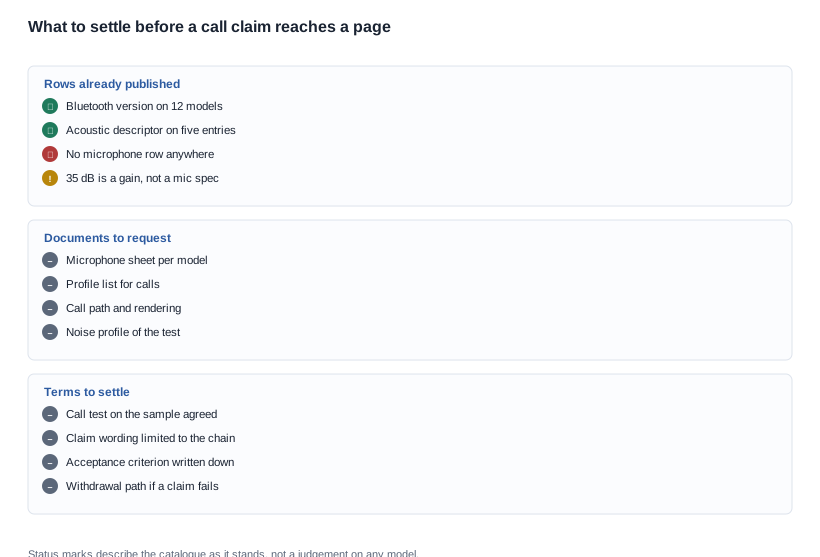
Start with the published side, because there is more of it than the opening paragraph suggests. The range publishes a Bluetooth version for twelve of the twenty-five named models: version 5.3 on the K01 and the K02, and version 5.4 on the ZH12 and the D17, the A07 and the D12, the LC-105-1 and the YK12, the D11 and the YKC02, and the LC-105-2 and the G07. The AR entry and the photochromic entry publish a version as well. Against that, none of the eleven camera models publishes a Bluetooth version, and neither the A05 nor the A06 does.
The catalogue also publishes five acoustic descriptors, on the YK12 and the YKC02, the D11 and the ZH12, and the D17. It publishes the AR entry's indicator light and button control rows, which are the only control rows anywhere in the range. It publishes the bone-conduction entry's amplification gain of 35 dB.
Two of those published rows are regularly mistaken for microphone specifications, so it is worth separating them carefully. The 35 dB figure is an amplification gain, which is a ratio between an electrical signal entering an amplification stage and the signal leaving it. It measures a signal path and not a microphone, it says nothing about capture, and the entry that carries it has no stock keeping unit, so it cannot be ordered or tested. A buyer who reads it as evidence of a call microphone has misread a number and also misread the product class it belongs to. The acoustic descriptors on the five entries are labels for a listening configuration and carry no microphone information either.
That leaves the absence. There is no microphone row, no microphone model, no microphone count, no array geometry, no beamforming statement, no echo-cancellation or noise-suppression specification, no capture sample rate, no capture bit depth and no sensitivity figure on any entry in the range. A page that states or implies a microphone specification is therefore making a claim the buyer cannot substantiate, and the cost of that claim lands on the buyer rather than on the supplier.
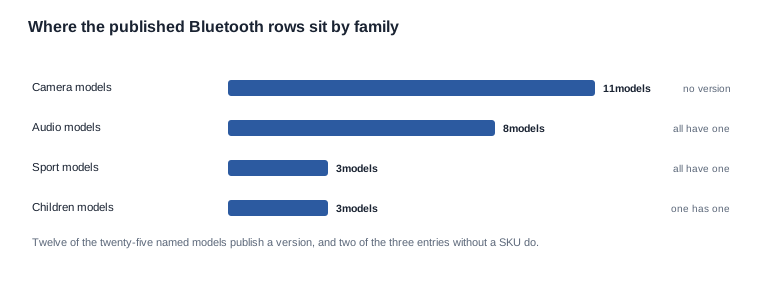
The family distribution makes the practical consequence sharper. The audio models publish a radio generation, which means the transport leg of a call is at least anchored. The camera models publish a resolution class and nothing else, so for a camera model the capture leg and the transport leg are both unpublished and the only routes to a call answer are a sample test and a document request. That is a materially different due diligence task depending on which family the programme is buying from, and it is a difference that a buyer should price into the sample round rather than discover halfway through it.
Six claims a buyer might accept, and the evidence each one needs
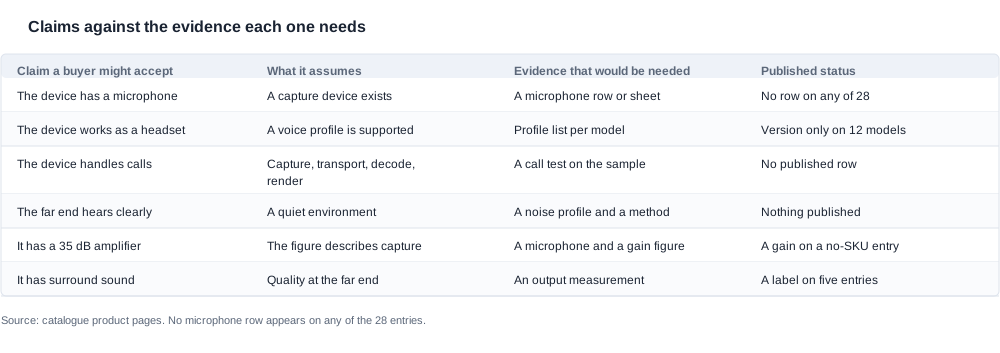
The six claims below are the ones that appear in procurement conversations about this category, arranged from the most concrete to the least. For each one, the point is not that the claim is false. The point is that it is not evidenced by anything the catalogue publishes, and that a buyer who accepts it is accepting an assumption.
-
"The device has a microphone." This is the claim that sounds the most like a specification and is the least evidenced. The evidence that would support it is a microphone row or a microphone specification sheet naming the type, the count, the position and any array arrangement. Nothing published supplies that, on any of the twenty-eight entries. The request is one document.
-
"The device works as a headset." A Bluetooth version is not a profile list. Whether a device can carry a voice call depends on the profiles it supports, and the catalogue publishes a version number but no profile list for any model. A device that supports only a media profile can play audio and cannot be a call endpoint at all, which is a completely different product. The request is the profile list per model.
-
"The device handles calls." This is a chain claim, and it is the one a buyer is most likely to accept by default. It requires capture, transport, decode and render all to work, plus a pairing procedure and an incoming-call answer path. The catalogue supports none of those statements for any model. The evidence is a call test on the sample, run against a written protocol, with the far end of the call recorded so that both directions can be assessed.
-
"The person at the far end hears me clearly." This is a noise question wearing a clarity question, and the catalogue publishes nothing that addresses it: no microphone position, no noise-handling row, no sensitivity. The evidence is a noise profile with the conditions stated, and a test performed at the level of noise the programme actually operates in.
-
"It has a 35 dB amplifier, so it carries calls." This one is worth naming separately because it circulates widely in comparison material. The 35 dB figure is a gain ratio on a hearing-amplification entry with no stock keeping unit. It is not a call specification, it is not an output level, and it is not attached to any orderable model. A page carrying it as call evidence is carrying a category error.
-
"It has surround sound, so the call sounds good." The acoustic descriptor tells a buyer that a listening configuration is advertised. It says nothing about the microphone, and it says nothing about the call in either direction. The evidence that would support a quality claim is a measurement at the far end under stated conditions.
The four legs of a call, and what each one has to achieve:
| Leg of the call | What the leg has to achieve | What the catalogue publishes |
|---|---|---|
| Capture | Turn a voice into a usable signal | No microphone row |
| Profile support | Carry voice rather than media only | A version, never a profile list |
| Transport | Move the signal between devices | A version on twelve models |
| Decode and render | Make the far end intelligible | An acoustic label on five entries |

How to evaluate the answer without a sample on microphone availability
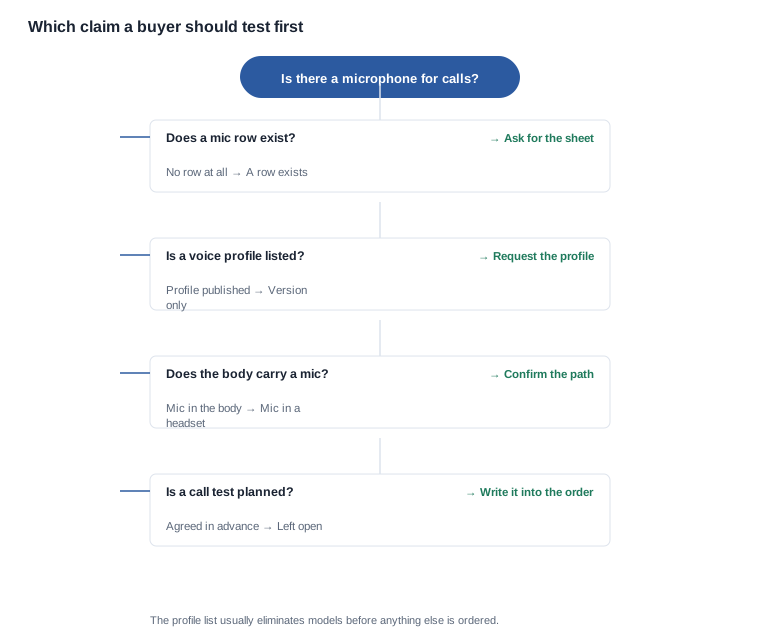
Four requests close most of this gap, and they are worth ordering so that the cheapest information arrives first.
The microphone specification sheet closes the capture leg. It should state the type, the count, the position relative to the front of the frame and any array or beamforming arrangement, and it should be per model rather than per family, because nothing in the catalogue supports an assumption that two models share one.
The profile list closes the transport leg and is usually the fastest document to obtain. If a model supports a voice profile, the question moves from whether a call is possible to whether it is usable. If it does not, that model leaves the shortlist for calls immediately, which saves the rest of the work.
The call path statement closes the routing question: which device captures, which device renders, and what happens to an incoming call. A configuration where the glasses capture and a paired headset renders is a legitimate product and a different requirement from one where the glasses do both.
The call test protocol closes everything the documents do not, and it is the only item that requires hardware. It should fix the speaking distance, the ambient noise, the far-end device, the recording of the far end, and the pass condition. A buyer who writes it before the units arrive gets a result; a buyer who writes it afterwards gets a story.
There is a fifth item that is not a document but a decision, and it should be made before any of the four: whether the call function is a primary use case for the programme or a secondary one. If it is primary, the whole chain is in scope and the acceptance criterion has to be written for the call itself. If it is secondary, the chain may terminate in a separately paired headset, and the requirement reduces to the capture and transport legs with a stated boundary. Both are legitimate programmes. The failure mode is a brief that describes the product as a call device while the programme only ever uses it for music, because that mismatch is discovered in a listing that promises something the product was never specified to do.
Before any of that, a buyer should decide which family the programme is actually buying from, because the evidence position differs sharply between them and the shortlist work is not the same. The audio models have a published radio generation to anchor the transport leg, so a requirement written for them starts from a partially documented chain. The camera models have a published still-image resolution class and nothing else that touches a call, so a requirement written for them starts from a blank page and a document request for the whole chain at once. Which model should you shortlist on, and what to ask, therefore differ by family, and the brief should say which family it is about rather than leaving it to the reader of the answer.
The commercial term that belongs with all four requests is the acceptance criterion, and it needs the same three sentences as any other measurement in this category: what was measured, under what conditions, and what happens when a unit falls outside. For a call, the natural criterion is intelligibility of the far-end recording under a stated noise level, judged by a named method. The sampling rule has to say whether the criterion applies to every unit or to a sample drawn from the batch, and the remedy sentence has to say what happens when a unit fails — rework, a revision of the published claim, a credit, or a rejection. A criterion without a remedy is a preference, and a preference does not survive a dispute with a supplier.
Two details in that criterion are worth spelling out, because they are the ones that decide whether the criterion can be enforced at all. The first is the noise condition, and it has to be written as a number with a character rather than as a label: a busy street and a quiet office are not interchangeable, and a criterion that says "in a typical environment" is not measurable by anyone, including the supplier's own engineers. The second is the far-end recording. A test that only captures the near end measures the volume of the device and not the legibility of the call, so the far end has to be recorded too and both recordings filed with the result. A test that records only the far end has the same defect in reverse, because it measures the headset rather than the glasses. Both ends, or the criterion is measuring something other than what the programme is buying.
There is a third detail, which is about what happens when a unit passes. A call criterion that is only used to reject units is a cost. Used the other way, it becomes a way of characterising the programme: the distribution of results across a batch tells the buyer whether the device suits a loud environment, a quiet one, or one of them, and that distribution is often more valuable commercially than the pass rate itself. Writing the criterion so that passing results are recorded rather than discarded costs one extra sentence and turns a gate into an instrument.
How to brief a call requirement when the whole chain is blank
A requirement brief that says "needs a microphone for calls" is a component request, and it will come back as a component answer. The brief that gets a usable answer describes the behaviour instead. Five lines are enough to transform it, and each of them is a question the supplier can answer without consulting a product manager.
The acceptable start delay, stated as a number, because a call that connects but takes a noticeable moment to open is a different experience from one that opens immediately, and the difference is only arguable if it has been written down.
Whether the call has to work with the device being worn and the hands being busy, because that condition eliminates whole product configurations and it is the condition a buyer is actually buying against when they reach for this category.
Whether the call must survive a dropped link, which decides whether a fallback path is required and whether the device is allowed to be the only endpoint.
How the call ends, stated as a requirement on the incoming-call answer path rather than on the outgoing one, because the answer path is where most consumer devices differ and where a procurement requirement is usually silent.
What has to be visible to the person carrying the device while a call is live, which turns the indicator question from a nice-to-have into a specified behaviour and gives the supplier something concrete to answer.
Written that way, the brief becomes comparable between suppliers. Instead of "does it have a microphone", the buyer asks which supplier can describe the whole chain, and the supplier who answers with a chain is the one whose device can be specified. The suppliers who answer the microphone question and cannot answer the chain question have not failed the question — they have answered a narrower version of it, and the follow-up is to ask for the chain.
There is a second thing worth doing at this stage, and it is cheap. Because the catalogue publishes no capture specification and no profile list for any model in the range, a buyer can request those documents from every supplier in a shortlist at once and compare the responses side by side without opening a single sample. That comparison usually ranks the suppliers more accurately than a comparison of catalogues does, because it compares engineering documentation rather than positioning. It is also the cheapest due diligence step available in this category, because it costs a fortnight of correspondence and no hardware at all.
The commercial framing of all of this is a total cost question, and it should be settled at the sample stage rather than at launch. A call requirement that is specified behaviourally can be tested on the sample against a written protocol and turned into an acceptance criterion with a remedy. The same requirement left as a component wish is discovered in the field, where the remedy is a returns process rather than a credit against an order. The difference between the two is worth more than any individual document in the request set.
is there a microphone for calls: what to put in the order
A call claim cannot be closed by naming a component, and the reason becomes clear once the chain is laid out against what the catalogue actually carries.
What the catalogue gives a buyer is a Bluetooth version on twelve of the twenty-five named models and on two of the three entries without a stock keeping unit, an acoustic descriptor on five entries, an indicator light and a button control on the AR entry, and an amplification gain of 35 dB on the bone-conduction entry. What it does not give a buyer is any microphone row, microphone model, array geometry, beamforming statement, noise-handling specification, capture sample rate, capture bit depth, sensitivity figure or profile list on any entry. We do not publish a microphone specification for any model in the range, and we do not treat the 35 dB amplification gain or the acoustic descriptors as substitutes for one.
So the working answer is the request set: a microphone sheet, a profile list, a call path statement and a call test protocol, plus the acceptance criterion and the scope decision on whether calls are primary or secondary for the programme. The order matters, because the profile list usually eliminates models before the rest of the work is done.
The position worth holding is that "is there a microphone" is a component question being used to settle a chain question, and the chain question is the one a buyer actually has to answer before an order goes in. The open-ear audio page sets out the architecture of the listening side, how to choose smart glasses on microphone quality works through the selection criteria, bluetooth audio glasses for calls covers the use case, does wind noise ruin the audio covers the one environmental factor that most reliably breaks a call leg, and can I adjust the volume per device covers the control granularity that a call programme needs on the render side.
Related reading
- Selecting on capture criteria: how to choose smart glasses on microphone quality.
- The use case itself: bluetooth audio glasses for calls.
- The factor that breaks a call leg: does wind noise ruin the audio.
- Control granularity for the render side: can I adjust the volume per device.
- Checking a supplier on a video call: factory versus trading company on a video call.
Ask for the microphone sheet and the profile list, and the yes-or-no question becomes four answerable requests.


