

Regulations reach a microphone in a smart glasses product through the radio, and they reach it in a way that is easy to underestimate because the microphone is not what anyone thinks of as the regulated component.
The reason is straightforward once stated. A microphone in a connected product is a sensor that transmits data. The data it captures is personal — the user's voice, and the voice of anyone in earshot — and it travels over the radio. Everything that applies to a radio therefore applies to the microphone, and a buyer who treats the microphone as an audio component rather than a data-transmitting sensor will find the cybersecurity questions arriving later than they expected.
Our published position across this range is that the audio is described as open-ear acoustic structure, directional audio and intelligent noise reduction, with Bluetooth 5.3 and 5.4 across the tier, and no published microphone specification at all. So smart glasses microphone quality smart glasses how regulations affect this has to be answered through the regulatory frameworks rather than through acoustic data.

The consequence for a procurement team is that the microphone question has three separate owners. The radio conformity file belongs to the compliance function and to the supplier's engineering. The data protection position belongs to the brand's legal function and to whoever operates the service. The output boundary belongs to whoever signs the packaging and the listing. A single requirement sent to a single supplier, phrased as a microphone question, will come back answered on one of the three and silent on the other two, and the silence is the expensive part.
Smart glasses microphone quality: a radio, not an audio component
1. The radio conformity route, and the cyber requirements inside it. In the European Union the Radio Equipment Directive (EU) 2014/53/EU applies to radio equipment, and the EN 18031 harmonised standards cited into it cover the cybersecurity requirements for radio equipment — internet-connected radio equipment, radio equipment processing personal data, and radio equipment enabling the transfer of money or virtual currency. A wearable with a microphone and an app is internet-connected radio equipment that processes personal data, which places it squarely in the scope of the third category.
The General Product Safety Regulation (EU) 2023/988, applicable from 13 December 2024, layers general safety obligations on top of the sector rules rather than replacing them. In the United Kingdom, UKCA applies with a framework that diverges from the EU's. In the United States, FCC equipment authorisation covers the radio.
2. The data protection route, which is a separate framework with a separate trigger. A microphone that is always listening — even to a wake word — processes personal data, and the data protection regime applies to the collection, the processing, the storage, the retention and the transfer. The questions that decide a product's position here are: is the audio captured continuously or only on trigger, is it processed on the device or sent to a service, where is it stored, how long is it retained, and what does the user see.
These are legal questions and they are triggered by the microphone specifically. A product with a camera and no microphone has a smaller version of the same problem.
3. The medical boundary, which applies to amplification rather than to pickup. The microphone is not what triggers it; the output stage is. Our catalogue entry for the bone conduction product publishes a 35 dB amplification gain, and the guidance that bone conduction products cannot be sold as over-the-counter hearing aids in the United States because the FDA's definition at 21 CFR 800.30 covers air conduction devices is a boundary that follows the amplification, not the microphone.
The distinction is worth holding clearly, because a buyer who assumes the microphone is the regulated part will ask the wrong questions.

The radio route: the directive, the cyber requirements and the technical file
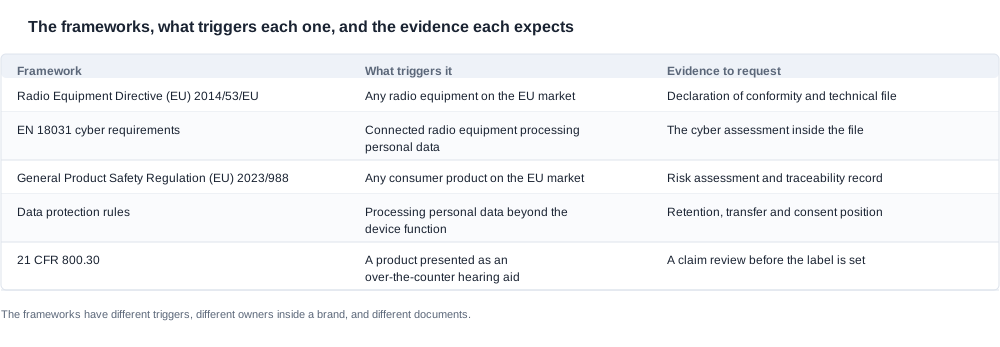
The radio route is the one with the most familiar paperwork and the most common failure. A buyer accepts a declaration of conformity at the quotation stage, the model is added to the file, and the file is never revisited. The failure surfaces when a second colourway, a second logo, a private-label derivative or a revised firmware version is added to the range, because each of those is a question about whether the model designation on the declaration still matches what is being shipped.
Three things in the radio route depend on the microphone specifically, and they are worth listing separately so that a supplier's answer can be checked. The first is the set of radio bands and the operating modes the device uses, because a device that transmits voice over a Bluetooth link has a declared radio configuration that the file has to describe. The second is the software that runs on the device, because the update path and its validation are part of the technical file rather than a factory quality matter. The third is the data the radio carries, because the EN 18031 categories turn on what the device is connected to and what it processes, not on what it sounds like.
The practical consequence for a procurement file. The document to request is not a certificate for the microphone; there is no such certificate in this category. The document to request is the technical file position for the exact model designation being ordered, together with the list of models it covers, the test report numbers with their issuing bodies and dates, and the description of the software update mechanism. A supplier who answers with a family-level document has told you that the file has to be extended for your configuration, and that is a cost and a schedule item, not a paperwork item.
How to read a partial answer. A supplier who answers two rows of the pack and is silent on the third has given a complete answer, and it is a bad one. The silence in this category is almost never ignorance, because the supplier's engineering team knows exactly which model entries their file covers and which they do not. Silence on the model list means the private-label configuration is not in the file; silence on the update policy means the software is treated as a factory concern rather than as a regulated element; silence on the data position means the capture behaviour is decided somewhere the brand cannot see. Each of those silences is a negotiation that has not yet started, and each is cheaper to resolve before the deposit than after the artwork is printed. The practical rule is to treat an unanswered row as a scope item, put it in the quotation request, and price the answer rather than assuming it.
The model list is the row that does the work. A declaration naming a family does not cover a branded unit, and a report on the factory's own SKU is not a report on yours. In a range with twenty-eight models and several markets, the number of model entries is what determines the size of the file, and the number of entries is a commercial fact that should be quoted like any other line. The number of configurations the brand commits to in the first year is a negotiated number, and it is worth more than the unit price difference between two suppliers.
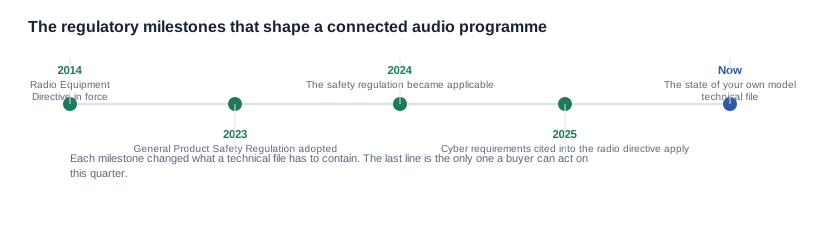
The regulatory milestones that shape a connected audio programme are set out below. Each one changed what a technical file has to contain, and the last line is the only one a buyer can act on in the current quarter.
The data route, which has its own trigger and its own owner
The data route is the one that determines whether a microphone is a product feature or a data-handling system, and it is the route where a buyer's own function, rather than the supplier's, holds the decisive facts.
Is the microphone continuously active or trigger-activated? A wake-word design and a push-to-talk design have completely different data profiles, and the difference is visible to the user and to the regulator. A continuous design also changes the hardware requirement, because the product needs a visible indication of its state, and that indication is a design constraint on the temple that the factory has to build around rather than something that can be added at the end.
Is the captured audio processed on the device or sent to a service? This determines the data's journey, and therefore whether the data protection questions are about the device or about the service. It also determines the operating cost and the latency, which for a buyer running a subscription model is a recurring cost rather than a one-off, and it is the difference between a product that needs a privacy notice and a product that needs a privacy policy.
What does the product do with the audio beyond the immediate function? Recording, buffering, uploading, storing. Any of these turns a simple device into a data-handling system, and each of them is a question for the software and service side of the programme rather than for the acoustic engineering.
Does the AI feature change the answer? If the audio is transcribed, translated or sent to a cloud service, the data position changes materially. Our published position is that these details are Not published for the models in this range, and a buyer who is being shown an assistant feature in a demonstration should ask whether the audio leaves the device.
The three questions to put to a supplier about the microphone and the compliance file. First, which EN 18031 category does this product fall into, and what is the evidence; internet-connected, personal data processing, and money transfer are three distinct categories, and the evidence expected is different in each. Second, is the microphone continuously active, and how is the state indicated to the user; a visible indication is a design requirement that follows from the data position, and it is worth confirming rather than assuming. Third, what is the software update mechanism, and how are updates validated; a device that processes personal data over a radio needs a controlled update path, and the policy for it is a technical file item.
The commercial point about ownership is the one that gets missed. The data route cannot be closed by a supplier's declaration, because the data position is a product decision that the brand makes and the brand operates. A buyer who waits for the supplier to resolve the data questions will be waiting for an answer that does not exist, and the honest commercial outcome of that delay is a launch date that moves.

The output boundary, where amplification rather than pickup is regulated
The output stage carries a boundary that is separate from everything above, and it is the one most likely to be crossed by accident because it lives in the copy rather than in the hardware.
The catalogue entry for our bone conduction product publishes an amplification gain of 35 dB. That is the most aggressive published parameter in the range, and it is the reason the boundary at 21 CFR 800.30 in the United States has to be handled by whoever approves the packaging and the listing. The definition of an over-the-counter hearing aid in that regulation covers air conduction devices, and the guidance is that bone conduction products cannot be presented as over-the-counter hearing aids. The boundary follows the amplification, not the pickup, which means that a product with a perfectly ordinary microphone can still cross it through the way its output is described.
There are three specific traps, and all three are copy traps rather than engineering traps. The first is the word "hearing" in a phrase such as "hearing clearly in a noisy environment", which describes an experience rather than a medical function and is still a phrase a compliance reviewer will have to look at. The second is a comparison against a hearing aid in any form, including a comparison against a phone's hearing-assist mode. The third is the reuse of an amplification figure as a quality claim, which is what happens when a 35 dB gain published as an engineering parameter reappears in a listing as a promise.
The four things a listing must not do. It must not describe the microphone as always listening without saying so precisely; if it is, the description must be accurate, because the accuracy is a compliance requirement and not just a marketing one. It must not claim a noise-cancellation figure that has no test condition, because the published position in this range is that no third-party acoustic measurement supports any model. It must not describe a cloud-based feature as local, because that is a data position claim and it is the one a customer is most likely to believe and least likely to check. And it must not imply a hearing-assist capability, because if the product amplifies, the boundary at 21 CFR 800.30 applies and the claim becomes a regulatory question rather than a wording question.

The evidence pack to price before the compliance file is commissioned
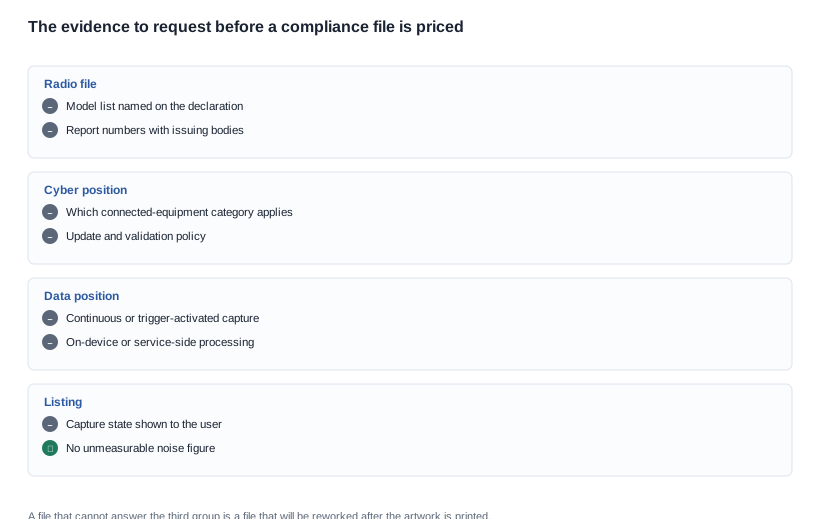
The four questions that determine the product's position. Whether the microphone is continuously active or trigger-activated. Whether the captured audio is processed on the device or sent to a service. What the product does with the audio beyond the immediate function, including recording, buffering, uploading and storing. And whether the product meets the cyber requirements for radio equipment, and how that is evidenced — the EN 18031 route in the European Union, and the equivalent position in each other market, where the evidence is a technical file rather than a claim.
The documents to request before the compliance file is priced. The declaration of conformity and the model list it names, for the exact configuration being ordered. The test report numbers with the issuing body and the dates, so they can be resolved later. The EN 18031 category position and the cyber assessment that supports it. The software update and validation policy. The data position in writing: what is captured, where it is processed, how long it is retained, and what the user is shown. The packaging artwork proof, because the labelling per market is a separate document set from the technical file.
What can be negotiated in this area. The number of models committed in the first year, because each model is a separate entry in the file. The number of markets committed, because the labelling scope and the file scope both scale with the market list. The artwork round count, which decides how many times a claim has to be re-reviewed. The per-market label scope, and the re-validation cost per variant where a private-label derivative touches the enclosure or the interface. The retention held against the documentation package, which protects the buyer on the failure that costs most, which is a product that arrives with a marking nobody can evidence.
What cannot be negotiated in this area. The cost and the elapsed time of the conformity work itself, because the queue is set by the laboratory and the certification body rather than by the order size. The statutory frameworks and their dates, because they are law rather than a commercial term. And the substantive position of the product on the data route, because that is a decision the brand makes about its own service, not a term that can be traded.
The clauses to write into the purchase order. The exact model designation attached to the order, attached to the declaration. A notice obligation before any change of capsule, port, interface or firmware that alters the radio configuration, since each of those can invalidate the file. A per-variant confirmation that a changed variant remains within the covered model list. The data position as a stated deliverable, so that it cannot drift between the sample and the production build. And a clause on who bears the cost when a configuration turns out to fall outside the covered list, which is the single most expensive clause to leave out of a contract in this category.
The retention question, which is a procurement question and not only a legal one. The compliance file is a living document, and the version of it that matters is the one held at the moment of an audit rather than the one held at the moment of the order. That has a commercial consequence: the buyer who has not retained the file position, the report numbers and the data position has no answer to give when a marketplace, a distributor's technical team or a customs inspection asks, and the fallback is an argument rather than a document. Retaining the pack, the report numbers and the declaration that covers the shipped configuration costs a shared folder and one request. Deciding who holds it, and requiring a copy on every production lot, is a line in the purchase order rather than a service request.
What a data-handling statement may and may not say
The working rule we apply: we publish the audio technologies as the catalogue states them and we will not attach a microphone figure, a profile list or a data-handling claim to any model in this range, because none is published to us.
We will also be direct about the boundary of our own role. The regulatory questions here are not technical questions about the microphone. They are questions about the data, and they belong to your legal function. What we can tell you is the published configuration, which is the audio family names, the Bluetooth versions, the cell configurations, the charge times and the runtimes, and we can tell you which questions have to go to the engineering team and which to the legal function. The published rows will not tell you whether the microphone is continuously active, because that is not in the catalogue, and we would rather say that than estimate it.
Two further boundaries are worth stating because they are easy to cross. We will not describe a product as having hearing-assist capability, and we will not present an amplification figure as a quality claim, because the 35 dB gain in our bone conduction entry is an engineering parameter with a compliance tail rather than a promise. And we will not confirm a conformity position on behalf of a buyer, because the file belongs to the party placing the product on the market and its contents are theirs to maintain.
If you tell us the destination markets, the product categories you are shipping, and whether the audio is processed on the device or in a service, we will say which routes are decisive for your programme and which of the four questions above will decide it. The compliance background is under EN 18031 cybersecurity compliance, the radio route is under Red Equipment Directive compliance, and the output boundary is under medical boundary compliance. The commercial structure of a first order is at pricing, and the file request list is at certification checklist.
Related reading
- Noise control and microphone pickup
- EN 18031 cybersecurity compliance
- Red Equipment Directive compliance
- Medical boundary compliance
Send the destination markets and the audio architecture and we will say which regulatory routes are decisive.


