

The honest position on microphone quality is that most of its limitations are physics rather than quality, and a buyer who treats them as defects will spend money chasing changes that cannot deliver.
So smart glasses microphone quality smart glasses limitations and drawbacks is best read as a list of things to accept in advance, decide about, and write into your own expectations — rather than a list to complain about later. The commercial value of that list is that it separates the limitations that cost nothing to accept from the ones that cost a development to remove, and the two are mixed together in most of the conversations a buyer has with a supplier.
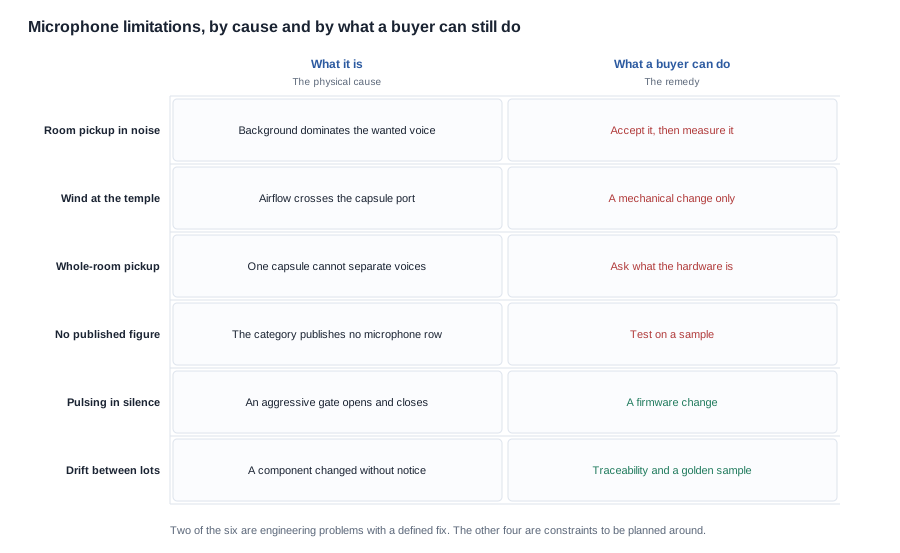
The practical consequence of getting this classification right is that it changes what a buyer asks a supplier to do. The signs that a limitation is being mis-routed are worth naming at the start: a development request that arrives without a measurement, a quality request that arrives without a lot reference, and a channel request that arrives without an environment named. Each of those three is a routing error, and each of them is cheap to correct before the work starts and expensive to correct after. A limitation that is physics produces a request for a different product, a narrower claim, or a test. A limitation that is a process produces a request for traceability and a retained sample. A limitation that is a design produces a development request, and it should be priced as one. A buyer who sends all three as a single complaint gets a quotation for engineering and a product that still has the physics problem in it.
Smart glasses microphone quality: the limitation list sorted by supplier control
Heavy background noise. An open-ear microphone on a temple is fundamentally exposed to everything around the wearer. A handset held at the mouth has an acoustic path advantage and an enclosure around the microphone. No amount of processing closes that gap completely.
If your channel sells into a genuinely noisy environment, set the expectation rather than chasing the specification. Test intelligibility in realistic noise on a sample, measure what it actually is, and describe the product in those terms.
Wind, in outdoor use. A temple-mounted microphone sits directly in the airflow, and wind noise is low-frequency, which is the range basic filters handle worst. Software reduces it; it cannot remove it, because the acoustic information is contaminated before the microphone receives it.
This one is mechanical. Windscreens, port geometry and microphone position are the interventions that work. If a supplier proposes a firmware fix for wind, expect improvement rather than resolution.
Whole-room pickup without beamforming. A single microphone cannot distinguish voices. Improvement comes from attenuating everything outside a target rather than from separating the speaker from the room, which is why it is partial by nature.
Ask what the hardware is before deciding whether this matters. Two microphones in a defined geometry can genuinely favour one direction; one cannot.
No published specification at all. This is the limitation that shapes the whole buying process. Our catalogue publishes no microphone count, pickup distance, frequency response, sensitivity, suppression description, codec or latency for any model — and that is typical of the category rather than unusual.
The consequence is that no amount of desk research will resolve microphone quality for this product. You will have to test.
The two that are often missed because nobody finds them at the demonstration. The quiet end, where aggressive gain control turns a working device into a hissing one in a low-noise room, and the leakage at the speaker, where the product announces itself to the people around the person using it. The first is a tuning consequence, and the second is an architecture consequence; neither appears in a specification, and both appear in a channel's return notes within a month of launch.
The two that are also missed because they are not visible at all. Reconnection time, which is what generates the majority of support contacts in this category and appears on no sheet, and end-to-end latency, which is invisible in a specification and obvious the first time a captured clip is used in a video. A buyer who has defined neither will discover both through a channel rather than through a test.
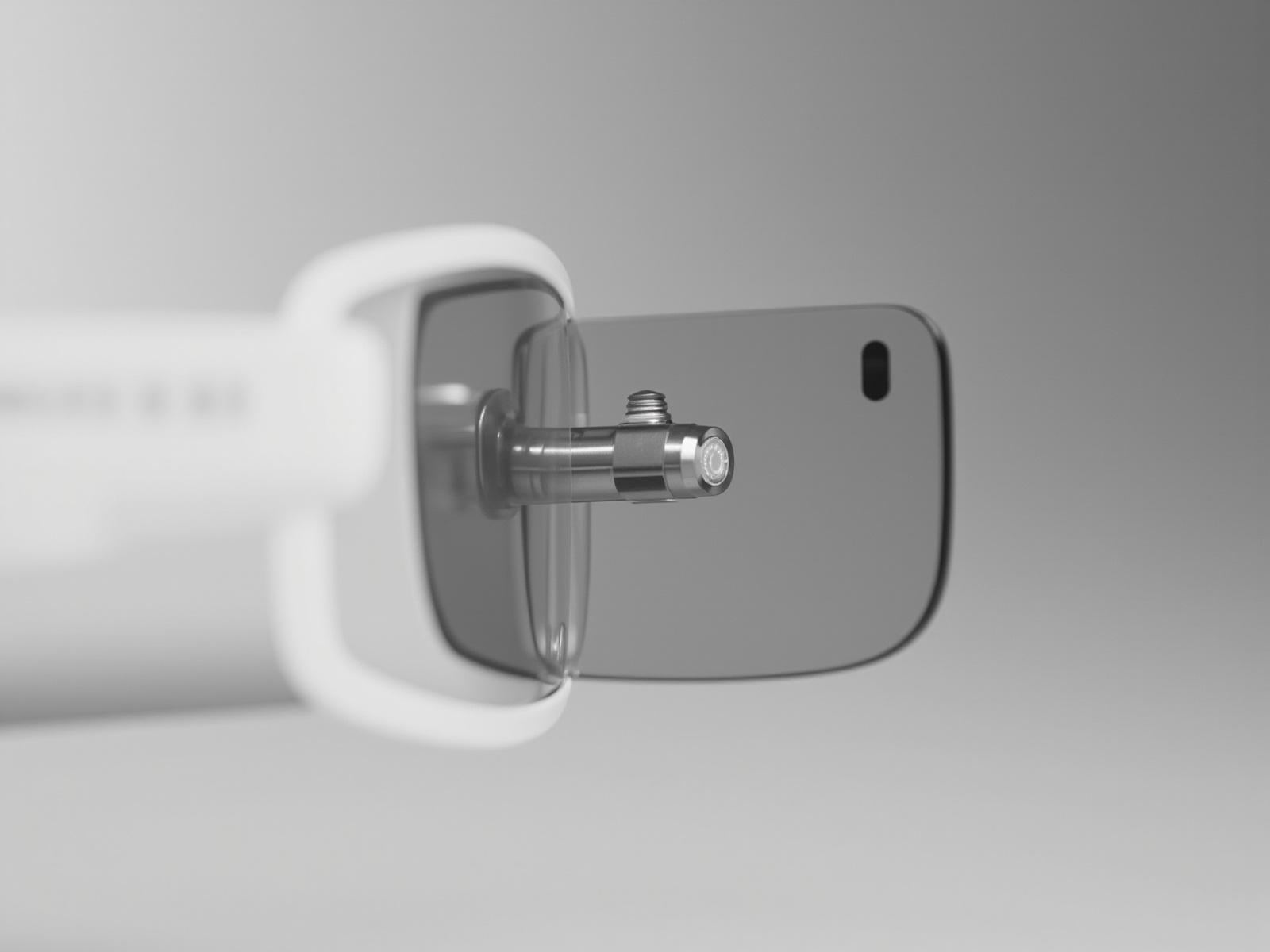
The two that are physics and will not improve with firmware
The distinction that saves the most money in this category is between a limitation that a supplier can engineer around and one that the physics of an open-ear frame imposes. Two of the six sit firmly in the second group, and the first thing to do with them is stop treating them as a defect.
Why the open-ear acoustic path cannot be engineered away. The distance from the mouth to a temple capsule is fixed by where a frame has to sit on a head, and the head is not sealed to the frame, so the head cannot be used as a baffle to exclude the room. That means the wanted signal and the unwanted signal arrive at the capsule through paths of comparable length, and the ratio between them is set by the environment rather than by the electronics. Processing can pull a wanted voice up against a steady noise floor, and it can do that well, because a steady floor has a consistent spectrum. It cannot reconstruct speech that has been masked by an impulsive or moving source, because the information is not present in the signal to be recovered.
Why wind is the hardest case of the two. Wind noise is broadband and non-stationary, and it enters the capsule through a designed opening. Once it has contaminated the signal, no filter can separate it, because the contamination and the speech occupy the same band. The interventions that work are all upstream of the electronics: a windscreen over the port, a change to the port geometry so the airflow is deflected, or moving the capsule away from the direct flow. A supplier that proposes a firmware route to wind is proposing a mitigation, and the correct procurement response is to accept the mitigation and to price the mechanical option as a separate line, because in many programmes the mechanical option is the one that actually resolves it.
What to do with a physics limitation rather than fight it. Two moves, and both are commercial. The first is to change the claim: a product that works well in a quiet and semi-quiet environment should say so, and the exclusions belong on the listing rather than in the returns file. The second is to change the application: if the channel's environment is the problem, then a different model in the range, or a different product category altogether, is a faster answer than a development. The decision to take depends on how much of the channel the current environment represents, and that is a number the buyer has and the supplier does not.
How to make the decision defensible. Produce a measurement rather than an argument. One named environment, one fixed phrase, one distance, a stated scoring rule, and a number that comes out of it. A limitation demonstrated once becomes a design constraint; the same limitation described in a meeting becomes a recurring dispute. The way to evaluate a physics limitation before you order is to ask the supplier to run that one environment on a sample and to write the result into the acceptance criteria, so that the constraint is priced into the programme rather than discovered in the channel.
The two that are engineering decisions, and the two that are process failures
Pumping during silence is a processing fault rather than a hardware one, and it is the clearest case for a firmware change. Record thirty seconds of silence on a table and any aggressive gating is immediately audible.
The quiet end degrading is the same family of problem seen from the other side. A gain profile that keeps the level stable in a loud environment will amplify the background in a quiet one, and the two requirements pull against each other. A firmware change can move the balance, and a supplier that has characterised the product will be able to say what the trade costs. A supplier that has not will discover it in the field, and the discovery will be reported as "it hisses", which is a description of a symptom rather than a diagnosis.
Degradation between production lots is a process problem with a process fix. Microphone performance drifts more often than specification sheets suggest, usually because a component supplier changed and nobody noticed. A retained golden sample with its firmware version recorded, plus lot traceability, is the only way to catch it — and both cost nothing before an order and cannot be reconstructed after one.
The second process failure, which is easier to miss, is the change to the port or the capsule that was made without a notice. A supplier who improves a part does not always change the model designation, and a buyer who has not asked for a change notification will find out when a lot behaves differently. The clause that prevents it is short, it costs nothing, and it belongs in the purchase order rather than in a quality file.
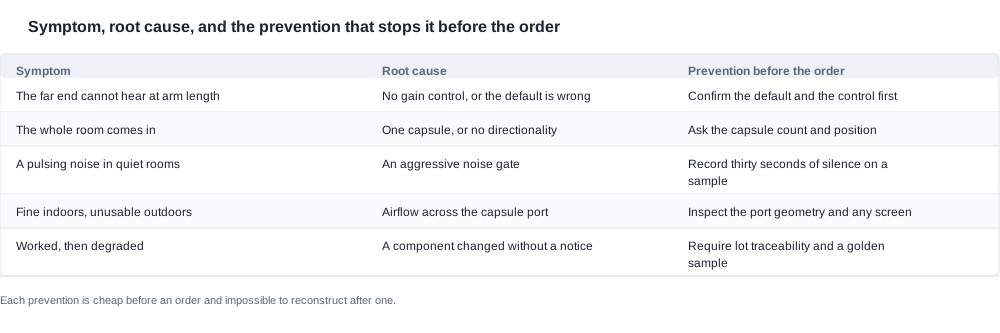
The boundary between the two groups. An engineering decision is a change to the product, and it has a cost, a schedule and a regression risk. A process failure is a gap in the controls, and it has a cost and a schedule but no product change. The trade-off between them is a matter of who is being asked to act: the same symptom costs a firmware branch or a control, and the negotiation is about which one the evidence supports rather than which one is cheaper to promise. The common pitfalls in this category are routing a process failure to engineering because the symptom sounds technical, and routing an engineering decision to a quality manager because the symptom appears on a subset of units. The symptom is the same, which is why the two are worth separating before a supplier is asked to act. A buyer who sends a process failure to engineering pays for a firmware branch that fixes nothing, and a buyer who sends an engineering decision to a quality manager waits for a control that cannot be written.

Writing the limits into the brief, the listing and the support script
Whatever you do, record what was and was not tested. A programme that has measured silence artefacts, three-metre intelligibility, a real-network call and outdoor wind knows its product. A programme that assumed knows nothing, and finds out through reviews rather than through returns.
This is a small thing that prevents a large amount of avoidable friction with your own channel.
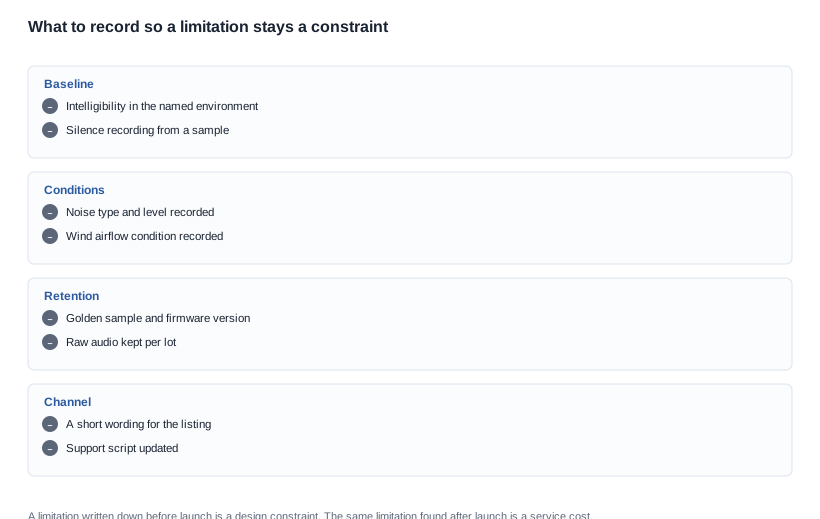
What goes into the product brief. The named environment the product is developed for, the named environment it is not, and the acceptance criterion for each. A brief that says the product is for calls and does not say which calls is a brief that will be developed for the room the engineering team sits in.
What goes into the listing. The claim as narrow as the evidence allows, and the exclusions stated next to it rather than left to the reader's imagination. A channel that knows the limits of the product sells it better than a channel that discovers them, because the discovery always arrives as a return and never as a question. The concrete version of this is worth stating plainly: "designed for calls in quiet and semi-quiet environments" is a claim the evidence can support, while "crystal clear voice in any environment" is a claim that produces a returns line.
What goes into the support script. The three questions a support team should ask before a microphone case is escalated: where were you, how far away was the other person, and was the device newly paired. The third question matters because a large share of the cases that reach a support team are pairing and configuration cases rather than microphone faults, and a script that separates them before the unit is returned saves the most expensive thing in the channel, which is a returned unit.
What goes into the incoming inspection. The rows that have to hold on every lot rather than on the first lot: the capsule configuration, the port treatment, the firmware version, and the lot reference. A golden sample held against those rows is what makes a drift visible in week three rather than in month six.
What goes into the contract. A change-notification obligation for anything that alters the capture chain, a traceability requirement on the production lots, and a golden sample retention term that names who holds it and for how long. These three clauses are the difference between a limitation that is detected and a limitation that is litigated. The questions to ask a supplier about them are specific: which changes to the capture chain require notice, on what timescale, to whom, and what the buyer's remedy is if notice is not given. A clause without a timescale is a clause that will be argued about in the month it matters.
A decision route for the limitation you are actually facing
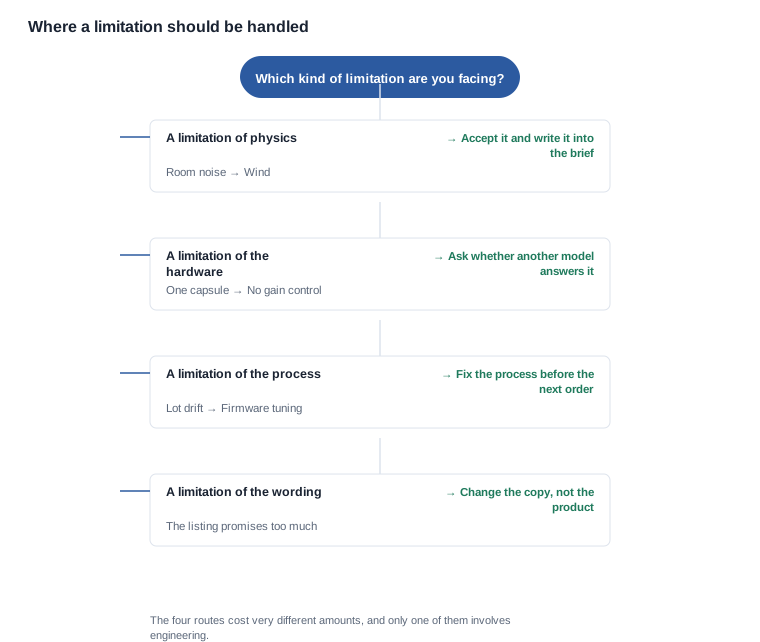
The route matters more than the list, because the four destinations have very different costs and the most common mistake in this category is sending everything to the most expensive one.
Send it to engineering when the symptom is present on every unit from a single model, is reproducible in a quiet environment, and survives a configuration check. The candidates are pumping, a degraded quiet end, and a systematic leak of background sound. Each of these has a firmware or a tuning remedy, and each needs a regression test against the radio and the assistant behaviour before it is shipped.
Send it to quality when the symptom appears on some units from a particular lot, or changes between lots, or follows a component change that nobody announced. The remedy is traceability and a golden sample, and it costs a control rather than an engineering branch. A buyer who routes these to engineering will pay twice.
Send it to the channel when the symptom is real and the product is sound. A product that works in a quiet office and does not work on a construction site is not defective, and the fix is a narrower claim, a different model in the range, or a different product for that channel. The evidence for this route is a measurement in the environment the customer is in, which is the same measurement the quality route would need. The question of which model to carry for that channel is a commercial shortlist question rather than an acoustic one, and the criteria for it are the total cost of the channel, the return rate it currently produces, and the cost of the alternative product against the volume the channel represents.
Send it to the copy when the product is sound and the listing is not. A claim that promises more than the product can deliver is a limitation of the description, and it is the cheapest of the four to fix and the most damaging to leave in place, because it converts an engineering question into a refund. Reviewing the listing against the measured result is an afternoon of work.
The order of the routing decision. Establish first whether the symptom is universal or lot-specific, because that single fact separates the engineering route from the quality route. Establish second whether it reproduces in the environment the customer is in, because that separates the product route from the copy route. Only then does the cost of the remedy matter, and at that point the cost is known.
What we will report, including the result that is worse than expected
Stated plainly: we will not publish a microphone specification because we hold none, and we will not estimate one. Where you send samples we will run a fixed protocol with you and report what we hear, including where the result is worse than you expected — because a limitation identified before launch is a design constraint and the same limitation identified afterwards is a customer service cost.
What we can and cannot do within that position. We can report the published configuration for any model, which is the audio family names — open-ear acoustic structure, directional audio and intelligent noise reduction — together with the electrical rows: Bluetooth 5.3 on the K01 and the K02 and 5.4 on the LC-105-1 and the G07, LC-105-2 and the YK12, and the D11 and the D12; cell configurations from 55 mAh by two up to 100 mAh; charge times of two hours or less; runtimes of roughly six to eight hours; and magnetic or Type-C charging depending on the model. The sport models publish the same rows on the same terms — the YKC02 on 5.4 with 70 mAh by two, the D17 on 5.4 with 115 mAh, the ZH12 on 5.4 with 100 mAh, and a charge time of about an hour on the last two. We can run a protocol on a sample and report the result against the criterion the buyer set. We can say which of the limitations above are decisive for a given environment and which are not.
What we will not do is estimate a pickup distance, quote a typical noise figure for the category, or tell a buyer that a product will work in an environment we have not tested it in. The last one is the refusal that costs the most in a short conversation and the one that protects the buyer from the largest downstream cost, because a product sold on an untested environment claim fails in the channel rather than in the factory.
What we would like from a buyer who sends samples. The environment, in one sentence and with the noise type named. The distance that matters to the application. The platforms the calls are made from, because the far end is half of the measurement. A pass criterion, written before the sample is opened. And the acceptance consequence, so that a result that fails has a defined commercial meaning rather than an arguable one. Should you send a sample before the criterion is written, the honest answer is that the result will be interesting rather than decisive, and the due diligence question is better asked of the environment than of the product.
Tell us the environment your users will be in and we will tell you which limitations are decisive. The design background is at noise control and microphone pickup, the request that precedes all of this is at microphone specifications to request, and the protocol itself is at how to measure microphone quality.
Related reading
- noise control and microphone pickup
- do you need microphone quality at all
- microphone problems and fixes
Tell us the environment and we will say which limitations are decisive.


