

Smart glasses microphone quality: the six absent rows
A microphone specification is the narrowest part of a smart glasses product and the one most often reduced to a single adjective. "Noise control" is not a measurement. It is a category label covering at least three different architectures, and the three cost different amounts of money, occupy different amounts of board area, and behave differently on a street than they do in a meeting room. A buyer who accepts the adjective is buying a promise with no method behind it.
Our working position is short. The catalogue publishes which models carry an AI voice assistant and which single model carries AI translation. It publishes Bluetooth generations, cell capacities, rated runtimes, charge times and charging methods across the range. For the children's entries it publishes the lens element type and the detection functions the product performs. It publishes no microphone row at all: no pickup pattern, no frequency response, no signal-to-noise ratio, no cancellation depth and no microphone part number, for any model. That absence is the subject of this article, because it is the same absence every buyer meets, and it can be closed with a questionnaire rather than with a compromise.
Six rows carry the decision. Pickup pattern decides whether the product collects speech from the side or from the front. Frequency response decides whether a call carries a voice cleanly. Signal-to-noise ratio decides whether a figure survives an outdoor environment. Cancellation depth decides whether a claim survives a test by somebody else. The microphone part number decides whether the design was made or selected. The element count decides the bill of materials, the board area and the returns profile.
The conclusion for a buyer is that the microphone is a configuration decision rather than a feature decision, and these six rows are what a supplier has to put in writing before one configuration can be compared with another supplier's.
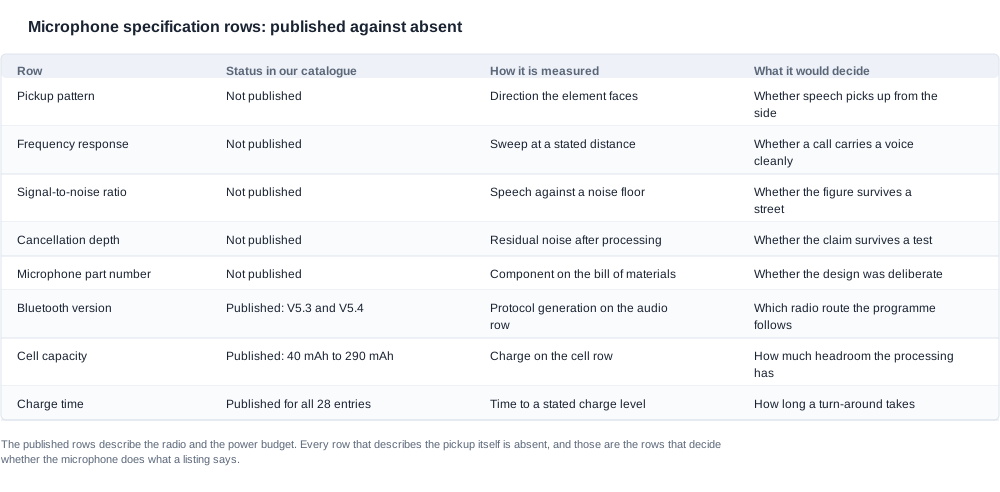
The rows we publish, and the rows we deliberately do not
Two things are worth separating before the rest of this article, because they are the reason the microphone question is awkward for every supplier in this category rather than only for us.
The first is the row set that does exist. Our published data settles the radio and the power budget in a way that can be compared across quotations: Bluetooth V5.3 on the K01 and K02 and V5.4 on the rest of the audio tier, cell configurations from 40 mAh on the children's entries up to 290 mAh on the camera tier, charge times of two hours or less on every entry except the D17 and the ZH12 at about one hour, and rated runtimes that run from roughly six hours on the slim-temple audio models to roughly twenty hours on the children's models. Those numbers are useful, and they are the numbers a buyer compares first.
The second is the row set that does not exist, and the reason is worth stating plainly rather than dressing up. A microphone specification is only meaningful against a measurement condition: the distance, the environment, the source, the processing state and the criterion. Publish a signal-to-noise ratio without those and you have published a number that cannot be reproduced by anybody, including the factory that produced it. We would rather carry an empty row than an unreproducible one, because a buyer who finds an unreproducible figure in the channel learns it from a customer rather than from a quotation.
So the practical instruction for a procurement manager is this. Ask for the microphone rows, and treat a supplier who answers with confident numbers and no method as having answered a different question. The noise control pillar describes what the category does; the longer treatment of microphone behaviour, including how pickup and processing interact, sits in how microphone pickup works, and the terminology a supplier is likely to use without defining it is collected in the microphone glossary.
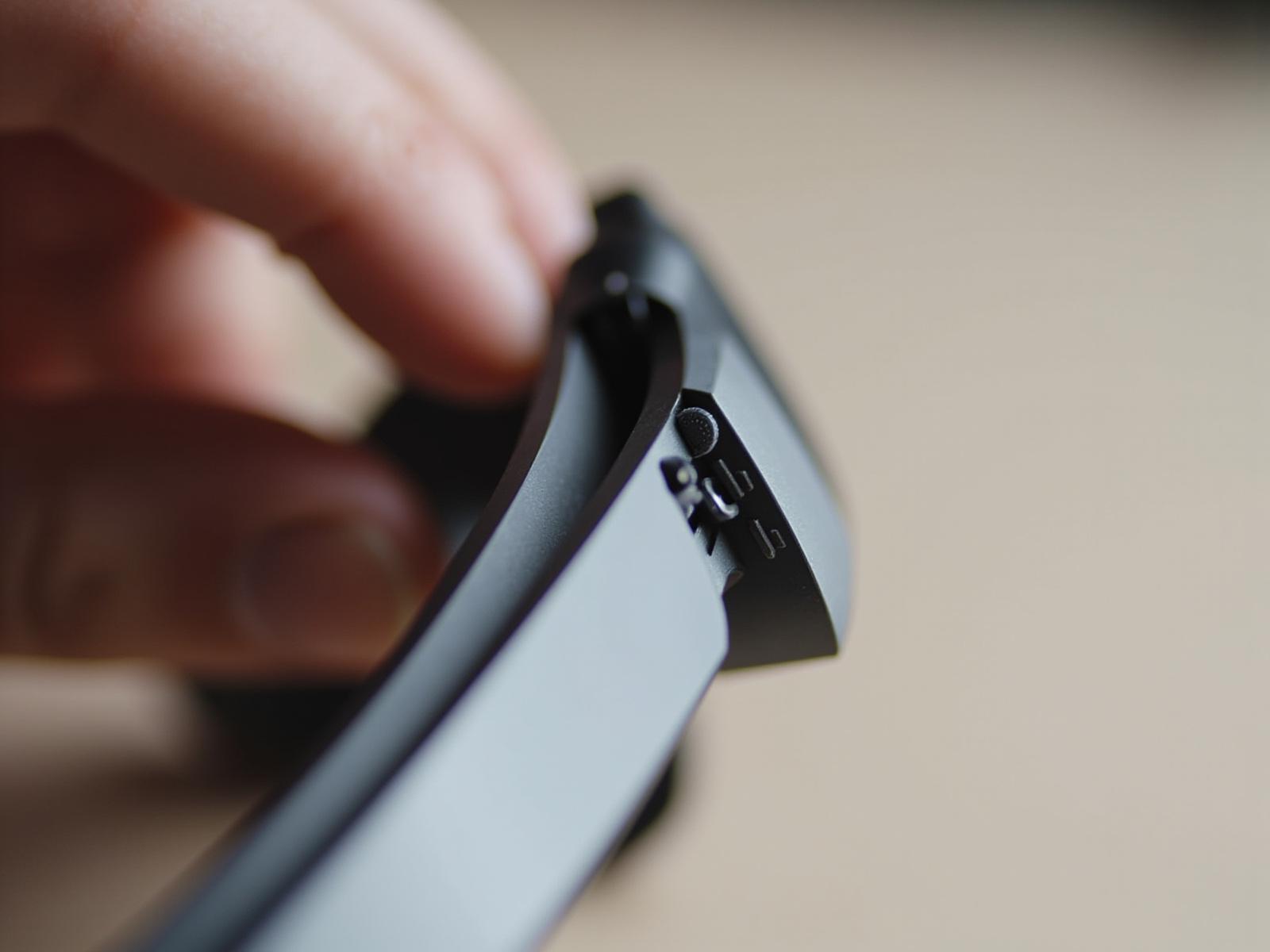
Who is approving the microphone row, and what they are really buying
The reader here is a brand-side product owner working alongside a procurement manager, or a channel buyer building a private-label range, or an e-commerce selector with a returns budget and no engineering team. Whatever the job title, the situation is one of three: a quotation to compare, a new material number to open, or a market to enter with a listing that already promises a voice experience. The microphone sits underneath all three.
What that buyer is afraid of is not a bad microphone. It is a launch that generates support contacts nobody budgeted for, because the failure mode of an under-specified microphone is not a defective unit. It is a unit that works in the supplier's demonstration and does not work in the customer's environment. The unit passes incoming inspection, arrives in the channel, and is returned by a customer in a place with a different noise floor than the one the supplier measured in. That return is not traceable to a defect, so it does not trip a defect rate, and it does not trip a warranty claim, so it lands in the cost model as an unexplained margin loss instead of a line item with an owner.
That is why the microphone specification is treated here as a configuration attribute and not as a marketing feature. A configuration attribute goes into the purchase order, is checked on the sample, and can be written into an acceptance criterion. A marketing feature goes into a listing and is discovered later.
There is also a second reader in the chain, and the technical reviewer who signs the sample approval needs the same artefact. They are not asking whether the microphone is good; they are asking whether the claim in the listing is defensible, which means they need the measurement condition, the distance, the environment and the failure criterion. If the supplier cannot supply those, the reviewer cannot sign the claim, and the programme stalls at a point where the money has already been committed.
Both readers need the same artefact: a written microphone specification with its conditions. The only difference is which clause it ends up in. The supplier question set for microphone quality is the shorter version of the same questionnaire, and it is worth sending in the first round rather than after the first quotation arrives.
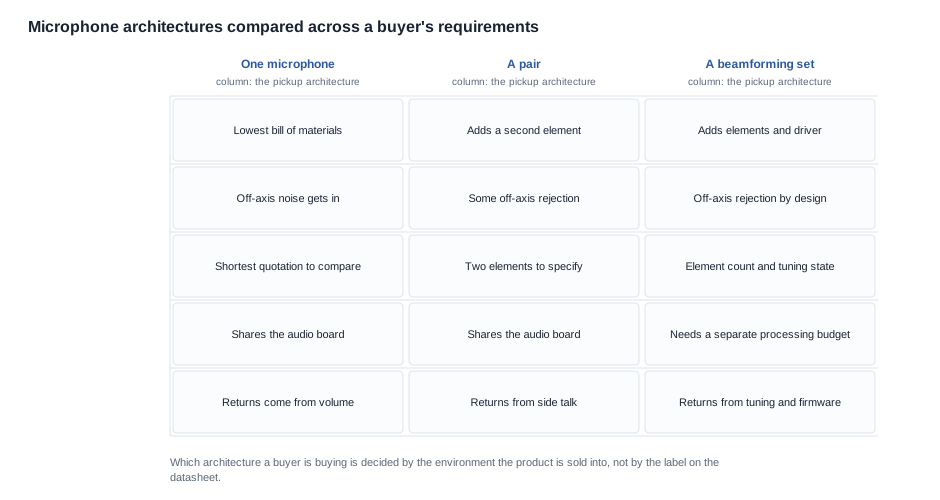
Where the cost of a pickup architecture sits in the quotation
The visible cost of a microphone is small. Almost every smart glasses product in the category carries one, and the difference between the cheapest element and the most capable arrangement is a few cents on a bill of materials that runs to tens of dollars. That is exactly why the cost comparison goes wrong: a buyer compares two quotations line by line, the microphone line is invisible in both, and the conclusion is drawn from the total, which is nearly identical.
The invisible cost is in three places, and each of them is larger than the element itself.
The first is the bill-of-materials consequence. A beamforming arrangement adds elements, a driver, an amplifier stage, a signal path and a processing budget, and the processing budget is the expensive part because it competes with everything else the radio and the cell are already doing. Our published cell rows make this visible in a way buyers rarely look at: the catalogue carries configurations from 40 mAh to 290 mAh, and the audio tier spans a 100 mAh single cell on one side and 55 mAh times two and 90 mAh times two on the other. The three sport models publish the same kind of row, with a 70 mAh times two cell on the YKC02, a 115 mAh cell on the D17 and a 100 mAh single cell on the ZH12. A processing-heavy configuration and a small cell do not belong in the same quotation without a runtime figure that reflects the combination.
The second is the test and certification consequence. A configuration that changes the radio, the housing or the acoustic path invalidates part of the conformity position, and the buyer needs to know whether the microphone arrangement touches any of those. The supplier's export certification is a company-level capability in our catalogue, not a per-model certification row, so a buyer cannot infer from it that any particular configuration carries any particular approval. That has to come from the supplier's own file, per model, and it is a question to ask rather than a row to read.
The third is the channel consequence, and it is the one that never appears in a quotation at all. A microphone that behaves differently in the environment the customer is actually in generates a return that no supplier can classify as a defect, so it cannot be charged back, so it comes out of the buyer's margin. The only defence is to price it in advance: agree the measurement protocol, agree the acceptance criterion, agree the environment, and then hold the supplier to the result. That is a commercial decision taken before the order, and it is the reason the verification sequence later in this article is framed as a negotiation input rather than as a quality formality.
The buyer's negotiating space therefore sits in the configuration definition, the number of orderable variants and the acceptance criteria, not in the price of the element. A supplier who offers you a cheaper microphone is offering you a different bill of materials with a different runtime and a different conformity position, and the quotation should show that difference as a line rather than absorb it.

The eight-row microphone criteria sheet and the thresholds behind each
The table below is the working version of the microphone criteria list. Each row states how the attribute is measured, the line that has to be met, and how an inflated figure shows up. It belongs in the evaluation file for the programme, not in a conversation with a supplier.
| Attribute | How it is measured | The line that has to be met | How inflation shows up |
|---|---|---|---|
| Pickup pattern | Direction the element faces, relative to the face | The direction is stated for the intended use | An adjective with no direction behind it |
| Frequency response | Sweep at a stated distance and orientation | A range with the distance and the method | A single loudness figure standing in for a range |
| Signal-to-noise ratio | Speech against a stated noise floor | A ratio with the noise source named | A figure quoted with no floor |
| Cancellation depth | Residual noise after processing, at a stated state | A depth with the processing state named | A depth measured on a different mode |
| Element count | Number of microphones on the product | The count is written into the configuration | A quote for one product used against another |
| Microphone part number | Component on the bill of materials | A part number, or a stated equivalent | No part number because the platform was not chosen |
| Processing and firmware | Which processing runs, and in which firmware state | The processing state travels with the unit | A demonstration unit on a different firmware |
| Channel behaviour with the feature off | What happens when the control is off or the battery is flat | The off state is defined and defensible | A feature that depends on a setting nobody changes |
Two of those rows need a second reading because they look administrative until the first shipment arrives. The element count row and the part number row are the two that separate a manufacturer from a reseller. A supplier who has a part number and an element count has a bill of materials and a production line. A supplier who has neither has a product they selected, and the row is the one you will be asked to defend when the units in the channel behave differently from the units on the evaluation desk.
What the thresholds actually are, in the absence of a published baseline
There is no industry-wide microphone baseline for this category that a buyer can point at, so the threshold has to be written by the buyer. That sounds like a weakness and it is actually the reason this category works the way it does: the contract is the standard.
The threshold for each row follows a shape, and the shape is the same in every row. Write down the measurement condition. Write down the number you will accept. Write down what happens to a unit that misses it. The third part is the one that is usually skipped, and it is the part that turns a specification into an acceptance criterion.
For pickup, the condition is the environment and the distance, and the number is the distance at which a normal speaking voice is still captured cleanly in that environment. For frequency response, the condition is the sweep method and the orientation of the product, and the number is the lower edge at which a telephone voice stops being intelligible. For signal-to-noise ratio, the condition is the noise source, because a ratio against a steady tone and a ratio against a street are not the same measurement. For cancellation depth, the condition is the processing state and the mode, and the number is the residual you are prepared to defend in a listing. The remaining four rows follow the same shape: the configuration string for the element count, the bill of materials version for the part number, the firmware version for the processing, and a flat battery for the off state.
Two warnings apply to every row above. The first is that these figures are not directly comparable across suppliers, and the reason is usually the measurement rather than the product. A signal-to-noise ratio measured at ten centimetres in a quiet room and one measured at a metre on a street are two different measurements of two different products, and only one of them describes anything the customer will do. The second warning is that a row filled in with a typical value from a general datasheet is worse than an empty row, because an empty row prompts a question and a typical value stops one.
The red flags worth naming before the quotation arrives
Four patterns show up repeatedly in this category and are worth recognising in the first round rather than the third. A supplier who describes the microphone as noise cancelling without stating whether the arrangement is passive, active or hybrid has not decided, and the configuration you receive will be whichever one the factory already had on the shelf. A supplier who quotes a cancellation depth but not the frequency band it applies to has quoted the most flattering part of a range. A supplier who quotes a runtime figure for the same product without the microphone processing in the load profile has quoted a different product. And a supplier who cannot produce a part number for the element has selected a platform, and the five questions you asked about that platform will get answered with a datasheet rather than with a measurement. None of these is a reason to stop the evaluation. They are reasons to know which quotation is incomplete before you compare the incomplete ones to each other.
Turning a supplier's microphone answer into a filed record
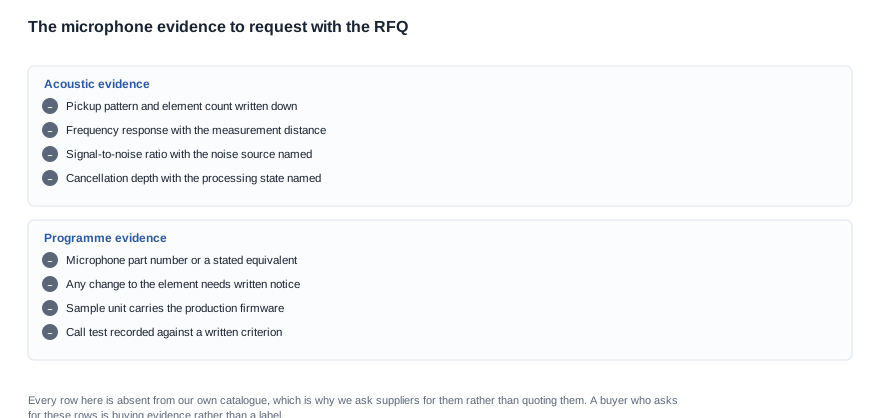
Verification in this category is mostly documentary, and it is fast once you know which five artefacts to ask for. The order below is deliberate: each step assumes the previous one passed, and a failure at any step tells you what the next step would have told you.

Step one: ask for the pickup rows as numbers with a method attached. The request is short: the pickup direction, the frequency response with its measurement distance, the signal-to-noise ratio with its noise source, and the cancellation depth with its processing state. A supplier who answers with four numbers and four conditions has done the work. A supplier who answers with four numbers has quoted a datasheet. Ask in the first round, because a supplier who answers is also a supplier who will put the same thing in writing later, and a supplier who deflects in the first round will not change their habits after the sample.
Step two: ask what the element count is and what the tuning state is. The element count is the cheapest way to tell a designed product from a selected one, and the tuning state is what makes two units with the same part number behave differently. Ask for the firmware version the figures were taken on, and require the sample unit to carry the production firmware rather than a demonstration build.
Step three: check which rows the supplier will put in a document that carries the price. This is the step that separates a supplier from a catalogue. A row that appears in a quotation can be held to; a row that appears in an email can be argued with. Ask for the acceptance criteria to be attached to the purchase order as a schedule, not as a note. If the supplier declines to attach them, that refusal is itself the answer to the question you were really asking, which is whether the microphone specification is settled.
Step four: run your own call test on a sample, on a fixed protocol. The protocol that closes the rows does not need laboratory equipment. Record the sample and a reference unit in the same place at the same moment, in the environment the product will be sold into, and not in the supplier's demonstration room. Run it in two environments at minimum, because a microphone that performs in a quiet office and fails on a street is the normal case rather than the exceptional one. Keep the recordings. They become the basis of the written acceptance criterion, and they are the evidence you would otherwise have to reconstruct from a support contact.
Step five: write the criteria and the measurement into the purchase order. This is the step most programmes skip and it is the one that converts a preference into a right. If the criteria live in an email thread, a unit that fails them is a unit you have to argue about. If they live in the order, it is a unit you can refuse or a lot you can claim against.
How microphone programmes fail in the channel
The failures below are the ones that reach a buyer as a surprise. Each is written as a symptom, the root cause and the control that stops it.
The figure without a condition. A broadband attenuation number was compared against a competitor's low-frequency claim and the comparison was published internally as a result. The root cause is that a number without a condition is treated as a number. The control is to require the range, the environment and the method in any comparison, and to remove a figure from your comparison table rather than carry it with a footnote.
The control that nobody finds. The feature depends on a setting that is not obvious, and the customer never turns it on, so the performance the supplier described is never experienced. The root cause is that the default state was never written down. The control is to require the default state and the discoverability of the control to be part of the sample evaluation, and to put the default state into the listing and the support script.
The trade-off discovered in review. The secondary function degraded the primary audio use and the interaction was not documented anywhere. The root cause is that the microphone specification was treated as independent of the audio path. The control is to ask for the interaction in writing and to publish it in the listing rather than leaving it to support to discover.
The feature cost that was not quoted. The arrangement added parts to the bill of materials that appeared in no line of the quotation, and the unit price did not move. The root cause is that a feature was priced as a feature. The control is to ask for the bill-of-materials consequence of every configuration option at quotation stage, and to have each option quoted as a separate configuration with its own minimum order quantity.
A supplier substituted the platform. The units in the channel behave differently from the evaluation units and no configuration change was notified. The root cause is that the microphone part number was never in the order. The control is to make the part number and the element count configuration attributes, with a change-notification obligation attached.
Nothing in this list is unusual, and none of it is grounds for moving to a different supplier. They are reasons to put a line in the order.
What a microphone programme can and cannot negotiate
The microphone is not a large commercial lever, and treating it as one wastes negotiating capital that belongs elsewhere. It is worth being exact about which numbers move and which do not, because a supplier who is told clearly that a feature is fixed will spend the negotiating capital where it is real.
The configuration set and its minimums are the live commercial numbers. Where a microphone arrangement is configurable across a family, ask whether the variants are separate orderable configurations with their own part numbers and their own minimum order quantities. A programme that mixes variants creates a packaging, labelling and artwork burden that is usually larger than the microphone itself, and it is usually missing from the quotation. Committing to a configuration count rather than a unit count is what moves the per-configuration minimum.
Sample cost and evaluation unit quantities are negotiable and are frequently wasted. A supplier who is under pressure on the first order will often concede sample cost, evaluation unit quantities, or a small first-article inspection allowance. These are real numbers, they are easy to get, and they cost the supplier very little, which is exactly why they are worth taking before you push on anything structural.
The acceptance criteria are negotiable in wording and not in substance. A supplier will argue about the method and the environment. The criterion itself, and the consequence of failing it, are the parts that should not move. A supplier who agrees to an acceptance criterion in principle and then attaches no consequence to it has not agreed to it.
Certification cost and certification time are fixed. They are a per-family cost and a queue at the test laboratory, and pressing on either produces a longer schedule rather than a shorter one. The same is true of any re-test that follows a configuration change, and that re-test is per configuration, which means it is the line that compounds across a range.
The microphone itself is not a commercial variable. If your requirement needs a certain pickup direction or a certain processing behaviour, no negotiation turns a single element into an array. What negotiation can do is change the number of orderable configurations, the size of the first order, the documentation obligations and the acceptance criteria that bind them.
The clauses worth having in the agreement are these. The configuration string, written into the order, including the element count and the microphone part number. The acceptance measurement, with the environment, the distance, the source and the criterion. The default processing state and the off-state behaviour. The firmware version the figures were taken on. A change-notification clause covering the element, the housing, the acoustic path and the firmware. And the defect remedy for a unit whose measured behaviour does not meet the agreed criterion, which is the clause that decides whether a bad lot is your cost or the supplier's.
A worked example: a brand opening a call-first line
This is a constructed scenario, not a client project, and it is written to show the order of the decisions rather than to report an outcome.
Assume a business software brand that has decided to add a call-first smart glasses line for field service technicians, selling into three markets, with a target of a first shipment that carries a listing describing the product as usable on a noisy site. The constraint that matters is not price. It is that the brand has no acoustic engineering resource and cannot evaluate a microphone specification on its own, and it has already learned that a claim its own support team cannot substantiate becomes a refund conversation rather than a sales conversation.
The brand's first move is to stop treating the microphone as a feature. It writes the use environment into the requirement rather than leaving it to the supplier: vehicle cab, plant floor and a customer site, with the vehicle cab as the quietest of the three and the plant floor as the noisiest. That single sentence converts the supplier question from "how good is the microphone" into "what is the measured result in these three environments", which is a question with an answer.
The second move is the questionnaire. It asks for the pickup direction, the response with its distance, the signal-to-noise ratio with its noise source, the cancellation depth with its processing state, the element count, the part number, the firmware version and the default state. Two of the three quotations answer all eight with a method attached. One answers with four numbers and no methods. The brand now knows that its comparisons are between three quotations and one set of numbers, and it prices the third quotation accordingly rather than discovering the difference at sample stage.
The third move is the protocol. Before the samples arrive, the brand writes down the call test: a scripted call, the same script for every sample, the same far-end device, three environments, and the criterion that the far-end participant can complete the script without asking for a repeat. The script and the criterion are attached to the purchase order as an acceptance schedule. This costs one page and it is what turns the microphone from an opinion into a measurable commitment.
The fourth move is the commercial one. The brand learns that one of the configurations it wants has a minimum order quantity twice the size of the others, and that the variant with the smaller minimum adds a distinct artwork and packaging line. It commits to a configuration count of two rather than three, takes the sample cost concession, and asks for the acceptance schedule to be attached to the order rather than to the quotation. The supplier agrees to two of the three because the third is a scheduling artefact rather than a refusal.
The result is a programme with one acoustic claim the brand can defend, a cost model that contains a returns allowance for the environment it specified, and a schedule that has one named risk rather than an unowned one.
What we publish about microphone quality, and what we will not invent
The published material is the part of a microphone specification we can stand behind, and the rest belongs in the supplier's own file. We publish the rows our documentation states, we mark the open rows as open, and we will not fill an open row with a typical value taken from a general datasheet. A buyer who builds a claim on an estimated figure finds the error in the channel rather than in the quotation, and the correction costs more than the question did.
These are the microphone rows we do not publish, and the reason is the same in every case:
- The microphone specification itself — pickup distance, frequency response, signal-to-noise ratio, cancellation depth and microphone model — is not published for any model in the range.
- The number of microphone elements per product is not published.
- The firmware state in which any processing runs is not published.
These are the rows our published data does settle, and they are the rows a buyer should use to structure the comparison:
- Bluetooth V5.3 on the K01 and the K02, and V5.4 across the rest of the audio tier including the D11, the D12, the LC-105 pair, the G07 and the YK12.
- Cell configurations from 40 mAh on the children's entries up to 290 mAh on the camera tier, with single cells on some entries and two cells on others, published as the catalogue states them.
- Charge times of two hours or less on every entry except the D17 and the ZH12, which publish about one hour.
- Rated runtimes from roughly six hours on the slim-temple audio models to roughly twenty hours on the children's models.
What we will not do is quote a microphone figure from a photograph, a demonstration, or a supplier's general data, and we will not present an unpublished row as though it were published. What we will do is take a use case, a configuration and a target market, and tell you which parts are settled, which are open, and which have to come from a sub-supplier. The procurement checklist is the same method applied to a different feature, and it is worth reading next to this one because the questions are the same questions.
What to request in the same round as the price request
Send the microphone questionnaire in the same round as the price request, not in the round after. Attach the use environment to it, because the environment is what converts the answer from a number into a measurement. Ask for the element count, the part number and the firmware version, and treat a supplier who cannot produce those three as a supplier who has selected a platform rather than designed one.
Then, before the sample order, write the call test down: the environment, the script, the far-end device and the criterion. Attach it to the purchase order as an acceptance schedule. A request sent at quotation stage costs one email, and the same gap found after the first shipment costs a returns rate that nobody budgeted.
If you want a second opinion on a specific configuration, send us the model, the quantity, the target market and the environment the product has to work in. We will tell you which of the published rows apply to that configuration, which of them are open on our data, and which questions are the ones we would put to the factory ourselves.
Related reading
- Noise control and microphone pickup
- Microphone how it works
- Microphone specifications to request
- Microphone glossary
Send the configuration, the quantity and the environment, and we will say which parts of the microphone specification are settled and which are yours.


