

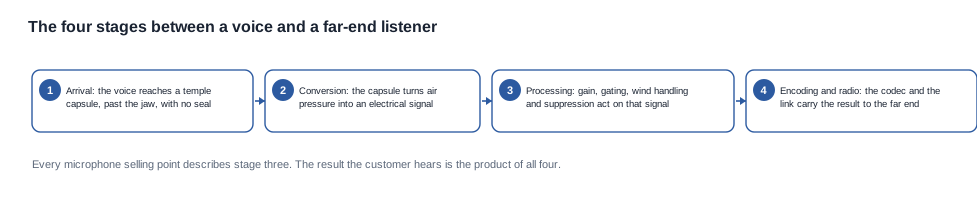
A microphone in an open-ear frame works in four stages, and a buyer who understands them knows which questions will produce a checkable number and which will produce a feature name. The stages are: the sound reaches a microphone that is not where the mouth is, the microphone converts it, the device applies some form of noise treatment, and the result is encoded and sent. Everything that makes an open-ear microphone good or bad happens in the first and third stages, and the first stage is a physical consequence of wearing a frame rather than an earbud. Our published position is that we publish no microphone specification — no sensitivity, no capture frequency response, no noise floor, no cancellation depth and no beamforming pattern — so the mechanism has to be understood rather than quoted, and the measurement has to be run on a sample.
Smart glasses microphone quality: the four stages and where the decision sits
The buying task behind this article. The reader is a brand buyer, a product manager or a sourcing buyer who is being shown noise cancellation, beamforming and wind resistance as selling points and needs to know what to ask for in return. The specific task is to translate the mechanism into a measurement protocol, so that a supplier's answer can be checked rather than believed. The commercial risk is a product positioned on a processing feature that a customer experiences as a mic that does not work in the noise they work in, which is an expectation failure rather than a defect and which arrives in the first weeks.
The four stages of what actually happens when someone speaks. First, the sound arrives — from the mouth, at a distance, past the wearer's own jaw, and in a frame that is not sealed to the head. Second, the microphone converts it, and the conversion is where the electrical characteristics and the physical placement combine. Third, the device processes it — noise suppression, beamforming, gain control, wind detection — and this is the stage that every selling point describes. Fourth, the result is encoded and sent, and the codec and the radio have their own effect on what the far end hears. A buyer who is shown stage three and asked to sign on it is being shown the only stage that is cheap to describe.
The four design decisions that follow from that mechanism. How many microphones there are, and where they sit relative to the mouth. Whether the device relies on beamforming to reject off-axis sound, or on a single microphone with aggressive suppression, which trades intelligibility in a quiet room for a better result in a noisy one. Whether the frame seals to the head at all, because a frame that does not seal cannot use the head as an acoustic baffle. And whether the device applies aggressive gain control, which makes the output level stable and the far-end experience worse.
The four reasons this mechanism is hard to measure, and hard to compare. The result depends on the distance from the mouth, which is a property of the frame rather than the microphone. It depends on the environment, which the test has to control. It depends on the far end's device and the network, which the test has to hold constant. And it depends on the speaking voice, which is why the test needs a fixed phrase and a fixed number of attempts rather than a conversation.
What this means for the price you are quoted. Two suppliers quoting the same unit price can be quoting two different products, because one of them has a directional array and a port geometry that the other does not. The stage-3 feature that separates them is a by-product of the stage-1 and stage-2 decisions, and those decisions are hardware decisions with tooling implications. A buyer comparing quotations at the unit-price level is comparing the only row in the specification that is identical by construction, and the differences sit in rows that were never written down. That is why the mechanism has to be understood before the comparison is made.
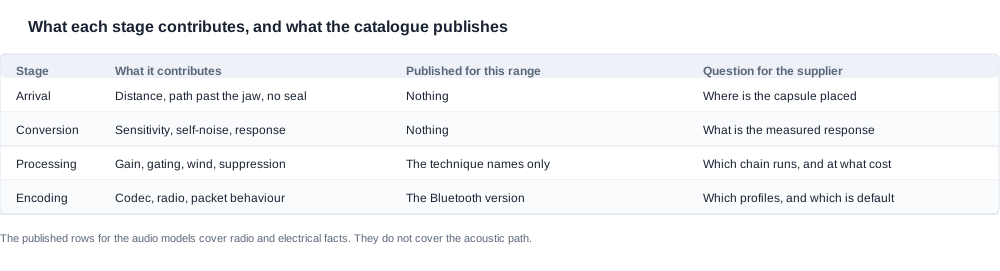
The table sets out what each stage contributes to the result, what our catalogue publishes for it, and the question that settles it. Read it as a sequence of gates: a stage that has not been settled cannot be compensated by a later stage, because the later stage only has the signal the earlier stage produced to work with. A supplier that can explain what the signal looks like at the input of stage three has told you more about the achievable result than a supplier that can name the algorithm running at stage three.
Stage one and stage two: the frame decides before the capsule does
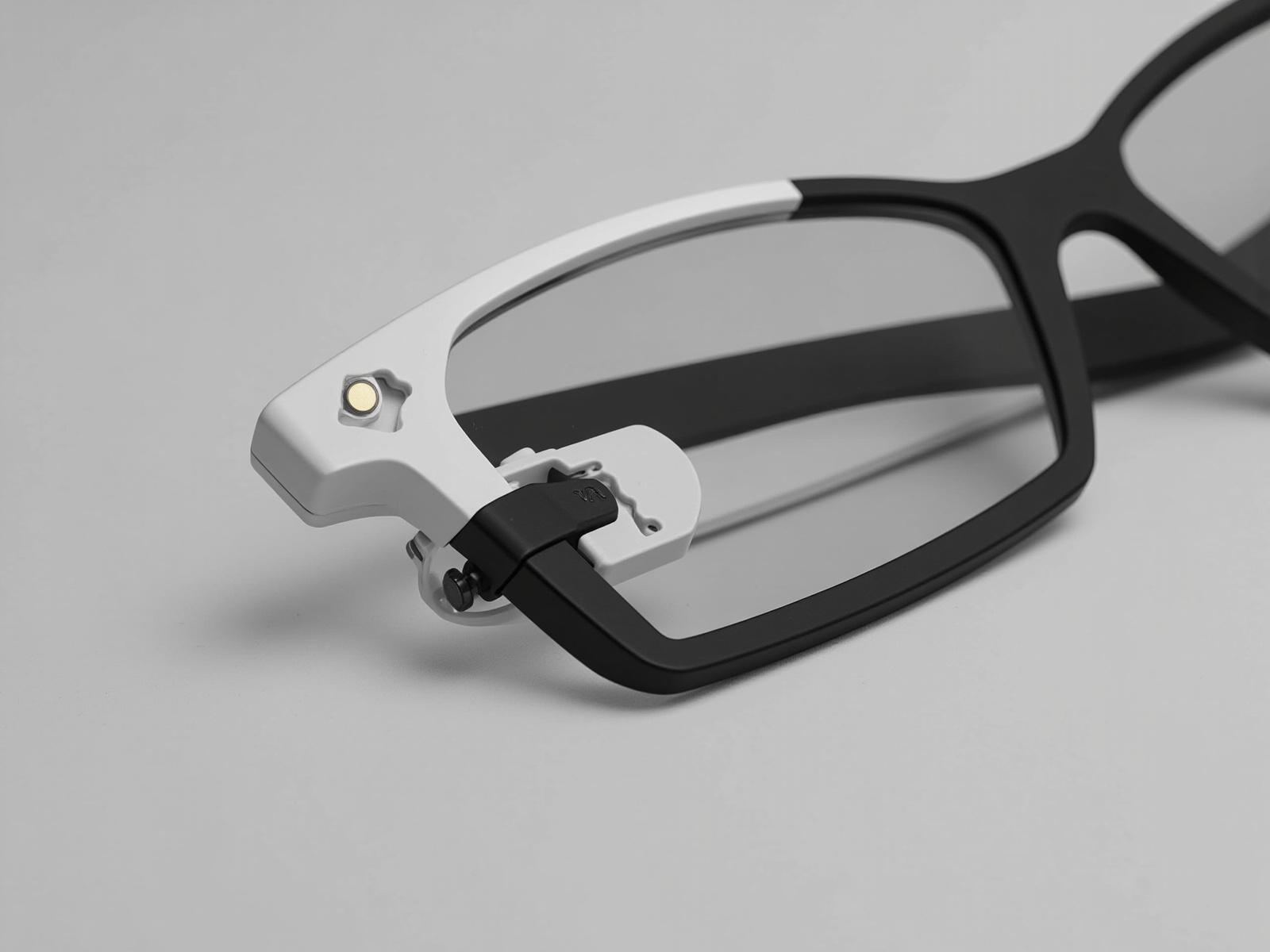
Stage one is the one that no processing can repair, and it is the stage that a buyer evaluating a frame usually skips. The voice leaves the mouth, travels a short distance, passes the jaw, and arrives at a capsule that is positioned somewhere on a temple. Along the way it competes with the room, with the person's own bone-conducted voice arriving through the skull, and with whatever else is in the environment at that moment. Nothing in the electronics can undo the fact that the source is not in front of the microphone.
Three consequences follow, and each of them changes what a buyer should ask for. The first is that the distance from the mouth to the capsule is a property of the frame, not of the capsule, so two products with identical capsules will differ, and a pickup distance quoted for one tells you nothing about the other. The second is that a frame which does not seal against the head cannot use the head as a baffle, which removes the single most effective way of improving the signal-to-noise ratio in any headset. The third is that a person's own voice arrives at the capsule through bone and tissue as well as through air, which is why echo cancellation in an open-ear device is a harder problem than the same function in a handset.
The questions this stage generates are answerable without any laboratory: how many capsules are there, where is each one positioned relative to the mouth and to the temple hinge, and is the port behind a screen or a filter. A supplier who cannot answer those has not examined the product, and that is worth knowing before a sample order rather than after.
Stage two is where the capsule converts air pressure into an electrical signal, and it is where the two classic figures live. Sensitivity describes how much signal the capsule produces for a given input. The self-noise, or noise floor, describes how much signal the capsule produces in silence. The second figure limits the first: a capsule with a good sensitivity and a high floor will produce a louder version of the same noise, and no amount of downstream gain changes that ratio. This is also why the floor is the right follow-up question to any claim about noise cancellation, since a cancellation depth is only meaningful relative to the floor it is cancelling from.
The capture response sits alongside them, and it is the row that determines whether speech is captured cleanly rather than merely captured. None of the three is published in our range. That is not an unusual position for this category, and it is not evidence of a poor product; it is evidence that the acoustic path in an open-ear frame is a property of the assembled product rather than of a component that can be characterised on its own. A capsule datasheet describes a capsule in a fixture. The number that matters to a buyer is the one from the finished assembly, where the capsule sits behind a port, on a moving head, at a distance from the mouth.
Stage three, the stage every listing leads with
Stage three is the processing chain, and it is the reason the category sounds more comparable than it is. Everything here is describable in a sentence: gain is raised to keep the level steady, the signal is gated below a threshold, wind is detected and attenuated, and off-axis sound is suppressed using the array or a single capsule.
Automatic gain control keeps the output level stable as the distance between the person and the capsule changes, and it achieves that by raising a quiet signal. In a quiet room the raised gain amplifies the background, which is the source of a large share of the "it hisses" reports this category receives. In a noisy environment the same gain control amplifies the noise along with the voice, which is what turns a working microphone into a marginal one. The question worth asking is what the device does in a loud environment, and a supplier that has tuned the system will have a specific answer.
Noise gating suppresses the signal below a threshold. It is what produces the pumping, clicking or dropping-out that open-ear devices are reported to have in quiet conditions, and it is the mechanism most often mistaken for a hardware fault. It also makes a device fall silent in the middle of a phrase, which on a call is a failure that a customer experiences as the product cutting out.
Wind detection and wind rejection are separate claims and are routinely conflated. Wind detection is the recognition that the signal contains airflow; wind rejection is the attenuation that follows. Software reduces wind rather than removing it, because the airflow has already contaminated the acoustic information before the capsule receives it. The interventions that actually change the outcome are mechanical: a windscreen, a change to the port geometry, or moving the capsule relative to the airflow. A buyer who accepts a firmware answer to a wind requirement has accepted an improvement rather than a solution, and that distinction should be written into the acceptance criteria.
Suppression and beamforming are the pair that most often appear in a listing without the hardware that would justify them. Beamforming requires several capsules in a defined geometry, and the geometry determines the width of the region it can favour. Single-capsule suppression attenuates everything outside a target rather than separating the speaker from the room, which is a partial result by nature and a noticeable one when a colleague is talking nearby. The question is therefore not how good the suppression is but how many capsules there are, and the answer decides which of the two you are buying.
Echo cancellation addresses the wearer's own voice returning into the capsule. It is the hardest of the five to do well in an open-ear frame, because there is no seal to work from and no clean echo path to estimate, and its practical result is that a device can be entirely usable in a quiet room and unusable in a loud one. A demonstration conducted in a quiet room does not test it.
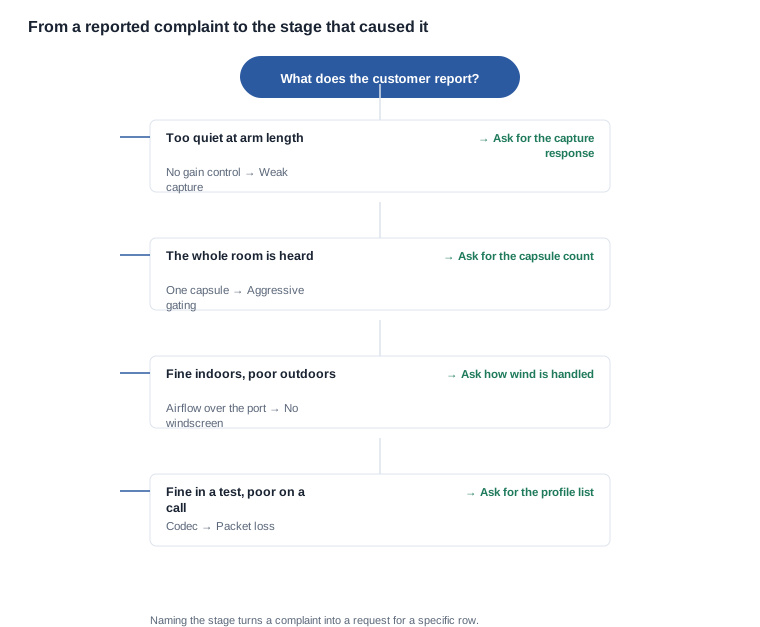
The four questions this stage implies are the ones worth putting in writing. How many capsules contribute to the pickup, and where are they positioned. What is the measured capture response and the self-noise, with a method. What processing is applied, and what does it cost at the quiet end. And what the wind behaviour is, measured how. A supplier that answers all four has tuned a system; a supplier that answers the first has fitted a part.

Stage four: the codec and the network the buyer forgot
The fourth stage is where a microphone that works perfectly produces a call that does not. The signal is encoded, transmitted over a radio, decoded at the far end and rendered by whatever the far end happens to be. A codec choice affects the bandwidth available for speech, a profile negotiation determines whether the two ends actually agree on that codec, and a congested network produces packet loss that a good microphone cannot repair.
Two commercial consequences follow. The first is that a microphone evaluation which uses a loopback — the device playing back into itself, or a test harness rather than a live call — does not test this stage at all, because loopback bypasses the radio and the network entirely. A device that is excellent in a loopback and unusable on a real call is not unusual, and the reason is almost always here rather than in stage one.
The second is that the profile list is a documentary answer that costs a supplier nothing to provide, and it is the only part of stage four that a buyer can obtain before a sample order. For the audio models in our range the published row is the Bluetooth version: 5.3 on the K01 and the K02, and 5.4 across the LC-105-1 and the G07, the YK12 and LC-105-2, and the D11 and the D12. The sport models publish 5.4 as well, on the YKC02, the D17 and the ZH12. A buyer should ask what profiles are supported, which one is negotiated by default, and what happens when the far end does not support it. The catalogue publishes the version and not the list, and the list is a question worth sending.
Latency belongs to the same stage and is usually invisible in a specification. It is what produces lip-sync drift when the captured audio is used for video, and it is a defect that a buyer can detect in a demo and then forget to write into the acceptance criteria, which guarantees that it will be discovered by a customer instead. The measurements to request are the end-to-end figures, not a component figure, and the only rig that produces them is a real call between two fixed endpoints.
Turning the mechanism into a protocol you can repeat
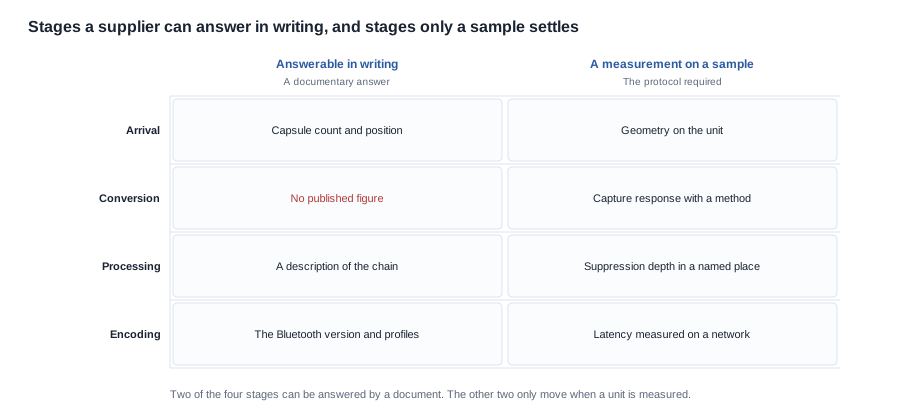
Running the four stages in order is not a stylistic preference. A defect at the arrival stage makes every stage-three figure meaningless, and a defect at the encoding stage means the stage-two numbers were never the problem, so the sequence decides which measurement is even worth taking. Each step below assumes the one before it passed, and a step that fails is a cheaper result than a conclusion reached out of order.
Step one: establish the hardware from a document. Ask for the capsule count and the position of each one, per model, and for the port treatment. This is a drawing request, it costs one email, and it settles whether stage one has been designed or inherited. A supplier who answers with a single capsule and a temple position has given you the ceiling on everything that follows.
Step two: ask for the response and the floor, with the method. If the supplier holds a measurement, the method is the deliverable rather than the number. If the supplier does not hold one, that answer is also useful: it means the row will have to be produced on a sample, and it can be written into the sample order rather than discovered afterwards.
Step three: fix the environment and the source. One named environment, one recorded phrase, one playback level, one talker distance, one number of attempts. The environment is the one your customers are actually in, not the one where the feature is easiest to demonstrate. Traffic, wind, café babble and an office fan are four different problems, and a tuning that handles three of them badly is worse than a simple device, because the customer experiences the bad one.
Step four: hold the far end constant. One handset, one network condition, one codec setting, and the same scorer for every recording. A test in which the receiving device changes between runs measures the far end rather than the product, and it is the most common way an evaluation produces a result nobody can reproduce.
Step five: put the criteria into the purchase order. In a category with no universally quoted method, the contract is the standard. A criterion that lives in an email is not binding; a criterion in the purchase order is an acceptance standard, and a lot that fails it is a lot you can refuse.
Step six: retain the recordings and a golden sample. Keep the raw audio, not only the score, and keep one unit with its firmware version recorded. These are the only way to detect drift between production lots, which is a failure mode no specification will tell you about, and they cost nothing before an order and cannot be reconstructed after one.
The failure modes this protocol is designed to catch. A processing feature accepted as a performance result, which produces a listing that invites a customer to test the device in a way it was never designed for. The quiet end never checked, because the demonstration is always the noisy case. The far end not controlled, so the result belongs to the receiving device. The wind case skipped, which is the condition a customer working outdoors hits in week one. And the distance from the mouth treated as constant, when it changes as the person moves their head, which is exactly what happens during a call.
What is negotiable in this category. Whether the supplier will run the protocol against production units rather than engineering samples, and whether they will supply the recordings so you can re-judge them. The minimum order quantity tiers, and the share of units taken at a pilot tier rather than a run tier. Whether the microphone test applies to every shipment or only to the first. Colour, temple configuration, logo, lens tint and packaging. Splitting a first run into two deliveries against a staged payment. And the cost of the fixture, which is a development item that can sometimes be amortised across a programme rather than charged as a one-off.
What is not negotiable in this category. The capsule count and the position of each one, because they are the hardware. The port geometry and any windscreen, because they are the mechanical answer to wind. The compliance file for the model as configured, because the cost and the queue for that are set by the laboratory and the certification body rather than by the order size. And the acceptance criteria themselves, because a criterion that can be changed after a lot has been produced is not a criterion.
The documents to request before a deposit. The measurement results with their conditions, the microphone count and placement per model, the processing description, the model designation table, the certificate register at certification checklist, the packaging artwork proof, the agreed incoming inspection criteria, and the battery transport documentation at battery transport. We publish rather than summarise: the drafting of the clauses is at contract terms, and the commercial form a first order takes at pricing. The measurement procedure is at how to measure microphone quality, the terminology is at the microphone glossary, and the surrounding standards discussion is at open-ear audio industry standards.
A worked sequence, and the boundary of what we can evidence
This is a hypothetical scenario rather than a client project, and it is here to show the decision sequence, not to report an outcome.
Assume a mid-size European distributor that sells a Bluetooth audio glasses line into three markets, currently buying a model whose listing leads with intelligent noise reduction, and about to place a second order that is large enough to be worth a specification argument. The binding constraint is not price. It is that returns in one market are running above the level the channel will accept, and the returns notes say "the other person cannot hear me" without saying where or at what distance.
Step one, the hardware. The distributor asks for the capsule count and the position of each one, per model. The answer is a single capsule on the temple, with a port behind a filter. That is a stage-1 answer, and it establishes the ceiling: a single capsule cannot separate the speaker from the room, so any whole-room pickup complaint has a structural cause rather than a tuning cause.
Step two, the processing. The supplier describes the chain — gain control, gating, wind detection, single-capsule suppression — and states that the tuning targets a set of noise profiles. The distributor asks which profiles. The answer names traffic and office fan but not a moving source, which tells the distributor that the wind case was never characterised, and the wind case is the one that matters for the outdoor channel in the market with the worst returns.
Step three, the protocol. The distributor fixes the environment from its own return data rather than from the supplier's demonstration: a street with traffic at a stated level, and an office with a fan. It fixes the source: one recorded phrase, one talker distance, three attempts per unit. It holds the far end constant on a single handset model, because the return notes come from three different handset models and the distributor does not yet know which end of the call is failing.
Step four, the result. The street case fails on a meaningful share of units and the office case passes. The finding is that the failure is concentrated in moving-source noise rather than in general loudness, which is a different diagnosis from the one the returns notes suggested, and it produces a different action: a mechanical wind intervention and a revision of the listing wording, rather than a firmware request or a supplier penalty.
Step five, the commercial structure. The distributor asks the supplier to run the protocol on production units rather than on engineering samples, and to retain the recordings. It negotiates the protocol into the incoming inspection criteria for the next lot, and it moves the listing wording ahead of the next print run rather than after it. The unit price is unchanged; what changed is that the product is now described in terms the evidence supports.
The decisive decisions in that sequence were all made before the second order was placed, and none of them was about the algorithm.
Concretely, we publish no microphone specification, because none is published to us, and we will not present a processing feature as a measured result. We will also not quote a typical performance figure for the category, because a typical figure is what produces a customer expectation the product cannot meet. What we will do is tell you which of the four stages the published rows can rule out, which have to be measured on a sample, and which have to be confirmed in writing before a purchase order. The technology background is at noise control and microphone pickup.
Send us the environment your product is sold into, the platforms your customers call from, and the models you are evaluating. We will tell you which of the four questions decides the project, which published rows apply, and what has to be written into the inspection criteria before you commit to a volume.
Related reading
- How the technology works — noise control and microphone pickup
- The measurement procedure — how to measure microphone quality
- The terminology — microphone glossary
- The standards discussion — open-ear audio industry standards
Tell us the environment and the platforms, and we will say which of the four questions decides the purchase.


