
Six beliefs about minimum order quantities in smart glasses do most of the damage in this category, and none of them is stupid. Each one is a reasonable inference from a conversation that did not quite contain the information the inference needed. A minimum that was quoted against one model becomes a belief about the product. A unit price that fell at a higher volume becomes a belief that volume always lowers price. A number that stayed the same twice becomes a belief that it will stay the same. The damage is not that these beliefs are wrong; it is that they are acted on at scale.
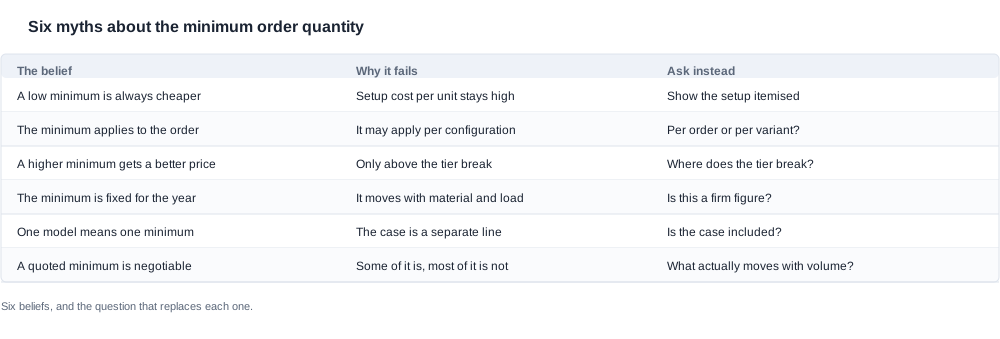
The conclusion: each of the six below comes with a replacement question, and the replacement question is the thing to take into the next supplier conversation. What to ask matters more here than what to conclude, because the beliefs are not held by one person in a company — they are held by the whole buying team and they survive until somebody writes the question down.
Smart glasses MOQ: six beliefs that cost more than they save
The conclusion, and the shape of the six
Six myths, and they are not equally costly. Two of them — the belief that the minimum belongs to the product rather than to a configuration, and the belief that a lower minimum is always cheaper — will cost more than the rest of this article put together. The remaining four are smaller but they are the ones that cause a programme to lose money quietly, in a channel, a season later.
They are arranged here in the order a buyer meets them, which is also the order in which they are cheapest to correct. The first is about what the number belongs to. The second is about what it does to the cost. The third and fourth are about how the number behaves over time and across variants. The fifth is about accessories. The sixth is about how negotiable the whole thing is.
Who repeats these beliefs, and why they are reasonable
The beliefs are repeated by competent people, which is why they survive. A buyer who asked one supplier for the minimum of a popular model was told a number, wrote it in a spreadsheet, and shared it with a colleague. Nothing about that exchange was wrong. The mistake is in the promotion of a configuration-specific number into a product-level fact, and that promotion happens silently, in a spreadsheet cell, with no decision attached to it.
That is the pattern to watch for. Every myth in the list below starts as a correct statement about a specific case and ends as a general statement about a category. The criteria for telling whether a belief has crossed that line are simple: if the belief would still be true if the colourway changed, the case option changed, the market changed or the date changed by six months, then it is a myth rather than a fact.
Why a belief survives a quotation
A belief survives a quotation because the quotation does not contradict it. A supplier who quotes a minimum for a one-colourway build is not contradicting the belief that the minimum is a product-level fact; they are simply answering a narrower question than the buyer believes they are being asked. The contradiction only arrives when somebody asks the next question — and in a busy buying process, the next question often never comes.
This is why the replacement questions matter more than the corrections. A correction delivered in a meeting is a comment; a question carried into the next enquiry is a control. The beginner's guide covers the structure behind the number and the buyer checklist covers the sequence in which the questions should be asked.

The six myths, and the question that replaces each one
The first three
One: the minimum is a property of the model. The belief is that a model has a minimum order quantity in the same way it has a battery capacity. It does not: a minimum belongs to a build, and our own catalogue shows how far a build can differ from a model designation. The V03 Pro is published in three colours and the V06 in four; the L2 Utral is published with either a 900 mAh or a 1400 mAh charging case while the V03 Pro is published with no case at all; the camera models split between two published resolution classes, with eight of the eleven at 8 MP and three at 13 MP; and the charging interface is magnetic on seventeen entries across the catalogue, Type C on seven, and unpublished on four. A minimum quoted for one build of a model says nothing about another build of the same model. The replacement question is: which colourway, which case option, which market and which date is this minimum quoted against?
Two: a lower minimum is always the cheaper order. This is the most expensive of the six because it produces the smallest possible order at the highest possible unit cost. The fixed costs — a mould, a first-article approval, a packaging print run, a file entry — are recovered over a production run, so a smaller order carries more of them per unit. The replacement question is: what are the setup charges itemised, and what is the setup cost per unit at each quantity you have quoted?
Three: the unit price falls as the quantity rises, so a bigger order is always better. The belief takes a true statement about a tier structure and extends it into a general law. The truth is that unit price is flat between tier breaks and falls at them, which means the larger order is only cheaper above a break, and the break has to be identified rather than assumed. The replacement question is: where is the tier break, and is my quantity on one side of it or the other?
The last three
Four: the minimum is a fixed number for the year. Minimums move, because the material position behind them moves and because the factory's load changes. A number collected eighteen months ago describes a past configuration of a business, and the practical consequence is that a renewal conversation starts from a figure that nobody is currently willing to honour. The replacement question is: how long is this offer valid, and what would cause the figure to change before then?
Five: one model means one minimum. The accessory breaks this. The charging case is a separate line with its own quantity logic, and whether it sits inside the minimum or beside it changes the shape of the order. The replacement question is: is the case inside the minimum, does it have its own minimum, and is the packaging counted separately from the product?
Six: a quoted minimum is negotiable. Some of it is and most of it is not, and the part that is negotiable is rarely the number itself. The minimum follows from the material set and the fixed costs; what moves is the shape of the order, the number of variants, the accessory position, the release schedule and the market. The replacement question is: which parts of this answer move with my quantity, and which parts are arithmetic?
Testing a belief against the record
The checklist that replaces the belief
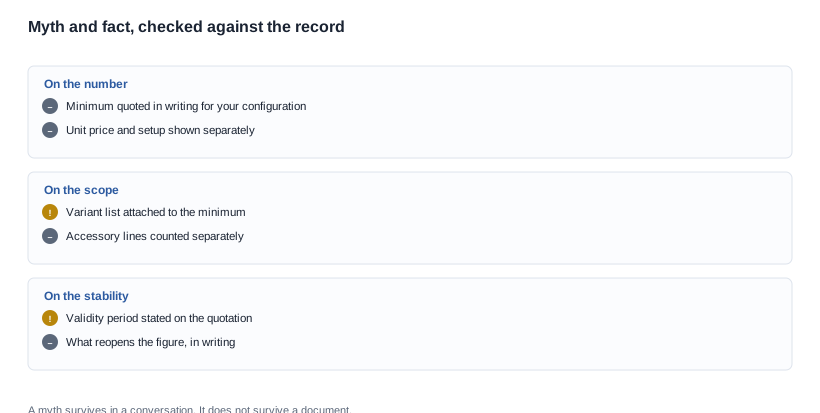
The checklist above is short because the beliefs are simple. Each item is a document rather than an opinion: a minimum quoted in writing for a named configuration, a unit price with setup separated, a variant list attached to the minimum, a validity period, and accessory lines counted separately. A belief that is written down as a document stops being a belief, because a document can be checked by somebody who was not in the conversation.
The order of the items matters more than the number of them. Identity first, because without the configuration the rest cannot be read; then scope, because a minimum without a variant list has not been defined; then stability, because a figure without a validity period is an expectation rather than an agreement.
How a belief gets into the file, and how it gets out
Beliefs in this category do not usually arrive as assertions. They arrive as cells. A quotation is pasted into a comparison sheet, a figure is typed into a column headed minimum, and the cell is later read by somebody who has no way of knowing what it was quoted against — so the cell becomes the belief, and the belief becomes the basis of a decision. The sequence matters because it means the correction is not a conversation with the person who holds the belief; it is a change to the file.
That makes the correction cheaper than it looks. The first step is to add a column to the sheet that records the configuration, the market and the date behind every figure, and to leave it empty wherever those are not known. A figure with an empty column is visibly incomplete, and a visibly incomplete figure does not get used as though it were complete. This is a small change to a spreadsheet and it removes more myth-driven decisions than any amount of training.
The second step is to require a validity period on every figure that enters the sheet. A figure without one is marked as indicative rather than quoted, which is a distinction that costs nothing and prevents a stale number from being treated as a current offer. Neither step requires a supplier to change anything, and together they address the mechanism rather than the symptom.
What to ask, in the order that works
- What is the minimum quoted against — model, colourway, case option, market, or a combination?
- Does more than one level apply at once, and does a second colourway restart the minimum?
- What are the setup charges, itemised separately, and what is the setup cost per unit at each quoted quantity?
- Where does the price tier break, and what quantity is required to reach it?
- Is the charging case inside the minimum, and is the packaging a separate line?
- How long is the offer valid, and what would change the figure before then?
- Which parts of the answer move with my quantity, and which parts are fixed?
Questions to ask in this order are not a negotiating script. They are the minimum set that turns a quotation into something comparable, and they are the same questions that a due-diligence checklist would carry, which is why the buyer checklist and this list overlap more than a buyer expects.

When a lower minimum genuinely is the better answer
The five conditions
A lower minimum is the right answer when all five of the following hold, and it is worth saying explicitly because the belief in myth two is not that a low minimum is never better, it is that it usually is.
- The setup charge is small, because nothing is being customised: no mould, no printed artwork, no firmware integration, no market-specific file.
- The configuration is a standard build that is already in production rather than a new one.
- The channel can turn the units inside one selling season, so the inventory position does not become the dominant cost.
- The cash committed is small enough to carry the risk of a slow start, which is a judgement about working capital rather than about the product.
- The alternative tier does not cross a price break, so the lower quantity is not being charged a penalty in the unit price.

All five together. Miss the third one and the saving becomes an inventory problem; miss the first one and the unit price carries the setup that was supposed to have been avoided.
The trade-off that is not one
It is common to describe the choice between a small order and a large one as a trade-off, and in this category it usually is not. The two are not independent: if the minimum falls because the setup spread is amortised across fewer units, the unit price rises, and if the unit price rises because the setup is being recovered over fewer units, then the smaller order is not a cheaper order at a different scale — it is the same order with a worse amortisation profile. Describing it as a trade-off lets a buyer treat the two as alternatives on a menu, when the actual choice is about whether the setup work is worth doing at all.
The genuine trade-offs in this category are elsewhere: breadth against depth in the range, speed against cash in the schedule, and one market against several. Each of those is a real choice between two things a buyer wants. The order size against the unit price is usually a false one, and the total cost calculation is what proves it.
The cost of acting on a myth
Two consequences worth naming
A minimum assumed to be per model, applied to a range. The plan contains four colourways, the minimum was quoted for one, and the second and third colourways turn out to carry their own. The order becomes four times the commitment that was planned and three times the inventory. The total cost of the programme rises by the sum of three setups and three unsold positions, and it is invisible on every line of the original spreadsheet because each line was individually reasonable.
A minimum assumed to be lower than it is, used to justify a launch. The plan was sized to a minimum that applied to a different accessory position, and the actual minimum is higher. The launch now happens with a narrower range than the plan required, or with a delay, or with an inventory position that has to be sold down before the second order can be placed. In all three cases the decision was taken on a belief that a single question would have exposed.
Neither consequence is dramatic, which is part of the problem. A belief that produces a fourfold inventory increase still produces a programme that looks busy, and a launch that happens on the intended date still looks like a success. The failure shows up in the second order, when the sell-through is lower than the plan because the range was narrower than the plan, and by then the belief has already been paid for twice.
How exposure decides what to do
The right response to a belief is not the same in every case. If acting on it would be reversible — a narrower first order, a different accessory position — the response is to test it on the smallest order that would produce the answer. If acting on it would be hard to reverse — a deposit, a launch date, a range commitment in front of a channel — the response is to get it in writing before committing.
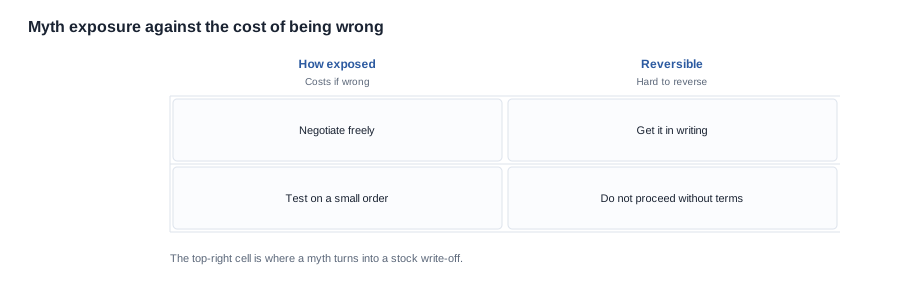
The quadrant in the corner is the one that matters. A belief that is both widely held and hard to reverse is a belief that has to be tested with a document rather than discussed in a meeting, because the cost of it being wrong is not recoverable through the channel that carried it.
Which of our own statements we will not repeat
Our position
There is a belief we have to be careful about because it is our own, and repeating it is how we would spread it. We do not publish a minimum order quantity, and the honest reason is that three readings of our own minimum order policy have not been reconciled with each other. We will not print a number we cannot defend, and publishing a figure that later changes when a colourway is specified would be exactly the myth this article is about.
What we will do is quote a minimum for a named configuration, state the level it applies to, itemise the setup charges from the unit price, give the tier boundaries, and put a validity period on the offer. The MOQ section describes the structure behind the figure, and the worked example shows the arithmetic of a small order against a larger one.
The question we would rather buyers asked
If there is one question that would dissolve most of the six beliefs, it is not about the number at all. It is: what is this minimum a minimum of? The wording sounds like a rhetorical question, and it is worth taking literally, because a supplier who has to answer it has to name the build, the market and the date behind the figure — and naming those three things is what converts the figure from a belief into a comparable term.
We would rather answer that question than a request for a smaller number, because the answer is reusable and a smaller number is not. It is also the question that keeps the file honest: the moment a buyer starts asking it, the comparison sheet develops the columns it needs. Which model a buyer should select, how to evaluate the answer, and what the total cost of the resulting order will be all follow from it.
What a minimum order answer depends on
Send the model, the colourway count, the case position, the destination market, the quantity and the forecast behind it. We will come back with the minimum for that combination, the level it applies to, the tier boundaries, the setup charges itemised, and the validity period. If you are working from a figure that another supplier gave you, tell us what it was quoted against and we will tell you what it would take to make it comparable — which is usually a smaller conversation than a renegotiation.
Related reading
- Beginner's guide to the minimum — the structure behind the number
- Buyer checklist — the sequence for asking
- Worked example of the three floors — the arithmetic