
A smart glasses MOQ quoted as one number is rarely the number you will actually commit to, because a minimum almost never applies to the thing a buyer is thinking about. It applies at four levels at once — to the model, to the configuration, to the order and to the production run — and the figure that matters to your balance sheet is the product of all four rather than any one of them. The V06 in our range is published in four colourways; the V03 Pro in three; the L2 Utral is published with either a 900 mAh or a 1400 mAh charging case, which is two physically different products behind one model name. Multiply a per-configuration minimum by the configurations you want, and the commitment that was supposed to be modest becomes a season of inventory. This guide sets out the six documents that make a minimum legible, the arithmetic that turns it into stock, and which parts of a minimum a supplier can move and which are structural.
Smart glasses moq: the structure behind the number
The buying task behind a minimum order question
The reader is a brand-side purchasing manager, a channel buyer or an importer who has been told a minimum and is trying to work out what it commits them to. The situation is usually a new programme with a fixed launch window, a supplier who wants a large first order, and a buyer whose own cash cycle and sell-through rate are both known and neither of which supports a large first order.
That tension is where the commercial negotiation lives, and it is why the first question should not be "what is your minimum" but "what does your minimum apply to". A minimum per model that applies once per order is a commercial condition. A minimum per configuration that applies once per production run is a manufacturing condition, and it changes what the buyer is buying: they are buying a set of small runs rather than one run, and the cost of that — in changeovers, in packaging variety and in the parts of the schedule that stop overlapping — is invisible until somebody does the multiplication.
The second thing the buyer needs to establish early is whether the minimum is a floor on a single transaction or a commitment over a period. These are different commercial objects. A one-off floor is negotiable and can be met with a single larger order. A standing commitment over a quarter ties the buyer's cash to the supplier's forecast, and it is much harder to exit from than its number suggests.
The fear underneath the question is the inventory one. A buyer who commits to a minimum that exceeds their realistic sell-through for a full season has not made a discount; they have made a warehousing decision, and one with no exit. That is the calculation this guide is for.
Why the same minimum figure means four different things
The minimum can attach to four levels, and the difference is not academic — it is the difference between committing to one run and committing to eight.
The model level is what most buyers assume they are agreeing to. It is the least constraining of the four, and it is frequently the only one that is published in a friendly-looking quotation.
The configuration level is where the real commitment hides. A configuration is a model plus everything that changes what gets built and packed: the colourway, the charging case option, the charger in the box, the artwork treatment. Two colourways are two configurations, and if the minimum applies per configuration, choosing four colourways multiplies the commitment by four.
The order level is the minimum for the transaction as a whole, and it is the one that determines whether several small lines can be combined into one shipment, one packing operation and one payment.
The production run level is the strictest, because it reflects how the line is actually set up. A factory that changes over between colourways cannot run them together cheaply, and the minimum per run is the physical constraint that sits underneath the commercial ones.
A minimum order schedule that does not distinguish the four levels is not a complete answer, whatever number it contains. That is the single most common form of an incomplete response, and it is invisible to a buyer who has not asked the question.

The six documents that make a minimum a commitment
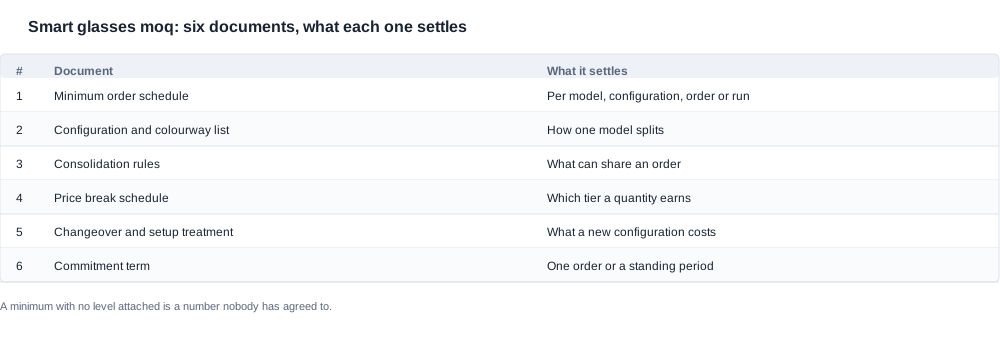
The six minimum order documents, and what each one settles
| # | Document | What it settles | The question it must answer |
|---|---|---|---|
| 1 | Minimum order schedule | Which level the minimum applies at | Model, configuration, order or production run |
| 2 | Configuration and colourway list | How one model splits | Every colourway and case option you may order |
| 3 | Consolidation rules | What can share an order | Which lines may be combined in one run or carton |
| 4 | Price break schedule | Which tier a quantity earns | The quantities at which the price changes |
| 5 | Changeover and setup treatment | What a new configuration costs | Setup, artwork and run cost per configuration |
| 6 | Commitment term | One order or a standing period | How long the minimum obligation lasts |
How to read a minimum order schedule correctly
Read the schedule in three passes, because the three passes answer three different questions and the order matters.
The first pass is the level test: for each model on your list, find the minimum and record the level it attaches to. Write it as four separate numbers rather than one, even where the numbers are the same, because the same number at the configuration level and the order level has completely different consequences.
The second pass is the multiplication. Take the number of configurations you intend to order for each model — colourways multiplied by case options multiplied by any artwork variant — and multiply it by the per-configuration minimum. That product, not the headline figure, is your first-order commitment. Do it for each model and add them; the total is the number that has to be funded, warehoused and sold.
The third pass is the exclusion test: check whether any of your intended configurations can be excluded, delayed or made to order later. A range that launches with fewer colourways and adds two in the second production run has a smaller first commitment and a smaller inventory risk, and the cost of the later colourways is usually a higher unit price rather than a larger order.
The questions to ask are therefore short and specific. What is the minimum per model, per configuration, per order and per run. How many colourways and case options does each model split into, and can they share a run. What does the price break schedule look like, and what triggers a re-price. And is the minimum a condition on one transaction or a commitment over a period.
The arithmetic that turns a minimum into inventory
Configurations multiply faster than models
The catalogue is a good illustration of how quickly a range becomes many products. Twenty-eight models divide into eleven camera models, eight audio models and three sport models, and within them the options multiply: the V06 is published in four colourways, the V03 Pro in three, and the L2 Utral with either a 900 mAh or a 1400 mAh charging case, which is a different object in the box and a different packing operation rather than a colour difference.
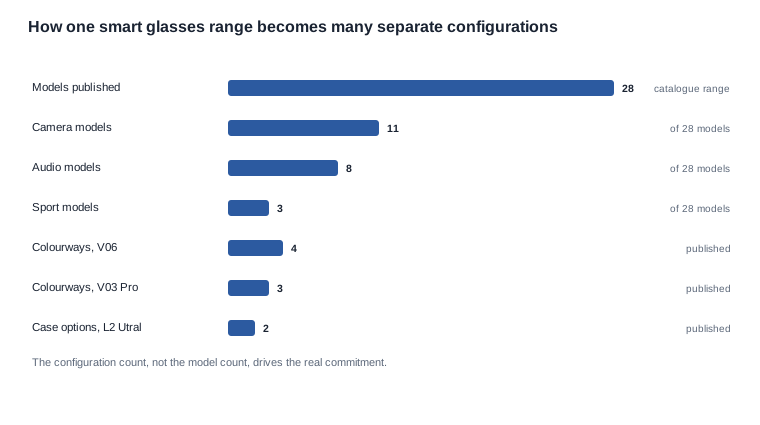
Three practical consequences follow. The first is that a per-configuration minimum turns a three-model launch into something closer to a twelve-configuration commitment, and a buyer who negotiated against three has negotiated against the wrong number. The second is that case options are more expensive than colourways in the minimum-order sense, because a different case changes the pack and the packing operation, not just a printed surface. The third is that the models you choose for a launch should be chosen with the configuration count in mind, because the range breadth a buyer wants on day one and the inventory a buyer can afford on day one are not the same decision.
The cash cycle the minimum creates
The number that settles whether a minimum is affordable is not the unit price and not the order value. It is the number of months of your own sell-through that the commitment represents.
Take the committed units, multiply by the unit price, and divide by what you will realistically sell in a month. The result is the inventory horizon in months. If that number is larger than the shelf life of the product category, the commitment contains a write-off that has not been priced into the margin. If it is much larger than one season, the discount that justified it is being paid away in stock.
This is also where a low minimum and a long lead time interact badly. A small first order with a long lead time commits your cash for longer and gives you less negotiating leverage on the reorder, because the reorder is where the price is actually settled. A higher minimum with a shorter lead time can be the cheaper programme overall, and it is worth asking a supplier to price both shapes rather than one.

There is a second calculation to run, on the configuration rather than the model. If a colourway is added later, it has its own setup, its own artwork approval and its own minimum, and its unit price is likely to be higher because it does not share the run. That is a reasonable arrangement for a buyer managing inventory risk, and it should be agreed at the start as a structure rather than discovered as an exception in month two.

What a supplier can move on a minimum, and what it cannot
The parts of a minimum a supplier can move
The terms that move are the ones that relate to the buyer rather than to the process. A minimum that applies per order rather than per model can usually be moved when the buyer is willing to consolidate. A commitment term can usually be shortened or converted into a per-order condition if the buyer can demonstrate a sell-through history. A price break schedule can usually be shifted by a defined amount in exchange for a longer commitment or a firmer forecast. And the setup charge for a later-added configuration can often be capped, because its real cost is amortisation over a run the buyer can commit to.
The consolidation question deserves particular care, because the answer is rarely a simple yes or no. Models can often share an order and a payment, share a production run, or share a carton — and those are three different permissions with three different costs. Sharing an order while running separately still gives the buyer one shipment and one payment, which is worth something. Sharing a carton is the one that changes the logistics, and the packing basis has to be settled for it, because a mixed carton changes the carton data that the freight quote was calculated on.
The terms that do not
What does not move is the physical constraint underneath the number: the run length that a line can execute without a changeover, the material lot that has to be bought to cover it, and the setup that happens when a new configuration enters the run. A minimum that is a multiple of a material lot and a setup cost is not a negotiating position, and a supplier who discounts it without changing one of those two things is buying a future dispute.
The other thing that does not move is the cost of the artwork and the approval. A new colourway with new artwork is a design and print cost regardless of quantity, and a supplier who quotes it as zero is quoting a number that will be corrected at the first invoice.
There is a trade-off worth naming, because buyers often negotiate the wrong end of it. A tighter minimum buys flexibility but loses price; a looser minimum buys price but costs cash. The decision that follows is not a comparison of two numbers but a comparison of the two programmes, and it should be made with the inventory horizon from the previous section in hand rather than with the unit price.

Where minimum order disputes come from
Three disputes
The minimum that was per line and became per order. A buyer places three models at quantities below their individual minimums and is told the order is short, on a rule that was never stated. The symptom is a disagreement about arithmetic rather than about product. The control is the level test in the first pass of the schedule reading.
The configuration that was not in the list. A colourway or a case option is added late, and the supplier applies the per-configuration minimum to it as though it were a new line rather than a variant of an existing one. The symptom is an order value far above the quotation. The control is the configuration and colourway list, agreed before the first order, with the rule stated for options added later.
The discount that turned into stock. A price break was reached on paper, and the units did not sell. The symptom is a write-down that appears in the buyer accounts and a supplier who regards the volume commitment as fulfilled. The control is to tie the break to the order rather than to the sell-through, and to check the inventory horizon before accepting a break.
The red flags in a minimum order schedule
Three patterns in a schedule are worth pausing over. A schedule with one number and no level attached is the first. A schedule that lists models but not configurations is the second, and it is the one that most often produces an unwelcome surprise at the second order. A schedule with a price break table and no commitment term is the third, because it implies that the discount is tied to a period of buying rather than to a quantity, and the buyer has not been told how long.
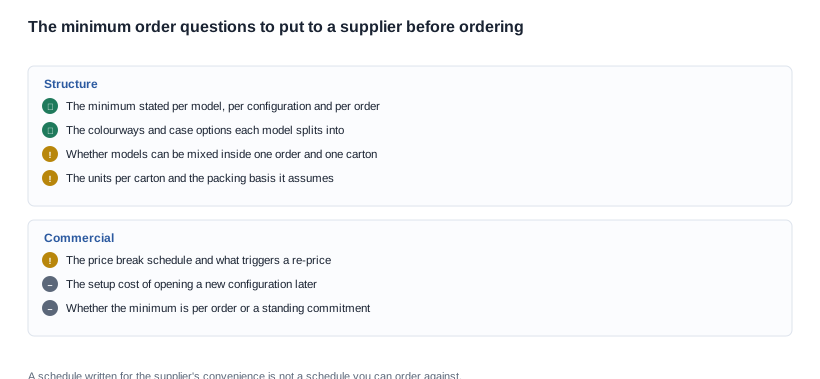
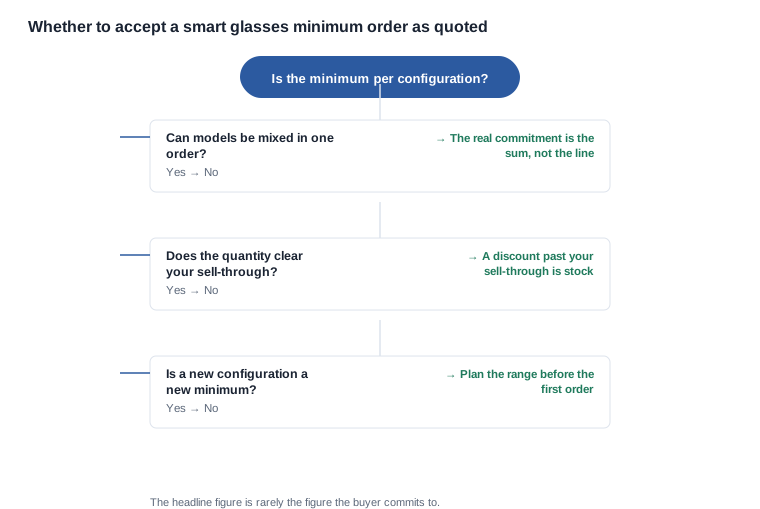
None of these are refusals or evasions. They are the ordinary shape of a document written for the supplier's convenience rather than the buyer's, and the fix in every case is the same: ask for the six documents as a set, scoped to the specific models and configurations in your launch, and with a request that names the level for every minimum.
A minimum order structure worked through, and what we will publish
A minimum order structure reasoned through
The scenario below is assembled to carry an argument, not drawn from a client engagement. No customer, order or engagement is described; the range, the quantities and the market are assumed so that the reasoning can be followed from the quoted minimum to the cash cycle.
A brand-side buyer is launching in a new market with three models from one supplier: a camera model, an audio model and a sport model. The supplier's quotation carries a headline minimum. The buyer's realistic first-quarter sell-through across the three models is well below the commitment implied by that headline.
Step one is the level test, and it changes the picture. The minimum applies per configuration, not per model, and there is a second minimum at the order level above it. The buyer's first-order commitment is therefore the per-configuration figure multiplied by the configurations it wants, which is more than three times the headline.
Step two is the configuration list. The camera model it wants is published in four colourways, and it has been planning two. The audio model it wants splits into two configurations on the charger in the box. The sport model is a single configuration. The buyer now knows the exact product of the multiplication, and the surprise has moved from the order value to a number it can work with.
Step three is the multiplication and the cash cycle. The committed units, at the quoted price, divided by the monthly sell-through, give an inventory horizon that runs well beyond one selling season. At that horizon the buyer is carrying stock that will not sell before it is obsolete, which is a write-down rather than a discount.
Step four is the exclusions, and this is where the negotiation actually happens. The plan changes: two colourways launch and two are added in the second production run, the audio configuration with the alternate charger is deferred, and the order-level minimum is met by consolidating across the three models. The commitment falls below the sell-through horizon, and the supplier's price is better rather than worse because the second colourway run is smaller and more specific.
Step five is the documents. The consolidation rules confirm that the models share a shipment and a payment but run separately, so the packing basis is settled and the freight quote is recalculated on the mixed carton. The price break schedule attaches the break to the order rather than to a period. The commitment term is converted to a per-order condition on the strength of the buyer's sell-through history.
What we will confirm about a minimum, and what we keep out
We will confirm which level a minimum applies to, which configurations a model splits into, and which lines can be consolidated into a single order, a single run and a single carton. Those three answers are what a buyer actually needs, and they are within our knowledge because they describe how we operate.
What we will not publish is a minimum order quantity as a standard figure, and we will not put a number into an agreement that we cannot trace to a production constraint. A number chosen to win an order is a number that becomes a commitment later, and a commitment that cannot be traced to a run length or a material lot is a commitment that will be renegotiated at the worst possible moment. For the same reason we publish no production capacity figures and no defect rates.
We will also be straight about the limits of a catalogue-based answer. Our range covers twenty-eight models across eleven camera models, eight audio models and three sport models, with colourways and case options published model by model — but the minimum that applies to a particular combination of configuration, quantity and destination is a commercial position, not a catalogue row, and we will set it out in a schedule rather than summarise it in a brochure.
What to send so the minimum can be checked against a configuration
Send the models, the colourways, the case options, the quantities and the target market, and we will tell you which configurations exist for each model, how the minimum applies at each of the four levels for that combination, and what a consolidated first order would look like. If you have been given a minimum that is a single number, send it and we will tell you what it would have to apply to for the arithmetic to hold.
Related reading
- MOQ glossary
- mixing models answer
- OEM customisation requirements
- MOQ how it works article
- MOQ supplier verification guide
- MOQ advanced guide
- AI camera glasses range
Send the models, the colourways, the case options and the quantities, and we will show you which parts of a smart glasses minimum order are a production constraint and which are a commercial condition.