

Smart glasses payment terms decide who carries the risk while the goods are being made, and in a first order that risk is larger than it appears because you have not yet learned which parts of the schedule are structural. The structure most first-time buyers accept by default is not the structure that protects them. This guide is written for a buyer placing a first order in this category: it explains the four schedules you will be offered, what each one actually protects, what to ask before you accept a deposit percentage, and where the decision belongs to you rather than to the supplier.
Smart glasses payment terms: the four structures a first order meets
The four structures, in the order they usually appear
Most first-time buyers in this category meet one of four schedules. They differ in what the money is tied to, and the difference shows up at exactly one moment: the moment something goes wrong.
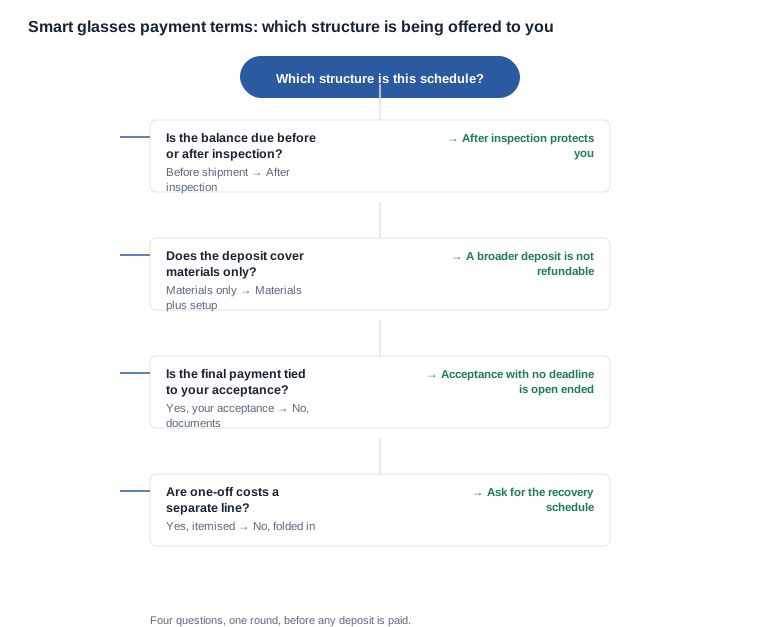
The full deposit with the balance on shipment. The deposit covers production, artwork and tooling together, and the balance falls due when the goods are loaded. The supplier's position is comfortable and the buyer's is not: the entire order value is paid before the buyer has seen a single unit, and the only remedy available afterwards is a claim.
The deposit with the balance after inspection. The deposit funds the material commitment, the balance is conditional on a pre-shipment inspection, and the inspection report is named as the document that triggers it. This is the structure the rest of this guide argues for, because it is the only one that pays the buyer for the window in which defects are actually found.
The material deposit with the balance against documents. The deposit covers the purchased materials only, and the balance falls when the shipping documentation is handed over. It leaves more of the order value in the buyer's hands for longer than the first structure does, and it introduces a new risk in exchange: shipping and document delays now sit between the inspection and the payment, which is a period in which the goods are in transit.
The tranche against a single configuration. A larger order is split into two or more tranches against one frozen configuration, each with its own milestone. This lowers the amount committed at any one moment and it is the structure most first-time buyers should look for when the order is large relative to their cash cycle.
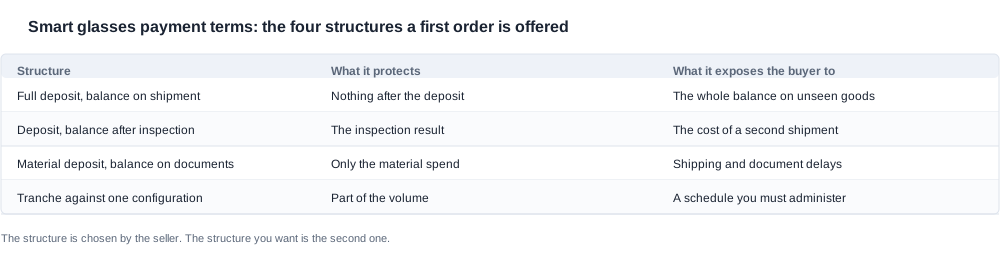
The structure is chosen by the seller, because the seller is the one who has priced its own risk. What the buyer can do is make sure the choice is made deliberately rather than inherited from a form.

How a payment schedule decides who carries the risk
The mechanism is simple, and it is worth understanding rather than memorising. A payment schedule is a sequence of money movements, and each movement transfers risk from one side to the other. Money that leaves before the evidence exists transfers the risk of that evidence being wrong to the buyer. Money that leaves after the evidence exists keeps it with the seller, who can act on it.
That is the whole principle. Everything else is detail, including the details that matter commercially.
It also explains why the percentage is the least interesting number on the form. A deposit of 30 per cent tied to a material commitment protects the supplier against a cancellation after materials are bought. A deposit of 30 per cent tied to nothing in particular, combined with a balance on shipment, protects the supplier against far more than it should. The percentage does not describe the protection; the trigger does.
There is a second mechanism that buyers in this category should be aware of, because it is structural rather than contractual. In a category where the schedule of work runs for weeks and where a substantial part of the value is in components bought in by the factory rather than made by it, the factory is carrying a cash cost before the buyer has committed in the same way. The deposit exists to share that exposure. The question of how it should be shared is a commercial negotiation, but the fact that it exists at all is a property of how this category is built rather than a sign that a supplier is being difficult.
Who is reading this, and what is at stake
The reader is a brand-side purchasing manager, a channel buyer or an importer placing a first order: a quotation to compare, a new programme to open, or a market to enter with a date that cannot move. The situation is usually one of three, and the payment schedule matters differently in each.
For a comparison between quotations, the schedule has to be read as part of the price, not as a separate item. Two suppliers quoting the same unit price with different triggers are not quoting the same thing, and the difference between a balance on shipment and a balance after inspection is a difference in what the buyer owns at the end of the production window.
For a new programme, the schedule has to be checked against the cash cycle. A deposit that falls due before the first revenue is collected is working capital, and working capital has a cost that does not appear in the unit price.
For a market entry with a fixed launch date, the schedule has to be checked against the compliance route, because documentation work that sits inside the production window sits inside the payment window, and it is the part most likely to be paid for twice.

The last question is the one that decides the order in which the rest should be asked, and it comes back to the configuration. A payment structure agreed against a configuration that is still moving is a structure agreed against something that does not exist yet.
What to ask before you accept a deposit percentage
Nine questions, asked in one round, before any money moves. The first four are the ones that cost the most when they are wrong.
- What percentage is the deposit, and what exactly does it fund? A deposit that funds the cell, the camera module and the charging case is protecting the factory against cancellation. A deposit that funds part of the materials is protecting the buyer. The answer determines what happens if the order is cancelled, and it determines whether the deposit is recoverable.
- What event triggers the balance? "Before shipment" and "against documents" are different triggers, and the second is better because documents can be checked by the buyer's own staff. "After your acceptance" is the worst of the three unless the agreement contains a written acceptance procedure with a time limit.
- Who performs the inspection, and is the report named in the agreement? An inspection that nobody is responsible for producing is a formality. Ask for the report to name the configuration it was performed against and the number of units sampled.
- How long are these terms valid? A quotation without a validity period expires by default in practice, and the re-quote is a negotiation you did not choose to have, conducted at the moment your urgency is highest.
- What currency is each instalment in? A deposit in one currency and a balance in another creates two exchange exposures, and the fee on the second one is sometimes larger than the difference you negotiated on the split.
- What happens to the deposit if the order is cancelled after materials are bought? This is the question almost nobody asks, and it is the one that decides the real exposure. Is it refundable, partially consumable as materials are bought, or forfeited?
- What is the remedy window for a defective shipment, and who bears the cost? The remedy window, the process and the cost bearer are commercial terms rather than payment terms, but a structure that pays the balance before the problem is known has already lost that argument.
- What does the payment method itself cost? In cross-border trade the fee on the balance is frequently larger than a five-point improvement in the deposit split, and it is also much easier to change.
- Does the invoice name match the contract entity? A mismatch between the contracting entity and the paying entity is a routine blocker at the payment step, and it is trivially fixed in advance and awkward to fix afterwards.
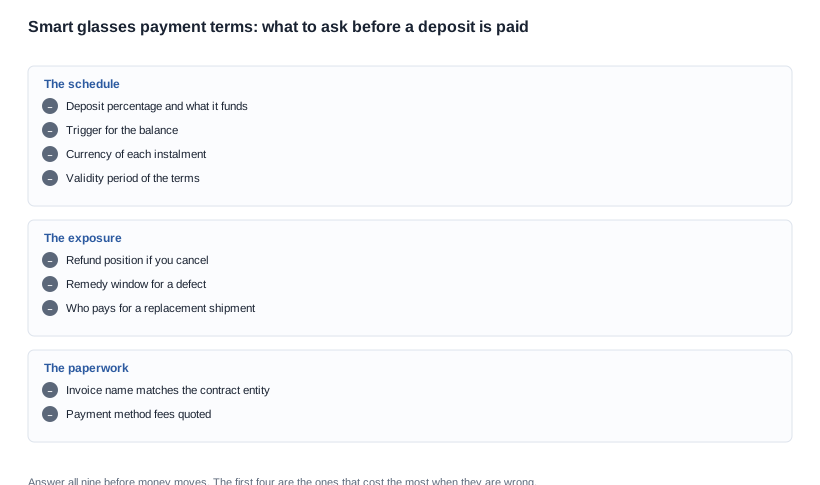
Record the nine answers as a table before agreeing anything. A schedule that cannot be written down as nine answers has not been specified, and the gaps in it will be filled by whichever party is more willing to assume.
What the answers look like when the programme is documentation-heavy
Some first orders carry a documentation burden that makes the payment schedule harder to place than the hardware does, and the pattern is worth recognising before the schedule is agreed rather than after.
The tell is that the compliance route is still open at the time the deposit is being discussed. When the destination market is settled but the per-model documentation scope is not, the work sits somewhere between the deposit and the shipment, and it is not attached to anything in the schedule. The result is a payment window that contains an unbounded amount of work, and a buyer who has already funded it.
Our own catalogue carries a company-level export certification page but no per-model certification line, which means the scope of documentation for a specific model string has to be established in writing against that string rather than read from a published table. A buyer who asks for that scope before agreeing the schedule discovers two things: how long the work takes, and whether it has to be repeated for every variant in the order. Both of those belong in the milestone structure.
The same applies to the shipment itself. Where the goods carry lithium cells, the transport documentation for the battery is a real requirement rather than a formality, and it is part of the handoff between the factory and the carrier. Our published catalogue does not carry a per-model transport document row, so the practical question is simply whether the supplier's shipping process produces the documentation the destination market expects, and at which milestone it is produced. If it is produced after the balance has been paid, the buyer has no leverage over it at all.

The three structures that leave the buyer unprotected
Three structures are routinely accepted by first-time buyers and are worth identifying by name.
The balance on shipment date. The buyer pays the full order value before the goods have been inspected, and it has paid it in full before it knows whether the shipment conforms. The exposure is the entire balance, and it is the largest single number in the transaction.
The deposit that quietly covers everything. The deposit is described as covering production, and it also covers the artwork, the tooling and the first compliance testing. The buyer sees a percentage and assumes it is a material commitment. When the order is cancelled, the difference between what was assumed and what was actually spent is not recoverable, and the assumption was never written down.
The final payment on the buyer's acceptance. It sounds like the most protective structure and it is the least protective of the three, because acceptance is a procedure the buyer has to run, and a procedure without a deadline never finishes. The money stays with the seller and the buyer has no way to close the condition.
There is a fourth pattern that is not a structure but a habit, and it is worth naming because it is so common. It is accepting the schedule as a set of percentages, reading the percentages, and never asking what the triggers are. A schedule expressed only as percentages is a schedule whose triggers have not been decided, and it will be decided by whoever moves first.
Choosing a structure for a first order you cannot repeat
Most first-time buyers in this category are placing an order they hope to repeat but cannot count on, and that changes the calculation in a specific direction. The cost of getting the first order wrong is not the difference between two schedules. It is the loss of the relationship, the delay to the launch, and the working capital locked in a structure that cannot be unwound.
Under those conditions, three decisions carry most of the weight.
Favour the structure that keeps a claim alive over the structure that looks generous. A deposit that funds only materials is worth more to a buyer than a larger deposit that funds everything, because it leaves the balance as the thing being negotiated over. The buyer who has a live claim is a buyer who can get the second order on better terms; the buyer who has already paid in full is a buyer asking for goodwill.
Insist on one named document per instalment. This is the single highest-value item in the whole schedule, and it costs the buyer nothing to ask for. A typed inspection report against the configuration string, with a stated response period, transforms the balance from a payment on trust into a payment on evidence.
Price the working capital before accepting the deposit date. A deposit that falls due before the first sale is a cash-flow decision, and it should be compared with the cost of the money rather than assumed to be free. This is a finance conversation rather than a purchasing one, and it is the one most often skipped.
There is a fourth consideration specific to this category. Our published range includes models with quite different weight and cost structures, from a 40 mAh cell on the smaller entries to a 290 mAh cell with a 1400 mAh case on the 13 MP camera models, and charge times that are published at up to two hours across almost the whole range. Where the value of the goods differs materially between the lines in an order, the schedule should not be uniform across them, because a uniform schedule always over-commits on the light lines and under-protects on the heavy ones.
What to do when the inspection-linked balance is refused
A supplier who declines to tie the balance to an inspection report is not necessarily declining the order, and it is worth separating the two before the buyer decides what to do.
The common reason for refusal is administrative rather than principled. The supplier may genuinely not have an inspection process, in which case the negotiation is not about the trigger at all but about what the supplier will do instead, and the options are real: a second tranche after delivery, a holdback released against shipping documentation plus a short claim window, or a small retained percentage released after a defined acceptance period. Any of those is better than a balance on shipment date, and any of them is negotiable in practice.
The harder reason is that the supplier does not accept the risk of the inspection findings, which is a commercial position rather than a capability gap. The answer to that is to reduce the exposure rather than to abandon the requirement: reduce the sampled quantity, define the inspection scope against the configuration string rather than against a general quality standard, and pair the inspection trigger with a short and specific remedy period so that the balance is not held open indefinitely over a marginal finding.
What the buyer should not do is accept the balance on shipment date without recording the refusal and the reason for it. That refusal is a fact about the supplier's process, and it belongs in the supplier evaluation rather than in a first order that was already going to be hard.
Where our own position stops and your instructions begin
The working rule we apply: the published material on payment terms is the part of the specification we can stand behind, and everything else is a question for the supplier's own file.
We will propose a structure tied to the actual milestones of your order, because the milestones in a production schedule are the natural anchors for a payment. We will state a cancellation position in writing before the deposit is paid. We will not accept a structure where the final payment hangs on an acceptance procedure with no time limit, and we will not move on the deposit percentage before the cancellation position is settled, because the two decisions are the same decision.
What we will not do is quote a payment schedule from a photograph, or fill a specification gap with a number that cannot be traced to a document. Our unit prices, minimum order quantities and lead-time figures are not published, so we cannot hand you a staged plan that happens to match your cash cycle. What we will do is take a use case, a configuration and a market, and tell you which parts are settled, which are open, and which have to come from a sub-supplier.
The order of decisions is set out under payment terms step by step, the beliefs that cost money are covered under payment terms myths, the clauses to check are under contract mistakes, and the framework sits under payment terms.
Send the order value, the model, the configuration, the quantity and the destination market, and we will propose a structure against that order rather than against a generic one.
Related reading
-
Payment terms step by step — the order to decide them in
-
Payment terms myths — the beliefs that cost money
-
Contract mistakes — remedies without milestones
Send the configuration, the quantity and the market, and we will say which parts of the schedule are settled and which are yours.


