

Smart glasses payment terms carry more folklore than any other part of a supplier conversation, and most of that folklore is inherited rather than checked. A buyer who believes that a high deposit proves reliability will either overpay for a supplier who is quoting a risk premium, or distrust a supplier who is quoting a normal position. A buyer who believes that payment terms are free will discover the cost inside the first bank statement, usually at the worst possible moment in the relationship. Six beliefs come up again and again in this category, and each of them has a specific correction that can be made before the deposit leaves the account. None of the corrections requires a discount, and several of them cost nothing at all.
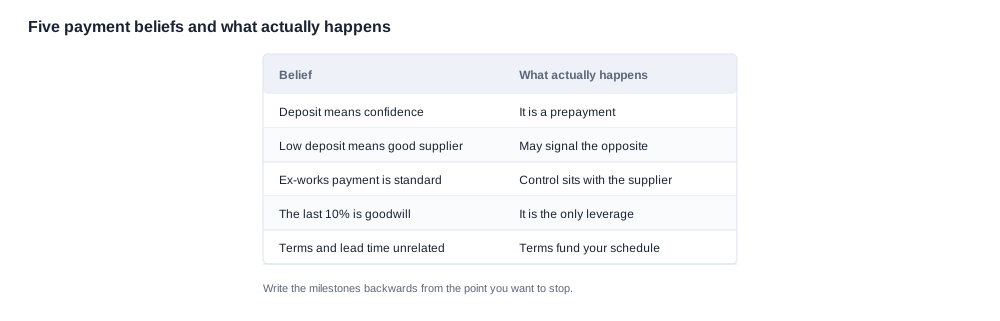
Smart glasses payment terms: the six beliefs and the cost each carries
How to tell a belief from a rule
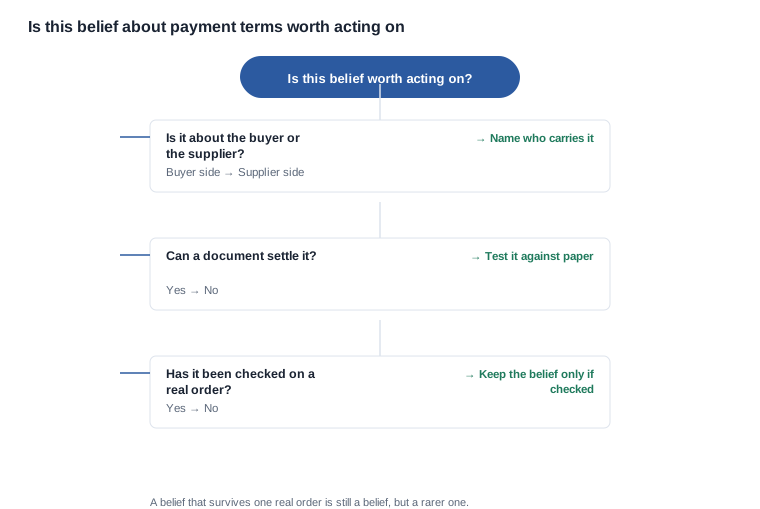
A rule can be checked against a document. A belief can only be checked against experience, and experience in this category is thin for most buyers because the number of smart glasses orders most companies place in a year is small. That is the environment in which these beliefs survive, and it is worth having a simple test before acting on any of them.
The test has three parts, and it applies to every belief in this section.
- Who carries the consequence? A belief about the buyer's side and a belief about the supplier's side read identically on the page and behave differently in a dispute. Name which side carries it.
- Can a document settle it? If a clause or a report can settle the question, the belief is a rule that has not been read. If nothing can settle it, the belief is a working assumption and has to be tested on a real order before it is trusted.
- Has it survived a real order? A belief that has been checked once against a signed order and a real shipment is worth more than a belief that has been checked against nothing. A belief that has been checked once and failed is worth less than nothing, because it will now be defended.
Beliefs one and two: what the deposit percentage means
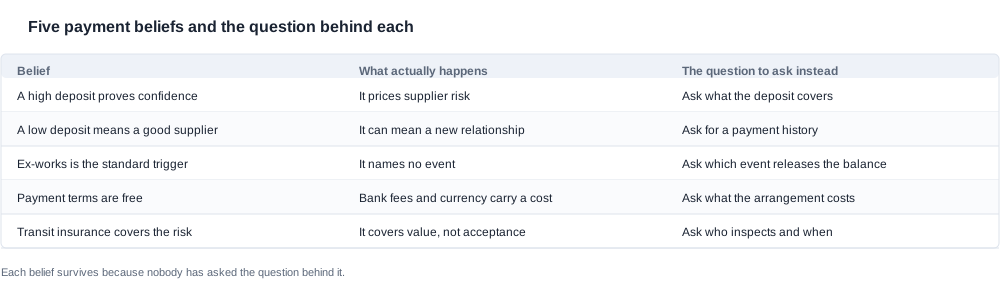
The belief: a high deposit proves the supplier is confident in the buyer. The reality is that the deposit prices the supplier's working capital, not their opinion of you. A supplier quoting a larger deposit share on a first order is describing the fact that they will buy components, commit assembly labour, print packaging and book freight before you have seen a finished unit. A supplier willing to take a small deposit from a new buyer is either buying your business or is not funding production, and the second case is the dangerous one.
The belief: a lower deposit means a better supplier. The reality is that a low deposit can mean a new relationship, and it can also mean the counterparty is a trading company rather than a factory. A trading company that never funds production has no working capital exposure to price, which is exactly why it can offer a low deposit and still be entirely credible on price. The distinction matters because the thing a deposit is pricing is not trust, it is the supplier's balance sheet, and a trading company has a different one.
The question to ask in both cases is the same and it is a good one: what does the deposit actually cover? A supplier who can answer in one sentence, naming components and labour against a named production milestone, is telling you the truth about their own exposure. A supplier who answers with a percentage is repeating a number.
Beliefs three and four: the trigger and the cost
The belief: ex-works is the standard trigger, so it is safe to accept it. The reality is that ex-works is not a trigger at all. It is a place, and a place names no event, no owner and no document. It appears in a schedule as shorthand for "when the goods leave", and in that form it releases the balance at the exact moment the goods are in someone else's hands, with no inspection performed and no evidence produced. The correction is small and it is complete: replace the place with an event and a name. Which event releases the balance, and who confirms that the event has happened.
The belief: payment terms are free, because nothing is being borrowed. The reality is that a schedule moves four kinds of cost onto one side or the other, and three of them are real. Bank charges and instrument fees are charged per transaction rather than as a share of value, which makes them disproportionately expensive on a first order. Currency conversion is charged as a rate spread and is invisible in the quotation. And the inspection, the courier and the internal processing of a payment are all costs that somebody carries. A terms discussion that only compares percentages has left three of the four out of the frame.
What a belief does to the order you are placing right now
There is a reason these beliefs matter more in this category than the numbers would suggest. A smart glasses order is a considered purchase, not a replenishment: the buyer is choosing a model, a configuration, a case option, a destination market and a launch date, and each of those is a decision that will be visible in the channel once the goods land. The tolerance for being wrong on the payment terms is therefore low, because the consequences of a mis-sized order do not stay inside the order.
Three practical effects follow, and they are worth separating because each has a different countermeasure.
- A belief delays the order. A buyer who is not sure whether a high deposit is a warning will add a round of enquiries, and every round pushes the production slot later. The delay is invisible in the order and visible in the launch plan.
- A belief misprices the comparison. When two quotations are compared and one has been read through a belief, the comparison is not between two quotations. It is between one quotation and one quotation plus an assumption, and the assumption is invisible in the spreadsheet.
- A belief transfers the cost. A deposit paid against a moving specification transfers the cost of the error from the supplier to the buyer, because the supplier built to the quotation while the buyer was waiting for the belief to resolve itself.
The countermeasure for all three is the same and it is cheap. Before the order, put the configuration, the release event, the document and the remedy in writing, and read the schedule against that list rather than against the supplier's reputation. A written schedule is a better filter than any belief a buyer has accumulated, because it can be shown to another person, sent to the bank, given to the inspector, and read again a year later by somebody who was not in the conversation.

The buyer who holds a payment belief, and what it costs
Where a wrong belief shows up first
A belief about payment terms rarely fails at the moment the order is placed. It fails later, and it fails in a characteristic way: the buyer discovers that the belief was a decision made by someone else and never checked.
The commonest version is the deposit that was paid against a configuration that was still moving. The buyer believed a deposit signalled commitment, so the deposit was paid to move fast. The factory, quite reasonably, read the deposit as an instruction to start production, and built the configuration that was on the quotation rather than the one the buyer had in mind. The dispute that follows is not about payment terms at all, and the payment terms are what made it expensive.
The second version is the missing inspection. The buyer believed that a letter of credit was the safe option and asked for one; the supplier agreed and added the bank and courier costs; the buyer believed the structure was now protecting them. It was protecting the value of the shipment against the risk of a counterparty who does not ship. It was not protecting the buyer against goods that do not meet the specification, because no inspection was ever written in.
The internal cost of an unexamined assumption
The costs of a wrong belief are not limited to the order. They reach the organisation, and they reach it in a form that is difficult to argue with later.
- A price that has been anchored wrongly. If the first order was priced on a belief about the deposit rather than on the specification and the volume, the unit price now carries an error that nobody can see, because the belief read like a fact in the comparison.
- A credit position that is misread. Buyers routinely assume that paying on time is a private matter. It is not. Payment reliability is visible to every supplier in the category through the trade, and it appears in the price of the second order before it appears anywhere else.
- A supplier that has been trained. A belief that a buyer acts on becomes the supplier's expectation of what that buyer accepts. This is the most expensive of the three, because it is invisible from the inside and it is inherited by every buyer who works there afterwards.
The countermeasure is unglamorous and it works: write the terms down, and check each one against a question before the order. That is the whole method, and it does not require a negotiation to be adversarial.
Beliefs five and six: insurance, letters of credit and the appearance of safety
What transit insurance actually covers
The belief: the goods are insured, so the risk is covered. The reality is that transit insurance covers the commercial value of the shipment against loss or damage in transit. It says nothing about whether the goods that arrive meet the specification, and it does not cover a batch that arrives intact and is wrong. It also pays out against a claim, after the fact, and the claim is a negotiation with an insurer, which is a different process from an inspection that happens before the goods move.
For a buyer, the distinction is the whole point. A claim under a transit policy pays the value of what was lost. It does not return the margin, it does not return the channel slot, and it does not return the months of shelf time the programme was built around. An inspection, by contrast, is the mechanism that stops the defective goods from entering the channel at all.
What a letter of credit buys and what it costs
The belief: a letter of credit is the safest structure available, so it should be the default. The reality is that the letter of credit is safe in one narrow direction and expensive in a direction that is easy to underestimate. It makes the shipment itself secure: the bank releases the payment when documents conform, and a supplier who cannot ship does not get the money. That is a real protection and it is worth having when the counterparty is unknown and the order value is large.
The cost side is what buyers underestimate. Bank charges are per transaction, document handling is per transaction, and the buyer's own compliance review of the documents is an internal cost that appears in no quotation. In a category where the unit value is modest, the total fixed cost of the arrangement can be a serious share of the margin on the order. The instrument is also aimed at a risk the buyer may not have: in most cases the risk that matters is not that the supplier will not ship, it is that the goods will not be right, and a letter of credit does nothing about the second.
The honest version of the belief is: a letter of credit is the right instrument when the counterparty is unknown and the value is high, and it is the wrong instrument when the real exposure is a specification the inspection has not yet checked.

How to replace each belief with a checkable question
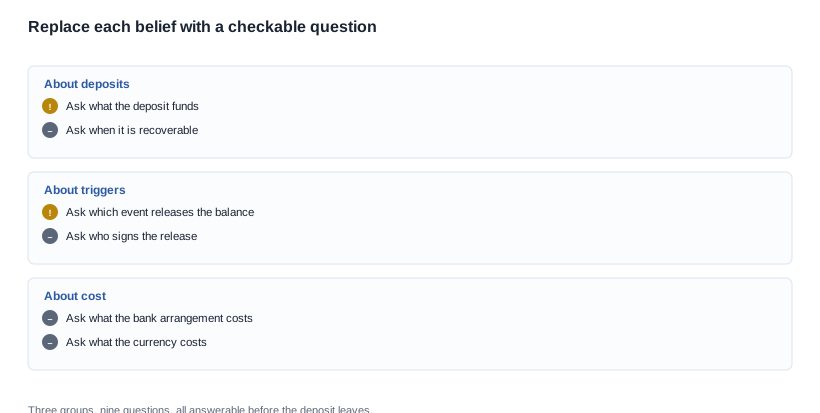
The nine questions, grouped
Each belief above has a replacement, and the replacements are questions a supplier can answer without preparing anything.
- What does the deposit cover, and against which milestone? Replaces the belief that the deposit measures confidence.
- Do you fund the production, or do you buy finished stock? Replaces the belief that a low deposit proves a good supplier.
- Which event releases the balance, and who confirms it? Replaces the belief that a place is a trigger.
- What do the bank, inspection and courier charges add to this order? Replaces the belief that payment terms are free.
- Does the insurance cover the specification, or only the transit? Replaces the belief that the goods being insured settles the risk.
- What does the letter of credit cost this order in total? Replaces the belief that the safest structure is also the sensible one.
- What happens to a batch that fails inspection? Replaces the belief that a rejected order is handled informally.
- Which document proves the release event, and can you produce it? Replaces any belief that a certificate number is a fact.
- What happens to the deposit if the configuration changes after the freeze? Replaces the belief that the deposit is a formality.
Two of them are expensive to ask late
The order matters because two of the questions are expensive to ask late. Question seven, about a failed batch, is cheap to ask before the order and very expensive afterwards, because after the first shipment the supplier's answer is usually that it will be handled case by case. Question nine, about the deposit against a changed configuration, is the one that determines whether the deposit is a commitment or an option, and it too is much cheaper to ask at the start.
The rest can be asked in any order, and they are best asked in a single written message so that the answers arrive together. A supplier who answers all nine in writing is giving the buyer something that is worth more than a percentage point on the deposit, because it makes the schedule enforceable later.

A belief tested on a hypothetical order
The order and the belief attached to it
This account illustrates a method. It describes no live project, no named customer and no real order, and every figure in it is assumed.
The scenario: a brand places a first order for an open-ear audio model at a volume above the supplier's usual minimum order quantity. The supplier quotes a deposit at a level the brand considers high and a balance due on the ex-works date. The brand has two beliefs working quietly here. The first is that a high deposit means the supplier does not trust the brand. The second is that a letter of credit would remove the risk, and the brand has already asked for a quotation on that basis.
What the checks changed
The first belief did not survive the first question. The supplier answered what the deposit covers in one sentence, naming component purchases and assembly against a dated production milestone, and the level made sense as working capital rather than as distrust. The brand had been reading a price as a judgement.
The second belief did not survive the fourth question, which was the total cost of the arrangement. On this order value, the bank's charges and the courier and processing costs came to a share of the margin that the brand could not carry, and the protection the instrument was buying was protection against a supplier failing to ship, which was not the exposure the brand actually had. The exposure was a specification that had not been inspected.
So the brand spent its negotiating capital in a place the beliefs had told it to avoid. It kept the deposit at a level the supplier had quoted rather than arguing it down, and it used the deposit that the supplier valued more than money, which was a configuration frozen earlier and a firmer volume against a rolling delivery. In exchange, the balance moved to a defined inspection with a named owner, and a remedy window was added that is measured from receipt rather than from shipment. Neither of those two changes cost the supplier a percentage point, and together they moved considerably more value than the deposit would have.
The lesson is not that payment terms are unimportant. It is that the beliefs were not about payment terms at all. They were about trust, and about a fear of shipping, and both of them were being priced into a clause that could not address them.
Where Cynrin stands on payment beliefs, and the next step
What we will not do
We will not quote you a payment term that we have not written down for your specific order, and we will not agree to a structure on a call and change it once the goods are moving. We will not use a payment term to cover a specification question, because the specification is where the answer actually is, and burying it in a schedule only makes it harder to find later.
We also do not publish our deposit percentage, our accepted payment methods, our unit prices, our minimum order quantities or our lead times. There is no honest way to publish a range for these and have it mean anything, and a buyer who is comparing a range against a competitor's specific quotation is doing an arithmetic that does not hold.
What we will do is put the terms in writing, name the event that releases the balance, tell you which document we will produce to prove it, and say plainly if the structure you have asked for is one we will not accept.
The information we need from you
Send the model, the case option, the quantity, the destination and the schedule you have been given, and we will tell you which parts of it we can meet, which parts we would want defined, and what the total cost of the arrangement is against the order value. The payment terms framework sets out the wider structure, the step-by-step sequence covers the order in which the decisions have to be taken, contract mistakes covers the clauses around the schedule, and minimum order quantity and hidden costs covers the fixed costs that sit outside the order value.
Send the schedule and the configuration, and we will tell you which of these beliefs the order has already settled.


