

Once a buyer has compared three quotations, the remaining questions are not about the unit price at all. They are about how the price decomposes, which line of the decomposition is negotiable, and which line is a decision that has been taken rather than a cost that has been incurred. This guide is written for the point where a buyer has enough data to stop comparing and start structuring.
The argument below is that a smart glasses price is five lines, and that only two of those five are negotiations. The other three are decisions, and a buyer who argues with them loses the negotiation on the two that matter. The pricing section sets out the quotation structure this article assumes.
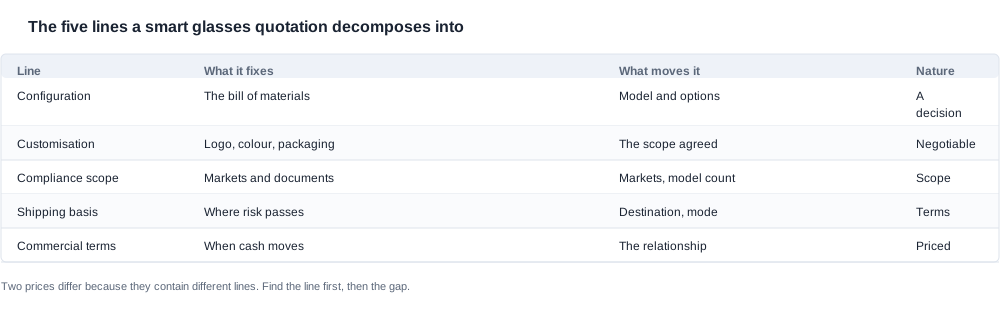
The table is the framework. Every quotation in this category can be decomposed into these five lines, in any order, and the first task of a comparison is to find which line is different before finding out by how much.
Smart glasses pricing: five lines, and the two that actually move
Why two quotations differ before anyone negotiates
Two quotations for the same product are rarely different because of the product. They are different because one of them contains a line the other does not, and the line is either inside the unit price or outside it. A quotation that folds artwork setup into the unit price produces a lower unit number and a higher first-order cash number. A quotation that shows setup separately produces a higher unit number and a smaller commitment. Both structures are legitimate and both are common; comparing them at the unit line is comparing two different products.
The second reason is volume treatment. One supplier applies a break at the buyer's quantity and the other treats the enquiry as a one-off, so the unit lines differ by a margin decision rather than by anything in the product. The third is the accessories scope: a case, a cable, a moulded insert and a manual in the carton, or quoted separately, or omitted. The fourth is the document scope, and in this category that scope is large and is frequently excluded rather than priced.
None of these four is a price difference. All four are scope differences in the costume of one, and the reason buyers argue about the unit price is that it is the only number on both sheets that appears to be the same number.
The published rows that let you challenge a configuration
The catalogue gives a buyer something most categories do not: a set of published per-model rows that a configuration can be checked against. Cell capacity, charge time, rated use, charging method and case capacity are published per model, along with the resolution tier and the available colour options. The Bluetooth version is published for the audio and sport models and is not published for the camera series, which is worth knowing before a buyer asks for it as if it were a settled row.
What that means practically is that a quotation written against a model family rather than a specific model can be challenged. If the quotation says camera model at 8 megapixels, the buyer can ask which of the eight models in that tier it is, and the answer determines the cell, the case and the charging method, all of which are published. A supplier who cannot name the model has quoted the cheapest member of a family, and the buyer now knows that the gap between the quotation and the intended product is the cost of everything the family contains.
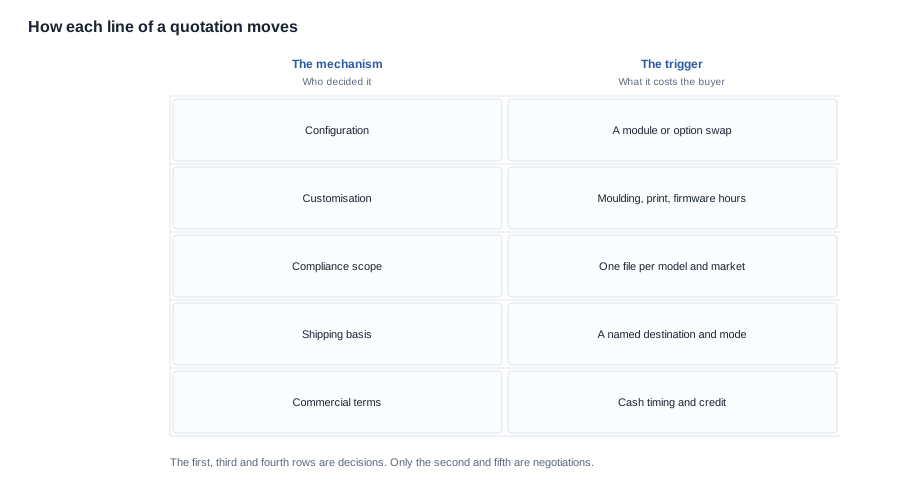
The matrix sets out the mechanism behind each line. Three of the five are decisions the buyer or the factory makes once, and the other two respond to volume and to time.
Which lines are negotiable and which are not
The customisation line and the commercial terms line are the negotiable ones, and they respond to different things. The customisation line responds to scope: what is included, at what setup cost, and over what volume the setup is recovered. The commercial terms line responds to the relationship and to time, and it always has a price.
The configuration line is a decision. The compliance scope is a decision, because it follows the markets the buyer actually intends to sell into. The shipping basis is a decision, because it follows the destination and the mode the buyer's logistics can handle. A buyer who negotiates a decision line is negotiating against their own requirements, and a factory that notices it will stop treating the buyer as a serious counterparty, because a buyer who argues about the destination is arguing about the wrong subject.

The configuration line, where the quoting error usually sits
What a model family name is worth in a quotation
Nothing. A quotation that names a model family has not been priced against a product; it has been priced against the cheapest member of that family, and the buyer is being offered the difference as a discount. The correction is not a complaint. It is a request for the quotation to be reissued against a named model code, a named colour, a named case option and a named interface, with the quantity and the destination attached.
That request is not pedantic. In the camera range the published rows diverge in ways that change what the buyer is buying. Some models ship with a 1400 mAh case, one model is published with a 900 mAh or a 1400 mAh option, one ships with a foldable 1200 mAh case, one has no charging case in the box at all, and two have a case whose capacity is not published. Some publish a charging method and some do not publish that row. The resolution tier splits into an 8-megapixel group of eight models and a 13-megapixel group of three. A family name hides all of it.
The case, and why it is a product rather than an accessory
A charging case is a second product with its own cell, its own charging circuit and its own set of test requirements, and the buyer who treats it as a free accessory is the buyer who gets surprised at invoice. It also changes the carton, which changes the shipping volume, which changes the freight band, which changes the landed cost. There is no configuration in this category where the case is a cosmetic choice, and the pricing template is the place to write down which case is in the box.
The colour line, and what a second colourway really costs
Colour options are published per model rather than across the range, which means the colour list is itself part of the configuration. Each colourway is a separate production setup, and the question that decides the real cost is the minimum per colour rather than the minimum per order. A buyer who plans one order across four colourways and is quoted a single minimum has been quoted a number that will not survive contact with the second setup. This is the single most common way a planned unit cost becomes a different number after the order is placed, and the pricing margin article covers what it does downstream.
The customisation line, where setup is mistaken for unit cost
Setup, tooling and the moulding that is not a unit cost
Most of what a buyer thinks of as customisation is setup rather than unit cost, and the two behave differently enough to matter. A logo applied to an existing temple is a setup with a modest value. A new temple shape is a mould, and a mould is a project: it has a quotation, it is recovered over a volume, and it locks the programme to one factory for as long as the buyer runs it. Frame or temple tooling belongs on its own line with its own terms, because a buyer who cannot tell whether they have bought a tool or been lent one will make the wrong decision about the repeat order.
The test is simple. If the cost disappears when the volume doubles, it is a unit cost. If it persists or has to be re-quoted, it is a project cost, and it should be amortised against a stated volume rather than folded into a headline.
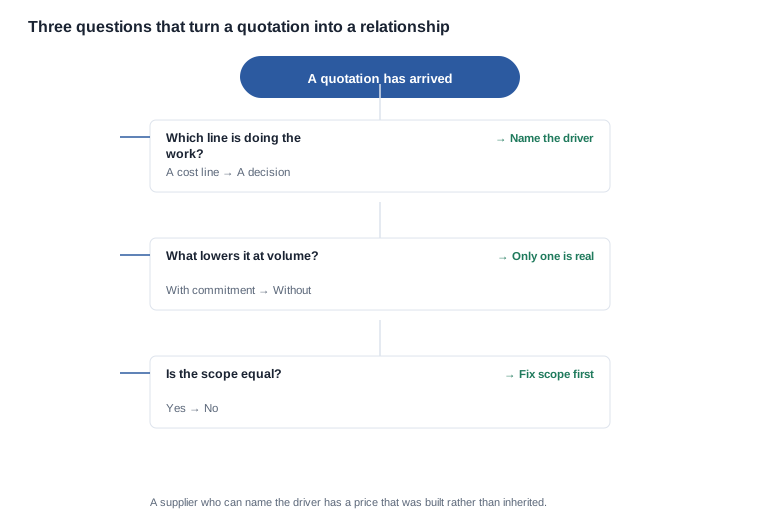
The decision chart is the shortest version of the whole argument. A supplier who can name the line that is doing the work in the price has built it; one who cannot has inherited it, and an inherited price will move without warning.
Firmware, the interface and the identifier
Firmware work, a customised interface and a branded Bluetooth name are engineering hours, and they are quoted as engineering or they are not quoted at all. The catalogue documents firmware and system customisation across the camera line and Bluetooth name and system customisation across the audio line, with capability marked unverified on the children's entries and undisclosed on the bone-conduction and AR entries. A buyer who is told that a feature is available, verbally, has been given a statement about capability rather than a quotation for a build, and the two are not interchangeable in an order.
The other thing that is quoted as engineering and should be is the identifier. A branded Bluetooth name affects the unboxing moment for the customer and the connection instructions for the channel, and it is a small line item that is easy to leave out of a specification and expensive to add late.
The scope that creates lock-in
The customisation line is also where a repeat-order lock-in is created, and the buyer should know which line creates it. A mould does. A bespoke firmware build may, if it depends on a component only one factory holds. A printed insert does not, but it does create a minimum print run length, which is a different kind of constraint and still a real one. The question to ask is what happens to the programme if the relationship ends, and the answer is normally that the buyer re-orders at a price that no longer exists, because the tooling and the setup have gone with it.

The compliance, shipping and terms lines, and why they dwarf the goods negotiation
Compliance scope, and the market that was never required
The compliance scope is priced per model and per market, and it does not scale down with volume in the way a buyer assumes. A file that covers one model and one market has a known cost; a file that covers the programme across several markets has a considerably larger one, and the marginal cost of the second market is not the same as the first. This is the line most often excluded from a quotation rather than negotiated within it, and excluding it does not make it cheaper; it makes it arrive later.
The most valuable question on this line is not about price. It is which market in the list is actually required. A buyer who adds a market to a quotation because it was easy to add has bought a cost. The catalogue has a company-level export certification page but no per-model certification rows, which means the certification scope of a specific model is a document the buyer has to request rather than a fact to check — and that is why removing an unnecessary market is often worth more than any reduction in the unit price.
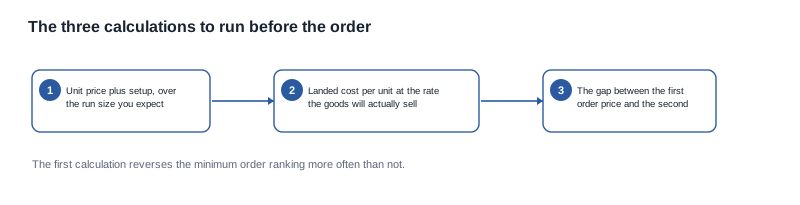
The three calculations below are the ones that survive a business case review, and each one answers a different question about whether the programme works.
Shipping basis, and the difference between two Incoterms
Every model in the range carries a rechargeable cell, which means the mode is partly chosen for the buyer rather than by the buyer, and a freight quotation for a cell-bearing consignment is not comparable with a general cargo rate. The difference between two shipping bases on the same goods, in the same container, to the same destination, is frequently larger than the entire negotiation on the unit price. The MOQ hidden costs page covers the cash side of the same arithmetic, and the point is the same: the goods are not the biggest number in the order.
Commercial terms, and why better terms have a price
The commercial terms line answers to the relationship, and it answers in the unit price rather than in a separate fee. A supplier that extends the payment window is extending its own working capital, and the cost of that comes back in the price of the goods. This is a better outcome than a hidden charge, because it is visible on the sheet, and a buyer who expects better terms to be free is going to find the price has moved instead.

The two questions to ask, and the three calculations to run
The first question: which line was worth negotiating on their side
Ask which single line, if any, was worth negotiating for the supplier. It takes one question, and the answer is diagnostic. A supplier who names one has a price that was built, with a driver behind it, and the named line is where the next conversation has leverage. A supplier who says the price is simply what it is has a price that was inherited, and an inherited price will move at their convenience and they will not be able to explain why.
The answer is also the fastest way to find out whether you are talking to a factory that knows its own cost structure or to one that does not. In a category where the cost of an order is dominated by a small number of lines, a factory that cannot name the largest one is a factory whose quotation is not built from its own costs.
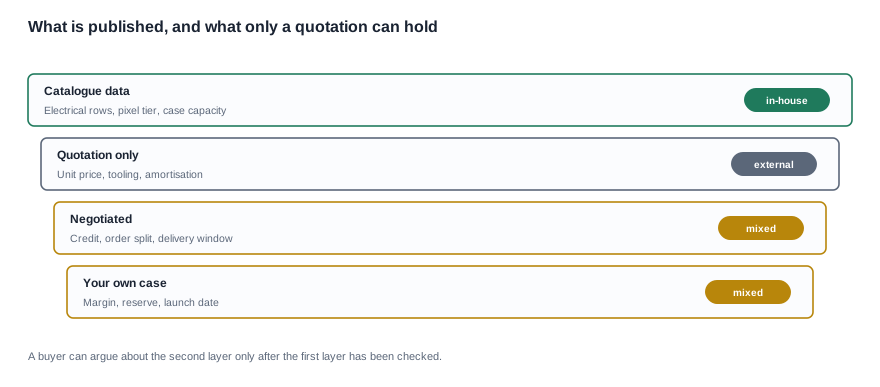
The layers show which part of the price is a fact that can be checked, which part is a term that has to be quoted, and which part is a decision the buyer has to make. Only the middle layer is negotiable in the ordinary sense.
The second question: what would make the price lower at the volume you plan
Ask what would make the price lower at the quantity the buyer actually intends to order. If the answer requires a commitment, take it: a volume discount tied to a stated quantity is a real price, because the supplier has priced the line and will hold it. If the answer requires nothing, the discount that was quoted is margin rather than cost, and it is a price that will not survive the next negotiation.
These two questions take about five minutes and they tell a buyer more about the durability of a quotation than any comparison that can be run between two suppliers' sheets.
Calculation one: whether a small order is viable at all
Unit price plus setup, divided by the expected run size. This answers whether a small order makes sense, and the answer frequently reverses the ranking of which supplier appears to have the lower minimum. A supplier with a higher unit price and a lower setup can be cheaper for a programme of a given size, and a supplier with a lower unit price and a high setup can be worse. The calculation is arithmetic once the lines are itemised, which is why the itemisation is the thing to insist on first.
Calculation two: landed cost at the rate the goods will sell
Goods plus freight plus duty plus compliance amortised, divided by the units likely to sell in the season the goods arrive. The denominator is the part buyers get wrong, because a first order usually arrives into a season it was planned for, and a delayed arrival changes the sell-through without changing anything on the invoice. A supplier with the lowest unit price frequently loses here, and the gap is usually the freight and the compliance scope rather than the goods.
Calculation three: the gap between the first and the second order
The first order carries the whole of the amortised set spread over the smallest quantity; the second order carries none of it and may carry a volume break. Ask for the second order's number, in the same conversation, and ask what specifically changes between them. If the answer names the setup falling away and the break applying, the arithmetic is real and the programme has a shape. If the answer is vague, the second order will be renegotiated, and the business case should be built on the assumption that it will be worse.
Why the two questions come before the three calculations
The questions and the calculations answer different things and they are not interchangeable. The two questions tell the buyer whether the numbers they are about to calculate with are stable, and the three calculations tell the buyer what the stable numbers mean for the programme. Running the calculations first is the usual mistake, because a calculation on an unstable price produces a precise answer to the wrong question, and a precise answer is more persuasive in a review meeting than a rough one.
There is also a practical reason. A supplier who answers both questions in writing has demonstrated something that is difficult to demonstrate any other way: that they know which part of the quotation is doing the work. That is the same capability a buyer needs in order to run the calculations at all, because the calculations are only meaningful when the lines have been separated.
What we publish, and what we keep inside the quotation
Rebuilding our landed cost from the published rows
Stated plainly: a buyer should be able to rebuild our landed cost independently and arrive at the same number, and where a line cannot be rebuilt, that line is the one to ask about before the order rather than after it. We will not quote a price against a certification position we cannot evidence, and we will not price a configuration we have not built. Unit prices, production lead times and minimum order quantities are not published in our documentation, because each of them is a function of the order rather than a property of the product, and a published figure for a term would be wrong for most of the readers who applied it.
What we do publish is the product data: the electrical rows, the resolution tiers, the charging methods where the catalogue publishes them, the case capacities, and the colour availability per model. Those rows are what makes a configuration checkable, and they are what lets a buyer challenge a quotation that has been written against a family rather than a model.
The five lines behind the number, and the one-time costs
We will quote against a defined configuration, a defined volume and a defined destination, and we will show which of the five lines is doing the work in the number. We will separate the one-time costs from the recurring ones so the second order can be modelled from the first, and we will tell you plainly when part of a specification cannot be quoted yet rather than putting a placeholder in the quotation and revising it later.
Send the models, the quantity, the destination market and the annual volume you are planning against, and we will tell you which configurations exist, which of the five lines your decision is going to sit in, and what the quotation would have to settle for each one. The procurement pricing section sets out the wider framework, and the pricing checklist for the first order is the item list this framework produces.
Related reading
- The comparison template — pricing template
- How scope affects margin — pricing and your margin
- MOQ hidden costs — smart glasses MOQ hidden costs
- How the price is put together — procurement pricing
Send the configuration, the volume and the destination, and we will show which of the five lines your decision sits in.


