

Smart glasses pricing effects on margin through scope lines
Two quotations for the same model in this category are rarely the same product, and the difference is almost always scope. The scope of what is being supplied — the hardware tier, the accessory block, the feature set, the document scope and the channel commitments — is what each quotation is actually pricing, and a buyer who compares two numbers without comparing two scopes will draw a conclusion about price when the real difference is elsewhere.
The practical consequence is that margin is decided before the negotiation opens, not during it. The scope lines that consume a margin are set when the configuration is written, and by the time two quotations are on the table the margin is a consequence of decisions that have already been made. A buyer who wants a better margin does not have a pricing problem; they have a scope problem, and the fix is to identify which scope line is moving the number and to change that line.
Three things follow, and they are the substance of this article. The five scope lines below are where a margin is actually consumed, and each one is legible in the published catalogue rows before a quotation is requested. A price floor should be set from the scope, not from the last number a supplier gave you, because a floor built on a competitor's scope is a floor built on someone else's product. And the largest margin leak in this category happens after the goods land, in the returns reserve, where the rate is set by the description rather than by the hardware.
We publish no unit price, no minimum order quantity and no production lead time, and nothing below should be read as a price. What is published are the model rows that determine the scope: the resolution class, the cell capacity with its cell count, the runtime band, the charging interface where the page carries one, the case capacity where the page carries one, the charge time, the ingress marking, the radio version and the colour options per model. Those rows are the fixed part of the margin calculation. The rest of it is a negotiation and a forecast, and this article is about telling the two apart.

The margin question a channel buyer is defending
The buyer who owns a margin in this category is normally a channel buyer or a brand-side commercial lead, and the question they are defending is narrow. It is not "can we make money on this product". It is "can we make money on this product at the volume we can realistically move, through the channel we actually sell into, with the returns we actually get".
That question has four inputs, and only two of them are negotiable with a supplier. The resale price is set by the market. The cost of goods is negotiated. The returns rate is set by the description the seller wrote and the expectations it created, and it is not set by the factory. The volume the channel can absorb is set by the channel. So the buyer's real negotiating surface is the cost of goods, and the cost of goods is a function of scope, which means the buyer's real task is to set the scope correctly and then to buy that scope well.
The mistake that is most common in this category is treating a quotation as a specification. The buyer receives two answers, both of them unit prices, and both of them plausible. The buyer builds a cost model on the cheaper one, adds a freight estimate and a percentage for the rest, and arrives at a margin. The problem is that the cheaper quotation is cheaper partly because it includes less, and the missing parts are exactly the parts the channel will find out about. Each missing part then arrives as a cost, individually small, and together large enough to turn a defensible margin into an indefensible one.
The supply chain is why scope has so much leverage over the price. This category is assembled from sourced components, and the factory buys most of what goes into the product. A change of scope does not just change the assembly step; it changes what has to be sourced, which changes the bill of materials, the lead time, the packaging and sometimes the documentation. The factory's price is a function of the bill of materials it has to buy, and so is the schedule. A buyer who understands that will stop looking for a discount and start looking for the scope line that is being priced.
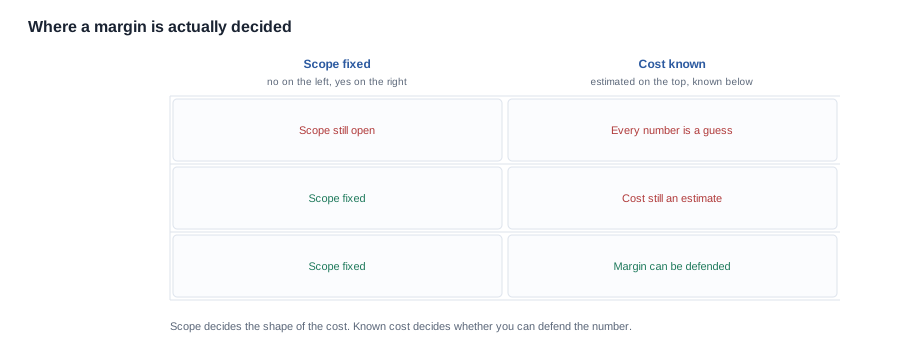
The matrix above is the shortest statement of the argument. When the scope is still open, every number in the cost model is a guess, and a margin calculated from guesses is a story. When the scope is fixed but the cost is still an estimate, the margin is better but not yet defensible. Only when the scope is fixed and the cost is known can a buyer stand behind a price to a finance team, to a retailer and to a customer.
Five scope lines and the margin each one consumes
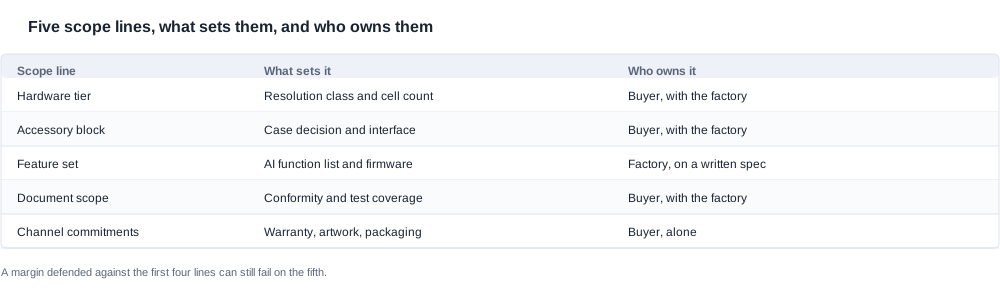
The hardware tier. This is the largest line and the least negotiable once chosen. The catalogue's camera family spans four published cell capacities — 220 mAh on the V03 Pro and the MT5, and the V03; 260 mAh on the V06 and the S7, and the KY06; 265 mAh on the MT6; and 290 mAh on the CY03, the CY05 and the L1 Pro, and the L2 Utral — and it splits into an 8 MP class of eight models and a 13 MP class of three. Moving between them moves the bill of materials, the cost and the schedule together.
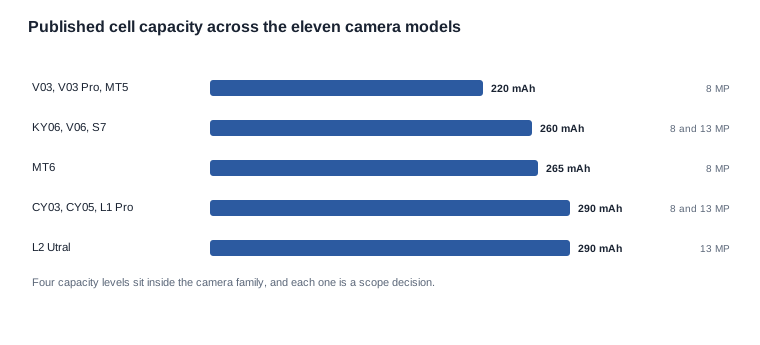
The chart makes the point more clearly than the words do. Within a single family, the published cell capacity spans from 220 mAh to 290 mAh, and the highest level is shared by four models that sit in both resolution classes. There is no relationship between resolution and capacity that a buyer could rely on to guess one from the other, which means the tier has to be chosen deliberately and cannot be inferred from the other published rows. Note too what the family does not publish: no sensor part number, no field of view, no video specification. The resolution class is the only handle on the largest line in the bill of materials, and it is a class rather than a component.
The accessory block. The case is the clearest example in the category. A cased configuration ships a second physical object and a second cell, and the published capacities are substantial: 1400 mAh on the CY03 and the CY05, and the L1 Pro, 900 or 1400 mAh on the L2 Utral, 1200 mAh on the MT6's foldable case, with the KY06 and the MT5 having a case whose capacity is not published and the V03 Pro having no case at all. A buyer who prices a cased model against an uncased one is comparing two products. The interface compounds it: magnetic charging on seventeen entries, Type-C on seven, and no published method on four cased camera models.
The feature set. Twenty of the twenty-eight catalogue entries carry AI function entries, and the number of functions is a scope decision with a cost and a schedule attached, because a larger feature set is a longer firmware branch, a longer validation step and a larger support commitment. A buyer who asks for a feature set after the quotation has to expect both the price and the date to move, and the second move is the one that hurts.
The document scope. This is the line buyers most often leave undefined, and it is a margin line because a per-model document set is a one-off cost with a queue in front of it. One company-level export certification page sits in the catalogue and no per-model certification row, so a conformity position is a request in every case. A buyer who defines the document scope up front pays for it knowingly; a buyer who does not pays for it later, in a schedule, and usually in a market access deadline.
The channel commitments. The warranty, the artwork, the packaging, the returns path and the support commitment are all yours. They are the only scope line where the counterparty cannot help at all, and they are the line that most often turns a good margin into a bad quarter, because the returns reserve is set by your own description and your own customer's expectations.

Setting a price floor before the negotiation opens
A price floor is a number you decide before you start talking, and it protects a margin in a way that a target does not. The floor is computed from the scope you intend to buy, at the landed cost you will actually incur, and it is the point below which the programme does not work for you regardless of what the market will pay.
The method is four steps, and the order matters more than the arithmetic.
Freeze the scope first. Write the configuration down: the model, the resolution class, the cell and the case decision, the interface, the feature list, the colour set, the document scope per market, the warranty and returns path, the packaging. This is the object whose price you are about to negotiate, and until it exists the comparison is between two undefined things.
Build the landed cost for that scope, at the volume you can actually move. Unit cost as quoted, plus the accessory and packaging block, plus freight, duty and insurance at the delivery term you will sign, plus the compliance cost per destination market, plus working capital from the payment terms and the days the inventory is held, plus a returns reserve from your own history. The reserve is the one most buyers skip, and it is the one that decides whether the channel survives a bad quarter.
Set the floor as a ratio, and state the assumption behind it. Take the total landed cost and divide it by the resale price. The number you want is not the ratio you get; it is the ratio you can defend if the returns rate doubles and the freight moves. Write the floor down with the assumptions attached, because a floor without its assumptions is a number you will move in the negotiation.
Then go and negotiate against it, in the scope language rather than the price language. This is the part that matters. Once the scope is written, a supplier's higher number is legible: it is a different cell, a different case, a different interface, a different feature set or a different document scope, and each of those is either a line you accept or a line you can change. A buyer negotiating a floor against a number with no scope attached has nothing to argue about except appetite.
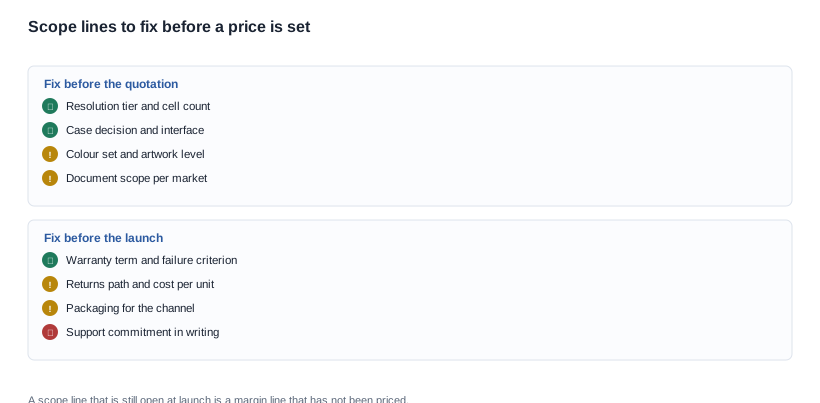
The checklist is split by when the line has to be settled. The first group has to be settled before the quotation, because those lines set the bill of materials. The second group can be settled later, but only before the launch, because after the launch they are no longer scope decisions but cost events. The support commitment is marked differently on purpose: it is the one line that nobody else can price for you, and it is the one buyers consistently leave to the end of the project.

Where margin leaks after the goods land
Most margin in this category is decided before the order, and most of the visible damage is done afterwards. Four leaks account for nearly all of it.
The returns reserve was a guess. The symptom is a quarter where the margin disappears and nobody can say why. The cause is that the reserve was set from an assumption about the returns rate rather than from a rate, and in this category the rate is a function of the description. The published endurance rows are the reason this is hard: the catalogue publishes a five-to-eight hour band on the V06 and the S7, and the V03 and the V03 Pro, a six-to-eight hour band on the KY06 and the MT5, roughly seven hours on the CY03, the L1 Pro and the CY05, and the MT6, and the L2 Utral, roughly eight hours on the LC-105-2 and the LC-105-1, and the K02 and the K01, roughly six hours on the G07 and the YK12, and roughly twenty hours on the A05, the A06 and the A07 — six different bands, none of them published with a test condition. A listing that promises all-day use against a six-hour band produces returns that have nothing to do with the hardware, and no supplier can negotiate that rate away.
The freight and duty assumption was dated and never refreshed. The symptom is a margin that drifts down a little every quarter for no visible reason. The cause is that the landed cost was built on a rate at approval and the rate moved. The prevention is trivial and almost never done: put the freight and duty rates in the model with a date on them, and re-run the model once per quarter.
The accessory scope quietly changed. The symptom is a landed cost that is higher than the model and a parcel that does not fit the carton. The cause is a case added, a colour added or an interface changed after the packaging was committed, with nobody tracking the cost. The prevention is a change-control list with the cost owner named against each line.
The working capital was modelled from the percentage rather than the days. The symptom is a cash position that is worse than the plan in a month when nothing went wrong. The cause is that the reserve was calculated as a proportion of the order value without multiplying by the days the inventory is actually held, which on a long cycle is a large correction. The prevention is to verify the figure against a real invoice rather than against the terms on the quotation.
Decide the reserve before you sign, not after the first quarter. The returns reserve is the one line that can be set after the goods have shipped, and that is precisely why it gets set badly. A buyer who defers it is a buyer who will set it in the quarter when the margin first looks wrong, and by then the only available figure is the actual rate, which is a fact about the damage rather than a plan about it. A reserve decided in advance can be defended, revised and budgeted; a reserve discovered in arrears can only be absorbed. The same is true of the two dated assumptions in the model. A freight and duty rate with a date on it, and a working capital figure checked against an invoice, are both cheap to keep honest, and both are usually left stale because nothing in the process forces anybody to look at them again.
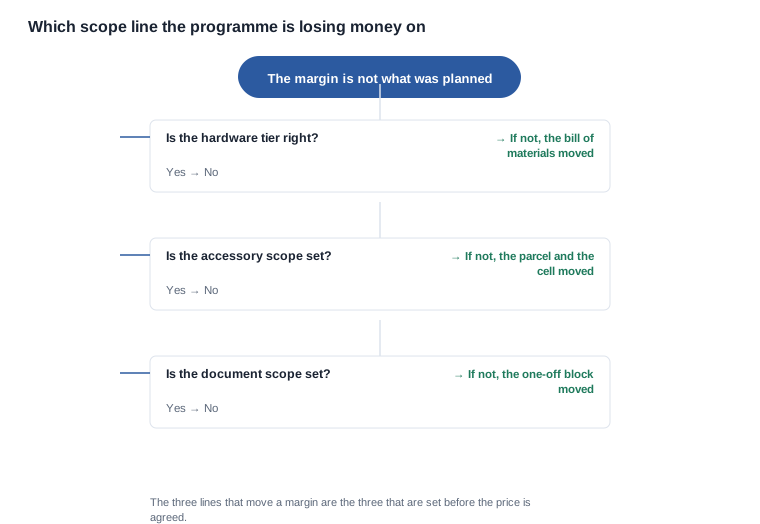
The decision tree is the diagnostic to run when the margin is not what was planned. The three questions run in order, because the hardware tier is the largest line and the cheapest to check, the accessory scope is the next largest and the easiest to miss, and the document scope is the one-off that appears in the wrong quarter. If all three are right, the margin problem is on your side of the line — the returns reserve, the freight assumption or the working capital — and no amount of supplier negotiation will fix it.
What we can and cannot say about your margin
Concretely, we publish the rows that determine the scope, and we will not publish a price that would be wrong for most of the rows in it. We publish the model designation, the resolution class where a camera is fitted, the cell capacity with its cell count, the rated runtime band, the charge time, the charging interface where the page carries one, the charging case capacity where the page carries one, the IP54 marking on the V06 and the S7, the Bluetooth version where the page carries one, the colour options on the models that publish them, the 158 g weight of the MT6 glasses unit excluding its foldable case, and the 35 dB amplification gain of the bone conduction entry.
We do not publish minimum order quantities, unit prices, production lead times, tooling and non-recurring engineering figures, price tiers, frame weights for any model other than the MT6, the weight of the MT6 charging case, sensor part numbers, field of view, video specifications, ingress test report numbers, certification numbers, patent counts, acoustic figures, battery transport test report identifiers, case weights or carton dimensions. One company-level export certification page sits in the catalogue and no per-model certification row, so we will not tell you a model is certified for a market on the basis of it. And we make no vision, health, eye-protection or hearing-aid efficacy claim for any product, in any market, in any configuration — a device that captures, notifies and connects is not a clinical intervention, and a claim of that kind is a regulatory exposure in the destination market rather than a marketing decision.
We also cannot tell you what your margin will be, and we will not try. Margin is a function of your resale price, your channel, your returns rate, your freight route and your payment terms, and none of those is ours. What we can do is mark the scope lines in your cost model, tell you which of them the published catalogue already answers, and tell you which ones are requests you will have to make and which ones are numbers only your own history can produce. Send us the configuration, the destination, the channel and the volume, and we will go through the five scope lines with you and mark them. The cost structure is under procurement pricing, the working template is in smart glasses pricing template, the beliefs that cost money are in smart glasses pricing myths, and the documentation side of the scope is in how to calculate a certification checklist.
Related reading
- How the cost is built — procurement pricing
- The working template — smart glasses pricing template
- The beliefs that cost money — smart glasses pricing myths


