

Smart glasses quality consistency means that the units in a later delivery match the units in the first, and it is decided at the first order rather than at the second. The short answer is this: consistency is secured by two documents and one reference unit, and the rest is a matter of checking that they still say the same thing. A buyer who has a written specification naming the exact configuration, a reference sample that is kept rather than thrown away, and a batch record that ties a unit to the build it came from, is in a strong position before the first container ships. A buyer who has a catalogue page, a price and a good impression is not. This guide is for a procurement manager placing a first order in this category, or a channel buyer taking on a supplier for the first time. It sets out where consistency actually breaks, which two documents carry the weight, and the one test that is available before a second order. The quality consistency section covers the same subject in more depth, and the checklist collects the questions in a form that can be sent straight to a supplier.
What smart glasses quality consistency means in a first order
Consistency means predictability, not quality
Consistency is not a measure of how good the units are. It is a measure of how predictable they are, and predictability is a property of the process rather than of any single unit. A factory can produce excellent units and still be an inconsistent supplier, if every batch is good in a slightly different way. The consequence for a buyer is specific: the first order can be managed by inspecting it, and the second order cannot be managed by inspecting it, because by then the channel has already learned what to expect and any difference shows up as a complaint.
That is why the first order is the one that decides the programme. Everything that makes a later order predictable has to be captured in the first one, because a reference that was not kept cannot be reconstructed and a specification that was not written down cannot be enforced.
Why a first order is where consistency is decided
The practical reason is that the evidence exists once and then stops existing. A reference sample is a physical unit; it either goes into a file or it goes into a box in a warehouse and is eventually thrown out. A written specification is a page; it either exists in the buyer's file with a date on it or it exists in somebody's memory, and memory is not evidence when a customer complains in eight months.
The second reason is that the first order is where the supplier is still forming its own habits for the programme. The first order of a new configuration is usually run with more attention than the fifth, partly because the factory is learning and partly because the buyer's sample approval is in the way. That attention is a gift, and the way to use it is to make sure everything learned during it is written down.
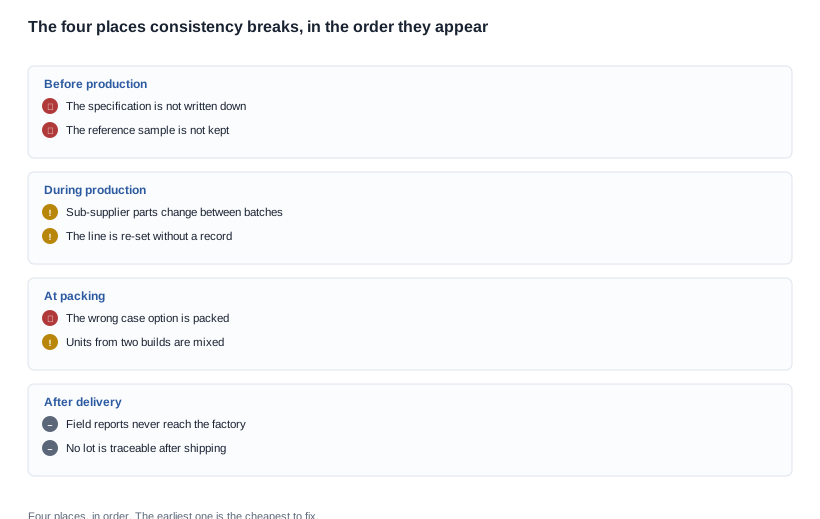

The four places consistency breaks, in the order they appear
Before production, and during it
The specification is not written down. This is the first break, and it is the most common. The configuration was agreed in a conversation, a quotation, a sample order and a drawing, and each of those captured part of it. None of them captured the whole build, and the part that is missing is the part that will drift.
What the specification has to name is the model, the configuration, the colour, the case option, the charging method, and the destination market, with the attributes that the programme depends on written as limits rather than as descriptions. In this category the configuration space is wide enough that an incomplete specification is close to a guess. The published range runs to twenty-eight entries, eleven of them camera entries, and within those eleven the charging case option alone moves between a nine-hundred milliamp-hour case, a fourteen-hundred milliamp-hour case, a twelve-hundred milliamp-hour folding case, a case whose capacity is not published, and no case at all. Four of the eleven camera entries do not record a charging method at all, which means that for those builds the charging route has to be defined by the programme rather than inherited from a catalogue page.
The reference sample is not kept. The second break is the reference, and it is the one that is easiest to fix and most often missed. The approved sample is used to sign off the specification, and then it is put in a box, and then the box is in a warehouse, and then the warehouse is reorganised. A programme without a reference is a programme where the standard for every future delivery is the memory of whoever last handled the goods.
Sub-supplier parts change between batches. This is the third break and it is outside the factory's control. The cell, the camera module, the case and the frame all arrive from somewhere else, and a supplier's approved source can change without the factory telling the buyer, particularly when a part is bought through an agent. The programme's defence is to specify which attributes of incoming material it depends on, and to require the factory to notify the buyer when a source changes. The comparison table article sets out which attributes of this product class are worth controlling.
The line is re-set without a record. A shift change, a new operator, a fixture adjustment and a changeover all leave the process in a slightly different state. None of them is a fault. All of them are reasons for a unit to differ, and a programme that does not record them cannot explain a deviation afterwards.
At packing, and after delivery
The wrong case option is packed. Packing is where the configuration finally becomes physical, and it is where a build that was correct can be turned into a build that is wrong. A case of one capacity packed into a configuration designed for another is a common and entirely avoidable fault, and it is avoidable because the case option is on the specification and the packing line can be told to check it.
Units from two builds are mixed. Two lots of the same model, packed together, are indistinguishable once the cartons are closed. The consequence appears later, when a complaint cannot be traced to a lot and the whole shipment has to be held as suspect. One identifying mark on the pack, kept consistent through the shipment, removes the problem entirely.
Field reports never reach the factory. The last break is the one that closes the loop, and it is the one most often missing. If a channel report goes to a sales contact and stops there, the factory never learns, and the same complaint arrives again in the next order. A named route for a defined report, with a response expected, is what turns feedback into a control.
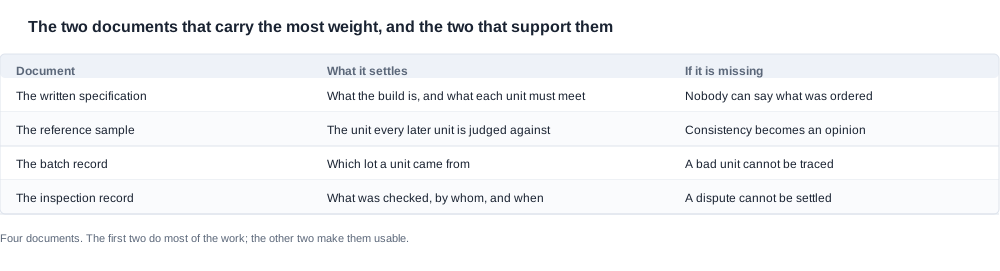
The two documents that carry the most weight
The written specification
The specification is the first of the two, and it is the document that decides what the goods are. A buyer who has one can say, in a dispute, exactly what was ordered, and a factory that has one cannot be surprised by a requirement it never saw.
The version that works is a short one that names the build and then names the limits. The build part covers the model, the configuration, the colour, the case option, the charging method and the market. The limits part covers the attributes the programme depends on, with the measurement method and the condition attached to each. A limit without a method and a condition is not a limit, it is a preference, and it cannot be used when a customer is arguing.
The part of the specification that is most often left out is the condition. The published charge time in our catalogue is a useful illustration of why: charge time is published for all twenty-eight entries — twenty-six of them at two hours or less, and the D17 and the ZH12 at about one hour — but the catalogue does not publish the starting state of charge or the point at which charging is treated as complete, so a charge time cannot be compared across models as a number of hours of interruption. The same applies to a runtime figure and to a consistency limit. The condition is not a footnote to the number. It is the number.
The reference sample, and the records that support them
The second document is a physical one: the reference sample, which is the approved unit kept under a number, dated and recorded, and never sold. It is what every later unit is compared against, and it is the thing that makes an argument about quality resolvable rather than rhetorical.
Two records support it, and without them the reference is only half a control. The batch record ties a unit to the lot it came from, which is what makes a deviation isolable rather than a total loss. The inspection record states what was checked, by whom and when, which is what makes a disagreement with the factory settleable rather than circular.
All four belong in the buyer's file for the programme, not in the supplier's, and a copy of the reference should be kept by both sides. Where a buyer cannot obtain these, the honest position is that the programme has no quality system yet, and that the first order is a learning order rather than a production order.

The one test available before a second order
What the test is
There is one test that is available to a buyer before committing to a repeat order, and it is simple enough that a buyer with no laboratory can run it. Take a small number of units from the end of the last delivery, and compare them against the reference sample. Then ask the factory to run the same comparison on units from the same lot, and compare the two sets of results.
The value of the test is in the second half. Comparing the buyer's units with the reference tells the buyer whether the goods have drifted. Comparing the buyer's results with the factory's results tells the buyer whether the factory is seeing the same thing, and a disagreement between the two is the most valuable single finding a buyer can have, because it means the fault is somewhere in the measurement rather than only in the goods.
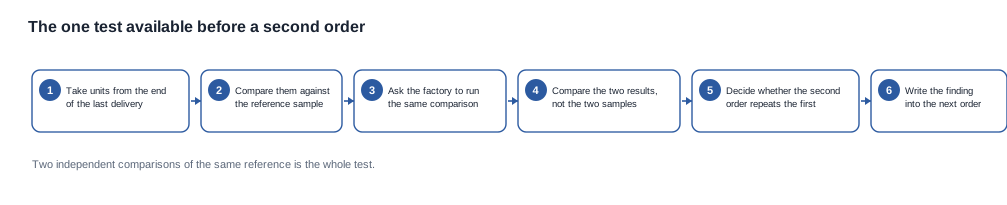
What the result tells you
Three results, and each one leads somewhere different.
If the buyer's units and the factory's units both match the reference, the programme is consistent and the second order can proceed. If the buyer's units differ from the reference while the factory's match it, the problem is in the measurement, the sample handling or the transport, and it is the buyer's problem to fix before it becomes a customer complaint. If the buyer's units match the reference while the factory's do not, the factory has a drift the buyer is not seeing, and the second order should wait until that is understood.
The test also produces something cheaper than a complaint: a number the buyer can put in the next order. Buyers who run it can say, when they place the repeat order, that the last delivery was checked against the reference on a named date with a named result, and they can say which attributes were checked. A buyer who has not run it can only say that the goods looked acceptable, which is not a basis for a second order.
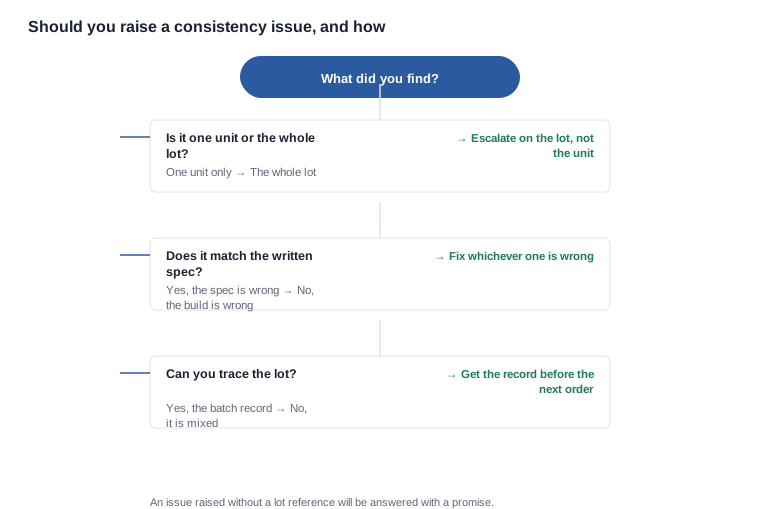

What consistency costs, and what to negotiate
The terms the two documents support
The two documents are also the evidence that makes the commercial terms enforceable, and a buyer who has them negotiates a different agreement from a buyer who does not.
The acceptance clause is the first. A quality claim is only arguable if there is something fixed to argue against. Written into the agreement, the reference unit becomes the standard for every future delivery, and every later conversation about quality becomes a comparison rather than an opinion. This removes the buyer's dependence on how the supplier characterises the goods, which is worth more in the third order than in the first.
The change control point is the second. Once the specification names what is fixed by the build, the agreement can follow: a change after the freeze is a change to the specification, and it carries a defined schedule and cost consequence. Without a written build, the freeze is an argument the buyer has to win every time.
The records and their retention are the third. A programme that cannot trace a lot back to a build cannot settle a claim from the field, and a claim it cannot settle becomes a credit at the buyer's price. Asking what to ask is straightforward: which records the factory keeps, for how long, in what form, and whether the buyer receives a copy at the end of the run.
The trade-offs a first-order buyer can actually make
Three decisions are available early, and each is a real choice rather than a preference. A tighter attribute list means fewer attributes to inspect and fewer to hold the factory to later. A wider sample means more confidence in each lot and a higher cost per unit. A stricter reaction rule means better protection for the customer and the evidence, and less working capital tied up in held lots.
The total cost of a consistency programme is the inspection and test time inside the build window, the working capital held in isolated lots, the cost of rework, and the returns a programme with a working control plan does not have. Those four numbers are usually larger than a first-time buyer expects, and the reason they are worth paying is that they are one-off. A programme that captures its consistency system properly in the first order pays the inspection cost once and the argument cost never, which is the cheapest version of quality in the category.
Before you order, the question to ask is which of the two sides is carrying the risk: the factory, the buyer, or the customer. The answer should be written down, because an unwritten answer defaults to the customer, and the customer is the party that cannot implement it.
What a first order should buy from the supplier
Three things, and they are all reasonable to ask for in a first order. A reference unit with a recorded date, kept by both sides. A batch record that ties a unit to the lot it came from. And a written specification of the build that the programme is ordering. A supplier that provides all three is telling the buyer that it expects a repeat order, and a supplier that cannot provide even one of them is telling the buyer something too.
What we will and will not say about quality
What we can state
We publish the configuration-level specification of every model in our catalogue. For camera and audio models that means the resolution tier, the battery, the case option where one exists, the charging method where the catalogue records it, the charge time, and the runtime with the condition it was measured under. Where the catalogue does not record something, we will say that it does not record it, and we will treat it as an item for the buyer to request rather than filling the gap with a typical value.
We will provide a reference unit with a recorded date for a named configuration, and we will say which attributes are fixed by the build and which depend on the run.
The figures that only exist for a build that does not exist
We do not publish a defect rate, a rework rate, a yield figure or a pass rate for the range, and we will not quote one to a buyer who has not named a configuration. All of them are functions of the mix, the incoming material and the particular run, so a published figure would be true of a build that does not exist and misleading for the one that does.
We also do not state a certificate number, a test report value or a certification scope for any model, because the catalogue carries no per-model certification row and the company-level certification page is not a model-level statement. Buyers in this category routinely ask about CE, FCC and RoHS, and the answer is that the applicable scope for a model and a market is written material to be requested and filed before the order. Where a model has no published weight, we will say that it has no published weight and tell the buyer to request it, rather than quote a figure that cannot be traced.
What to send us to start a first order
Send the model, the configuration, the quantity, the destination market and the launch date, and we will tell you which parts of the build are settled, which are open, and which have to come from a sub-supplier. We will also tell you which attributes the programme should control, what a reference unit for that build is, and what we would want to see in the agreement. The who needs this most article sets out the buying situations where consistency is the deciding factor rather than a detail.
Related reading
Send the model, the configuration and the market, and we will tell you which parts of the build are settled and which are yours to decide.


