

The most instructive smart glasses quality consistency case is not the one where a batch failed. It is the one where a batch was fine, a drift was real, and four months went past before anyone could name it. This article is that case, constructed rather than reported: no customer is named, no order is claimed, and every figure in the narrative is an assumption chosen to carry an argument. The value of a hypothetical case in a category like this is that it can be examined at the points where the real ones are usually left vague.
The scenario is a channel buyer in a European market, running one camera model across three colourways, with a reorder cycle of roughly four months. The first order arrives without incident. On the fourth reorder, returns rise on one colourway and stay flat on the other two.
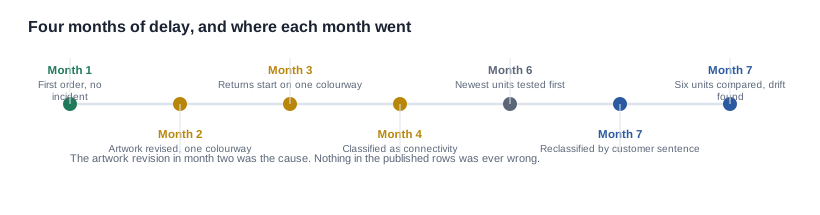
Smart glasses quality consistency: the scenario and the assumptions behind it
The assumptions are stated first because a hypothetical case with unstated assumptions is a story, and a story cannot be argued with.
- The product is a camera model from the published range, configured in three colourways, with the same cell capacity, the same charging method, the same charge time, the same rated use and the same case option across all three.
- The channel places four orders in a year. The first is roughly three hundred units, the second and third are similar, and the fourth is the order in which returns appear.
- A single approved sample exists, built by the supplier's own staff, and it is signed. No inspection record was retained from the first order.
- The returns are recorded, because the channel partner insists on it, but they are recorded by internal category rather than by the customer's own description.
- Nothing in the published specification was wrong at any point. The catalogue rows for this model family are the same across all four orders.
That last assumption is the load-bearing one. It means the case cannot be solved by comparing specification sheets, because there is no specification drift. It means the buyer has to find the difference in something the catalogue does not describe.
The commercial setting the case depends on
Three commercial facts about the scenario matter to the argument, and none of them is about the product.
The first is that the channel's reorder cycle is four months, which sets the resolution time of the whole case. A buyer on a weekly reorder cycle would have found the drift in two reorder cycles rather than three, because the comparison between a good order and a bad order would have happened sooner. Four months is not unusual in this category and it is a structural feature of the buying pattern rather than a supplier behaviour: a channel that reorders on a long cycle is a channel whose drift is discovered late, every time, unless a baseline was retained.
The second is that the affected units were already in the channel. The buyer had stocked three colourways of the same model, so the three unaffected units that produced the answer were sitting in the same warehouse as the three affected ones. That is why the bench comparison worked at unit level and could not have worked at batch level: the two populations were physically present, drawn from the same production window, and separated only by colourway.
The third is that the destination market sets a content requirement on the carton. The colourway names, the manufacturer information and the economic operator details printed on the box are part of the same artwork revision as the registration, and a drift in any of them is not a cosmetic issue but a market-access one. The buyer in this scenario had not separated those two consequences, which is why the finding was treated as a finish complaint for four months rather than as a packaging control failure.
What the buyer had in place before the fourth reorder
The buyer was not a novice and the order was not a casual one. There was an approved sample, a written purchase order naming the model and the colourways, a retention policy on the finished goods, a channel agreement with a returns reserve built into the margin model, and a supplier who answered questions within a day. On the evidence available at the time, the programme seemed under control, and the reason it seemed under control is that every element of it was aimed at the wrong target.
The purchase order named the model and the colourway. It did not name the case option, and it did not carry an artwork revision number, because artwork revision numbers are not normally part of a purchase order in this category. The returns reserve was set at a percentage the channel had carried over from a previous programme, without a denominator, and it was reviewed quarterly against a number that was itself derived from the same classifications that turned out to be wrong. The approved sample was signed, and it was signed against a specification, not against a configuration, so it could not be used to identify a unit in the warehouse.
None of these are negligence. They are the ordinary state of a first-year buying programme in a category where the supplier's own documentation is also in its first year. The point of publishing the case is that the gaps are visible in advance, and each one has a cost that can be stated in advance.

Three decisions that each seemed administrative and each delayed the finding
Three decisions turned a one-week investigation into a four-month one. None of them would have survived a question in a review meeting, because each was reasonable on its own terms.
The first decision was classifying returns by internal category rather than by the customer's sentence. The channel's returns system had four categories, and returns were allocated to them by the person processing them. On the first month's data, most of the complaints were routed to connectivity, because the customer had described a unit that would not hold a charge as "it keeps disconnecting". The investigation therefore began with the case-to-unit behaviour and radio performance, which were not the problem. Changing the classification to the customer's own sentence changed the category within the first month, and it is the single cheapest change in the whole case.
The second decision was starting the investigation with the newest units. The instinct in a returns investigation is to test what arrived most recently, because that is the material that generated the complaint. The problem is that the newest units are the ones closest to whatever the change is, and the oldest units in stock are the ones closest to the approved sample. Starting at the wrong end of the stock does not produce a wrong answer; it produces no answer, because every unit tested is from the affected population.
The third decision was having no inspection record from the first order. This is the decision that made the other two expensive. Without a record from the first order, the only available comparison was between the fourth reorder and a sample, which meant the investigation had no baseline and no way to bound the problem. The buyer could not establish when the change happened, so every unit in the warehouse became a candidate and every unit in the warehouse had to be examined.
The cost of these three decisions was not inspection labour. It was that the buyer could never answer the question a supplier asked in week three, which was: which units from which production window do you want compared with which units from which earlier window.
The request that was never made
There is a fourth decision in this case, and it is the one the buyer controls entirely: the decision not to ask the supplier for anything.
The supplier in this scenario held a production record. It had to. The units had to be assembled against a configuration, the packaging had to be released against an approved proof, and the finished goods had to be stored against a batch identifier. The record existed whether or not anyone requested it. The buyer simply never asked, because the programme had no step in which asking was a defined activity, and because in the first three orders there had been no reason to ask.
The cost of that omission is worth stating in a way a buyer can use in a supplier meeting. Two months of the delay can be attributed to the three decisions, and two months to the absence of a request. A request for the artwork proof from the second order, made in month one of the programme, would have produced a file showing two revisions, and the question in month five would have been answered in an hour. The buyer's due diligence did not fail at the point of investigation; it failed at the point of order, and it failed quietly, because nothing about a quiet failure announces itself.
This is the difference between inspecting a supplier and documenting a relationship with one. Inspection produces a result at a point in time. Documentation produces a comparison, and only a comparison can settle a dispute four months later.
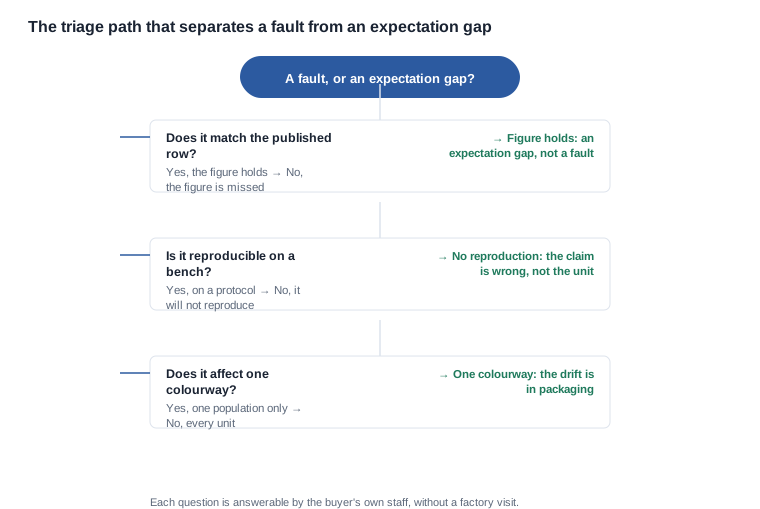
Pulling finished goods from stock rather than watching a line
The investigation that eventually worked did something that buyers rarely do, and it is worth describing precisely because the method is transferable and the cost is low.
Three units were drawn from the affected colourway's finished stock, not from the production line and not from the first order's leftovers. Three units were drawn from the unaffected colourways in the same shipment. All six were examined on the same bench, against the same written protocol, on the same day. The protocol had been written before the examination, and it named what was compared, the condition of each unit before the comparison, and the number of units.
Two of the three affected units reproduced the symptom. None of the three unaffected units did. The buyer had the answer inside a day, after four months.
The reason the bench comparison worked, and the reason a factory visit would not have, is that the factory visit would have shown a line running correctly. The drift was not in the assembly operation; it was in something that reached the line from outside the assembly operation. Pulling finished goods from stock and examining them against a written protocol finds differences between populations. Watching a line finds differences between a process and its own description, and a well-run line passes that comparison every time.
There is a second reason the bench method beat the line visit, and it is commercial. A line visit produces a report about a process. A bench comparison produces a set of units, and a set of units can be attached to a claim, a credit or a rework decision. The buyer needed the second thing, and the fact that the first thing was available and easier to obtain is the reason many investigations stop one step short of the answer.
Running the comparison with a buyer's own staff
The bench work in this case was done by the buyer's own quality staff, not by a third-party laboratory, and that is worth explaining because it changes the cost of the method by an order of magnitude.
What the comparison required was: six units drawn from two populations, a written protocol agreed in advance, one comparison method per characteristic, and a record that ties each result to a unit identifier. It did not require laboratory equipment, and it did not require the supplier's cooperation beyond access to the warehouse. The units had already been paid for. The protocol was four paragraphs long. The whole comparison cost one person two days, most of which was spent writing the protocol before the bench work rather than during it.
The single discipline that made the result usable was that the protocol was written first. A comparison designed after the units are on the bench is a search for a difference rather than a test of a difference, and the record of it will read as an opinion rather than as a finding. Written first, the protocol is a document, and a document is something a supplier can be shown.
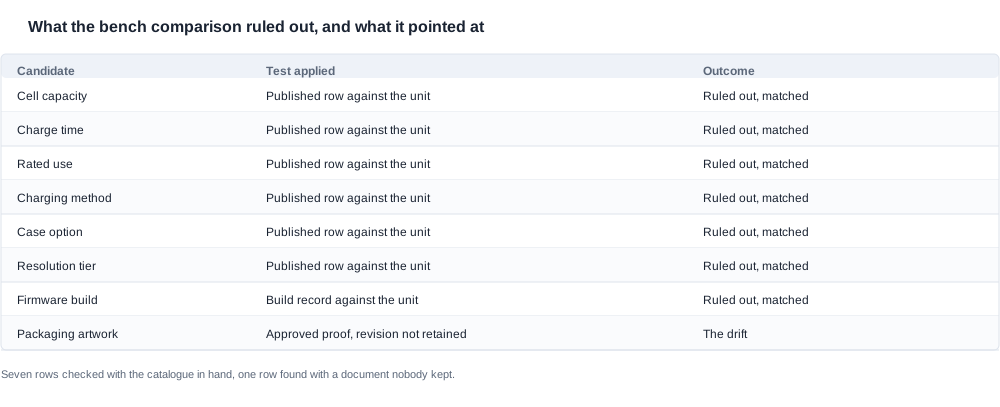

What the comparison ruled out, and what it pointed at
The comparison settled the specification question in a single afternoon, and the result was worth more than the finding that followed.
Ruled out, because the three affected and three unaffected units were identical on every published row: the camera the cell capacity, the charge time, resolution tier, the rated use, the charging method, the charging case option and the firmware build. Ruled out as well, because the units came from a single shipment and a single production window: any explanation that depends on the factory changing between deliveries.
What the comparison pointed at was the one thing the two populations did not share, and it was not a hardware row at all. The affected colourway had been reprinted. The packaging artwork for that colourway had been revised between the second and third orders, and the revision had not been retained.
The mechanism is mundane and completely sufficient on its own. A revised print file, approved by someone, issued to a print supplier, and not filed anywhere the buyer could reach, produces a slightly different registration on one colourway. A customer notices the registration. The customer photographs the box. The unit is returned as damaged. The returns system classifies the description as a finish or packaging issue, or — in this case, wrongly — as connectivity, and the investigation leaves the building.
That the specification was never in question is the generalisable finding. The published rows on the model family covered the hardware accurately and throughout, and the drift lived entirely in a row that no buyer had written a criterion for, because the buyer had assumed that artwork, like the hardware, was specified and controlled by the same engineering process. It is not. Packaging artwork is approved by commercial staff, and it is the one artefact in the chain that is routinely approved, released and then forgotten.
What the ruled-out list is worth
The ruled-out list is the part of the case that generalises furthest, and it is also the part buyers are most reluctant to produce, because listing what you have eliminated feels like reporting progress rather than making a decision.
It is the opposite. In this category the published rows are the cheapest possible comparison, because they are free and they are already in hand, and their value is not in finding a fault but in eliminating a population. Once the cell capacity, the charge time, the rated use, the charging method, the case option, the resolution tier and the firmware build are ruled out for a colourway, the candidate population for a drift in that colourway collapses to the parts of the chain that no published row describes: packaging, accessories, and the assembly operations themselves.
That collapse is what made the conclusion in this case defensible rather than merely plausible. The buyer was not asserting that the hardware was fine; the buyer was asserting that the hardware had been checked against every published row available and had matched, and that the difference lay in a row nobody had written down. A supplier can argue with the second kind of statement. The first kind of statement can only be checked.
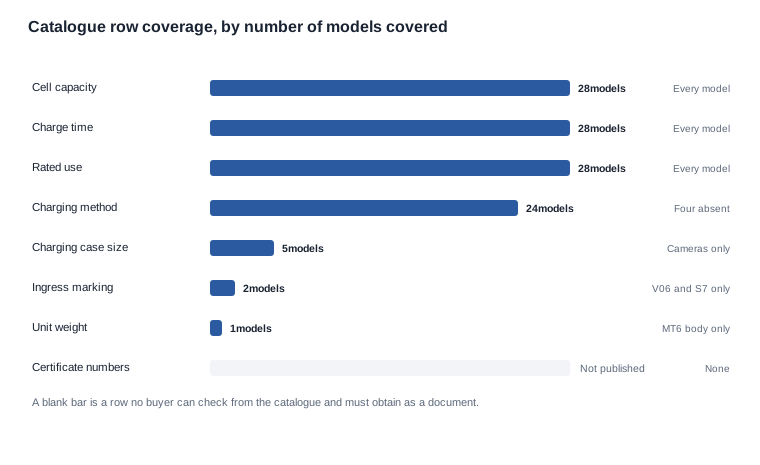
For a buyer comparing two suppliers, the same list is a screening tool. The rows in the catalogue that cover all twenty-eight models — cell capacity, charge time, rated use — are the rows that make a like-for-like comparison possible at all, and the rows that cover only a handful, such as the unit weight published for one model or the ingress marking published for two, are the rows where a supplier's claim and a buyer's expectation are most likely to diverge. The full coverage map is set out below.

The controls that closed it, and the two that were missing at the point of order
Three controls were added after the finding, and each of them is a document rather than an inspection.
A retained, signed pre-production proof attached to every run file. The approval step already existed; what was missing was the retention. A proof that is approved and then discarded is a proof that cannot be produced when a customer disputes a registration, and the buyer in this scenario had no way to show the supplier which revision was in the box.
An acceptance criterion on print registration, with a method rather than a limit. The criterion was written as a comparison against the approved proof, at a stated viewing distance and under a stated light, because "registration acceptable" without a method is an argument waiting to happen. This is the same discipline the hardware rows get and the artwork row did not.
A component and artwork list with written sign-off required before any substitution. This one was added because the investigation had searched for a substitution rule and found that no such rule existed. The rule was not a supplier failure; it simply had never been requested, which is a buyer-side gap rather than a supplier-side one.
Two controls that would have closed the case faster, and that were missing at the point of order, are worth naming because they are cheap and they are generic. The first is a retained inspection record from the first order, which would have turned a four-month investigation into a four-week one by bounding the problem in time. The second is an artwork revision number in the purchase order, which would have made the reprint visible in the order history instead of invisible in a print supplier's inbox.
Two process changes followed the finding, and they are the part of the case a buyer can actually carry forward. Returns were classified by the customer's own sentence for the following three months, which changed the category within the first month and would have changed it in week one here. And the run file was restructured so that the artwork proof, the acceptance criteria and the component list are held together as one object rather than as three objects in three places, because the failure mode of this case was precisely that each of the three existed and none of them could be found.
The commercial position the finding created
A finding is only worth the effort of making it if it changes a commercial position, and in this case it changed three.
The first was the disposition of the affected stock. Units in the affected colourway could not be sold into the market in question, because the carton carried a registration the buyer's own acceptance criteria did not permit, and the affected units were not electrically defective in any way. That made them a rework question rather than a scrap question, and the difference between a rework and a scrap in a three-hundred-unit colourway is a meaningful number on a channel's margin model. It was also a market-access question for any unit already in the channel's own network, which is a harder problem than the return itself.
The second was the supplier conversation. The buyer did not have a defect to claim, because the hardware was within specification. What it had was a control failure with a documented cost, and the request it made was correspondingly narrow: the retained artwork proof for the affected revision, the approval record for it, and a written statement of which colourways were affected in which production window. All three were records the supplier held. The request took a day to satisfy and settled the question in a week.
The third was the order. The artwork revision number went into the purchase order as a line, the acceptance criterion on registration went into the specification annex, and the retained proof became a delivery document. The next reorder was checked against the previous proof before the goods left the factory, which is a step that costs nothing and that would have caught the original drift at the first reorder rather than the fourth.
That is the transferable outcome of the case: the three controls that closed it were all documents, and the two that would have closed it sooner were also documents. Nothing in the resolution required a factory visit, a laboratory, or an inspection regime.

The transferable shape of a records failure, and what Cynrin will do about it
The shape of this case is the shape of most consistency failures in this category, and it is worth stating plainly because it redirects the buyer's effort. The specification covers the hardware, and the drift happens in the packaging, the accessories and the firmware — the three things in the chain that are specified by people who are not writing a test plan.
That pattern is not a complaint about factories. It is a consequence of how the work is divided. Hardware is specified by engineers, and engineers write things down. Artwork, inserts and accessories are specified by commercial staff working to a deadline, and their approval is usually a signature on a proof that goes into a supplier's system. The buyer who knows this can point the questions at the right place: ask for the retained artwork proof, ask for the accessory list inside the acceptance criteria, ask for the firmware build record. Those three requests cost an afternoon and cover the part of the chain where the drift actually lives.
What we will do is retain production samples, agree acceptance criteria with methods before the production run, keep a signed artwork proof with the run file, and tell a buyer in writing when a component or an artwork version changes. What we will not do is publish a defect rate, a consistency figure or a component-vendor list, because none of them appears in our source material, and a number without a denominator and an inspection method is a marketing figure rather than a measurement. We will also say which published rows the buyer can verify themselves and which ones have to come from the supplier's own file, because the boundary between those two is where a buyer's due diligence usually stops early.
The related material in this section is at the quality consistency section, and the same reasoning applied to a component substitution rather than an artwork drift is at the worked example. The questions that would have shortened this investigation are at what to ask before ordering, and the same five drift points set out as a comparison are at the comparison table.
The action to take now. Send us the models, the colourways, the case options and the production windows you are dealing with, and we will tell you which of the three drift points — hardware, packaging or firmware — your configuration leaves unprotected, and which record closes it. A buyer who can name the gap before the reorder has a procurement problem; a buyer who finds it afterwards has a returns problem.
Related reading
- A substitution found six months later — quality consistency worked example
- The seven questions that shorten this investigation — what to ask before ordering
- The five drift points as a comparison — smart glasses quality consistency comparison table


