

Smart glasses quality consistency is not the same thing as a good sample, and the difference is where most of the cost sits. A supplier can show you a perfect unit and still deliver a run that does not match it, because a sample is drawn from one point in one process while a run is produced across an entire production window. Before you order, the questions worth asking are the ones that turn "the sample was fine" into a written standard that a production run can be measured against and a claim can be settled against. There are six of them, and the first is the one that changes how you read every other answer you receive.
Smart glasses quality consistency: a property of the run, not the sample
The buyer reading this, and the risk they are actually managing
The reader is a brand-side buyer, a channel buyer or an importer who has approved a sample and is now deciding whether to release a production order. What they are managing is not the sample. It is the spread — the distance between the unit they approved and the units that arrive.
That spread is what reaches the customer. A single non-conforming unit in a batch of a few thousand is a returns conversation. A run where ten percent of the units share one defect is a channel conversation, a review score conversation, and a conversation with the supplier about the next run. The commercial difference between those two outcomes is much larger than the cost of the defective units, which is why the quality discussion is worth having properly before the order rather than after the shipment.
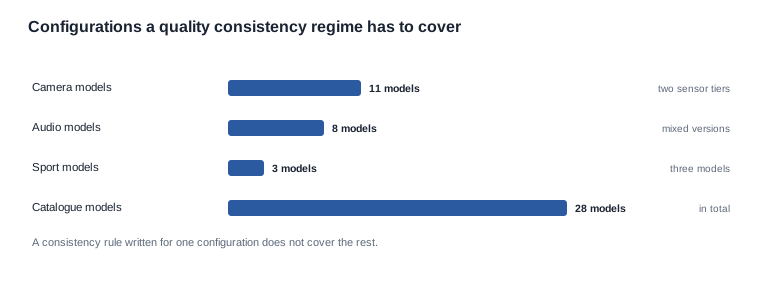
The thing that makes this category unusual is the number of configurations a quality regime has to cover. The catalogue runs to twenty-eight models: eleven camera models, eight audio models and three sport models. The camera models alone split into two published sensor tiers, eight megapixels across eight models and thirteen megapixels across three. A consistency rule written for one configuration does not automatically cover the others, and a supplier who says "our quality is consistent" has told you nothing until you know which configuration and which stage they mean.
Consistency and conformity are two different requirements
A run can be perfectly consistent and entirely wrong. If every unit in a batch carries the same incorrect firmware version, or every unit has the same misaligned camera housing, the run is the most consistent thing in the building. Consistency means the units resemble each other. Conformity means they resemble the specification.
The two requirements are supplied by different mechanisms. Conformity comes from a written specification and an inspection against it. Consistency comes from a controlled process — same materials, same settings, same procedure, same people — and it is a property of the production run rather than of any individual unit.
This distinction has a practical consequence for what you ask. "Do you check every unit?" is a conformity question, and it may be answered yes without anyone having thought about consistency at all. "How do you know the units in this batch resemble each other?" is the consistency question, and it is a different question with a different answer, usually involving incoming material controls, setup controls and a sampling plan rather than a per-unit test.
The three stages where consistency is actually won
Consistency is determined well before the final inspection. It is won or lost in three places, and a buyer who only negotiates the third place is negotiating the most expensive one.
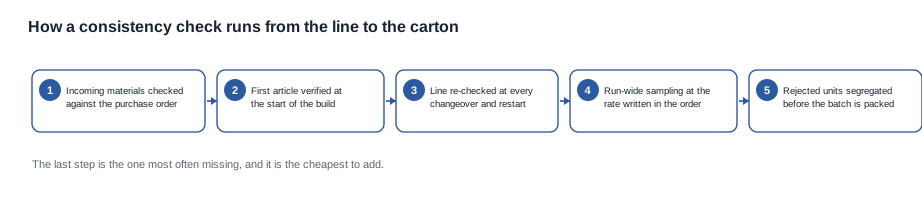
Incoming materials. If the cells in a batch come from two lots with different characteristics, or the camera modules come from two sources, then the units built from them are different units. No inspection at the end of the line makes them consistent. This is why a question about incoming material control is a better consistency question than a question about final inspection.
Process settings. The assembly line runs a configuration for a period. Within that run, settings drift unless somebody holds them. A first-article check at the start of the run establishes the reference, and a re-check at every changeover or restart is what makes the reference valid across the whole run rather than at its start.
Segregation of rejects. This is the cheapest and the most frequently missing. If non-conforming units are set aside as they are found, the batch that ships is the batch that passed. If they go back into the carton, the batch contains whatever the line produced, and the inspection result describes the sample rather than the shipment.
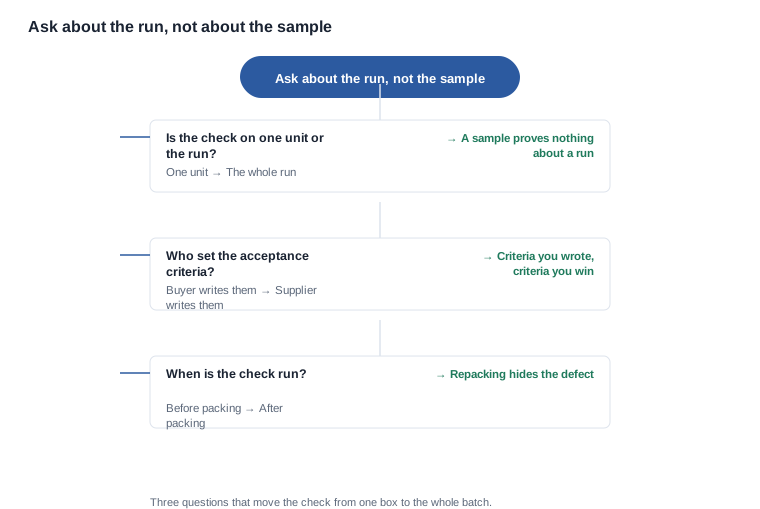

What consistency means at each stage between the line and the carton
At incoming: the same lot, the same part number
The consistency question at incoming inspection is whether the parts arriving for your order are the same parts that were used to build the sample. This sounds obvious and is frequently not true, because a sample is often built from stock on hand while a production order is filled from a new purchase.
The specific questions that resolve it are narrow. Ask what part number or supplier the camera module for your configuration comes from and whether a second source exists. Ask whether the cell for your configuration is allocated to your order or drawn from general stock. Ask what happens to the production date if the part changes — specifically, whether the change triggers a re-inspection and whether it triggers a re-approval of the sample.
That last question matters more than it appears. A second source is a normal and legitimate supply decision, but it is a change to the bill of materials, and the sample the buyer approved was built against the first one.
At process start: the first article, and what it is compared against
The first-article check compares the first units off the line against the approved sample. For that comparison to mean anything, three things have to be held in common: the configuration, the firmware build, and the test method.
The firmware build is the one that gets forgotten. A sample may have been produced with an earlier firmware build than the one the production run will use, because firmware is developed continuously and the production order is placed later. The buyer has then approved a unit whose software is not the software that will ship, and the software is not visible in a physical comparison at all.
The test method is the second. A check that is performed differently at the sample stage and at the production stage does not establish consistency; it establishes two unrelated observations. Ask for the test method in writing — what is measured, how, how many units, and what result is recorded.
At changeover: the point where consistency is usually lost
A changeover is where the line stops producing one configuration and starts producing another: a material change, a shift change, a maintenance stop, a restart after a breakdown, a re-run of the same configuration after a fault.
Every one of those is a discontinuity in the process, and every one of them is a point at which the units produced before it and the units produced after it may differ. This is why a re-check at each changeover is the single most valuable consistency control in the whole scheme, and it is cheap — it is one unit and one procedure.
Ask how changeovers are logged. A log with times and results is evidence; a supplier who says they re-check after changeovers without one is describing an intention.
At final inspection: what the sampling rate actually tells you
Sampling is the normal method of final inspection because inspecting every unit of a multi-thousand-unit batch is not economically sensible. But a sampling plan is a statistical claim, and it should be stated in the terms that make it one: the sample size, the acceptance number, the defect classes covered, and what happens when the acceptance number is exceeded.
The defect classes are the part buyers omit. A sample of twenty units that checks the housing, the buttons, the charging contacts and the accessory box is a very different document from a sample of twenty units that checks the housing only. Both are "a twenty-unit sample".
The other two omissions are more consequential. A sampling plan that does not say what happens on failure is not a plan, because it leaves the disposition of the batch undefined at the moment the plan matters. And a plan that is silent about the shipment date is treating the result as a formality: a batch that fails is only useful if the buyer has time to act on it.
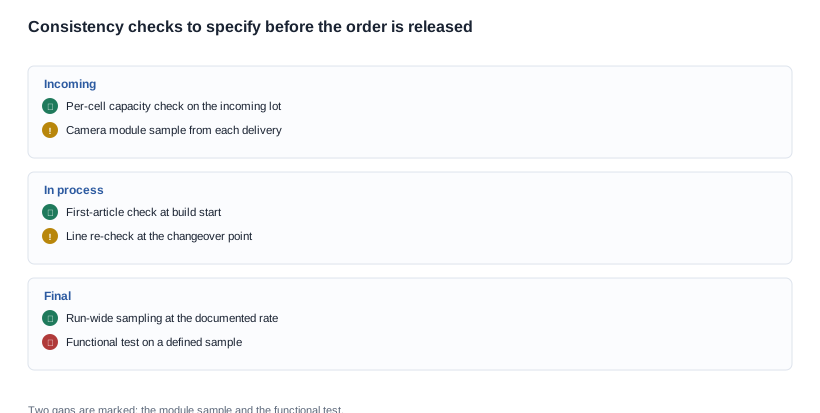
The acceptance criteria that make consistency measurable instead of arguable
An acceptance criterion that cannot be measured cannot be enforced, and an acceptance criterion that is not written down cannot be quoted in a claim. The table below is the set of criteria worth having in writing before the order, expressed so that each one has a method attached to it.
| Criterion | How it is measured | The line it has to meet | How an inflated result shows up |
|---|---|---|---|
| Configuration identity | Model designation on the unit against the purchase order | The designation on the unit matches the order | A unit from a sibling model with a similar name |
| Battery behaviour | Runtime under a stated test condition | Meets the published runtime for that model | A figure quoted without the test condition behind it |
| Charge method | The charging interface fitted to the unit | Matches the published method for that model | A model where the method is unpublished treated as if it were known |
| Accessory contents | The box contents counted against the specification | The box contains what the order specifies | A case or charger present that was never quoted |
| Firmware build | The build identifier read from the device | The identifier on the device matches the order | A build identifier nobody wrote down in advance |
| Label and marking | The markings on the unit against the documentation | The unit carries the markings the destination market expects | A mark applied to the carton but not to the unit inside it |
| Cosmetic limits | The stated surface and fit criteria against the specification | Meets the stated criteria | A limit written after the units were made |
The runtime row, and why the published figure needs its test condition
The catalogue publishes a runtime for every model, and those figures are the benchmark a buyer will naturally use. They need one condition attached before they can be used as an acceptance criterion, because the published runtime does not state the state of charge the measurement started from, nor the criterion that ends the measurement.
That gap is visible in the way the figures themselves are expressed. Some camera models publish a range — the V06 and the V03, and the S7 and the V03 Pro publish five to eight hours, and the KY06 and the MT5 publish six to eight hours — while the CY05, the MT6 and the L2 Utral, and the L1 Pro, and the CY03 publish a single figure of about seven hours. A range and a point figure come from different measurement practices, and the honest way to use them is to require the test condition alongside the number rather than to treat the range as a soft version of the point.
There is a second, smaller trap in the same area, and it is worth knowing about because it catches people reading a catalogue quickly. The catalogue labels runtime with more than one wording across its pages, and on at least one camera model the runtime row carries the label normally used for charge time. That is not a catalogue error so much as a reminder that a label is not a definition: a buyer comparing two models on runtime should confirm that both rows are measuring the same thing, rather than assuming that a shared label means a shared method.
The label and marking row, and why it is a quality item
Markings on the unit are not a cosmetic detail. In a market with radio-equipment requirements, the identification on the device has to correspond to the documentation that covers it, and the relevant framework for radio equipment is the Radio Equipment Directive (EU) 2014/53/EU. A unit whose label does not match the file that is supposed to cover it is a documentable non-conformity, and it is invisible to anyone who does not know to look for it.
This is also the point where the catalogue's silence becomes useful to a buyer rather than awkward. The catalogue publishes no per-model certification row for any of the twenty-eight models, and its text contains no CE, FCC or RoHS marking. A buyer therefore cannot check this criterion against the catalogue — it has to be requested as written material for the specific model designation. That is a reason to ask, not a reason to accept the risk.

Auditing consistency before the first bulk shipment moves
Verification in this category is a paper exercise with a physical check at the end, and it works best when it happens before the production run rather than at the end of it. Each step below has a completion test: a document with a date, a number or a named owner.
- Get the acceptance criteria in writing, in your own words. Not a reference to the supplier's standard, which is written to be satisfied. The criteria set out above, with the method and the limit for each line, attached to the purchase order.
- Get the sampling plan before the run, not after it. Sample size, acceptance number, defect classes, the disposition rule on failure, and how long the result takes to reach you. If the result arrives after the goods have left, the plan is decorative.
- Get the first-article check arranged as something you can witness. A photograph of a first article is evidence; a first article your own inspector holds is better. This is a normal request and it is the cheapest point in the whole scheme at which to catch a wrong configuration.
- Get the changeover log format. What is logged, when, and who signs it. This is what makes the consistency claim auditable rather than plausible.
- Get the incoming material position for the production lot specifically. Whether the cell and the camera module for this order are the same lots used in the sample, and what changes if they are not.
- Ask for the reject disposition procedure in writing. Where rejected units go, how they are marked, and who authorises their return to the line. This is the step that determines whether the shipped batch is the batch that passed.
The value of running all six before the production run is that they convert consistency from a claim into a record. A buyer who has the six documents can reconstruct what happened to the batch after the fact; a buyer who has a verbal assurance cannot. The consistency checklist is the same six steps in a form that can be sent to a supplier, and the quality consistency section holds the reference structure.
Where a consistent-looking run still fails in the channel
The batch that is consistent but built to the wrong configuration
What happens. Every unit in the batch carries the same accessory or the same marking that was never ordered. The run is internally consistent, the inspection passes against the criteria that were written, and the goods are wrong.
Why it happens. The criteria were written after the configuration was settled rather than before, or the configuration changed and the criteria did not change with it. A change to the bill of materials is a change to the acceptance criteria.
How it is avoided. Tie the criteria to the configuration explicitly, and make any change to the bill of materials a written re-issue of the criteria and a re-approval of the sample. The consistency mistakes article covers this and the patterns that sit next to it.
The accessory that is present in some cartons
What happens. The box is right on the sample and wrong in the run, because the accessory is packed by a different instruction. Some cartons have the case and some do not.
Why it happens. The accessory position in this catalogue is genuinely ambiguous in the specification for some models. Our catalogue publishes a charging-case capacity for five camera models, publishes a case without a capacity for two more, and publishes no charging-case row at all for four — the S7 and the V03 Pro, and the V03 and the V06. A packing instruction that says "with case" against a model whose catalogue row is silent is an instruction with no referent.
How it is avoided. Name the accessory position per model in the purchase order, and add a carton-content check at the sampling stage rather than trusting the packing instruction.
The unit that is heavier than the one approved
What happens. The sample is right and the run is heavier, and the reason is a component change rather than a defect. The buyer discovers it through a freight invoice or a packaging complaint.
Why it happens. Weight is the attribute buyers most often assume is fixed, because almost every other published attribute is. In our catalogue the only published model weight anywhere is the MT6 at 158 grams for the glasses body, which covers the battery and the camera and excludes the folding charging case; the weight of that case is not published. Everything else in the catalogue has no published weight at all.
How it is avoided. Ask for the weight against the production configuration rather than carrying a figure over from a sample or from another model, and treat an unexpected weight change as a component change to be declared rather than as a measurement to be explained away.
The firmware that is two builds behind
What happens. The units are physically consistent and functionally behind the version the buyer approved, and the gap shows up as support contacts rather than as a returns crisis.
Why it happens. The sample was built weeks before the production order, and firmware development did not pause in between.
How it is avoided. Write the build identifier into the purchase order, and make it an acceptance criterion rather than an assumption. Then ask what the roll-forward policy is: whether the production run uses the sample's build or the current one, and who confirms the decision.
The documentation that describes a different model
What happens. The goods are correct and the paperwork is not, so the shipment is stopped or the declaration is challenged at destination.
Why it happens. The documentation was written for the sample and the order changed afterwards, or the model designation on the paperwork is a sibling rather than the ordered configuration.
How it is avoided. Check the model designation on every document against the designation on the purchase order and on the unit, at the point where the document is issued rather than at the dock. This is a small check with a large schedule consequence, and it is why a buyer should treat a documentation change as a configuration change.
What we publish about quality, and what we commit per order
We do not publish defect rates, yield figures or acceptance numbers for our models, and we are not going to quote a typical figure that you cannot verify against an order. A defect rate without a configuration, a quantity and a period is not a fact about our production; it is a rounded question. Stating one would look more confident and be less useful than saying what we can actually commit to.
What we do publish is the specification that a consistent run has to match, and that specification is unusually complete in the electrical rows. Every one of the twenty-eight models publishes a battery capacity, a published runtime and a charge time, and twenty-four of them publish the charge method as well, with the charge method unlisted for the MT6 and the CY03, and the L1 Pro and the CY05. The camera resolution tier is published across the eleven camera models. The charging-case position is published for five camera models and their capacities with them, published as a case without a figure for two more, and left unpublished for four. The IP54 marking appears on the V06 and the S7 and nowhere else.
Against that specification we will commit, for a specific order and a specific configuration: the incoming material controls that will be applied to that order's lot, the first-article check and the changeover re-checks, the sampling plan with its acceptance number and defect classes, the reject disposition procedure, and the inspection report. We will also say plainly which attributes are not published for a given model — the weight on all but one model, the charging method on four, the case capacity on two, the case row on three — so that you know which acceptance criteria you have to set yourself and which ones we will set.
That is the honest division of labour in this category. The specification is public and the process is a commitment we make against an order, and the acceptance criteria are the document where the two meet.
Related reading
Send us the configuration, the quantity and the destination market and we will tell you which acceptance criteria we will write into the order.


