

This is a hypothetical case rather than a client project, and it is written as a reasoning exercise because the value of the example is in the order of the reasoning. No customer is described, no project is claimed, and no figures are presented as our own. The scenario, the model count and the market are assumed so that the steps can be followed and reused.
The case is worth reading because the cause was not a defective product, the fix was not a replacement batch, and every published row on the specification sheet was identical across both runs. Nothing a buyer would normally compare had changed. The programme still failed, and it failed for six months before anyone found it.

The single most useful thing in the case is the last finding, and it is the reason the case is set out in this order rather than as a story.
Smart glasses quality consistency: when a fixed spec sheet is not enough
The scenario, stated plainly
A channel brand placed a first order for two audio-glasses models, and placed a second order for the same two models six months later. The first order's returns were low and unremarkable. The second order's returns rose on one model and stayed flat on the other, and the stated reason on every ticket was the same: the unit will not reconnect after it has been out of the case for a day.
Nothing in the product specification had changed. The firmware version matched what had shipped. The packaging artwork was the same revision. The cell capacity, the charge time, the rated use, the Bluetooth version, the charging method and the case capacity were all identical on both runs, and identical to the published rows for those models.
The buyer's first instinct was a supplier quality failure, because a rising return rate on one model reads as a defect. It was not.
Why the first order was not the clue
The first order is the reason the problem survived so long, and it is worth understanding why it was not treated as a signal.
A first order is small, and a small order produces few units from which to draw a rate. More importantly, the returns data from the first order was low in absolute terms, so there was no baseline to compare against and no threshold to cross. The programme therefore had no idea that a rate had changed, only that the second order felt worse. A programme that had recorded a per-batch return rate from the start would have seen the change in week one of the second run; a programme that tracked returns per quarter would have seen it late, and the quarterly figure would have been diluted by the healthy model in the same period.
This is the first transferable point and it is about measurement design rather than about suppliers: a rate you did not measure cannot alert you, and a rate measured against the wrong denominator arrives too late to be useful.
What the first investigation assumed, and why it was stuck
The first line of inquiry was the obvious one: the returns were on one model, so the investigation focused on that model. The team pulled units of the affected model, tested them in the lab, and found nothing. The symptoms did not reproduce on the bench.
That is a genuinely awkward place to be, and the wrong response is to conclude that the returns are a customer-handling problem. The correct response is to notice what was not tested. The symptom was a reconnection failure after a day out of the case, on one model, but the cause was not necessarily on that model. The two models in the programme shared a supply chain, a component list and a factory, and a cause on the shared side would present on one model and not the other.
The team's error was not the focus on the affected model. It was the absence of a comparison against the healthy model, and the absence of a comparison against the earlier run.

What comparing the two runs found
The breakthrough was not a better test. It was a better comparison.
Compare the runs, not the models
Two units were pulled from each run's stock — finished goods from the earlier build, not fresh production — and tested the same way. Two of the four units from the second run reproduced the symptom within a day. None from the first run did.
The significance is in the selection method. A factory will show you a line running for your configuration, and a line running today is a demonstration of the current state rather than evidence about the earlier build. Finished goods pulled from a previous run are evidence, because they are the units that actually went to customers.
The specification had not changed; the supply had
The comparison of the two runs then went to the component list. The cell supplier had been substituted between the runs, at the same nominal capacity.
Everything visible to a buyer had stayed still. The cell capacity figure was the same number before and after, because the substitute was selected to match the published capacity. The charge time, the rated use, the charging method and the case capacity were unchanged. Every row a buyer would normally check against the catalogue still read correctly, and the goods still passed a receiving inspection against the published specification.
That is the mechanism worth naming precisely: a substitution made at the same nominal value is invisible to any check built on published rows, because published rows describe the value, and the value did not change. Only the part number behind the value changed, and the part number is not a published row.
The behaviour that changed
Whatever the substitute cell changed in the power path, it changed it in a way that affected reconnection after a deep discharge. Two units from the first run and two from the second, same published rows, different behaviour on the same test.
We do not hold a measurement for that behaviour, and we will not present an industry figure for it. What the case establishes is the shape of the failure: a behavioural difference that no published row can express, discovered only by running the same method against units from two different builds.
The two tests that had already been run, and what they excluded
Before the run comparison, the team had tested extensively, and it is worth being precise about what those tests excluded, because the exclusion is what made the case look impossible for six weeks.
The lab test charged the unit and worked it immediately, and it passed. That excluded a fault that appears on a unit charged and used straight away, which is a real and valuable exclusion. It did not exclude a fault that appears only after the unit has been idle, and it did not exclude a fault that appears only in units from a particular build.
The second test was a single-unit check on the affected model, taken from current production, and it also passed. That excluded a fault in the current build of that model as sampled. It did not exclude a fault specific to the earlier run, because there was no earlier run to test against — which is the point the retained unit control addresses.
Neither test was wrong, and neither was a waste of time. The mistake was treating two exclusions as a general exoneration. A test that passes rules out the conditions it exercised and nothing else, and the discipline of writing down which conditions a test exercised is the same discipline that the acceptance criteria sheet later applied to the reconnection check. The programme had a method for its bench tests and did not have one for its acceptance criteria, which is why the bench tests were precise and the acceptance criteria were satisfiable by anything that worked.
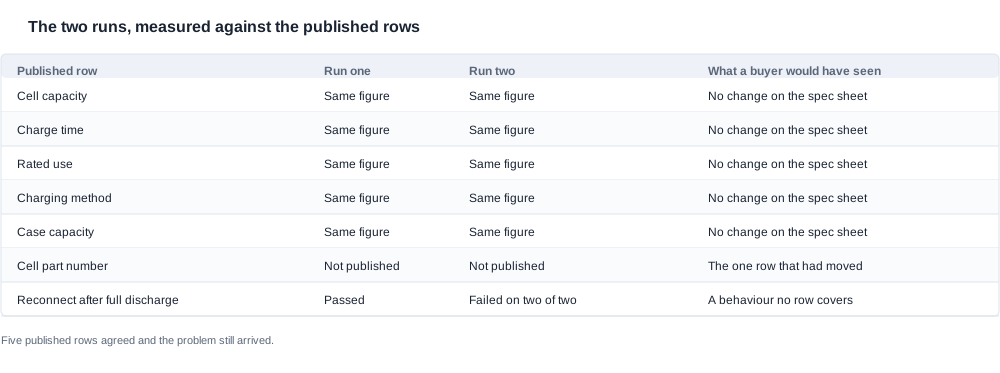
The table above is the heart of the case. Five published rows agreed across both runs, and the problem arrived anyway. The sixth row — the cell part number — is the one that had moved, and it is a row the catalogue does not publish.
Why the supplier did not dispute it
The supplier did not dispute the finding once the two batches were on the table, and it is worth saying why, because it is the difference between a quality failure and a control failure.
The supplier had not hidden the substitution. Nothing in the material was false. What was missing was a mechanism: nobody had asked the supplier to obtain approval before changing a critical component, so the change had been made as a normal purchasing decision, and nobody had been in a position to notice that it mattered. The absence was not dishonesty. It was a control that had never been written down, on both sides.
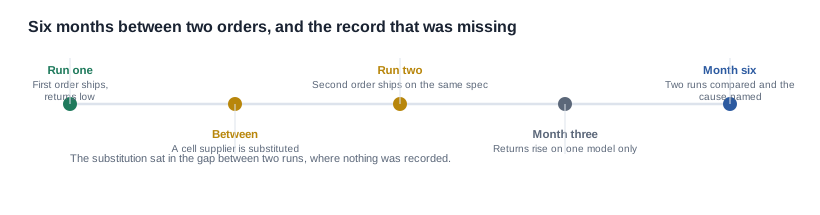
The timeline shows where the six months went. The substitution happened in the gap between two runs, in a period when no record was being written because no run was in progress. By the time the symptom appeared, the evidence needed to attribute it was three months old and had to be reconstructed from stock.

The three controls that closed it
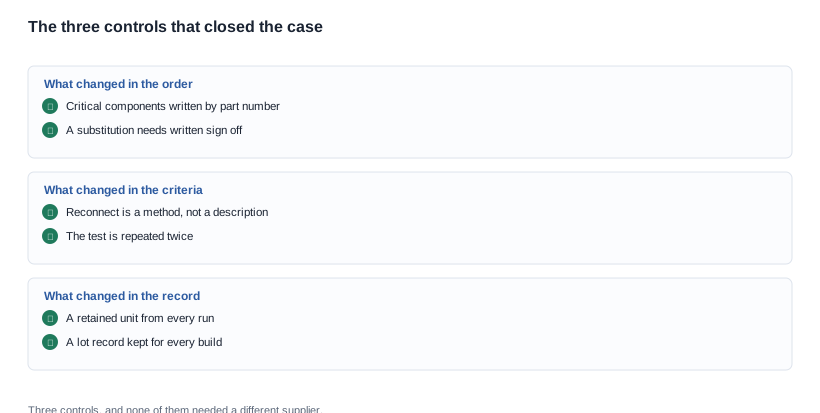
Three things changed, in this order, and none of them required a different supplier.
A component list attached to the purchase order
The critical components — the cell among them — were written by part number on the purchase order, with a rule that any substitution requires written sign-off before it is used. The rule is the part that matters. A component list without an approval rule is a description; with one, a substitution becomes a conversation the buyer is part of.
This is the cheapest of the three controls and the one that would have prevented the entire failure. It costs a line in the purchase order and a signature.
An acceptance criteria sheet with a method, not a description
The reconnection check was written as a method — connect, disconnect, reconnect, twice — rather than as a description of a working product. Every criterion in the second order had been satisfied on paper, and none of them would have caught this, because "the unit reconnects" is satisfied by a unit that reconnects on the bench immediately after a full charge.
The method added the two things a description cannot carry: the condition that triggers the failure, which is a full discharge, and a repetition count, which distinguishes a behaviour from a coincidence. The number of units tested is small, but the number of attempts per unit is what makes the result repeatable.
A retained unit from every run
A unit from each production run is kept and labelled with the run it came from, so that a future comparison has something to compare against. This is the control that would have shortened the investigation from six months to six weeks, because the first run's units would have been available to test against the second run's rather than being discovered as unavailable.
Retaining one unit per run is a cost of one unit per run. It is the least expensive control in the set and the one most often left out.
What the three controls cost, and why they were accepted
The useful thing about this set is that all three were cheap, because the resistance a buyer meets when adding controls is almost never about money. It is about effort, and about the belief that a control which has never caught anything is not worth the paperwork.
The component list costs a line in the purchase order and a signature on any substitution. The acceptance criteria sheet costs one drafting session before the first production run, and it removes argument later. The retained unit costs one unit per run. In total, the three controls are less expensive than one return shipment, and the argument for them was not made on quality grounds — it was made on the grounds that the programme had just spent six months and a credit note learning a lesson that three small controls would have carried.
The reason they were accepted is also the reason they are worth recommending. Each one attached to a moment the programme already had. The component list attached to the purchase order, the acceptance sheet to the first article, the retained unit to the end of the run. Controls that require a new meeting, a new system or a new habit get abandoned; controls that attach to an existing step get used.

What this case teaches that a specification cannot
Compare runs, not models
The symptom appeared on one model and the cause was on both. A buyer who investigated only the affected model would have found nothing, which is exactly what happened for the first six weeks.
The general form of this lesson is worth keeping: a symptom that appears on one item in a programme is a statement about that item, and the cause is frequently on the shared side. The first question to ask of any unexplained drift is what else the affected item shares with the healthy one.
Sample from stock, not from the line
A factory will show you a line running for your configuration, and a line running today tells you about today. Finished goods pulled from a previous run are the evidence, and they are also harder to arrange, which is part of why they are not requested often enough.
The practical request is small: two units from the previous run and two from the current, tested the same way. It is worth having the right to ask for it written into the agreement, because it depends on the supplier retaining stock from a run that has already been delivered.
Write the method, not the adjective
Every criterion in the second order was satisfied on paper, and none of them would have caught this. The reconnection check needed a method and a repetition count, and it needed the condition that produces the failure to be written into the instruction.
This is the general lesson of the case, and it applies to every characteristic a buyer specifies. A criterion that can be satisfied by describing a good product is not a criterion; it is a way of deferring the argument to a moment when the argument is more expensive.
The published rows are a floor, not a ceiling
Everything the catalogue publishes describes the value. It does not describe the part behind the value, and in a category where the same nominal figure appears on several products, the published row cannot tell you whether two units with the same number are the same product.
That is not a criticism of the catalogue, and it is worth being precise about it: a published specification set is an excellent narrowing tool and a poor closing tool. It tells you which models to consider and it tells you what a unit should look like when it arrives. It does not tell you whether the component inside the unit is the one the programme was designed around.
Building the comparison in before it is needed
The comparison that solved this case — two units from the previous run and two from the current one, tested the same way — is not an investigation technique. It is a routine, and the routine is worth setting up while nothing is wrong.
Three lines in the programme make it routine. Retain a unit from every run and label it with the run, the date and the configuration. Retain the units from a second run rather than shipping or scrapping them, so that a comparison is possible. And record the acceptance method once, so that the same method can be applied to units from different builds without it having to be rewritten under time pressure.
The commercial case for this is simple and does not depend on the case above being typical. A returns rate that cannot be attributed to a build is a cost that cannot be bounded, and a cost that cannot be bounded is a cost that eventually exceeds the margin on the programme. A programme that can attribute a fault to a run can stop it, credit the affected batch and continue shipping the rest. A programme that cannot will either credit everything or credit nothing, and both answers are worse than the one the data would have supported.
What the failure cost, in commercial terms
The cost of this case did not sit in the defective units, because there was no defect in the sense of a unit that should not have been built. It sat in the commercial terms that had to be renegotiated after the fact.
The first cost was the returns reserve. A programme that had budgeted a return rate on the basis of the first run had reserved a number that turned out to be wrong on one model, and the difference between the reserved rate and the actual rate was a direct margin reduction across the whole second order rather than a credit for the affected units.
The second cost was the rework of the purchase order and the acceptance criteria, which was not funded by the supplier because the supplier had not breached anything. Every hour spent rebuilding the documentation was a cost the buyer carried, and it arrived at the point in the programme when the schedule had no slack in it.
The third cost was the one nobody priced: the relationship. A supplier that disputes a finding is a commercial problem, and so is a supplier that is right six months later and has to absorb the credit and the apology. Neither party in this case had done anything wrong, and both had a worse programme afterwards.
The commercial lesson is that the cheapest point to buy certainty in this category is the agreement, and that the controls which produce that certainty cost a fraction of a returns reserve that is set by guesswork. The alternative — negotiating a defect rate after a fault has happened — is the most expensive way to establish a number, and it establishes a number for the wrong batch.
What we will and will not put in writing about it
We do not publish a defect rate or a consistency figure, because any number without a denominator and an inspection method is a marketing figure — all of those are Not published in our documentation. We will not publish a reconnection measurement for a cell we have not characterised, and we will not present the case above as a measurement of our own production, because it is a hypothetical reconstruction written to show the order of reasoning.
What we will do is the part of it that is a commitment rather than a statistic. We fix critical components by part number with a written approval rule. We agree acceptance criteria with methods before production starts, not after the first shipment. We retain a unit from each production run. And we tell a buyer when a component or a firmware version changes, in writing, before the change is used, so that the conversation happens while it is still cheap.
A substitution made without a conversation is the one failure mode this case produced, and it is the cheapest of all to prevent. It costs a line in the purchase order.
The quality consistency section covers the framework this case sits inside.
Related reading
- What to ask before ordering — the seven questions
- Consistency mistakes — where it goes wrong
- Factory audit case example — the same finding, different route
Send us the two runs and the component list, and we will tell you which published rows agree, which row moved, and what smart glasses quality consistency still has to be closed in writing.


