

A benchmark is a reference point a buyer uses to judge whether a number is reasonable. In smart glasses shipping that sounds easier than it is, because most of the reference points circulating in this category were built for a different kind of consignment. A freight index that tracks pallets of general cargo says nothing about a consignment of battery-equipped eyewear packed in retail cartons and moving under a consolidation window. What a buyer actually needs is a set of reference points built on the same basis as the quotation in front of them — same route, same incoterm, same shipment rule, same definition of cost — and a written way to establish that basis before any number is compared to anything.
The practical test is short. Take the benchmark, take the quotation, and ask whether both were produced under conditions that could produce the same answer twice. If you cannot answer that, the benchmark is decoration. It can be interesting in a meeting and it cannot carry a decision.
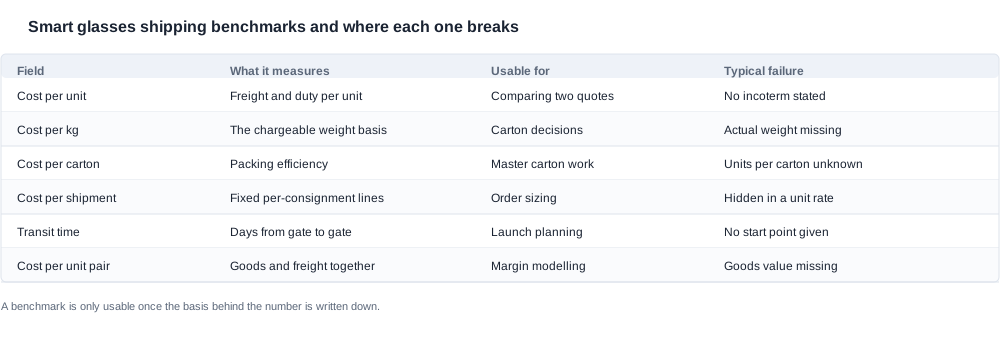
Smart glasses shipping: what a benchmark leaves open without a basis
Every usable benchmark in this category has the same structure, whether it comes from a forwarder, a colleague, a previous order or a published index. It names a scope, it names a route, it names a cost definition, and it carries a date. Remove any one of those four and the figure stops being transferable.
The four attributes below are the working set. The fourth column is the one most often skipped, and it is the one that decides whether the other three survive.
| Field | What it measures | Usable for | Typical failure |
|---|---|---|---|
| Cost per unit | Freight and duty per unit | Comparing two quotes | No incoterm stated |
| Cost per kg | The chargeable weight basis | Carton decisions | Actual weight missing |
| Cost per carton | Packing efficiency | Master carton work | Units per carton unknown |
| Cost per shipment | Fixed per-consignment lines | Order sizing | Hidden in a unit rate |
| Transit time | Days from gate to gate | Launch planning | No start point given |
| Cost per unit pair | Goods and freight together | Margin modelling | Goods value missing |
Two failure modes recur, and they are worth naming separately because they look similar in a spreadsheet and behave differently.
The first is a missing denominator. A figure quoted per kilogram is not a freight cost; it is a statement about the weight basis, and the weight basis for a boxed consumer product is normally the greater of actual and volumetric weight. Change the carton and the cost per kilogram changes even though the goods are identical. A buyer who compares two suppliers on cost per kilogram without seeing the packed carton dimensions is comparing packaging decisions and calling it freight.
The second is a missing scope boundary. A figure that covers goods, freight, duty and clearance is a landed cost. A figure that covers freight and documentation alone is a carriage cost. They are not variants of the same number, and the difference between them is frequently the whole of the difference between two competing quotations.
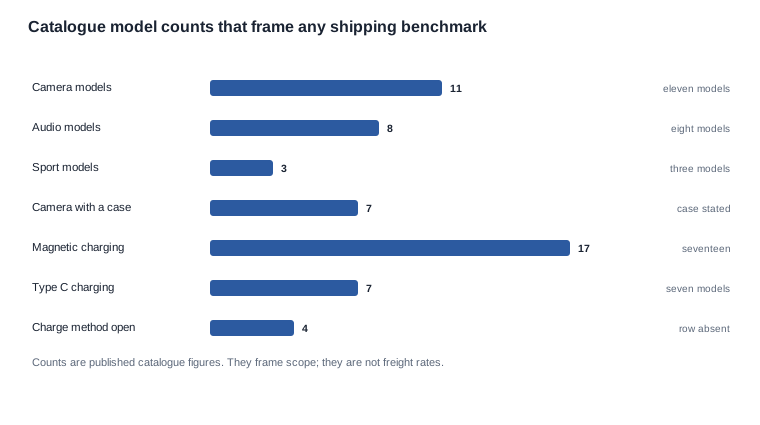
The catalogue figures above are worth a short note, because they show how much of a quotation in this category depends on which model is moving. The range in this catalogue runs from eleven camera models and eight audio models down to three sport models, and the packing consequences differ sharply between them. Seven of the eleven camera models are published with a charging case in some form, and the case capacity published across the range runs at 1400 mAh, 900 mAh and 1200 mAh. A case is a box inside a box, and it changes the carton, the chargeable weight and therefore the freight band. A benchmark assembled for a model without a case will not transfer to a model with one.
The same applies to the charging method. Seventeen models in the catalogue are published with magnetic charging and seven with a Type C port, and four camera models publish no charging method row at all. That last group is the one that matters for a benchmark discussion: the packing step for those models is not described in the published data, so any benchmark that assumes a charging dock or a fixed cable is an assumption rather than a reference.
The three benchmark sources and what each can carry
There are effectively three sources of reference information available to a buyer, and they are not interchangeable.
Your own shipment history is the strongest source and the slowest to build, because it only exists once you have shipped. Its weakness is that it describes one route, one carton and one shipment rule, so it is a benchmark for that exact shape of consignment and nothing wider. Used correctly, it is still the best source, because it is the only one whose conditions you know completely.
Matched forwarder quotations are the second strongest. Two quotations requested on the same specification, on the same day, for the same route and under the same incoterm are close to a controlled comparison. The weakness is that a quotation is an offer rather than a history, and it can be withdrawn, so it needs a validity date to survive as a reference.
Published indices and general cost guides are the weakest and are the ones most often presented as authoritative. A published index describes a population of shipments, and the population is not yours. A general guide is a rule of thumb written for a reader who was not thinking about a battery-equipped consumer product with a per-consignment documentation charge. Both can be useful for sanity-checking an order of magnitude. Neither can be used to reject a quotation.
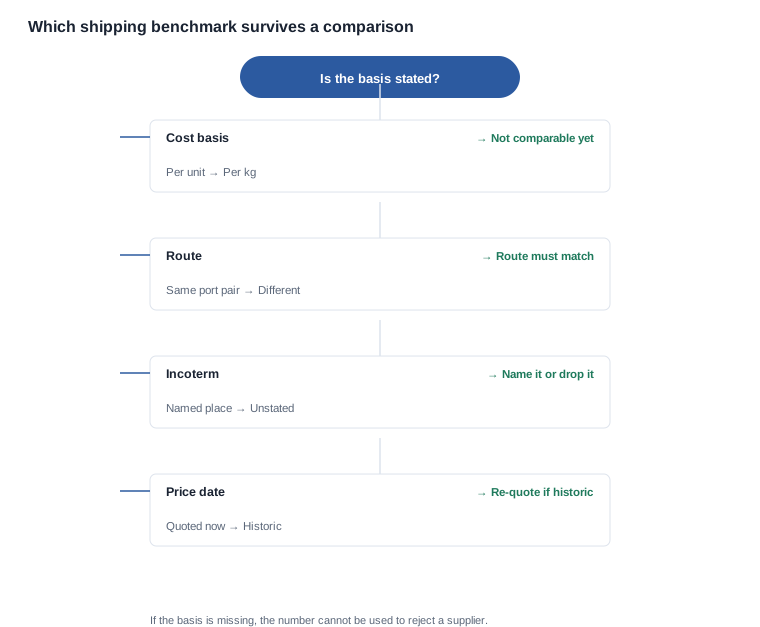
The decision path above is deliberately blunt. A benchmark that fails the basis test is not a weaker reference, it is not a reference at all, and it should be set aside rather than discounted.

Which reference points survive a like-for-like comparison
Before comparing anything, a buyer has to establish that the two sides of the comparison are the same kind of object. The checklist below is short, and every item has a completion test rather than a judgement call.
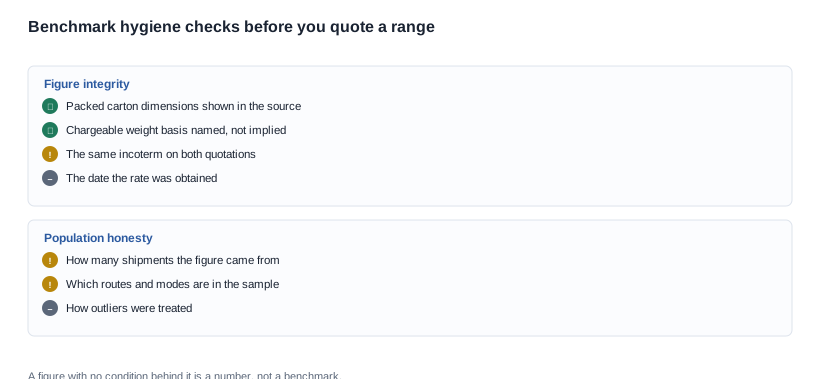
The first group is figure integrity. The packed carton dimensions have to be visible in the source, because without them the chargeable weight cannot be reconstructed and the freight band cannot be checked. The chargeable weight basis has to be named — actual, volumetric, or whichever rule the carrier applies to that lane — because a rate with an unnamed basis cannot be projected to a different carton. The same incoterm has to appear on both quotations, and this is the single most common reason two prices differ for no visible reason. And the date the rate was obtained has to be visible, because freight is one of the few inputs in this category that moves on a published schedule and is renegotiated constantly.
The second group is population honesty. This is the part that separates a real benchmark from a number somebody remembered. How many shipments the figure came from, which routes and modes are in the sample, and how the outliers were treated. A rate derived from one consignment that happened to move well is not a benchmark. A rate derived from a hundred consignments with a stated route mix is, and you should expect to be told what the number of shipments was.
When a supplier gives you a figure that fails these checks, the useful question is not whether the number is right. It is whether the number is the same kind of object as the one you are comparing it with. Often it is not, and the quotation was never out of line.
What a benchmark is allowed to be used for
There is a distinction worth being strict about, because it changes what you do with a weak source. A benchmark of poor quality is still good for one thing: establishing that a quotation is not absurd. If a forwarder quotes an air freight rate for a battery-equipped consignment and it sits within a factor of two of what similar shipments have cost, the quotation is plausible enough to proceed to a detailed comparison. It is not good enough to accept, and it is not good enough to reject.
A benchmark of good quality does one more job: it lets you set the terms of the comparison in advance. If you know before you open the quotations that the decisive variables are carton density, consolidation and destination charges, then you know which lines to interrogate first. That is worth more than the number itself, because it is the part that transfers between programmes even when the specific figures do not.
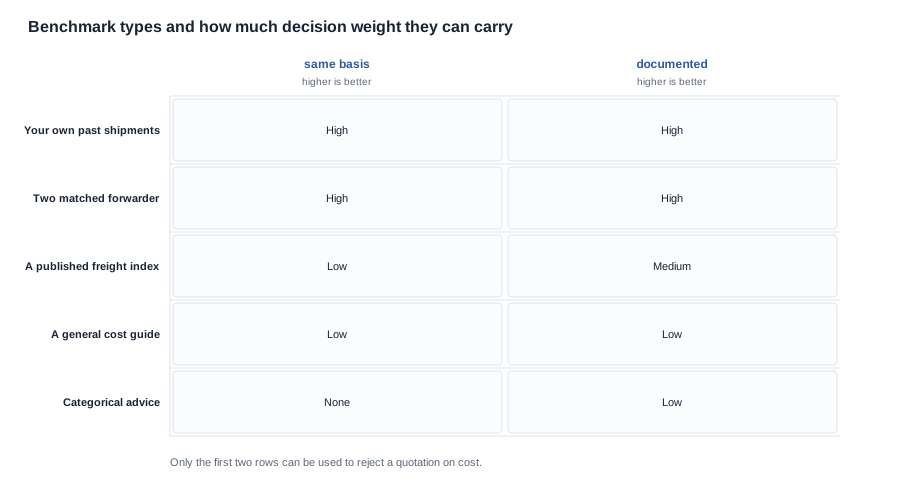
The matrix makes the ranking explicit. Only the first two rows — your own shipments and two matched forwarder quotations — can be used to reject a supplier on cost. The lower three rows can be used to set expectations, to structure an enquiry and to sanity-check an order of magnitude. Using them for anything stronger is how a buyer ends up negotiating against a benchmark that never had a relationship with the goods.
The question that makes a benchmark usable
If you only ask one question about a reference figure, ask this one: what would have to be true for this number to be reproduced?
The answer should be a list of conditions, not a narrative. Which carton, which quantity, which route, which term, which date, which shipment rule. A benchmark that can be restated as a list of conditions is a benchmark you can use, because you can test whether the quotation in front of you meets those conditions. A benchmark that cannot be restated that way is a story about somebody else's shipment.
This is also the fastest way to see whether a supplier is taking the question seriously. The list is short, and it can be written on one side of a page. If a supplier cannot produce the conditions behind their own reference figure, the conditions behind their quotation are unlikely to be any more precise.

How to build a baseline you can defend to a supplier
Most buyers in this category have no baseline at all, and the reason is usually that nobody owns it. The freight conversation arrives as part of a larger price conversation, and the larger conversation is the one with a deadline. The result is that a buyer compares quotations that differ in structure and attributes the difference to quality.
Building a baseline does not require a data project. It requires three numbers, recorded once per configuration, and stored where the next buyer will find them.
The first number is chargeable weight per unit, built from the packed carton dimensions and the gross weight rather than from the product weight. This is the input that decides the freight band, and it is the one the buyer can influence, because the carton is a specification decision rather than a product decision. The catalogue publishes the case capacities that make this possible in part: a 1400 mAh case, a 900 mAh case and a 1200 mAh foldable case are three different packed volumes for the same device, and the difference between them is larger than most buyers expect. The shipping weight and the chargeable basis article covers how that calculation is built.
The second number is the per-consignment line, expressed as a fixed amount and as a percentage of goods value at your planned order size. It is the line that makes a small order expensive per unit, and it is the reason that splitting an order to reduce unit price usually raises the landed cost of every unit in it. Because every model in this range ships with a lithium cell, the transport documentation component applies to every consignment without exception, which makes it one of the few per-consignment lines you can plan around with confidence.
The third number is destination charges as a percentage of goods value, on the specific incoterm you intend to use. This is the line that turns a carriage cost into a landed cost, and it is the line most often missing from a comparison, because it is the line that arrives after the decision has been made.
Record those three numbers against the configuration string, with a date, and the next quotation you receive becomes comparable to the last one. That is the whole mechanism, and it is why a baseline is worth more than a good guide.
When a baseline is not available
Sometimes there is no history, because the programme is new, or the model has changed, or the destination has changed. In that case the honest position is that you have no benchmark and must construct one before you compare anything.
A forwarder quotation is the fastest substitute. Request one on a written specification — configuration, quantity, cartons, route, incoterm, destination — and ask for the validity period. If the supplier or their forwarder will not release a quotation against a written specification, that is itself a finding, and it belongs in the comparison alongside the price.
The second substitute is a deliberately small trial consignment. It will not give you a benchmark, because one shipment is not a population, but it will give you the three numbers above on your own goods, your own carton and your own route, and it is cheaper to learn that on one consignment than on a full programme.
A third option is to accept that you have no benchmark for this configuration and say so in the comparison. This sounds like weakness and is not. A comparison that states "no prior shipments exist for this configuration, so the first shipment is a priced trial" is a comparison a reader can trust, and it is far more useful than a range assembled from other people’s numbers.
The discipline that keeps a baseline honest
A baseline decays. Rates are renegotiated, surcharge schedules change, carton designs get revised, and a route that was cheap last year may be carrying a new congestion charge. A baseline without a review interval is a number from a moment that has passed.
Set a review date alongside the baseline and mark it on the same record as the three numbers. When the review comes, the choice is to refresh the numbers or to retire the baseline. Leaving a stale baseline in place is worse than having none, because it will be used.

Where a benchmark quietly stops being comparable
There are four points in a shipping programme where comparability is lost, and in each of them the loss is silent — nothing breaks, no number looks wrong, and the comparison simply stops meaning what it appeared to mean.
When the configuration changes. A benchmark built for one model is not a benchmark for another, because the case status, the charging method and the carton are all model-dependent in this catalogue. Seven camera models are published with a case in some form, and four publish no charging case row at all — the V06 and the V03 Pro, and the V03 and the S7. Two of the remaining camera models, the KY06 and the MT5, are published with a case whose capacity is not stated. That is three different packing situations inside one product family, and a benchmark that survives none of those transitions is a benchmark for a model that no longer exists.
When the route changes. Every benchmark carries a route, whether or not it says so. A figure obtained on a lane with a short dwell time does not transfer to a lane where containers sit. Route is also where the biggest hidden differences live: an ocean route through a congested transhipment point and an ocean route with direct connectivity are not the same product, and the quotation for the second is frequently the one that looks competitive until the first vessel misses a connection.
When the shipment rule changes. A rate that assumes consolidation is a rate that depends on a calendar you do not control. It is a legitimate rate and it is a poor benchmark, because the condition under which it holds — a consolidation window, a particular packaging configuration, a particular forwarder — is rarely stated.
When the cost definition changes. The most expensive of the four, because it produces the largest apparent movement. A baseline that covered goods and freight and a new quotation that covers goods, freight, duty and clearance will show a jump that has nothing to do with the market.

The check that catches all four is short: list the four conditions — configuration, route, shipment rule, cost definition — against both the benchmark and the quotation, and mark any that differ. Where they differ, the difference is the explanation, and the explanation is usually available in writing.
A note on the numbers that are not published
There is one class of reference information a buyer in this category will look for and will not find in a published catalogue, and it is better to name that up front than to let a buyer spend a week looking for it.
Packed carton dimensions, gross packed weights, units per master carton and freight weights are not published, because they depend on the final retail packaging and the destination rather than on the device. The same applies to any freight rate, transit time or customs handling arrangement, which depend on the destination, the incoterm and the composition of the order. Per-model weight is published for one model only: the MT6 glasses body is published at 158 g, which includes its 265 mAh battery and the camera and excludes the foldable charging case, and the case weight is not published. For the other models, no weight is published at all, and we would rather say that than quote a typical figure that cannot be verified.
That absence is not a gap in a benchmark. It is the reason a benchmark has to be built from your own shipments, and it is a reasonable basis for treating any published "typical" figure in this category with caution.
What we publish, what stays open, and what to send us
The short answer: the catalogue is the part of the specification we can stand behind, and everything else is a question for a supplier’s own file or for a forwarder’s quotation. We publish the configurations, the interfaces, the case capacities, the endurance figures and the charging methods. We mark the rows that are open rather than filling them with a typical figure from a general data set, and in this article the open rows are named explicitly: the charging method for four camera models, the case capacity for two camera models, the charging case row for four camera models, and the packed weight for every model except one.
We do not publish a shipping benchmark, and we will not quote one. A benchmark assembled from our own shipments describes a route, a carton and a shipment rule that would not be yours, and quoting it would create the false impression that a transferable number exists. What we can do is tell you which parts of your shipping arrangement are settled by the published data, which are open, and which have to come from a forwarder, and then tell you what to ask for in each case.
The cost breakdown article sets out the six lines that a landed cost in this category usually contains. The logistics and shipping section covers the sequence those lines sit in, and the when to skip an optimisation article is about the point at which a shipping improvement is worth the effort and the point at which it is not. Where a battery consignment is involved, the battery transport guidance governs the document set that has to travel with the goods.
Related reading
- Shipping cost breakdown: the six lines
- When you can skip an optimisation
- Battery transport compliance
- Logistics and shipping
Send the configuration, the quantity and the destination market, and we will tell you which published rows are settled for that combination, which are open, and which questions to put to a forwarder before you compare a single number.


