

Smart glasses sourcing risk in this category is not a scattering of unrelated traps. It is one substitution made seven times — a cheap confirmation accepted in place of an expensive one — and what decides the cost is not how serious the mistake is but how long the buyer leaves before noticing it. A wrong belief that arrives with the first quotation and is corrected the same afternoon costs an afternoon. The same belief accepted at the repeat order costs a re-listing, a re-tool and a channel conversation, and by then nobody can establish what was actually agreed.
So the useful question is not "what can go wrong with a smart glasses order" but "how much time is left when it does". That is the window, and the seven mistakes below are described by where each one becomes visible and how wide the window still is at that point. Three of them surface while the window is still wide, three surface in a window that has narrowed to days, and two surface after it has shut — at which point the only instrument left is a claim rather than a control.
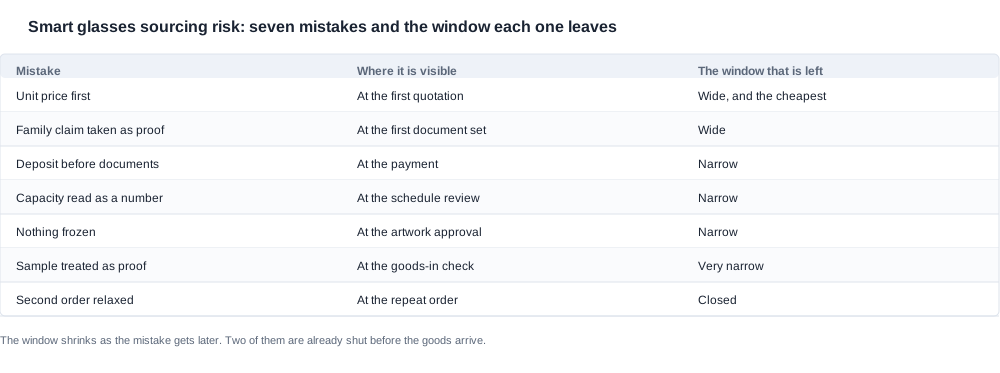
Read the third column of that table rather than the first. The name of a mistake tells you what a buyer gets wrong; the window tells you what it costs and whether it is still worth catching.
Smart glasses sourcing risk: seven mistakes and the window each one leaves
A window, used this way, is the interval between the moment a belief enters the programme and the moment the programme becomes expensive to correct. Its length is set by how many decisions still sit downstream of the belief, and its value to a buyer is that it can be measured before a single unit is ordered. A belief recorded at the enquiry stage has three or four decisions downstream of it — the requirement, the comparison, the order, the artwork — so it is still correctable by an email. The same belief recorded at the repeat order has no decisions downstream of it at all, because the programme has already been run once on that basis.
The catalogue this category is bought against makes the seven mistakes visible in a specific way, and it is worth stating what it publishes before using it as evidence. It covers twenty-eight entries. Eleven of them carry a camera. Eight are published as AI Bluetooth models, three as sport models, and the remainder are the two children's protection models, the A07 children's audio model, the AR entry, the AI electrochromic entry and the bone-conduction entry. Twenty of the twenty-eight carry an AI designation in the product name, which is exactly the kind of figure that gets quoted back as a category claim.
The electrical rows are published, and the way they are published is where the category's misreadings come from. Five separate entries publish 100 mAh and they are not the same product. The D11 and the D12 publish 100 mAh with a Type C connector and about seven hours of use; the ZH12 publishes 100 mAh with a Type C connector and about eight hours; the AR entry publishes 100 mAh with magnetic charging and about eight hours; the AI electrochromic entry publishes 100 mAh with magnetic charging and about seven hours. One number, two runtimes, two charging methods, four products. Seventy milliamp-hours appears twice as well, in incompatible forms: the A07 publishes a single 70 mAh cell, and the YKC02 publishes 70 mAh2. The 55 mAh2 band splits the same way, with the LC-105-1 and the LC-105-2 publishing about eight hours and the G07 and the YK12 publishing about six — and the two publishing six are the two publishing a slim or a detachable temple.
Alongside those rows there is a list of things nobody publishes: no bill of materials, no sensor model, no field of view, no video format, no frame rate, no microphone pickup distance, no ingress test report number, no certificate number, no issuing body and no validity date. The catalogue carries a company-level export certification page showing ten patent certificates, eight appearance-design patents and two utility-model patents, publishes no per-model certification row, and names no CE, FCC or RoHS in its text. A Bluetooth version appears on fourteen of the twenty-eight entries, V5.3 on the K01 and the K02 and V5.4 on the rest of the entries that carry it, and on none of the eleven camera models — which is a fact about catalogue coverage rather than about connectivity. Production capacity, lead times, minimum order quantities, unit prices, defect rates and warranty terms are published by nobody in this category.
A catalogue with that shape produces a predictable set of mistakes, because each mistake below is what happens when a missing row gets filled in with something cheaper than a document. What makes them tractable is that they are ordered in time. The quotation comes first, the documents second, the payment third, the schedule fourth, the artwork fifth, the goods sixth and the repeat order seventh — and the window shrinks as the sequence advances.
| Mistake | Where it becomes visible | The window that is left |
|---|---|---|
| Unit price first | At the first quotation | Wide, and the cheapest to correct |
| A family claim taken as proof | At the first document set | Wide |
| A deposit before the documents | At the payment | Narrow |
| A capacity figure read as a number | At the schedule review | Narrow |
| Nothing frozen | At the artwork approval | Narrow |
| The sample treated as proof | At the goods-in check | Very narrow |
| The second order relaxed | At the repeat order | Closed |
Two of the seven are already shut before the goods arrive, and one of those two is shut permanently. That is the reason to read the table as a schedule rather than as a list of warnings.
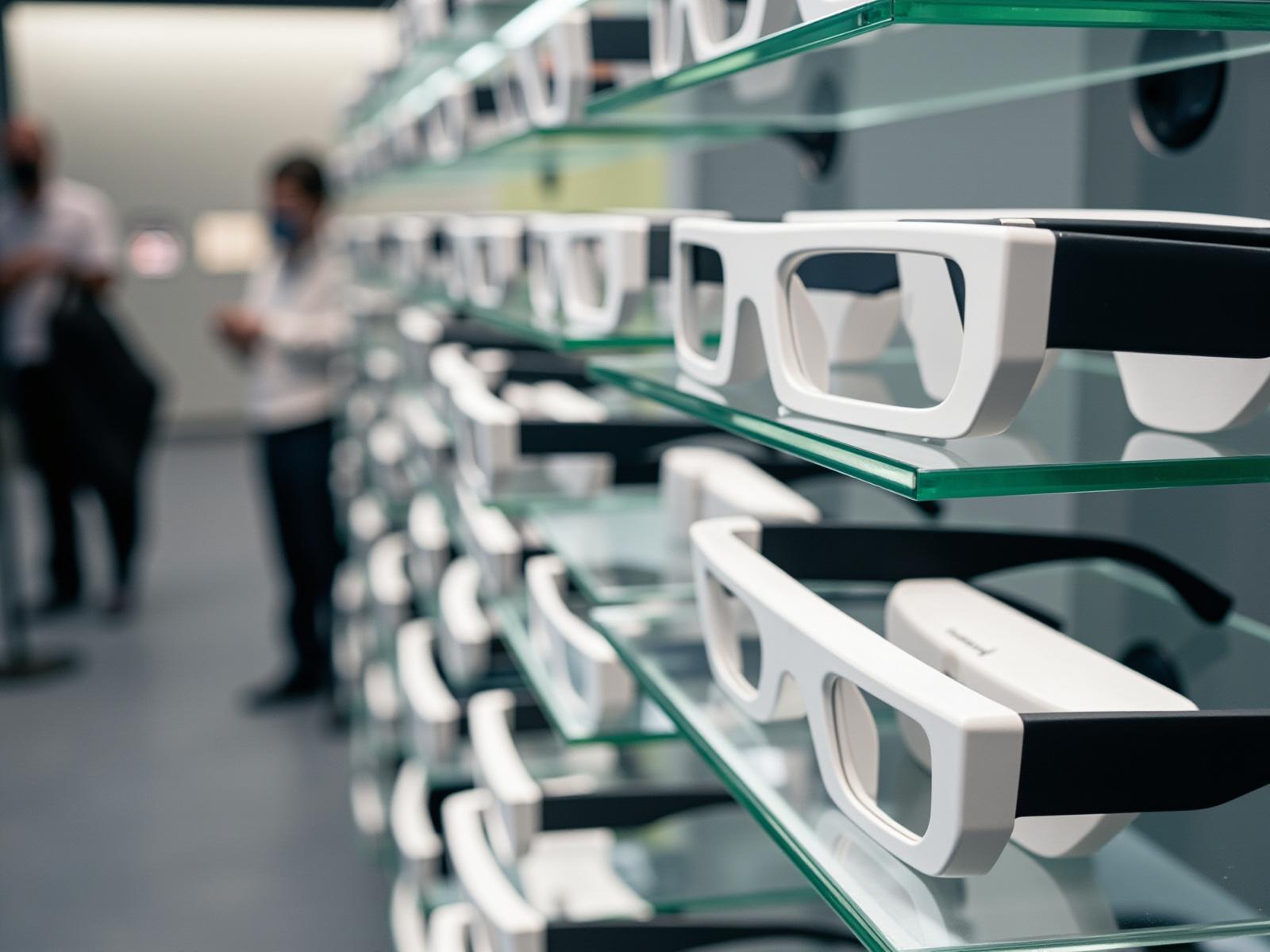
Enquiry, quotation and requirement: the three checkpoints where a mistake is still cheap
The programme has a structure and the structure is not negotiable: enquiry, quotation, requirement, sample, order placed, goods in. Three of those points sit inside a fully open window, the sample sits in a window that is closing, and everything after the order is a claim rather than a control. That single fact is the argument for doing the comparison work early — not because early work is more thorough, but because early work is the only work that is still reversible.
Mistake one: choosing on the unit price first. The unit price is the number a buyer sees, which is why the conversation starts there. The trouble is not that it is a bad number, it is that it is a number without a scope, and a scope-less number cannot be compared with anything. Two quotations that both describe "a 100 mAh smart glass" may be describing the D11 and the ZH12 — the same capacity, the same connector, and runtimes that differ by an hour — or the AR entry and the AI electrochromic entry, where the same capacity arrives with magnetic charging and the runtime order is reversed. The buyer who starts from the price is not comparing two products; the buyer is comparing two sentences.
The control is a comparison sheet with the same columns filled for every candidate, and the first column has to be the configuration, not the money. A price quoted without a named configuration should be treated as a rate card and returned unanswered, because a rate card will produce a price for whatever the supplier happens to build that week.
Mistake two: taking a family claim as proof. A supplier who says the products are certified, or that the glasses are AI glasses, or that they are waterproof, has described a catalogue rather than a product. The catalogue for this category carries an AI designation on twenty of twenty-eight entries and an ingress marking on two, the V06 and the S7. Both statements are true of the catalogue. Neither tells a buyer anything about the build on the quotation, and the distance between the two is where a programme loses money.
The correction is a demand for granularity: every document has to name the model designation being bought, the holder, an issue date and an expiry. A file that covers a product family was assembled; a file that names a model and carries a holder and a date has been maintained. Those two artefacts look identical in an email and behave completely differently when something has to be traced.
At the requirement checkpoint, the discipline is to write the requirement before the price rather than after it. A requirement written first is a reference that later questions can be measured against; a requirement written after the price is a description of what has already been decided, which is a document with no evidentiary value and considerable persuasive value.
Payment, schedule and artwork: three mistakes and a window narrowing to days
Everything from here to the end of this article is a different kind of problem. The window is still open, but it is measured in days, and the instrument available inside it changes. Before the order, a buyer controls the outcome by writing things down. From the payment onward, the buyer controls it by writing things into an agreement, and an agreement that was never drafted is an agreement that does not exist.
Mistake three: paying a deposit before the documents arrive. This is the mistake with the shortest recovery period of the seven, and the reason is mechanical rather than moral: once the money has gone, the buyer's only remaining leverage is whatever the supplier has already promised in writing. A buyer who has received the model-level document list and then paid holds two things — the goods and the documentation. A buyer who has paid holds one.
The practical control is sequencing rather than size. A smaller first payment does not create protection that a refund clause would not, because the clause is what does the work; the amount of the first instalment only changes how much of the programme is exposed while the clause is being tested. Ask which documents will be issued, on what date, in what form, and make the payment milestone fall after the date.
Mistake four: reading a capacity figure as a number. There are two capacities in a smart glasses quotation and they fail in opposite directions. The battery figure is the one most often quoted as if it identified the product, and as the four separate 100 mAh entries show, it does not. Two of the camera models sit in the same 6~8 hour runtime band, both publish magnetic charging with a case, and neither publishes that case's capacity — the KY06 at 260 mAh and the MT5 at 220 mAh are separated by a single number that identifies neither the case nor the configuration.
The production capacity figure fails in the other direction, and it fails at the schedule review, which is the point in the programme where a number gets committed to a customer-facing date. No one in this category publishes a production capacity figure, so every capacity number a buyer receives is a supplier's own, and a supplier's own capacity number is a statement about a line rather than about a programme. The control is to ask which stage is binding, and what the schedule is if that stage slips. A supplier who cannot name the binding stage is quoting a typical figure, and typical figures move for reasons they will not be able to explain afterwards.
Mistake five: freezing nothing. One designation in this range can carry several builds, and the catalogue makes the point without intending to: the L2 Utral is published with either a 900 mAh or a 1400 mAh case, and the case status across the camera models splits three ways. Five models publish a case capacity — the CY05 and the L1 Pro, and the CY03 — each at 1400 mAh, the L2 Utral at 900 or 1400 mAh, and the MT6 with a 1200 mAh foldable case. Two more publish a case without its capacity, the KY06 and the MT5. Four publish no case row at all, the V06 and the V03 Pro, and the S7 and the V03. Those are three different states, and all of them are silence rather than a published absence, and silence is what a configuration string gets written out of. No model in the range is published with a row that says the box holds no case.
The control is a versioned configuration string that the packing line works from, and the test of whether it exists is simple: ask which single build this order is, and get a string back that a packing operator could read without a phone call. "We can do either" is not a build.

Goods-in and the repeat order: two mistakes caught after the window has shut
The last two mistakes are different in kind from the first five, because by the time they are visible the buyer is no longer deciding anything — the programme is running, and the remaining question is who pays for what has already happened.
Mistake six: treating the sample as proof. A sample establishes what is in the box. It does not establish what was agreed, and in this category the two come apart in a specific and predictable way. Four camera models — the CY05 and the CY03, and the L1 Pro and the MT6 — publish no charging method row at all, so a sample shows a connector that the catalogue row does not describe. Three models publish no case row, so a case in the box proves nothing about the configuration string. And the single published unit weight in the whole range belongs to the MT6 glasses body at 158 grams, including its 265 mAh cell and its camera and excluding the 1200 mAh foldable case whose own weight is not published — a figure that describes a whole assembled unit and not a frame, and that a sample in the hand cannot be used to check because no frame weight is published for any model.
The control is a written test list sent before the sample ships, with the measurements and the protocol on it, and a requirement that the result comes back as a record. A supplier that has tested its own units against a written list can produce that record. A supplier that cannot is telling the buyer that the buyer will be the first to look, which is a legitimate position and should be priced accordingly.
Mistake seven: relaxing the second order. The repeat order is where the window closes permanently, because by then the configuration has become a habit rather than a document. A first order is written down; a second order is usually quoted from the history of the first, and the history contains every ambiguity the first order carried. Nothing on the supplier's side has changed — the catalogue rows have not been renegotiated — but the buyer's own shorthand has taken over, and shorthand does not survive a change of model, a change of colour or a change of case option.
The control is unglamorous: quote the repeat order against the published rows and the frozen configuration string from the first order, exactly as if it were the first, and treat any difference as a new configuration requiring a new string. The people who lose money here are not the ones who chose a poor supplier on the first order. They are the ones who let the second order be an email.

The six pre-order checks, and the one line the checklist does not have
The seven mistakes reduce to six checks, and the mapping is not one-to-one because the checks are organised by when they happen rather than by which mistake they catch.
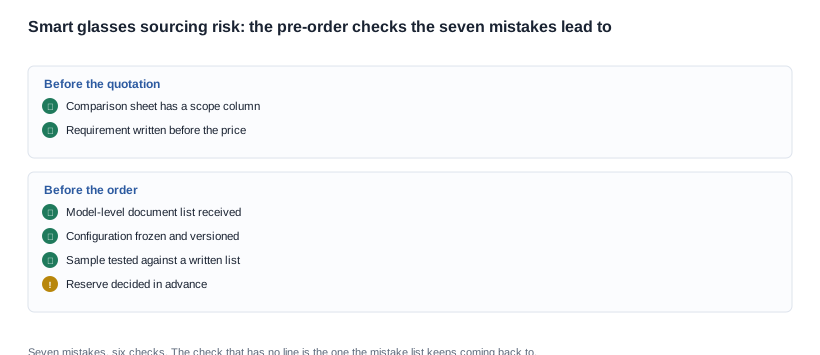
- Before the quotation. A comparison sheet with a scope column, filled the same way for every candidate; and the requirement written before the price rather than after it. These two catch the unit-price mistake and give the later checks something to be measured against.
- Before the order. A model-level document list, received — which catches the family-claim mistake and is also the precondition for sequencing the payment after the documents. A configuration string, frozen and versioned, which catches the nothing-frozen mistake. A sample tested against a written list, which catches the sample-as-proof mistake. And a reserve decided in advance, which has no mistake of its own attached to it: it is the only line that acknowledges that none of the other five is a guarantee, and it bounds what a mistake costs when it happens anyway.
What that leaves uncovered is the repeat order, and the checklist's own note is that the check with no line is the one the mistake list keeps coming back to. That is worth stating plainly rather than papering over: the six checks are a first-order instrument, and a programme that runs them once and then relies on the history it creates is running the seventh mistake on purpose.
Questions to ask in sequence, and the four checkpoints before you commit
The controls above only work if the questions are asked in the right sequence, because each answer determines what the next question can be. A buyer who asks everything in one email gets the answers back in the supplier's preferred order, which is never the order that settles the programme.
At the enquiry, before a price is quoted:
- Which single build does this price cover, written as a configuration string a packing line could read without a phone call?
- Which rows are published for that build, and which rows does the catalogue leave silent for it?
- Which documents will be issued for that build, and on what date?
At the document set, before the deposit is released:
- Which model designation does each document name, who is the holder, and when does it expire?
- Does any document cover the build itself, or only the product family it belongs to?
- Which stage is binding on the lead time, and what happens to the date if that stage slips?
At the artwork approval, before the order is released:
- Which single build is this order, in a versioned string that the packing line works from?
- What is the case and accessory configuration for that build, and is it inside the quoted price or outside it?
- What does a unit that fails the agreed test cost the buyer, and who carries that cost?
At the sample, before the shipment is released:
- What did you measure, against which written list, and on how many units?
- Which published row does each measurement correspond to, and which measurement has no published row behind it at all?
Those are the questions to ask, and the red flags are consistent enough to name in advance: a configuration answer that comes back as a capability rather than a string; a document that names a family instead of a build; a lead time with no start point; a sample answer with no protocol attached to it. Each one is a signal that the corresponding control is missing, and the remedy in every case is to ask again for the same thing in a more specific form, not to accept a more confident answer.
When a programme has to be short quickly, the shortcut is to shortlist on the two fields the table marks decisive — the configuration and the scope of documents — because which model survives the shortlist is settled by those two before the money is discussed. A buyer who does that is not skipping the comparison; it moves the comparison to the point where the answer is worth more. And because a total cost cannot be computed from a quotation whose scope is unknown, the price comparison is the last step rather than the first, which is the opposite of the order most programmes use.
The decision tree below turns a symptom into a name, which is faster than reading the list.
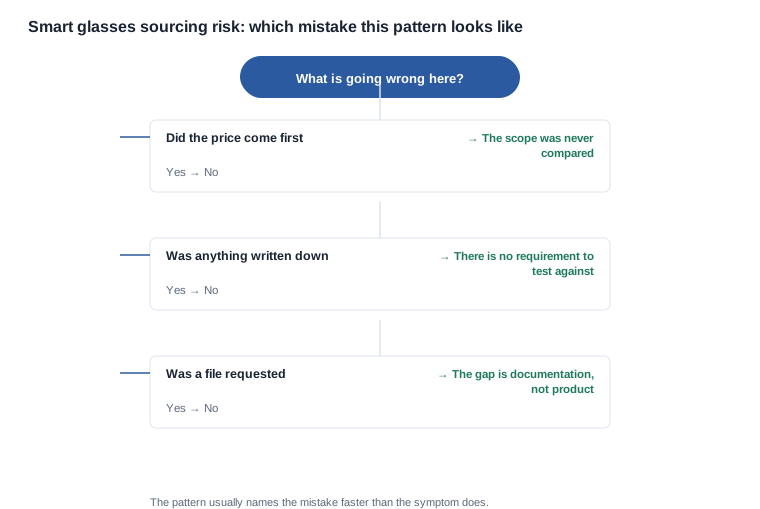
The first question separates a commercial mistake from a documentary one, the second separates a mistake with a written requirement from one without, and the third separates a gap in the product from a gap in the file. Most programmes that are going wrong answer "no" to all three, and the answer to all three is that the failure is documentary — which is the cheapest of the seven to fix, provided it is caught while the window is open.
What Cynrin publishes, and where this list stops
Stated plainly: a buyer in this category should judge a supplier on their paperwork habits, because paperwork habits are what produce the goods, and because the catalogue for the category is thin enough that the gap between what is published and what is not is where most of the risk sits.
We publish the electrical rows and the resolution tier for the models in our range, the charging method for twenty-four of the twenty-eight entries, the case capacity for the five camera models where it is published, the ingress marking for the two models that carry it, the charge time for all twenty-eight entries, and the unit weight for the one model where it is published — stated the way the catalogue states it, 158 grams for the MT6 glasses body, including its 265 mAh cell and its camera, excluding the 1200 mAh foldable charging case, whose own weight is not published. We publish no bare frame weight for any model, because no frame weight has been measured and published.
We do not publish certificate numbers, issuing bodies or validity dates, and we will not fill a blank line in a buyer's checklist with a typical figure we cannot trace to a document. Where a row is absent, we would rather say so than supply a number that fails in the field, where the correction costs more than the question did.
The seven mistakes above are process mistakes, not allegations about any particular supplier, and no manufacturer in this category would recognise the first five of them in a supplier they respect. They are the errors a reasonable buyer makes when a published row is missing and the gap is filled with something cheaper than a document. The sourcing risk section sets out the wider framework behind them.
Related reading
- Sourcing risk SOP — the process version, and where the repeat order belongs
- Hidden costs — what arrives after the order rather than before it
- Pricing comparison template — the scope column that closes mistake one


