
Six costs in this category are absent from the quotation and present in the bank account, usually between month four and month twelve. None of them is exotic, all of them are foreseeable, and every one of them can be moved earlier — at the cost of a conversation you may not have wanted to have. What follows names the six, places each one in the window it lands in, and separates the part of each cost that is a unit price from the part that is an investigation, because the second part is the one that quietly eats a margin.
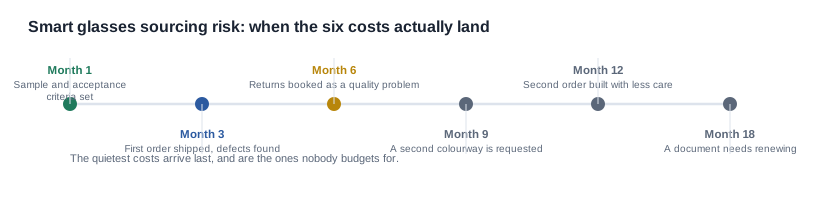
The practical test for whether you are exposed is short. Take the last programme you ran in this category and ask three questions: did anything come back, did anything have to be re-explained to the channel, and did anything have to be re-approved by a customer. A yes on any of the three means one of the six below has already been paid for, and the only question now is whether it was budgeted or absorbed.
Smart glasses sourcing risk: the order the six costs land in
Who is reading this and when the first bill arrives
The reader is a brand-side buyer, a channel buyer or an importer. The moment this article is usually needed is not the enquiry stage; it is the moment a second programme is being planned and someone has noticed that the first one cost more than the spreadsheet said. At that point the temptation is to blame the supplier, and the temptation is usually wrong, because in most of these six cases the supplier did exactly what the paperwork asked.
What makes this category unusual is that the catalogue rows are good. Our published material gives cell capacity, rated runtime, charge time, the charging interface where it is published, the case configuration for camera models, the Bluetooth version for the audio and sport models and the resolution class for camera models. A buyer can therefore write an unusually precise specification. The problem is that precision at the specification stage does not create precision at the second order, and the gap between those two things is where the six costs live.
The six costs placed in the window they land in
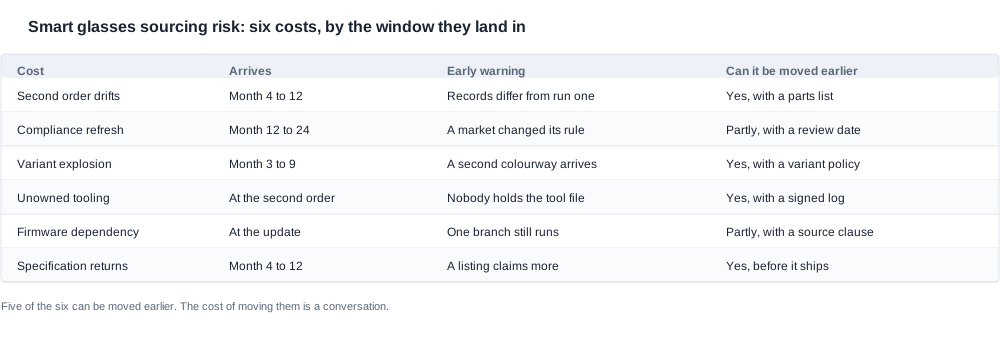
| Cost | Arrives | Early warning | Can it be moved earlier |
|---|---|---|---|
| Second order drifts | Month 4 to 12 | Records differ from the first run | Yes, with a controlled parts list |
| Specification returns | Month 4 to 12 | A listing claims more than the file supports | Yes, before the listing ships |
| Variant explosion | Month 3 to 9 | A second colourway arrives without a policy | Yes, with a written variant policy |
| Unowned tooling | At the second order | Nobody holds the tool file | Yes, with a signed custody log |
| Firmware dependency | At the update | One branch still runs in the field | Partly, with a source clause |
| Compliance refresh | Month 12 to 24 | A market changed its rule | Partly, with a review date in your own calendar |
Two rows in that table deserve a note before the rest of this article, because they are the two that cost the most and are the hardest to see coming.
The second-order drift row is not about the supplier cutting corners. It is about attention. The first batch is built by people who are concentrating on it, and the second is built while other work is running. The published rows do not change — the catalogue will still say the same cell capacity and the same charge time for that model — but the unit in the carton is subtly different from the unit that was signed off, and the difference shows in finish consistency, in the firmware build and in the print registration on the packaging.
The specification returns row is different because it is caused on your side of the table. A channel listing, a sales brief or a distributor description promised a capability that the documentation does not support. The supplier built to the order, the order was met, and the difference between the order and the promise shows up in the channel as a return or a complaint. Both sides then spend weeks investigating a question that one paragraph in the specification would have answered.
Why none of the six appears in a quotation
A quotation answers a question. A programme generates costs. The six above are programme costs, and a supplier who itemises them in a quotation would be quoting something unusual, because most of them are triggered by decisions the buyer has not made yet.
A second order cannot be priced until somebody decides whether it exists, what it contains and who signs it off. A variant cannot be priced until the colourway, the artwork and the packaging artwork are decided. A tooling handover cannot be priced until somebody accepts responsibility for the tool. A firmware dependency cannot be priced until somebody decides that a branch must keep running for five years without a fee. A compliance refresh cannot be priced until a market changes its rule, and a specification return cannot be priced at all, because it is caused by a claim you made.
This is not an excuse, it is a scheduling fact. The consequence is that the buyer has to create these costs deliberately, in a budget line with a name, at a point in the programme when they are still cheap. The total cost of the programme is therefore decided by what the buyer writes down before the order, and by nothing that happens afterwards. A cost with no name in the budget and no owner in the project plan will be discovered in the month it lands, and by then it is an argument rather than a line item.

What it actually costs to discover a hidden cost
The expense is not the unit
The largest number in most of these six cases is not the defective unit or the second colourway's setup charge. It is the labour of establishing what happened, on both sides, after the fact. Six weeks of one person's time on each side, a credit note, a returned consignment, a product listing that is withdrawn and republished, and a channel relationship that has to absorb the interruption.
That is why the same failure can occur three or four times in a year without appearing in any post-mortem. The unit cost is small enough to write off, the freight is recoverable, and the investigation never gets booked as a cost because it happens inside a procurement buyer's month rather than inside a factory's. It shows up eventually, as a returns rate that is a little higher than it should be and an account manager who is a little harder to reach.
The way to defend against this is not a bigger reserve. It is a cheaper discovery. The criteria for deciding that a hidden cost is worth moving earlier are simple: if the question can be answered from a document rather than from a person, move it. If the question "is this the same build" can be answered in two minutes by comparing a unit against a golden sample, the whole investigation never starts. That is the single highest-yield habit in this category.
How the gap opens in the first place

The sequence below is the same in every case we have seen, and it is worth reading because each step is individually reasonable.
- A brief, a listing or a sales description promises more than the supporting file supports.
- The supplier builds to the order, which is not the promise.
- The gap surfaces at the point of use, in the channel, rather than at the factory gate.
- The complaint is logged as a defect and routed for investigation.
- Both sides spend weeks reconstructing a decision that one sentence would have recorded.
- The cost lands in the returns reserve rather than in the factory's data.
Step five is where the money goes. Step three is where the clock starts. The lesson is that a claim made in the channel is expensive to investigate regardless of whether it is fair, because it is investigated by people who do not have the file.
Why it lands in the wrong ledger
Three of the six costs are booked as quality problems, and that misclassification is worth naming because it changes what you do next. A quality problem gets a supplier corrective action request, an audit maybe, and a defect rate that the supplier is asked to improve against. A specification problem gets a rewritten specification. The first response does not fix the second, and a supplier asked to reduce a defect rate on a defect that does not exist will do the only sensible thing, which is to argue that the units are fine.
The tell is simple. If a unit returns because it is physically different from the approved sample, it is a quality problem and the factory's records should answer it. If a unit returns because it does not do what a listing said it would do, no factory record can answer it, because the defect is in the sentence. The second category is the larger of the two in this category, and it belongs to the buyer's own file.
The three costs that land in the second year
The second order that does not repeat
The second order is where a programme stops being a project and becomes a relationship, and it is where the difference between the two shows up. The first run had a specification sheet that was read. The second run has a memory of the first run, and memory is a poor substitute for a document because it is not queryable and cannot be checked by a third party.
Three specific items carry the risk, and all three are cheap to control. A controlled parts list with part numbers tells the factory what may not change, and it catches the substitution that nobody intended. Inspection records kept for every run turn "the second batch feels different" into a comparison. A signed custody log for any private mould or custom temple shape answers the question that otherwise turns into a new tooling charge that the buyer believes was already paid.
None of these is a factory capability. All three are a buyer's documentation habit, which is why this cost is unusual: it is largely within your control and it is usually not controlled.
The variant you did not plan for
A second colourway, a different packaging artwork or a region-specific configuration arrives, and the question nobody has answered is what happens to the files that already exist. The specification sheet now describes one build out of two. The conformity evidence may name one configuration and not the other. The inspection checklist still describes the first. The artwork file is versioned and version four exists somewhere that only one person knows about.
The rule that prevents this is a variant policy, and it is one paragraph: a new variant is a new configuration, it gets its own configuration string, it is checked against the evidence before it is quoted, and it carries a named approval date. A programme with such a rule absorbs a colourway in a week. A programme without one absorbs it in a quarter, and the quarter is usually discovered when a broker asks which document covers the units actually in the carton.
This is also the cost where the catalogue's own structure creates the temptation. The charging interface is published as magnetic for seventeen of the twenty-eight entries and Type C for seven, and is not published at all for four camera models. The case configuration is published for some camera models, published as present but unspecific for two more, and explicitly absent for the V03 Pro, while the catalogue publishes no case row at all for the V03 and the V06, and the S7. A buyer working from a family-level mental model will treat all of these as one product, and a variant programme will find out otherwise.
The document that expires while you are selling
Every conformity document in this category carries a validity period, and every validity period outlasts the first order. The renewal is nobody's task by default, because it is not urgent until the day it is urgent. In the meantime the product is being sold normally, in volume, and the exposure is a shipment stopped or a listing withdrawn rather than a small shortage.
The fix is a review date in the buyer's own calendar, with an owner, tied to the sale of the model rather than to the date of the order. It is the least glamorous of the six and the only one where a small amount of administration removes the risk entirely.
There is a related point about scope rather than time. A company-level certification page says nothing about any particular model, and a document that names a product family does not cover a sibling configuration. Our own catalogue contains no CE, FCC or RoHS text at all and no per-model conformity rows, which is a statement about our published material rather than about our certifications, and it is the reason model-level evidence has to be requested per configuration rather than assumed from a page.

Moving a cost earlier without adding a supplier
The early-warning questions for each cost
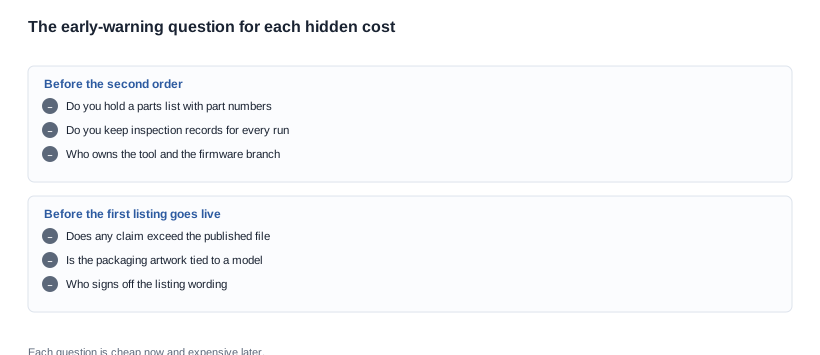
Each of the six has a question that is cheap now and expensive later, and the list below is short enough to send as a one-page attachment to the next supplier. It is the shortest useful version of what to ask, and it doubles as the early-warning checklist for the whole programme.
Before the second order:
- Do you hold a controlled parts list with part numbers for this model?
- Do you keep inspection records for every production run, not just the first?
- Who owns the private tooling and the firmware branch, in writing?
- Is there a written variant policy, and who approves a new one?
Before the first listing goes live:
- Does any claim in the listing exceed the published file?
- Is the packaging artwork versioned and tied to a named configuration?
- Who signs off the listing wording, and against which document?
- Is the model-level conformity evidence on file for this exact configuration?
If the answer to the first question is no, the second-order drift cost is already scheduled. If the answer to the first question in the second group is yes and the answer to the second is no, the specification returns cost is already scheduled. This is not a judgement of the supplier; a factory that keeps inspection records for every run is unusual enough that it has to be asked.
What a conversation costs and what a silence costs
There is a reason these costs survive: moving them earlier requires a conversation, and conversations about quality carry a tone. A buyer who asks a supplier to confirm that it keeps inspection records for every production run is, in that supplier's hearing, questioning whether it keeps records at all.
The way to avoid the tone is to ask for the artefact rather than for the assurance. "Please send the inspection record for run two" is a request for a document. "Do you keep inspection records" is an accusation with a question mark on it. The first is usually granted, because most factories that keep records will send them, and the second is usually deflected.
The red flags that one of these costs has already been paid for are worth naming, and they are quiet: a returns rate that drifts up without a spike, a second order that is visibly less careful, a channel question that nobody can answer from the file. There is also a version of this that runs the other way and is worth using. If you are the buyer, tell the supplier in advance that you will want the second-order comparison, the batch records and the firmware baseline at the end of the programme. Suppliers who know a comparison is coming tend to produce a better second order, which is the cheapest quality improvement available to a buyer in this category.
Which of the six can actually be moved
Four of them move without anybody's cooperation, because they live in the buyer's own file and can be negotiated internally before you order: the specification returns cost, the variant explosion cost, the compliance refresh cost, and the tooling custody cost if the buyer agrees to hold the paperwork. Two need the supplier: second-order drift and firmware dependency, because both depend on records the supplier keeps.
That split is the useful part of this table, because it tells you where to spend attention. Roughly half of the exposure is closed by documents you write yourself, at no cost and without a negotiation. The other half is closed by a clause, and the clause is much easier to obtain before the order than after the first shipment.

What to do when the cost has already landed
Four questions to ask of your own data
When a programme is already running, the first step is not to ask the supplier what went wrong. It is to ask four questions of your own records.
- Of the units that came back, how many were physically different from the approved sample, and how many were functionally fine but did not match a description? The ratio tells you whether your problem is quality or specification, and the two have completely different remedies.
- How many of the returns were raised by the channel rather than by your own inspection? A high ratio means the discovery process is running in the wrong place.
- How many of the returns were still inside the claim period when they arrived? Units that arrive after the window have usually been charged to the wrong side of the account.
- Which single document, if it had existed, would have answered most of the questions? That document is the one to add to the next programme.
Question four is the one that pays. It converts a retrospective into a specification change, and it is the mechanism that stops the same cost arriving twice.
A hypothetical situation, worked through
The following is an illustrative case rather than a client project, and no customer is described.
A channel buyer runs a camera model for one market, with a charging case in the box, and places a first order in the low thousands of units. The specification names the model and the case. Nine months later the channel reports a rising return rate, and the reason given is that the product does not do what the listing describes. The buyer's own inspection records show no defect trend at all, and the factory's records show nothing either.
The diagnosis takes an afternoon and it is not a quality problem. The listing describes a resolution and a runtime that sit inside the range the catalogue publishes for the model family but are not what this specific configuration delivers, and the case that ships changes the box content and therefore the customer expectation of what is included. The specification was never wrong, exactly. It was incomplete, and the gap was filled by a sentence written by somebody else.
The buyer's remedy is not a supplier corrective action request. It is three changes: a specification section that states what the listing may and may not say, a sign-off on the listing copy against the published rows, and a routine where the first three hundred units of any new configuration are compared against the listing before the rest are shipped. None of these costs anything that was not already being spent, and all of them are in the buyer's file, not the supplier's.
The generalisable point is that the expensive version of this article is the version where the cost is discovered once and never written down. How to evaluate which of the six you are exposed to is a question about your own file, and it is worth answering before the next quotation rather than after the next returns. The cheap version is a paragraph, written after the first programme, that says what the listing may claim.
Where our own numbers stop, and what we will answer instead
It is worth being precise: we publish the configuration rows our own documentation supports and we mark the rows that are open rather than filling them with a plausible figure. For a camera model that means the resolution class, the cell capacity, the charging interface where it is published, the rated runtime, the charge time, the case configuration and the customisation scope.
What we do not publish, and what a buyer should therefore not expect to find in a quotation from us, includes minimum order quantities, unit prices, production lead times and defect rates. All four are not published in our documentation, and a quotation that appears to carry them as standing figures is one worth interrogating. We also do not publish per-model certificate numbers, and our catalogue contains no CE, FCC or RoHS text at all, which means model-level conformity evidence for a given configuration is something we produce and hand over rather than something you can read off a page.
One further boundary is worth stating because it has been misread before. The catalogue publishes one weight, and its scope is narrow: the MT6 unit is published at 158 g, which is the glasses body including its battery and camera and excluding the folding charging case. The weight of the case itself is not published, and no bare frame weight is published for any model. We would rather tell you that than quote a typical figure you cannot verify, because a figure you cannot verify is exactly the kind of number that turns into one of the six costs above.
The sourcing risk section covers the assessment behind these six, and the cost breakdown covers the arithmetic that stops a quotation from being the whole story. The documentation requirements article covers the files whose absence causes several of these costs, and the quality implications piece looks at the consistency side of the second-order problem.
If you want to know which of the six your particular programme is most likely to meet first, send the model, the configuration, the quantity and the destination markets. We will tell you which of the six is decided by a clause, which by a document in your own file, and which by a conversation you may want to have now rather than in month nine.


