

Twelve documents, requested in this order, will tell you more about a supplier than a three-day site visit. The order matters because the early documents are cheap to request, cheap to refuse, and the pattern of refusals is itself the finding.
That last clause is the one most buyers do not act on. A refusal is normally treated as a gap to be filled later, and usually it is. But a supplier who answers eleven of the twelve has told you something specific: which one they chose not to answer, and why that one is the one they avoided. In this category the most common such pattern — producing everything except the model-level evidence for your configuration — is not evasiveness. It is a statement that the evidence does not exist yet, which is a completely different risk with a completely different remedy.
So this article is two lists. The twelve documents, in the order to ask for them. And the reading of what comes back.

Smart glasses sourcing risk: the identity documents, and who must supply them
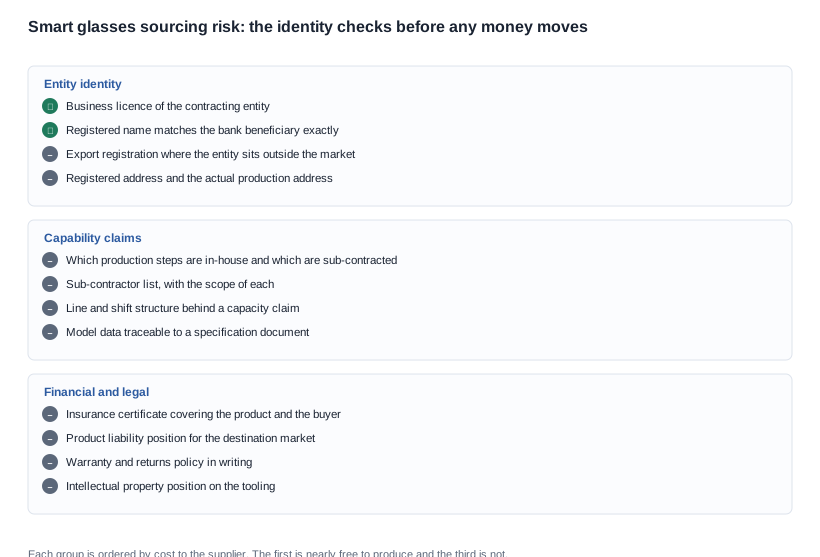
- Business licence of the contracting entity. Check the registered name against the bank account beneficiary character by character. A mismatch is the clearest early warning available and it costs nothing.
- Export registration or equivalent, if the entity is not in the same country as the goods.
- Quality management certificate — number, issuing body and validity dates. Not a logo on a letterhead.
These three are first because they answer the only question that has to be settled before any of the others are worth asking: is there a real entity on the other side of the transaction, and is it the one that will receive the money.
The name comparison is worth doing carefully rather than quickly. Read the registered name off the licence, read the beneficiary name off the bank details, and compare them character by character rather than by shape. Two differences account for most of the real mismatches — a corporate suffix that is present in one and absent in the other, and a trading name used on the quotation instead of the registered name on the licence. Both are benign on their own and both are worth a written confirmation, because the alternative is discovering them when a payment needs reversing.
The export registration and the quality certificate are both verifiable against a third party, which is what makes them worth asking for early. A certificate number, an issuing body and a validity date can be checked by anyone with the right registry access, and a supplier that cannot supply all three has either no system certificate or no intention of being checked.
The reader, and the three situations this list is written for
The reader is a procurement manager on the brand side, a channel buyer or an importer, and the situations are three. A first-article quotation has arrived from a supplier nobody has worked with before, and the buyer needs to decide whether to spend a week on due diligence or to place the order and see. A supplier has been recommended by another supplier, and the recommendation makes the verification more necessary rather than less, because a referral removes the incentive to present a weak point. Or a programme is being moved to a new factory because the current one has failed on delivery, and the buyer knows how a bad supplier behaves in detail and wants to see whether this one is different.
What is at stake in all three is not the unit price. It is the possibility that the entity behind the quotation cannot deliver a lawful product to the destination market, and that the buyer discovers this after the packaging has been printed with the brand on it.
Why the order of the twelve is a cost order
The twelve are grouped into three blocks of four, and the blocks are ordered by how much effort each document costs the supplier to produce. That is deliberate, and it is the reason a buyer can send the whole list without a supplier walking away.
The identity documents cost almost nothing. They already exist, they are produced from a register, and the reason to ask for them first is that they are also the ones a supplier has least excuse to withhold.
The product documents cost a moderate amount of time. A specification sheet for a model already in production is a document the factory already maintains. A test report for a model already shipped is a document the factory already has to be able to produce for a customs authority.
The process documents cost the most, because a filled inspection checklist and a corrective action record have to come from a real run rather than a template. Asking for these on the first exchange usually produces a promise rather than a document, and a promise on the first exchange is worth very little.
The right sequence therefore asks for the cheap ones immediately, accepts a date for the expensive ones, and treats the promised date as a commitment that has to be met before the deposit rather than before the first enquiry.

The next four: product evidence
- The specification sheet for the exact model, including suffixes. A range document is not a specification.
- Test reports for that model — standard referenced, laboratory named, sample batch identified. In the EU, radio equipment sits under the Radio Equipment Directive (EU) 2014/53/EU and the traceability position under GPSR (Regulation (EU) 2023/988, applicable since 13 December 2024).
- Battery transport documentation — the test summary and packaging arrangement that have to exist before an air shipment moves. This is the one most often missing at first contact.
- A declaration or statement covering the destination market, where one applies beyond the above.
The fourth document in this block is where a buyer has to be most careful about which entity is being asked. A specification sheet for the model, with the full suffix, is a document about a product; a range document is a document about a catalogue, and the difference shows up in the model's camera module, its cell, its charging interface and its case. In a category where the catalogue itself publishes different charging methods across the range — magnetic charging on seventeen of the twenty-eight rows, Type-C on seven, and no published charging method at all for the CY05 and the CY03, and the L1 Pro and the MT6 — a range document tells a buyer very little about what will actually be in the box.
The battery transport documentation is item six rather than item four because it is the document with the longest lead time and the shortest tolerance. It is also the one where the specificity matters most, because this category ships more than one cell type in a single consignment: device cells from 40 mAh through to 290 mAh, and charging cases at 900 mAh, 1200 mAh and 1400 mAh. A summary that covers the device cell does not cover the case.

The last five: process evidence
- A filled inspection checklist from a real run. Blank forms prove nothing.
- A batch traceability example — how a finished unit is traced to a component lot. "By the date code on the box" is an answer, but a weak one.
- A corrective action record from a past defect. An empty log means either no defects or no recording, and neither is reassuring.
- The tooling or mould ownership terms, where customisation is involved. This is the document that matters most at the end of a relationship and is the one nobody asks for at the start.
- The firmware update and support commitment where your product carries your own software.
Item eleven is the one that gets deferred and then becomes irreversible. Tooling ownership is a term that is easy to agree at the start of a programme and very hard to renegotiate once the tooling has been paid for and the supplier knows the buyer cannot walk away without losing the mould. Asking for the ownership position in the first exchange costs nothing, because the supplier has not yet invested in the answer.
Item twelve matters more than its position in the list suggests for any product that carries a companion app. A firmware build that is not versioned against the order is a support cost that arrives eighteen months later, when the unit on a customer's desk is running a build nobody in the factory can identify.

What to do with the twelve once you have them
Read them against each other rather than one at a time. The licence name against the bank account. The model designation on the report against the model on the specification sheet. The battery test summary against the cell capacity on that same sheet. The corrective action record against the inspection checklist — a supplier with detailed inspection records and no corrective actions has a process that has never met a defect, which either means the defect rate is genuinely zero or means the corrective action step is not happening.
That cross-reading takes about an hour and it is the part of supplier evaluation that most substitutes for a site visit. A site visit tells you about a day; a document set tells you about a year, provided the documents are from a real year rather than compiled for the request.
The cross-reading has four pairings that matter most, and each of them catches a different failure.
Licence name against bank beneficiary catches the identity problem. It is the cheapest check available and it catches the most consequential one.
Model designation on the test report against the model on the specification sheet catches the configuration problem. A report for a neighbouring model string is a document that proves nothing about the model ordered, and it is common because model strings are close together and the report is easy to send by mistake.
Cell capacity on the specification sheet against the cell on the battery test summary catches the transport problem. It is the pairing that determines whether the consignment moves on the day it is collected.
Corrective action record against inspection checklist catches the process problem. A supplier can have an elaborate inspection system and no corrective action habit, and the two together tell you whether defects are actually being resolved or only being detected.
How to read a refusal
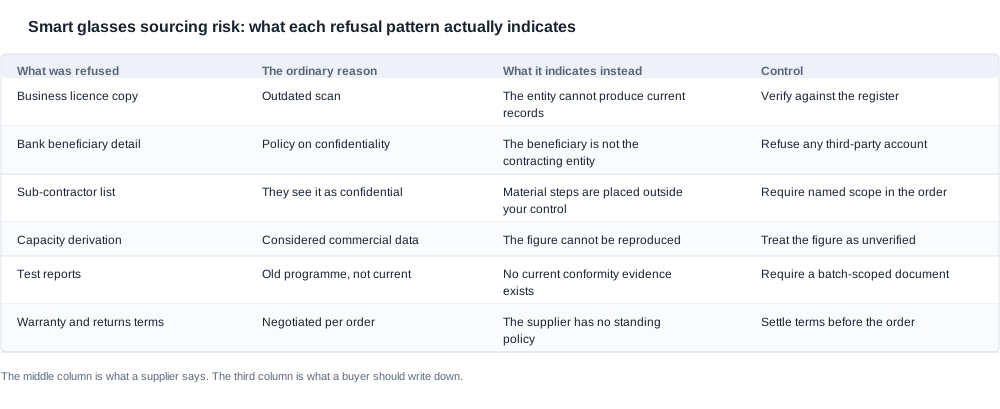
The table above sets out what a supplier says against what the refusal usually indicates. The middle column is what a supplier will tell you, and the third column is what a buyer should write in the file.
Refusals at the first three are unusual and informative. A business licence that cannot be produced is not an administrative gap; it is either an entity that does not exist or an entity that is not the one on the quotation. A bank beneficiary that cannot be confirmed against the registered name is the clearest early warning in the whole list, and there is no reason to proceed past it.
Refusals at the last five are more common and usually mean the process does not exist in written form. A blank inspection checklist and an empty corrective action log are the same finding in two forms: nothing failed, or nothing was recorded. Neither is reassuring, and the difference between them is only visible if the buyer asks which one it is.
The pattern worth acting on is narrow and specific: a supplier who produces everything except the documents about your exact model. That pattern has one common explanation — model-level evidence for your configuration does not exist yet. Which is not the same as a refusal to disclose, and the remedy is different too. The remedy is not to escalate; it is to change the programme. Either order a configuration for which the evidence already exists, or make the creation of that evidence a priced line in the order with a date attached.
What happens to a request that arrives too late
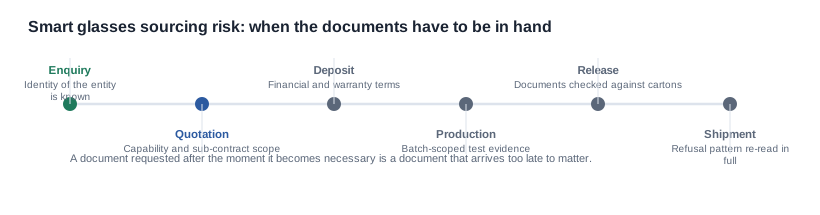
The timeline above places each document against the moment it becomes necessary, and the pattern is the same in every programme: a document requested after its moment is a document that arrives too late to matter.
An identity document requested after the first payment is a document that confirms what has already happened. A model-level specification requested after the artwork is printed is a document that describes a product that no longer exists, because the artwork revision has already changed the model string. A batch test report requested after the consignment has shipped is a document about a batch that has already cleared customs.
The rule that follows is straightforward and is worth stating as a procurement rule rather than a request-handling tip: each document should be in hand before the event it governs, and the event it governs is the point at which the buyer's position is hardest to recover.
How to sequence the request so it does not stall
The twelve documents are best sent as three requests rather than one, and the reason is practical rather than presentational. A single request for twelve items from a new supplier reads as a test of whether they will cooperate, and it tends to produce one long reply with gaps. Three requests, each with its own reason and its own deadline, produce three replies that can be acted on separately.
The first request carries the three identity documents and nothing else. It is short, it is the easiest thing in the world to answer, and it should be answered the same day. A supplier who takes more than a working day on this one is telling you something, and the answer to that question is available before you have spent anything.
The second request carries the four product documents and asks for a date rather than the documents. This is the request where a date is more useful than a document, because the products may not have been made for your market yet and the honest answer is "not until the batch runs". What you want from this request is a date that is tied to an event — the production slot, the laboratory booking, the shipment — rather than a general timeframe. A supplier who gives "within a month" has told you nothing; a supplier who says "the summary exists once the batch is booked, and the batch is booked in week three" has given you a usable schedule.
The third request carries the five process documents and is the one most likely to come back partly refused. The way to handle it is to accept the refusals in writing and keep them. A refusal with a stated reason and a date is a documented risk. A refusal with no reason is a documented risk of a different and worse kind.
The criterion for whether this sequencing has worked is not how many documents arrived. It is whether, at any point, you could have said in one sentence which supplier you were dealing with and where the risk in the relationship sat. If you can, the request did its job even if three of the twelve never arrived.
How to evaluate a supplier's answer before you place the order
The three outcomes to sort a supplier into are worth stating explicitly, because the middle one is where buyers spend the most time and decide the least.
A supplier who answers everything and whose answers cross-reference correctly is a supplier whose process can be relied on. That is rare and it is worth a premium.
A supplier who answers most of it and names the gaps is a supplier with a smaller operation than the one you assumed. This is normal for a specialist factory and it is workable. The gaps become your due diligence task rather than the supplier's, and the question to ask for each one is "who holds this for you" rather than "why do you not have it".
A supplier who answers with documents that do not identify your model, your configuration or your destination is a supplier whose documents are catalogue items rather than evidence. The distinguishing feature is not that the documents are generic — a category-level declaration is a legitimate document in some contexts — but that the generic document was offered in answer to a specific question.
Which criteria to apply depends on the programme. For a first order on a new configuration, the middle group is fine and the third group is disqualifying. For a reorder of a configuration already in production, the question changes: ask what has changed since the last delivery, and treat any change to the test evidence, the specification or the sub-contract scope as a new configuration requiring the whole sequence again.
Where the risk actually sits in a sourcing decision
The risk in this category is concentrated in three places, and they are not the three a buyer usually worries about.
The first is the identity of the entity behind the quotation, which is behind the two documents that cost the supplier least to produce and which therefore get the least attention. A buyer that assumes the entity exists because it answered an email in good English has skipped the only check that is free.
The second is the gap between the model on the quotation and the model that ships, which is where a range document substitutes for a specification and a neighbouring test report substitutes for the right one. The remedy is a document set that is specific to the configuration, and the cost of it is that some suppliers will decline.
The third is the terms that are only settled at the end of a relationship — tooling ownership, warranty scope, firmware support, the corrective action obligation — and which are systematically deferred because they are not needed until something has gone wrong.
The due diligence that closes the first is an hour of cross-reading. The due diligence that closes the second is a document request that a supplier who cannot satisfy will find awkward. The due diligence that closes the third is four items on a list, requested before the deposit, when they cost nothing.
The boundary we will state, and the documents we actually hold
We will supply the documents that exist for a given configuration and say plainly which we do not hold. Certificate numbers, issuing bodies and validity dates are not published in our documentation, and we will not produce a plausible-looking reference to fill a gap.
The reason is worth stating, because it applies to the whole list rather than to one item. The catalogue lists a company-level export certification page and no per-model certification row, and the published material contains no CE, FCC or RoHS claim tied to any model string. A document we could produce that identified a specific model's conformity position would therefore be a document from our own file rather than from the catalogue, and the honest position is to say which of the twelve we hold and which we do not rather than to send something plausible that does not identify your model.
The boundary we hold: a buyer who asks for all twelve before a deposit learns more than a buyer who asks for two after one, and pays less for the privilege. The refusal pattern is the same whichever supplier you are asking, and reading it correctly is worth more than the documents themselves.
The sourcing risk section covers the assessment behind this list.
Related reading
- Factory audit documents — the paper version
- Sourcing risk SOP — where each document sits
- Hidden costs — what arrives later instead


