

Price comparisons in this category usually collapse into one number against another number, and the number that gets quoted is rarely the number that decides the order. The honest comparison has two halves: the published rows, which describe what each model is, and the written quotation, which describes what a specific configuration costs and on what terms. For the V03 Pro and the CY05, this guide sets out what is published on each side and exactly what to ask for in the quotation, because a quotation that is not itemised per configuration cannot be compared with any other quotation at all.
The two models are close enough to be confused and different enough to matter, which is precisely why a lazy comparison misleads. Both carry an 8 MP camera row and both publish a charge ceiling of ≤2 h. One of them publishes three colours and prints no charging-case row; the other publishes a charging case with a 1400 mAh cell and prints no colour row. Nothing in the catalogue turns those differences into a price, so the comparison has to be built in two stages, and the first stage is the one this guide covers in full.
V03 Pro vs CY05 price positioning: the published rows first
Positioning is not a feeling and it is not a price band. In a range like this one, positioning is the relationship between what a model publishes and what a buyer ends up paying for a defined configuration of it. The published side is knowable before you contact anyone, so it is the right place to start, and it is the side most comparisons skip.
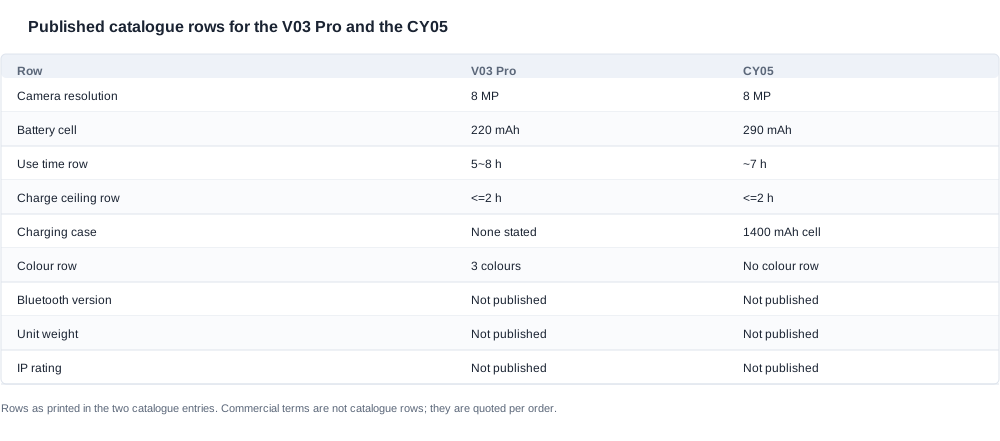
The table sets the two entries against each other row by row. Three rows are identical and therefore useless as differentiators: camera resolution at 8 MP, the charge ceiling at ≤2 h, and the absence of a Bluetooth version, a unit weight and an IP rating on both sides. Four rows differ in ways a buyer can act on. The cell row reads 220 mAh on the V03 Pro entry and 290 mAh on the CY05 entry. The use-time row reads 5~8 h on the V03 Pro and approximately 7 h on the CY05. The charging case row exists on the CY05 side, with a 1400 mAh cell, and is stated as absent on the V03 Pro side. The colour row names three published colours on the V03 Pro and does not appear on the CY05 entry.
Read the table in the order a buyer will actually use it. The identical rows tell you that camera class, charging ceiling and the four unpublished rows are not where the commercial argument lives, so none of them should appear in a specification sheet you intend to use to justify a choice. The differing rows are the ones that will end up on your product page, in your accessory list and in your service model, and each of them has to be priced somewhere. A colour line creates SKUs. A charging case creates a different box content. A longer use time changes what a customer can do with the unit in a single working day.
One methodological point matters more than any single row. Every difference stated in the two sections that follow is one we can point to in the published entries. Where we hold no row for one side, we do not assert an absence and we do not fill the gap with an assumption. We list it as a question to ask instead, because a difference you cannot evidence is a difference that will not survive your own audit, and it is also a difference a supplier will rightly decline to defend.
That discipline is what makes the published comparison useful as a purchasing instrument rather than a marketing paragraph. When the same two models are later discussed in commercial terms, the arguments will be about configuration, box contents and order conditions — all of which sit outside the catalogue. Building the technical half in a defensible order first means the commercial half is a short, structured conversation instead of an argument about which number was quoted first.
There is a third way to use the published rows, and it is the one that saves the most time later. Treat the two entries as a screening filter before any quotation exists. Write the criteria that actually separate them — charging architecture, box content, the runtime band, colour availability, and whether the accessory list falls on you — and drop any candidate whose entry does not print the rows you need. The result is a shortlist rather than a long comparison, and the shortlist is short for a reason: a model whose entry leaves four rows unprinted will produce four open items in the quotation however the conversation goes, and those items are usually the ones that move the commercial terms later. Scoring the candidates against the same criteria also keeps the exercise symmetrical, so the final decision criteria are visible in writing rather than implied. When a supplier answers only the comfortable questions, you can see that in the shape of the answer set, and you can decide whether to press on the open items or to work around them. Every published row used in this comparison is set out in full in the published specification and feature index and each quotation should be checked against it.

What the V03 Pro publishes that the CY05 does not
The V03 Pro entry carries a configuration block that does not appear on the CY05 side, and it carries it in three separate ways. Each one has a commercial consequence, and each one should be written into a specification sheet as a fact rather than left as an impression.
The first is the colour row. The V03 Pro entry names three published colours: orange, an off-white or cream tone, and black. Across the whole catalogue only one other model carries a colour row at all, and that one lists four colours, so the V03 Pro is not simply better dressed than the CY05 — it is the only one of the two with any colour line to work with. The commercial consequence is direct and measurable: three SKU definitions can be written from published material alone, without a single clarification request about colour, which means three product pages can be built without waiting on a supplier. The CY05 side of this comparison has no equivalent line, so any colour-led plan on that model starts with a question, not with a fact.
The second is the form in which runtime is published. The V03 Pro prints its use time as a bounded range of 5~8 h, which gives you two usable facts: the floor under the claim and the ceiling above it. The CY05 prints a single approximate figure. A range is more work for a buyer to write honestly and less work to defend, because the customer-facing claim can sit at the conservative end while the engineering team works against the other end. An approximate single figure does the opposite: it is easy to quote and awkward to test, because there is no stated floor to hold anyone to. If your own quality process measures runtime, the range is the more convenient starting point, not the less certain one.
The third is the charging port. The V03 Pro entry prints a Type C charging port row, and that row is what tells you how the unit is physically recharged, which charger ecosystem it fits into and what your accessory sourcing has to cover. It also tells the customer what to expect in the box, or rather what has to be added to the box by whoever assembles it.
There is a fourth item that belongs in this section because it sits on the V03 Pro side even though it describes something absent: the charging-case row is simply not printed. Of every entry in the range, only this one records the absence of a case in writing, instead of leaving a reader to infer it from a row that was never printed. That is an unusual kind of publication, and it is useful, because it converts a buyer assumption into a verified fact. A silent gap would leave you guessing whether the case was omitted by mistake or by design; a stated absence closes the question before anyone has to ask it.
Each of these four items is a prompt for the same kind of follow-up. What does the row mean for the SKU I am quoting? What has to be added to the box to make it a sellable product? Which of those additions changes the quotation line? Asking those three questions is what converts a published row into a comparable commercial item.

What the CY05 publishes that the V03 Pro does not
The CY05 entry carries one large published item that the V03 Pro entry does not, and it is the item that changes a quotation the most: the charging case. The CY05 entry prints a charging case row and prints a 1400 mAh cell inside that case. The V03 Pro entry prints no charging-case row. Everything else on this side is smaller but still relevant.
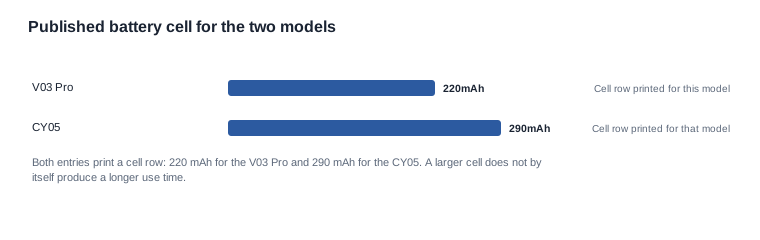
The cell comparison above is the simplest way to see the shape of the difference: 220 mAh for the V03 Pro against 290 mAh for the CY05, both printed in their own catalogue entries. A larger cell does not by itself produce a longer working day, because each entry publishes its own use-time row and the hardware behind those rows is not identical — which is exactly why the use-time figures are best read as two separate claims rather than one ranking. What the cell difference does tell you is that the CY05 has more energy available to spend, and that energy is what funds the case.
That case is the commercial centre of gravity in this comparison, for four reasons. First, it changes the box content, so a shelf-ready unit from the CY05 and a shelf-ready unit from the V03 Pro are not comparable objects until the accessory sets are made equal. Second, it changes the service model, because a cased unit can be recharged away from a cable while a cableless unit cannot. Third, it changes the freight and handling profile, since a case is volume that ships, stores and gets damaged. Fourth, it changes the customer expectation, because a cased product is read as complete and a cableless one can read as incomplete. Each of those four consequences eventually appears in a commercial term, which is why a quote that does not separate the box contents cannot be compared with any other quote.
The second CY05 item is a labelling nuance that is easy to miss and expensive to get wrong. The V03 Pro entry prints its ceiling under a charge time label, while the CY05 entry prints its ceiling under a charge duration label. Both read ≤2 h, so the numbers agree, but the labels do not, and a specification sheet that copies the label from one model onto the other produces a document that misquotes one of the two suppliers. The rule that avoids the problem is simple and mechanical: quote the label exactly as the entry prints it for that model, and never normalise the two into a single line item.
The third item is the runtime figure again, seen from the other side. The approximately 7 h published for the CY05 sits inside the 5~8 h range published for the V03 Pro, so a buyer who reads only the headlines may conclude that the two are equivalent. They may be equivalent in a working-day sense while differing in every other respect that a quotation touches, and the second sentence is the one that appears on the invoice.
A practical summary of the CY05 side, in the order it should reach a quotation:
- The charging case and its 1400 mAh cell are published items, and they belong in the box-content line of any comparison.
- The charge ceiling label is printed differently and must be quoted exactly as printed for each model.
- The runtime figure is approximate rather than a range, so it needs a test condition attached before it is used as a claim.
- The 290 mAh cell is a published number that explains, but does not replace, the published runtime row.
Add a short due diligence checklist to the comparison and the two models start to behave like comparable objects. Four lines are enough: the configuration each quotation is based on, the box contents including accessories, the order conditions attached to the figure, and the file name where the answers live. Send the checklist instead of a paragraph, because a checklist is answered line by line and a paragraph is answered selectively, and the selection tends to favour the questions that are easy rather than the ones that matter. The checklist also gives the comparison a second dimension that the catalogue never prints. On one side, the box is complete at delivery and the buyer carries no accessory sourcing task for the unit itself. On the other side, a cable, a charger and instructions become a buying task that has to be specified and described, and the total cost of ownership of that decision carries the handling and the shelf presentation that follow. Neither side is automatically the cheaper one; the difference is that one lands in the quotation as a line and the other lands in your operation as work.

Why a price comparison cannot be closed from the catalogue
Here is the uncomfortable part of the comparison: the catalogue cannot close it, and any attempt to close it from published rows will produce a number with no evidence behind it. The published rows describe hardware class. They do not describe what a buyer is quoted for a specific configuration, what ships in the box, on what terms the order is placed, or what documentation accompanies the shipment. A figure that appears on a supplier's product page and a figure that appears on a purchase order are different kinds of number, and treating them as interchangeable is the single most common reason a price comparison in this category goes wrong.
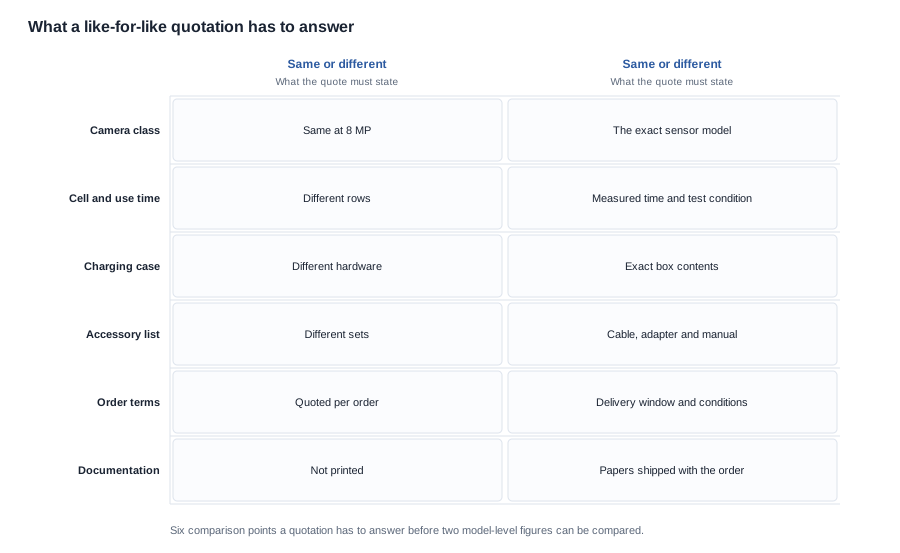
The matrix lists the six comparison points that a quotation has to answer before two model-level figures can be placed next to each other. Camera and sensor class is the same at 8 MP on both sides, so the quote has to state the exact sensor model rather than the resolution. Cell and use time are different rows with different forms, so the quote has to state a measured use time and the condition it was measured under. The charging case is different hardware, so the quote has to state exactly what the box contains. The accessory list differs, so it needs its own line. Order terms are quoted per order, so the delivery window and the order conditions belong in the same document as the figures. Documentation is not a published row for either model, so the papers that ship with the order have to be named.

The flow is the order in which to do it, and the order is what makes the result defensible. Fix one configuration per model and write it down before asking for anything, because a configuration that exists only in the head of a salesperson is the reason two quotes end up describing different products. Ask for a per-configuration quote rather than a model-level one. Then ask what changes when the configuration changes, which is the question that turns a price into a price structure. Then ask for box contents and accessories separately. Then ask for the delivery window and the order conditions in the same document, so that a comparison does not have to be reconstructed from three emails. Finally, compare the two quotations line by line rather than total to total, because the totals hide exactly the differences that matter.
Three red flags are worth naming before you start. A quote that gives one number for a model without naming the configuration behind it. A quote that omits the accessory and box-content lines, which makes a cableless model look artificially cheap. And a quote in which the two configurations are not equivalent, most often because one side includes a case and the other does not. Any of the three means the comparison has to be redone, and it is cheaper to detect them at the quotation stage than at the receiving stage.
There is a fourth discipline that matters more than the method itself: ask both suppliers the same questions in the same order, and put the answers side by side. It is not enough to ask one side for clarification that the other side already published. Asking symmetrically is what turns two separate commercial conversations into a comparison, and it is what stops a well-documented quotation from being mistaken for a better product.
Two red flags belong on the list before you order. The first is a quotation that answers your questions but attaches no document, because an answer with no document cannot be checked on receipt. The second is a quotation whose delivery window and order conditions are missing, which means two figures are being compared without their terms attached and the comparison is not yet valid. Red flags like these are cheaper to find at the quotation stage than at the receiving stage, and the total cost of a red flag that reaches production is a re-order rather than an email. Negotiate on that basis. The negotiation belongs to the terms — the configuration, the box contents, the delivery window, the documentation — and not to which model appears stronger on paper, because that ordering has no published basis. Write the evaluation criteria down before the first supplier call, keep the same criteria for both models, and make the criteria visible in the questions you send. When both quotations come back against the same checklist, the comparison closes itself and the decision becomes a record rather than an argument.
Where CYNRIN stands on the V03 Pro and CY05 placement
On the placement of these two models, our position is deliberately modest. We do not publish price bands for any model in the range, we do not attach a tier to the V03 Pro or to the CY05, and we will not rank one above the other in this guide, because the published rows do not support an order and a ranking built on a quotation you have not seen is a guess dressed as advice.
What we will do is the part that is within our control and that you can check:
- We keep the published rows in step with the document we send, so the table in this guide matches the entries you were given.
- We name the rows we do not publish rather than leaving them to be filled in by assumption.
- We answer an open row in writing when it is asked for in writing, and we attach the answer to the order file rather than leaving it in a message thread.
- We quote per configuration, with box contents and accessories on their own lines, so that two of our quotations can actually be compared.
- We supply sample units so that the quoted figures and the measured figures can be checked against each other before a bulk order is released.
The commercial conversation is yours to run, and the method above is what makes it a comparison rather than a pair of numbers. For the sampling step specifically, the sample ordering guide sets out what to check on receipt and what to photograph while the unit is in front of you, which is the cheapest moment to catch a difference between the written answer and the physical product.
The related reading below covers the parts of this comparison that each deserve their own treatment.
Related reading


