
Cy05 smart glasses and the V03 Pro are both published as 8-megapixel camera glasses with a charge time of two hours or less, so a buyer who compares them on the camera row is comparing two rows that match. The published differences sit elsewhere. The CY05 sits on the 290 mAh frame cell and ships with a 1400 mAh charging case. The V03 Pro sits on the 220 mAh frame cell, is published with a Type-C charging port, carries a photochromic lens row and a flexible-temple row, lists three colourways, and is published without a charging case.
This page is written for the procurement manager who holds two quotations and has to defend the choice to a channel partner. It does not give a verdict, because our catalogue does not contain the rows a verdict would need: neither model publishes a unit price, a frame weight, a sensor model, a field of view, a colour list for the CY05, or a per-model certification position. What it gives instead is the decision path. Which published row settles which part of the question, which rows are open on both models, and the six questions to put in writing before a purchase order is drafted.
Cy05 versus V03 Pro: what the two published rows actually separate
The rows both models publish
Four rows are published for both models, and on all four the values are identical or explicitly equivalent. The camera row is 8 MP on both. The charge-time row is a published ceiling of two hours or less on both. The rated-use row differs in disclosure type rather than in meaning: the CY05 publishes a single figure of about seven hours, while the V03 Pro publishes a range of five to eight hours. The charging method row is published for one model and absent for the other.
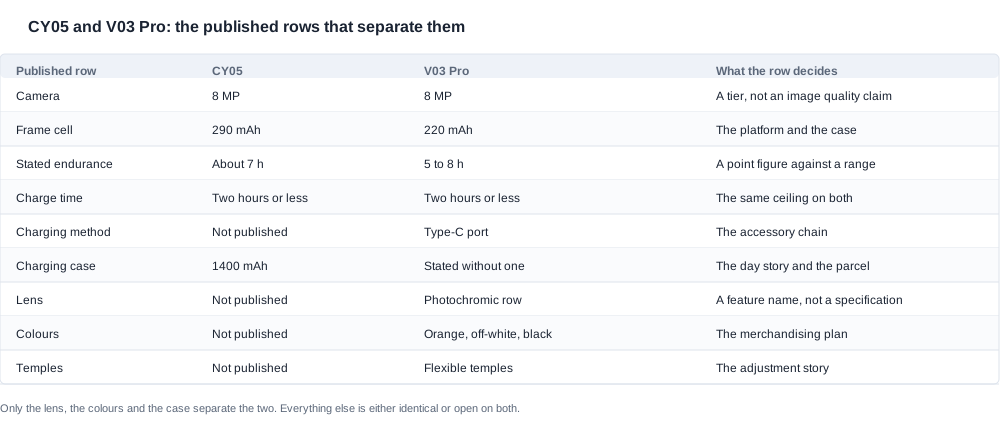
| Published row | CY05 | V03 Pro | What the row decides |
|---|---|---|---|
| Camera | 8 MP | 8 MP | The resolution tier, and nothing about picture quality |
| Frame cell | 290 mAh | 220 mAh | The platform block the model sits on |
| Rated use | About 7 h | 5 to 8 h | A point figure against a range, and the disclosure type that follows |
| Charge time | Two hours or less | Two hours or less | The turnaround ceiling, identical on both |
| Charging method | Not published | Type-C port | The accessory chain and the in-box cable |
| Charging case | 1400 mAh | Stated without one | The day proposition and the parcel weight |
| Lens | Not published | Photochromic row | A feature name rather than a characterised lens |
| Colours | Not published | Orange, off-white, black | The merchandising plan |
| Temples | Not published | Flexible temples | The adjustment and replacement path |
A procurement manager reading that table will notice something that is easy to miss in a two-model shortlist: the row that usually carries a camera comparison is the row that separates them least. Eight megapixels is a resolution tier, not a statement about light, colour or motion, and the same tier appears on eight camera models in our catalogue. The remaining thirteen camera models carry one other tier, thirteen megapixels. Neither model publishes a sensor model, a field of view, a video format or a frame rate, so the tier tells you which shelf the product belongs on and not much else.
The three places the published rows differ
Only three rows separate the two models, and each of them is a row about the proposition rather than about the electronics. The charging method is published as a Type-C port for the V03 Pro and is absent for the CY05. The charging case is published as 1400 mAh for the CY05, while the V03 Pro is published without a charging case at all. The lens, colour and temple rows are published for the V03 Pro and absent for the CY05.
That is the whole separation, and it is enough to build two different products from the same camera tier. The CY05 as published is an all-day accessory-led product: a larger frame cell and a substantial second cell in a case that a customer can carry. The V03 Pro as published is a product-led model: a smaller frame cell, a standard interface, a lens feature, a colour list and a temple feature, with the accessory chain kept deliberately thin. Whether either of those is the right proposition depends on your channel, not on the catalogue.
The rows that are open on both models
The two models leave the same rows open, and that symmetry is itself useful to a buyer, because it means a single request can cover both. Open on both: the sensor model, the field of view, the video format, the frame rate, the storage arrangement, the frame weight, the frame dimensions, the temple length, the endurance test condition behind both endurance figures, the colour list for the CY05, and the certification position for each designation in each destination market.
Two of those deserve a note. The endurance figures are different kinds of number, and a range is a better disclosure than a point figure because it says more than one condition was measured. Neither is usable until the condition behind it is known, and the two conditions are unlikely to be identical, because a model with a photochromic lens row and a model with a case-led proposition are not the same product under test. The second note is the certification position. The catalogue carries a company-level export certification page whose content is images rather than text, and that text contains no reference to CE, FCC or RoHS anywhere. There is no per-model certification row for the CY05, for the V03 Pro, or for any other model, so market access is written material to be requested rather than a line to be transcribed.
The CY05 charging case and the V03 Pro position with no case
What the 1400 mAh case decides downstream
The 1400 mAh charging case is the largest published case capacity in the camera family, and it is the CY05 row that changes the most downstream work. It is a retail proposition, because a customer who can carry a second cell buys the product for a working day rather than for an hour. It is a parcel decision, because a second lithium cell in every unit changes the packed weight, the carton, the volumetric calculation and the freight class. And it is a documentation decision, because the battery transport file for a parcel containing two cells is not the file for a parcel containing one. The battery transport compliance notes set out the paperwork side, and the AI camera glasses shipping weight breakdown covers the parcel arithmetic.
None of that makes the case a recommendation, and it is worth saying why. The case is a cost with a benefit attached, and which side dominates depends on the channel, the delivered cost structure and the proposition the customer is buying. A wholesale buyer with a thin margin on a high-volume line treats the case as a cost line to be negotiated down. A brand selling a day-length capture product treats it as the reason the product exists. Both readings are consistent with the same published row, and the difference between them is not visible in the catalogue.
The AI camera glasses charging case options analysis covers the accessory economics in more detail, and the packaging options piece covers what the presence of a second cell does to the pack design.
What the catalogue states about the V03 Pro case
The catalogue makes a positive statement about the V03 Pro rather than leaving the row absent: the V03 Pro is published without a charging case. That is a different statement from the one our catalogue makes for the V03 and the S7, and the V06, where there is no charging-case row at all. The distinction is worth carrying into a purchase order, because the first is a decision and the second is an absence. A model that is published without a case tells you what the product is; a model with no case row tells you only that our documentation is silent, and silence is an item on the request list.
For a buyer, the published position on the V03 Pro removes a line of work rather than adding one. There is no case to specify, no case weight to include in the freight model, no second cell in the transport document, and no spare-parts line for a case that does not exist. The trade is that the customer has no way to extend the day beyond what the 220 mAh cell gives, and the catalogue publishes that endurance as a five-to-eight-hour range rather than a point figure.
The delivered cost consequences that follow
Two cost structures follow from the two published positions, and they should be modelled before either quotation is accepted. On the CY05, the delivered cost per unit carries a second cell, a heavier packed weight and a transport document that covers two cells. On the V03 Pro, the delivered cost per unit carries none of that, and the accessory chain is a cable rather than a case. Neither model publishes a unit price, a price tier, an order minimum or a cost per unit, so the comparison has to be run against the quotations themselves, and the questions to ask are specific: whether the case is included in the quoted unit price or billed as a separate line, what the packed weight and carton dimensions are with and without the case, what the accessory set contains, and what the order minimum is for the case if it is a separate line.
A total cost comparison that ignores the case is not a comparison between the two models; it is a comparison between the frame and the frame. A buyer who asks for the quoted unit price of the frame and the quoted unit price of the frame-plus-case, at the same quantity break, can build a delivered cost model that survives a finance review. A buyer who asks only for the unit price ends up with a number that does not include the accessory the proposition depends on.

The V03 Pro photochromic row, the three colourways and the flexible temples
A photochromic row is a feature name, not a lens specification
The V03 Pro publishes a photochromic lens row. It is the only camera model in our catalogue that does, and that fact alone is a real differentiator for a channel whose proposition depends on the lens rather than on the camera. It is also a feature name, and the distinction decides how far a product page can go.
A feature name is a catalogue entry. A lens specification is a set of measured values: the transmission range, the tint depth, the time to darken, the time to return, the temperature at which the response changes, and the behaviour under a windscreen. Our catalogue publishes none of those, and it publishes no lens model number for the photochromic row on the V03 Pro. Any of those values that appear on a listing has come from somewhere other than our documentation, and a buyer who lets an unverified value into the product copy has accepted a claim they cannot support when a customer tests it in a parked car.
The photochromic smart glasses buying guide sets out what to demand before promising anything about switching speed or tint depth, and the photochromic technology explainer covers the mechanism behind the behaviour. The procurement task here is narrow and doable: ask for the lens specification and the catalogue entry it belongs to, in writing, and check it against the values on the lens in the sample unit.
The colour list is published for one model only
The V03 Pro lists three colourways — orange, off-white and black. The CY05 publishes no colour list at all. For a brand with a merchandising plan this is the sharpest of the three published differences, because a colour story that cannot be delivered is a tooling and packaging cost rather than a marketing asset.
Two things need confirming before the artwork is committed. The first is whether all three V03 Pro colourways are available in the configuration and quantity being ordered, rather than in a stock colour that the supplier will not produce for that pack. The second is whether the CY05 has colourways at all, and if so whether they are shared with the CY03 or the L1 Pro, since the three models share the same 290 mAh platform and a shared colour would be a range-level decision rather than a model-level one. Our catalogue publishes no colour row for the CY05, so the answer exists only in a written reply.
Flexible temples and the service path they imply
The V03 Pro publishes a flexible temple row. Flexible temples are a service story before they are a feature story: a temple that can be replaced or adjusted changes the aftersales conversation, and a temple that cannot be replaced changes the failure mode of the product.
The question to put in writing is specific. Are the temples user-replaceable, is the replacement sold as a spare part or as a warranty item, what is the adjustment range, and is the part number available for the life of the product. A brand that plans a range has to answer this for the spare-parts list, and a channel that has promised a temple feature to a customer has to be able to answer it too. The CY05 publishes no temple row, so the equivalent question for that model is whether any temple adjustment exists at all.
The six questions that close the CY05 and V03 Pro comparison
The same question to both designations
The single most important instruction in this comparison is to ask the same question of both model designations, in the same words, in one message. Six questions close the comparison:
- Sensor model, field of view, video format and frame rate for each designation, with the values stated for the camera as it ships in that configuration.
- The endurance test condition for each designation, including what was running during the measurement, whether the camera was active, and whether the radio was connected.
- The charging interface on the CY05, since our catalogue publishes no charging method row for it, together with the charging interface and recharge time of the case on the CY05.
- The photochromic lens specification on the V03 Pro, with the catalogue entry it belongs to, and the confirmed availability of the three published colourways in the configuration ordered.
- Frame weight and frame dimensions for each designation, with the battery fitted and the case excluded, so the two numbers are comparable.
- The certification position for each designation in each destination market, with the model named in the technical file.
Two details matter more than the list itself. First, ask for answers tied to the designation: a reply that names the V03 Pro does not settle the CY05, and a family-level answer settles neither. Second, log every answer against the designation as it appears in the quotation, because a designation change between the sample and the production order is the failure mode that turns a closed question back into an open one.
The two questions only a sample unit can answer
Two of the six questions cannot be closed by a document at all, and a buyer who tries will get a non-answer that looks like an answer. Whether the camera captures what the product brief describes, and what the field of view feels like against the scene the customer needs to record, are answered by a captured file rather than by a datasheet row. The same is true of what happens when storage fills during a long recording, and of how the frame sits across the size range the brand actually sells to.
The sample script is short, and it is the same script for both models so that the comparison stays fair. Capture a still and a clip in the conditions the brief describes: indoors under office lighting, outdoors in daylight, and indoors in the evening. Note what the field of view captures against the scene that has to be captured. Transfer the files and observe what happens when storage is exhausted. Run the charging routine through a full cycle and record the interface and the case behaviour. The camera imaging guidance sets out the longer method, and the sample request page covers what to ask for and what to check on arrival.
The order of work before the purchase order
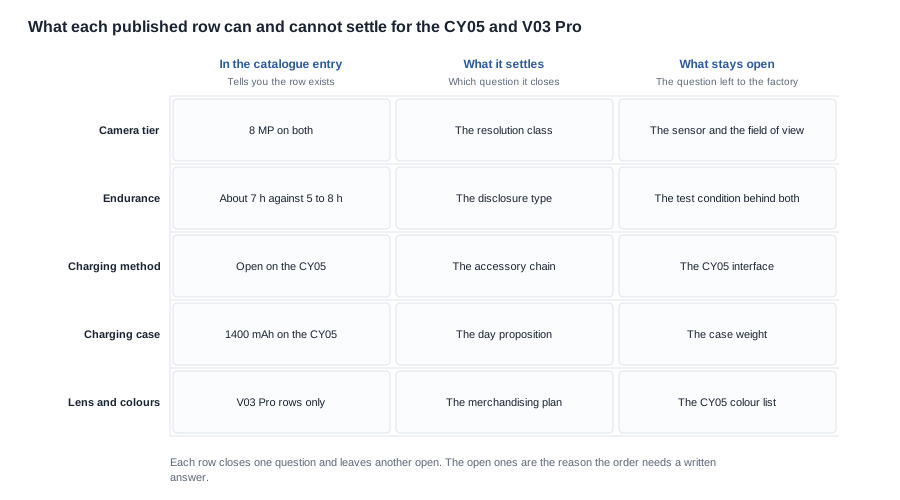
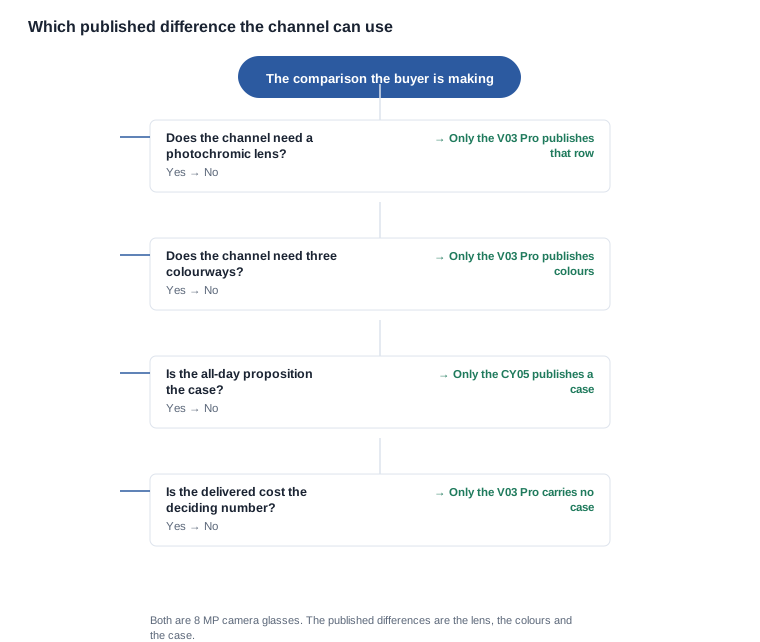
The three activities have to run in this order, and the order is what keeps the programme cheap. The proposition comes first, because it decides which of the three published differences the order actually depends on. If the day proposition is the point, the case row and the charging interface are the critical questions. If the lens and the colourways are the point, the photochromic specification and the colour availability are the critical questions. If delivered cost per unit is the deciding number, the case and the freight class are the critical questions. Choosing the model before deciding which published row matters most is how a buyer ends up with two samples and no argument.
The written request comes second and runs in parallel with sampling, because the two activities have different owners and different outputs. The purchase order comes third, and by then each closed item becomes an acceptance criterion with a stated value and each remaining open item becomes a documented exception with a named owner and a date. That last step is what stops an open question from returning as a warranty argument six months later, when nobody remembers which side of the correspondence it fell on.

A worked sequence for a hypothetical buyer is worth walking through, because it is the shape most camera glasses programmes end up running. Assume a brand is planning a two-model camera line for an e-commerce channel, with the V03 Pro as the product-led model and one slot still open. First, the proposition is fixed in one sentence, and the sentence names the published row that carries it. Second, the six questions go out in one message with the designation attached to every item. Third, one sample unit of each shortlisted model arrives and the same script runs on both. Fourth, the answers arrive; if the CY05 and CY03 difference turns out to be a colourway or a packing format, the two-SKU structure is confirmed and the artwork moves forward, and if the answers come back saying the two models share everything the channel needs, the buyer runs one SKU and the cost model loses a line it was never going to earn from. Fifth, the closed answers become acceptance criteria in the purchase order.
This is a hypothetical sequence rather than a client project, and it is presented that way deliberately. The sequence is the reusable part, and it applies to any pair in this camera family whose published rows are close enough that the specification cannot make the decision for you.
Where the CY05 and V03 Pro comparison has to stop
What we will publish and what we will not
We publish the electrical rows and the resolution tier for every model, and for these two that means the 8 MP tier, the 290 mAh and 220 mAh cells, the about seven-hour and five-to-eight-hour endurance figures, the two-hour-or-less charge ceiling, the 1400 mAh case, the Type-C port, the photochromic row, the three colourways and the flexible temples, each on the model it belongs to. We will not present the 8 MP on either model as an image quality claim, because the sensor model and the field of view that would let us make that claim are not in our documentation. We will not present the photochromic row as a characterised lens, because no lens performance data is published for it. We will not present the five-to-eight-hour range or the about seven-hour figure as a working day, because the test condition behind both is not published. We will not quote a frame weight for either model, and we will not fill an unpublished row with a typical value from another model. We will not quote a unit price, an order minimum, a lead time or a certificate number, because our documentation does not contain them.
The published CY05 specification list and the published V03 Pro specification list are the honest baselines for the two models, and the V03 versus V03 Pro comparison covers the third model on the 220 mAh block if the shortlist is still open after the V03 Pro.
The next step and what we need from you
The decision path above is complete enough to run without us, and the six questions are the only thing standing between a shortlist and a purchase order. To help you close them faster, four things are useful: the channel the product is built for, the target market, the quantity per designation, and whether the range is one model or two. With those four, we can tell you which of the published differences the configuration depends on, which rows are still open for the designations you have named, and which of the six questions are on the critical path for your order rather than in the sample queue.
Send us the market, the channel, the volume and the two designations you are comparing, and we will answer with the published rows, the open rows and the request list — not with a verdict the documentation does not support.
Related reading
- The entry model on the same 220 mAh block — V03 smart glasses specifications and features
- The platform the CY05 sits on — OEM ready platforms which models are ready
- The export paperwork a camera parcel needs — OEM ready platforms export documentation
Tell us the channel, the target market and the volume, and we will say which of the published differences your configuration depends on and which questions have to be closed with the factory before the order is placed.


