

Form factor in camera glasses is decided by fewer things than buyers expect, and two of them are published: how the unit is recharged, and whether a case is part of the box. Everything else — the weight on the head, the protection rating, the dimensions — is either unpublished or unmeasurable from a page. This guide compares the V03 Pro and the KY06 on the rows that are actually printed, separates the shared rows from the ones that differ, and ends with the five questions that have to be closed before either model is listed on your site.
The conclusion comes first, because it saves a lot of reading. On the printed rows, these two models are closer than the marketing language around them suggests: both carry an 8 MP camera row, both publish a charge ceiling of ≤2 h, both run in the same broad band of hours on a single charge, and neither publishes a unit weight or a protection rating. The real difference is not cosmetic. It is architectural: one model recharges over a Type C port with no charging-case row printed for it, the other recharges magnetically through a case that the catalogue does describe. That single difference changes the accessory set, the counter logic, the service model and the page you have to write.
V03 Pro vs KY06 form factor: what the catalogue actually prints
A comparison of form factor usually starts with pictures, and pictures are the least reliable evidence available. What is printed on the page is reliable, and for these two models the printed material is compact enough to transcribe in full.
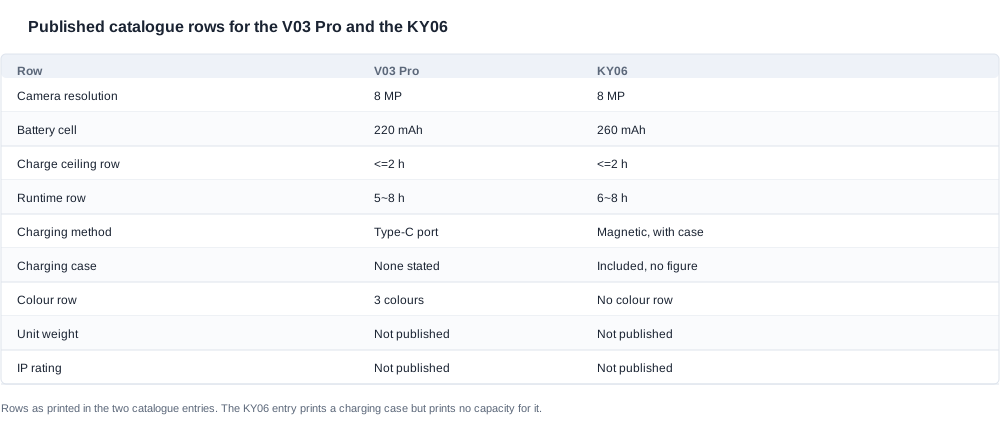
The table is the whole of the published comparison. Camera resolution is 8 MP on both sides. The battery cell row reads 220 mAh on the V03 Pro and 260 mAh on the KY06. The charge ceiling row reads ≤2 h on both, and both entries label that row in the same way, which is worth checking rather than assuming. The runtime row reads 5~8 h on the V03 Pro and 6~8 h on the KY06. The charging method row is the one that decides everything else: the V03 Pro prints a Type C charging port and prints no charging-case row, while the KY06 prints magnetic charging with a case and prints no capacity for that case.
Two absences are worth naming, because they are catalogue-wide facts rather than quirks of these two entries. Unit weight is published for one model in the entire range, so neither of these two prints a weight. Protection ratings are published for two models, so neither of these two prints an IP rating either. Any comparison of these two that claims to be about physical handling is therefore resting on rows that do not exist for either model.
What is left is genuinely useful. The published rows determine three things a buyer actually pays for. The charging architecture determines the accessory set: a Type C port needs a cable and a charger that the buyer sources, a magnetic dock needs a dock that may or may not be in the box. The box content determines the shelf-ready proposition and the freight profile. The runtime row determines what a customer can do with the unit in a working day, and therefore what the product page is allowed to promise.
There is a fourth element on the V03 Pro side that does not appear as a specification at all: a configuration block naming a flexible temple, photochromic lenses and three published colours. Those are printed rows in their own right, and they shape the physical proposition more than any of the electrical rows do. The KY06 entry carries no equivalent configuration block in the material we hold, so the honest treatment is to record it as a question rather than to assert an absence.
The point of tabulating rather than narrating is that the comparison then works in both directions. A buyer choosing between the two can see immediately which rows are settled and which rows still have to be asked about, and can tell in one glance whether a supplier has answered the right questions or only the comfortable ones.
Form factor is also a screening question that can be settled before a single supplier email. Two criteria carry most of the weight: how the unit is recharged, and what is actually in the box when it arrives. Apply the same screening criteria to every candidate model in the range and the surviving list is short, because most entries leave one of those two rows unprinted. That shortlist is the useful output of the exercise, and every model on it can then be compared against the same questions in the same order, which is what keeps the comparison symmetrical. The published rows also tell you what the exercise cannot settle. Neither model prints a weight, so comfort claims are unavailable for both; neither prints a protection rating, so outdoor or vehicle use is unevidenced for both; and neither prints a sensor model, so the camera comparison stays open on both sides. Recording those three gaps once, in writing, saves a repeated argument later, and it keeps the differences that are real — the charging architecture and the box content — at the centre of the decision.
The shared rows: sensor class, cell class, charge ceiling
Three rows are common ground between these two models, and each of them does a specific job in the comparison. Treat them as settled, then spend the quotation conversation on everything else.
The first is the sensor class. Both entries print an 8 MP camera resolution. Two models that both print 8 MP are not automatically the same product, because a resolution figure describes the output, not the sensor, and the catalogue does not print sensor models for either of them. The shared row therefore removes camera class as an argument between the two models while leaving the actual camera comparison open. The question it generates is a good one: if you need to compare image output, ask for the sensor model and the field of view in writing for each, then look at them side by side on a sample rather than at a resolution figure.
The second is the cell class. 220 mAh against 260 mAh is a difference in the same order of magnitude, not a difference of architecture. That is the useful way to read it. Two cells of 220 mAh and 260 mAh can sit inside the same published runtime band, and the band is what a customer-facing claim is allowed to rest on. The published runtime rows are 5~8 h for the V03 Pro and 6~8 h for the KY06, which overlap across most of their length.
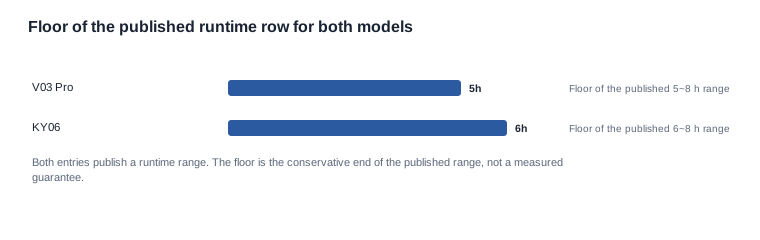
The chart takes the conservative end of each published runtime row, five hours on one side and six hours on the other, because a floor is the only number in a range that can be planned against without a test condition attached. The upper ends are identical at eight hours, which means the two models are not separated by their best case. They are separated, slightly, by their worst case. A buyer planning around a full working day should plan around the floor of the range rather than the top of it, and the five-to-six hour difference between the two floors is small enough that it should not drive a decision on its own.
One labelling note applies here and it is easy to miss. The V03 Pro entry prints its runtime under a use time label. The KY06 entry prints its runtime under a charge duration label, while both entries use a charge time label for the ≤2 h ceiling. The numbers are readable in both cases, but a specification sheet that copies a label from one entry to the other misquotes one of the two models. The rule that avoids this is mechanical: copy the wording from that model's own entry, every time, and never merge two models into a single line item.
The third shared row is the charge ceiling of ≤2 h. It is a ceiling rather than a measured average, and the practical reading is the same on both sides: a full charge takes no longer than two hours under the specified condition, and the actual number moves with temperature and with how depleted the cell was. Nothing in the printed material distinguishes the two models on this row, so a comparison should not pretend otherwise.

The rows only one of the two publishes
Now the inventory of differences, model by model. Each item below is a row that exists on one side, and each one has a commercial consequence that belongs in a quotation rather than in a description.
On the V03 Pro side, two items are published and are not present as equivalents on the KY06 side. The first is the colour row: three published colours, namely orange, an off-white or cream tone, and black. No other entry in the range prints a colour line of any length apart from one that lists four options, so this is the only one of the two models where a brand owner can define three SKUs from published material without asking anyone anything. The second is the configuration block: a flexible temple row and a photochromic lens row, which together tell you how the unit is meant to be worn and how the lens behaves in changing light. The third difference is not a row at all: the catalogue prints no charging-case line for this model, where the KY06's entry does describe a case, so the case question is open on one side and answered on the other.
On the KY06 side, two items are published and are not present as equivalents on the V03 Pro side. The first is the charging method row, which prints magnetic charging with a case. That single row is a complete change of operating model: the unit is recharged by placing it on a dock rather than by plugging a cable into a port, which means the dock is a dependency rather than an accessory, and the question of whether the dock is in the box becomes a question about whether the product works at all on arrival. The second is the case itself, whose presence is published while its capacity is not. So the box content is known and the energy stored in the box is not.
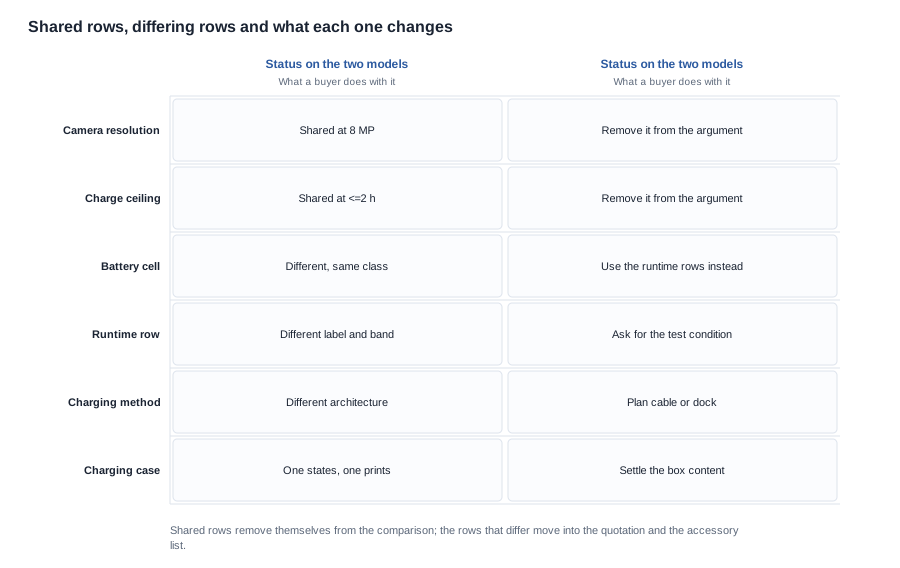
The matrix puts the comparison in one place, with the shared rows separated from the differing ones and a consequence attached to each. Three rows are shared and remove themselves from the argument. The cell and runtime rows differ but stay inside the same order of magnitude, so they inform a plan rather than settle a choice. The charging method and the case differ architecturally, and those are the rows that move into the quotation and into the accessory list.
The commercial consequences are worth stating plainly, because form factor arguments look cosmetic until they are priced. A Type C port means the accessory set is a cable, a charger and instructions, and every one of those is something the buyer sources, specifies and describes. A magnetic case means the accessory set is the case, and the question of whether the charger is included in that case is the question to ask. At the counter, the first model needs a cable presented with it, and the second needs a dock that must not be separated from the unit or the purchase looks incomplete. In the warehouse, the first model is a single small item, and the second is a two-piece set with a defined pairing rule. In a return, the first model may come back without anything missing, while the second comes back with or without its case, and the second case is the more common problem because it is the piece most easily left behind.
None of this is an argument for one model over the other. It is an argument for writing down the operating consequence of each before you build a page, a shelf plan or a service process around either one.
The trade-off between the two operating models is a real trade-off rather than a preference, and the way to evaluate it is to write down the consequences instead of arguing from instinct. Three operations carry most of the difference: the counter, the warehouse and the return desk. At the counter, one model needs a cable presented alongside it and the other needs a dock that must not be separated from the unit, because a dock left behind makes the purchase look broken. In the warehouse, one is a single small item and the other is a two-piece set with a pairing rule. At the returns desk, one comes back with nothing missing and the other comes back with or without its case, and the case is the piece most easily left behind. None of this is an argument for one model over the other; it is an argument for knowing which operations you are willing to take on. Two red flags deserve naming in this context. A model whose charging method depends on a dock that is not in the delivered box, and any published weight claim for a model whose entry prints none, are both reasons to pause rather than proceed.
Five questions to close before either model is listed
The five questions below are the ones that decide whether either model can be listed with confidence. They are ordered so that the answers arrive in the sequence that lets you use them, and each one is written in a form that can be sent as-is and answered in writing.
- For the KY06, is the charging dock and the case included in the delivered box, and what is the box content exactly?
- For the KY06 case, what is the cell capacity inside it, and how many recharges does it provide in practice?
- For the V03 Pro, what accessory set must the buyer source to make a shelf-ready unit, and what does the supplier include in the box?
- For both models, under what test condition was the published runtime row measured, and what measured figure do they hold in the condition you will claim?
- For both models, what is the unit weight, what protection rating applies, and what documentation ships with the order?
The reasoning behind the order is that questions one to three are about hardware that arrives, and they have to be answered before anything is written about the product. Question four is about the claim you are about to publish, and it is the only one that needs a sample in hand, because a runtime figure measured under a condition you did not specify is not a figure you can repeat. Question five is the paperwork question, and it belongs last in the conversation but first in the file, because it is the part that has to be attached to the order before it is released.

The chart is the working order for those answers. Write the five questions as a numbered list and send the same list to both suppliers, in the same sequence, so that the two answers can be laid side by side. Order one sample of each model rather than two of one, because the whole point is a comparison and a second unit of the same model teaches you nothing about the difference. Then measure the runtime under the condition you intend to publish, and check the charging path on each unit with the accessories that actually ship. Finally, attach the answers to the listing file before the page goes live, so that what the page says and what the supplier confirmed are the same document.
There are two answers that should be treated as red flags rather than as gaps to be filled later. The first is a dock that is not included for a model whose charging method is magnetic charging with a case, because the unit then arrives with no way to charge it. The second is a runtime figure given without a test condition, because it cannot be repeated, verified, or defended when a customer compares it against another model. Both should be resolved before the listing, not after the first complaint.
Run the list the way you would run a due diligence checklist rather than a conversation, because a checklist is closed line by line and a conversation is closed selectively. Each line should end with a document that names itself: the specification sheet, the packing list, the note that accompanies the sample. Before you order, run the same checklist twice — once against the written answers and once against the physical sample — and treat any difference between the two as an open line rather than a rounding error, because a measured figure that contradicts a written one always ends up in your quality file. Negotiate on the answers rather than on the model, and keep the negotiation about terms: what is in the box, what the runtime figure means, what documentation travels with the order. A quotation that is specific about those three things can be acted on. A quotation that is vague about them is a number without a meaning, and comparing two of those tells you nothing except that both were written from the same template.
Where CYNRIN stands on the V03 Pro and KY06 form factor
On this comparison, our position is that the printed rows decide what is comparable, and that nothing beyond the printed rows should be used to claim an advantage. We do not publish a physical weight for either model, we do not publish a protection rating for either model, and we will not rank the two on a dimension the catalogue does not print.
What we will do is straightforward:
- We align the published entries with the PDF we send out, so the table above reflects the rows you were given rather than a summary of them.
- We name the rows we do not publish, including the weight and the protection rating, so that nobody has to infer them.
- We close an open row in writing whenever it is asked for in writing, and the answer goes into the order file with the quotation.
- We supply sample units so that each written answer can be tested against the physical product before a bulk order is released.
- We state the charging architecture plainly, including the fact that one model charges over a Type C port with no charging-case row and the other charges magnetically through a case whose capacity is not printed.
For a buyer, the shortest form of the method is: use the three shared rows to remove camera class, charge ceiling and cell class from the argument, treat the runtime rows as planning ranges rather than guarantees, and put the real question into the quotation, which is what arrives in the box and what it takes to keep the unit charged. The sample ordering guide covers what to check and photograph on receipt, and the battery life reference sets out why a published runtime range and a measured figure are different things.
Related reading


