
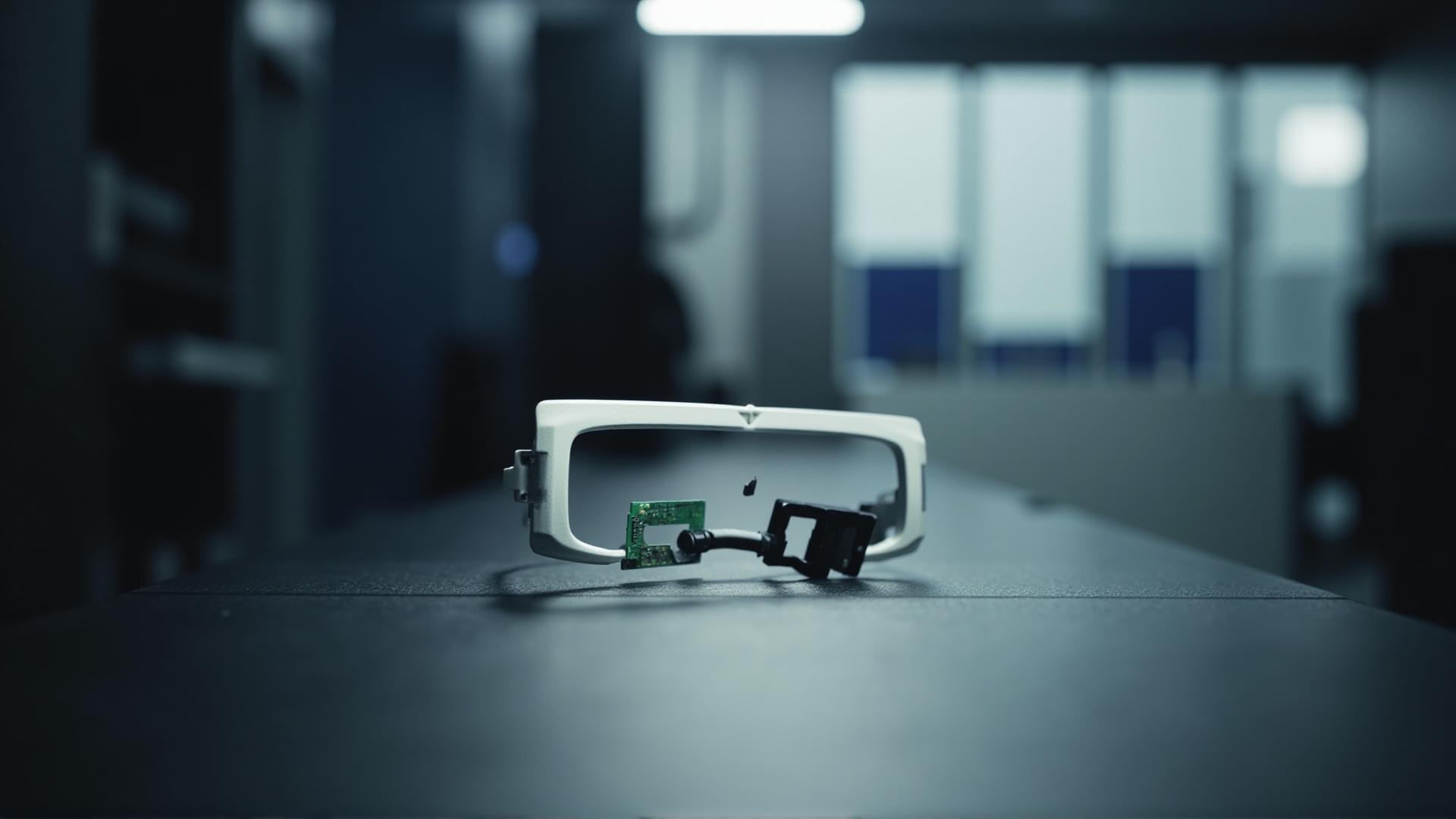
The V06 is the only camera product in our range that publishes a retail colour list, and that turns out to be the most commercially useful thing about it. Orange, white ice-blue, black and black ice-blue are recorded in our catalogue as available configurations for this model, and no other camera model in the range names any colours at all.
A camera glasses product is bought on a shelf, next to real glasses, and colour is a decision the customer makes before they read a specification. The V06 is the model in the camera range that a customer can choose.
That claim is worth testing against how this category actually sells, and the test is easy to run: look at what a shopper can evaluate while holding the product. Colour is immediate. Specification is not, because a shopper cannot compare two megapixel figures on a hook any more than they can compare two chip generations. Every model in this range competes on a specification the customer has to trust rather than verify, which makes the model that offers a verifiable choice structurally advantaged at the moment of purchase.
There is a second reason the colour list matters that is less obvious and more valuable to a brand. A published colour list is a document the packaging team, the artwork team and the distributor can all work from without asking anyone. In a range where most rows publish nothing about finish or colour, every colour decision becomes a negotiation with the factory at the point of artwork approval, which is the most expensive place to negotiate anything. The V06 removes an entire category of late-stage negotiation, and the saving is measured in approval cycles rather than in unit cost. A camera product competes with ordinary eyewear on a hook, and ordinary eyewear competes on colour, shape and price. A camera model with no published colour has nothing to offer on that hook except a specification, and a specification is the one thing a shopper standing in front of a shelf cannot evaluate at all. The V06 is therefore not better specified than its neighbours; it is better positioned for the moment of choice.
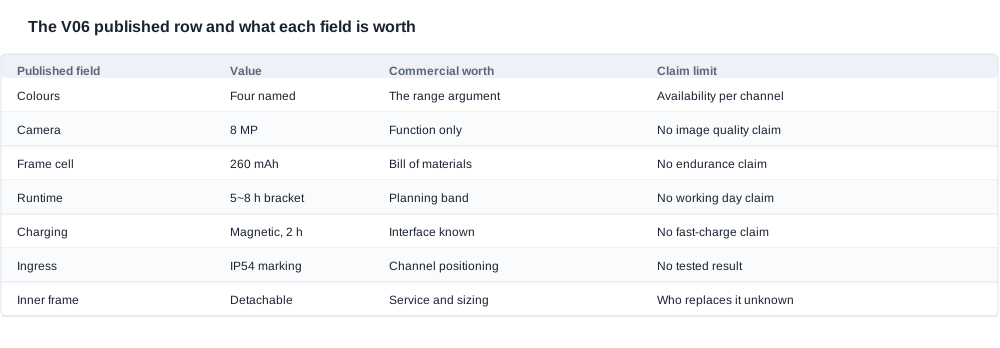
The published row, and why the colours matter more than the camera
The published specification is: 8 megapixels, 260 mAh, magnetic charging in up to two hours, a rated runtime of five to eight hours, an IP54 marking, an ergonomic frame, a detachable inner frame, and four colour options.
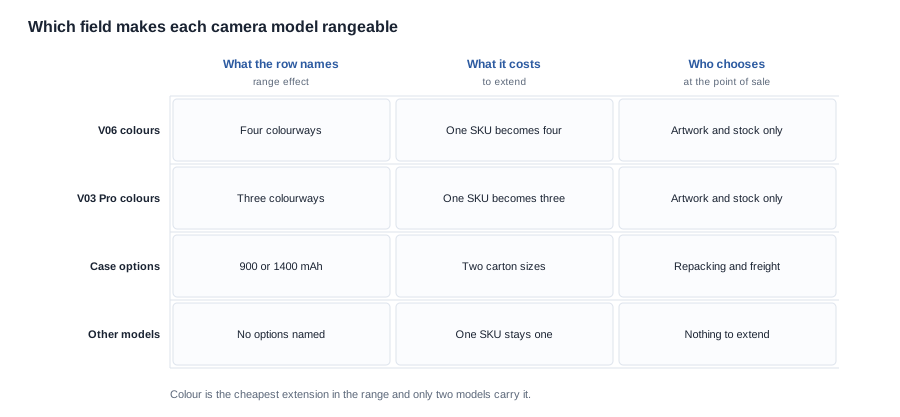
Set that against the other camera models. The MT6 and the KY06, the L2 Utral and the CY05, and the MT5 and the CY03, and the L1 Pro all publish no colour list. The V03 and the V03 Pro are the exception in the other direction: the V03 Pro publishes three, and it is the only model in the whole catalogue with a photochromic lens.
So the V06 sits in a gap that is genuinely its own: a camera product with sport mechanics and a documented retail colour range. It is not the highest-resolution camera model — the L1 Pro and the L2 Utral are 13 megapixels — and it is not the feature-led one, which is the V03 Pro's lens. It is the one a customer picks off a shelf.
And colour is the cheapest range extension a brand can buy. Four colourways on one platform means four listings, four sets of product photography and four merchandising decisions, with no new tooling, no new certification position, no new firmware and no new accessory line. In a category where the specification sheet is four rows deep, colour is frequently the only real differentiation available, and the V06 is the only camera model that offers it.
It is also worth being honest about what the four colours do not do. They do not make the product better, they do not improve the specification, and they do not answer the two questions a distributor asks first, which are what the defect rate is and what the minimum order is. A buyer who chooses this model for the colours and then discovers the operational terms are open is going to spend the same amount of time closing them as with any other model. The colours save artwork and qualification work; they do not save diligence.
That last point is the one a procurement manager should test hardest, because it is the whole argument. Four colourways without a second certification position, a second firmware branch or a second accessory line means the marginal cost of the third and fourth colour is artwork plus inventory, not qualification. Compare that with adding a model: a new model repeats the camera qualification, the compliance work and the accessory line, and it buys a specification difference that the published documentation does not support. For a brand assembling a range under a fixed budget, the arithmetic strongly favours colour over models, and the V06 is the only camera product on which that arithmetic can be run.
There is one more commercial consequence of a documented colour ladder that only shows up after launch, and it is the merchandising one. Four colourways create four distinct demand curves, and the curves will not be equal. In practice one colour moves quickly and three move slowly, which means the slow three become working capital that sits in a warehouse while the fast one is reordered. A buyer who has not anticipated this inherits the problem; a buyer who has asked for colour-level minimums and a colour-level reorder lead time inherits a manageable one.
The mitigation is unglamorous and effective: ask for the minimum order quantity per colourway rather than per model, ask whether the minimum can be mixed across colours, and ask what happens to the lead time if a single colour is reordered separately. Three questions, and they determine whether four colours are a range or a liability.
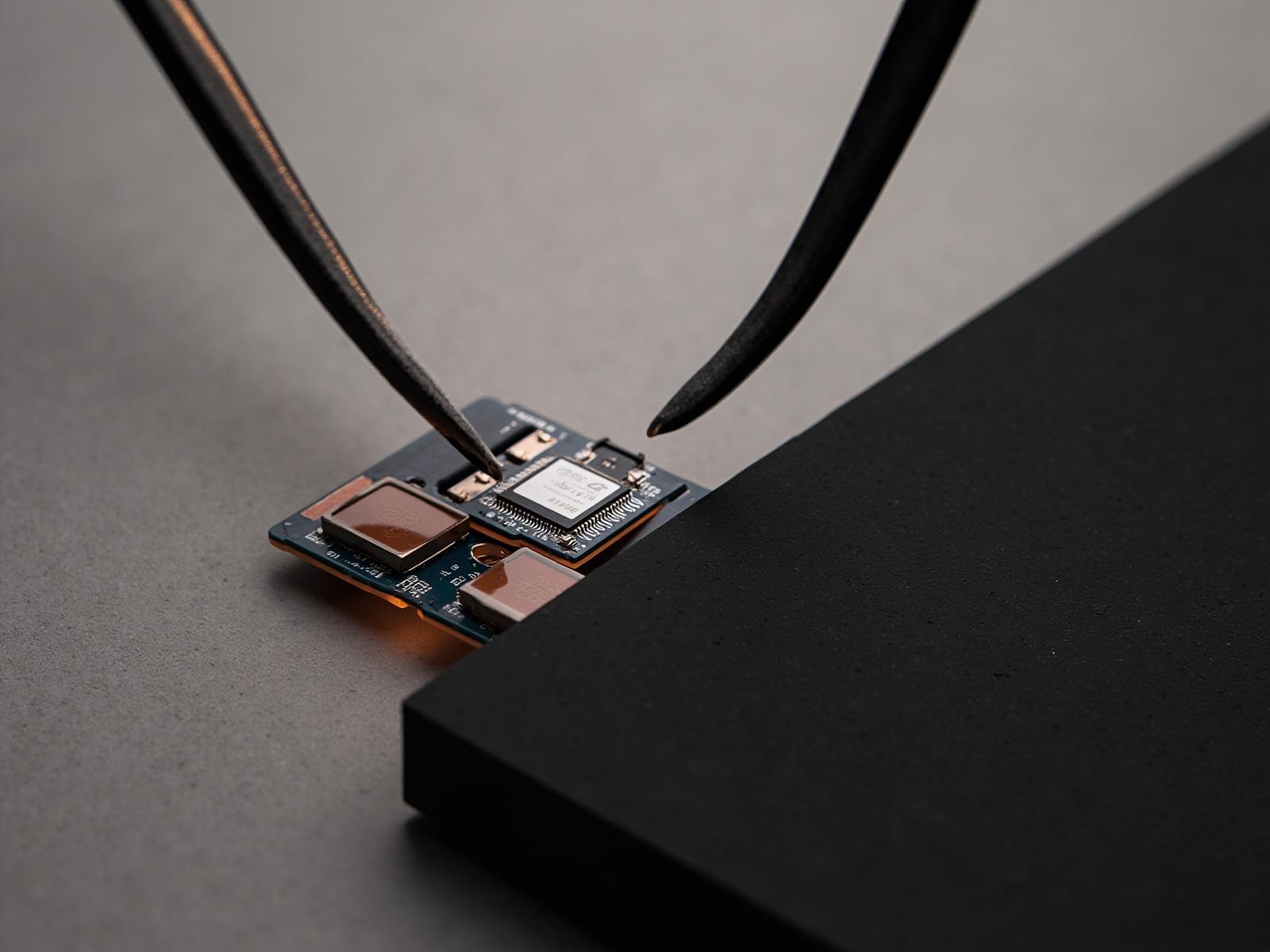
The sport mechanics, and the one qualification
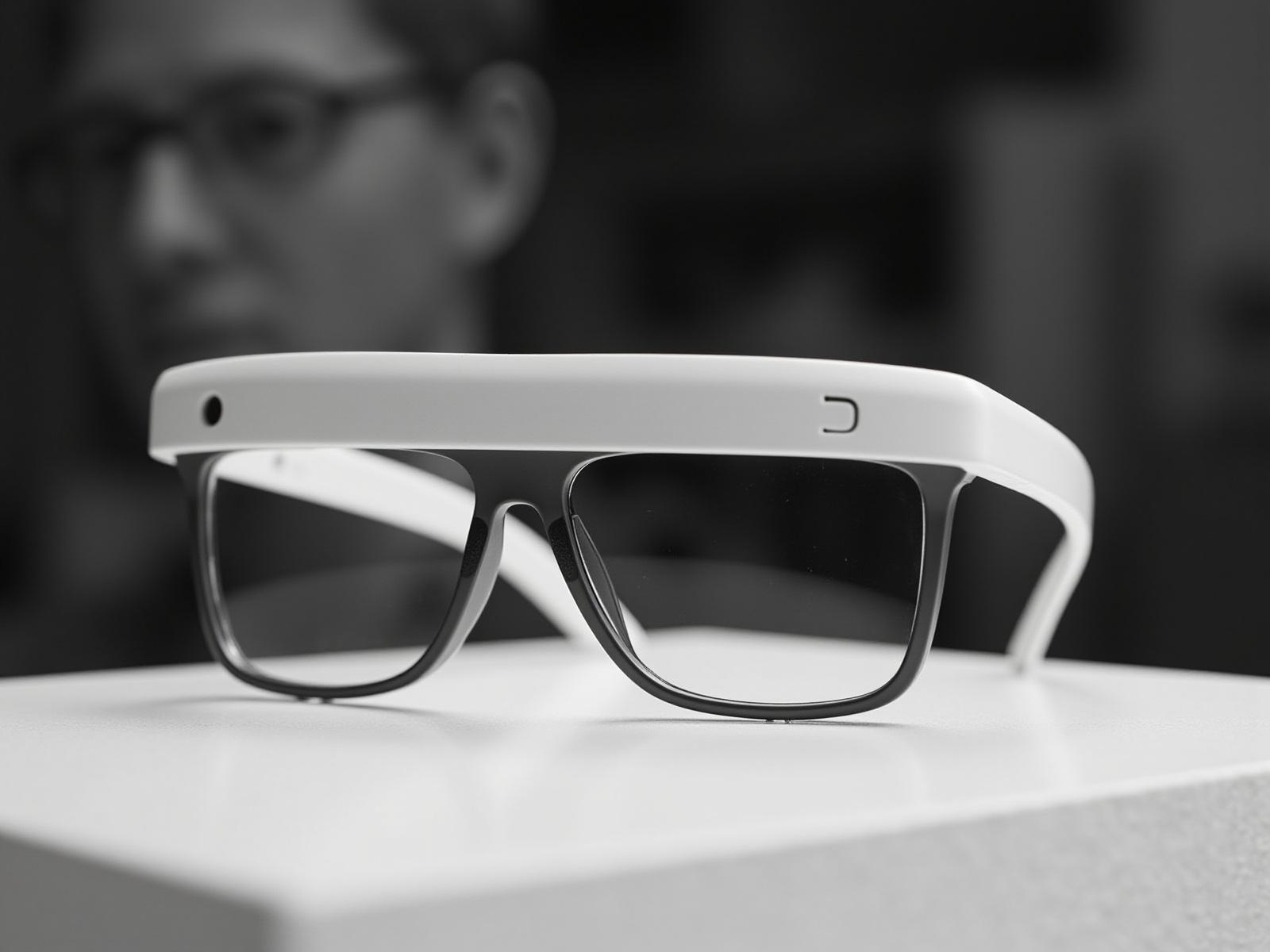
The IP54 marking, the ergonomic frame and the detachable inner frame are the published feature list of the two camera models that carry them, and they are what lets a brand sell this model in an outdoor or eyewear channel rather than a gadget channel.
Before either channel is chosen, there is a question about the sport mechanics that a buyer should ask, and it is about who carries the risk. An eyewear channel sells on a hook and accepts that some units are returned because the shape was wrong. A gadget channel sells on a comparison and accepts that some units are returned because the specification was not what the customer expected. Those are two different return populations, and they need two different inspection criteria at incoming. Mixing them produces an inspection that is too strict for one channel and too lax for the other, which shows up later as an acceptance dispute rather than as a quality finding.
The same applies to the sport mechanics themselves. The IP54 marking, the ergonomic frame and the detachable inner frame are three claims a customer can only partly verify at the point of purchase. A buyer who lists them prominently should be able to say what each one is worth in observable behaviour, or the listing becomes a set of adjectives. IP54 is worth dust tolerance and sprayed water; the ergonomic frame is worth nothing observable at all; the detachable inner frame is worth a sizing range, once the replacement policy is known.
That channel choice is the second commercial argument, and it is worth stating in commercial terms rather than in product terms. An eyewear channel buys on colour, shape and price and sells on the hook; a gadget channel buys on specification and sells on comparison tables. A product with four colours and sport mechanics is sellable in the first and merely comparable in the second. A product with a specification advantage and no colours is the reverse. The V06's published row happens to suit the channel that has more units to sell, which is not the same as being the better product.
The qualification is that the IP54 marking is a catalogue marking with no third-party test report number published behind it, and IP54's second digit covers protection against splashing water rather than immersion or sustained rain. A brand can state the marking as a marking; it cannot state a tested result. Our IP rating guidance covers the difference, and the family-level compliance position is in V06 certification status.
The detachable inner frame is a service and a sizing story, and whether it is user-replaceable or factory-only is not published for this model. That single answer decides whether a brand can offer a temple-length range on it.
The consequence of that answer is larger than it first appears. A user-replaceable inner frame turns the programme into one finished SKU plus a small range of parts, which lowers the working capital tied up in finished units and creates a recurring parts line. A factory-only frame turns it into several finished units, each carrying its own minimum order quantity, and the range ladder then costs inventory rather than parts. Both structures work; they are different businesses with different cash profiles, and the question is worth asking before the first artwork is approved rather than after the first size proves unsellable.
A fourth case, less obvious than the other three, is a brief built on a published weight. A channel that lists a weight on the product page, or a programme that ships per-gram shipping data, needs a number this row does not carry. That number has to come from a sample order, which means the launch date is now dependent on a measurement rather than on a document, and any launch plan that assumed a same-week figure has to absorb a week of slack.
Where the V06 does not win
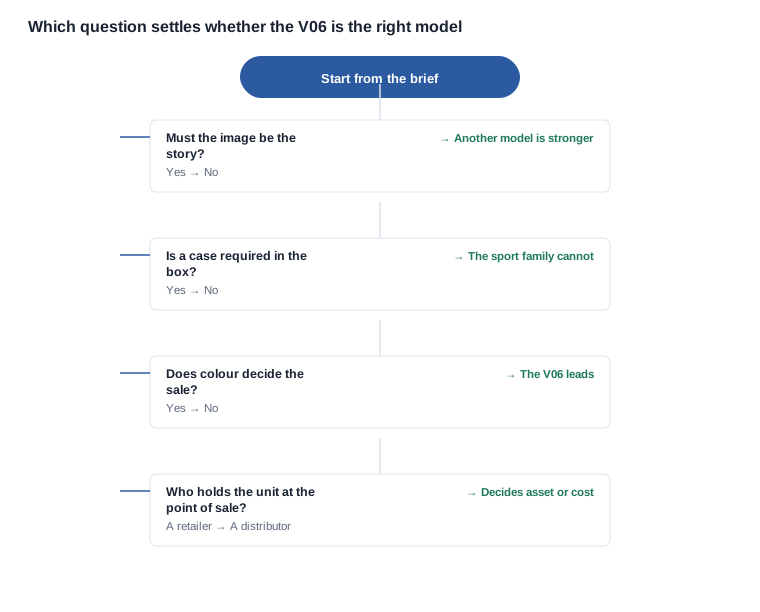
If the image has to be the story, this is not the model. 8 megapixels against the 13 of the L1 Pro and the L2 Utral — and no sensor, field of view, video resolution or frame rate is published for any camera model in the range, so neither figure can be shown to produce a better image. A brand selling on image quality needs a sample and a test shot, and the V06 against the S7 comparison sets out the same trade from the other side.
A fourth case is the brief that specifies a changing lens. Only the V03 Pro publishes one, so a programme whose differentiator is a lens that reacts to light is not choosing among camera models; it is choosing one model and excluding the rest. That is worth saying plainly because the V06's sport mechanics make it look like a natural fit for an outdoor brand, and an outdoor brand is exactly the kind of customer who ends up wanting a lens that darkens in sunlight.
It is worth adding what that sample test should measure, because a resolution figure on its own is not a test. Photograph both units in the same scene at the same light, compare them side by side at print size rather than at screen size, and record which one a non-technical viewer prefers. That is the only comparison that maps onto the decision the customer actually makes, and it takes an afternoon rather than an engineering programme.
If the product needs a charging case, the sport family does not have one. No model in this family publishes a case, and the camera family does — the CY05 and the CY03, and the L1 Pro — each at 1400 mAh, the MT6 at 1200 mAh with a folding case, the L2 Utral with a 900 or 1400 mAh option. If the retail story is built on the case, the V06 is the wrong line.
If the product needs a lens that changes, the V03 Pro is the only model in the range that publishes one.
And if the product needs a published weight, the V06 does not have one. The 158 gram figure belongs to the MT6 and does not transfer, and no frame weight, temple length or lens dimension is published for this model — which matters in a product worn through an active session.
Those four cases share a shape. Each of them is a brief whose deciding requirement is a specific published field, and in each the V06's row is silent or contradicted. A buyer who has one of these briefs is not choosing between similar products; they are choosing between this model and a different model, and the colour advantage does not survive the comparison because the channel argument has already been settled by the requirement.
The other thing a buyer should settle first
Whether a colourway is a product decision or a marketing decision for this model. Four published colours means four SKUs for a brand to manage, four sets of artwork, and four inventory positions. On a sport product sold to a customer who is choosing between real glasses, that is usually the right call. On a product sold to a distributor who wants a single line, it is a cost. Our entry level analysis covers how to decide that kind of question across the range.
The cost side of the same decision is worth quantifying before the SKUs are split rather than after. Four colourways mean four minimum order quantities rather than one, four artwork approvals rather than one, and four sets of inventory to forecast rather than one. Against that, four colourways mean four chances to sell on a hook where a single variant might not sell at all. Which side dominates depends entirely on whether the channel can display more than one variant at a time, and a distributor filling a single line from a container usually cannot.
The test is short. Write down who holds the finished unit at the point of sale. If it is the retailer choosing from a hook, four colours multiply the chance of a sale. If it is a distributor filling a single line from a container, four colours divide the same container into four smaller quantities, and each of those has to clear its own minimum order quantity, its own freight band and its own slow-moving risk. The same four colourways are an asset in one channel and a working capital problem in the other.

The judgement behind this recommendation
The V06 is a well-specified camera model whose commercial value is mostly in the four colours and the sport mechanics, and a brand should put the colour range in the listing rather than the megapixel figure, because the colour range is a claim a customer can check and the megapixel figure is a claim the documentation cannot support.
We will not present the family's IP54 marking as a tested result, we will not extend the 158 gram figure to this model, and we will not add a lens or a fast-charge claim that its own row does not carry.
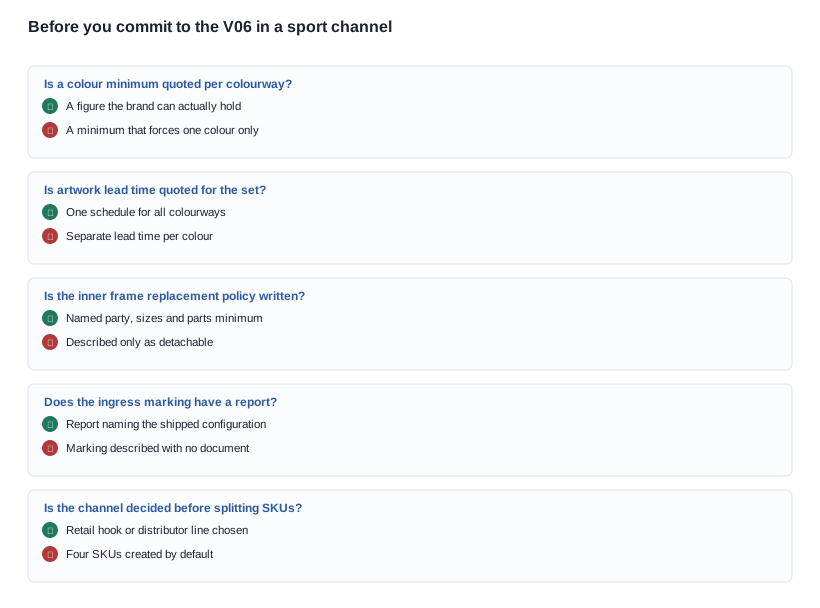
How to evaluate a supplier on this model is different from evaluating one on a specification-led product. The questions that decide the programme here are colour minimums per colourway, artwork lead time per colourway, the inner frame replacement policy, and the certification position for the exact configuration that will ship. A supplier who answers all four in writing has told the buyer more about this model than a supplier who has described the camera at length, because the camera is the part of the proposition that is already published.
One further red flag belongs on the list, and it is the most common one in colour-led ranges: a supplier who quotes artwork per colourway with no set price and no shared schedule. Per-colourway quoting means each colour is being treated as a separate product with its own approval path, which is the cost case rather than the range case, and a brand that accepts it has paid the tooling premium without receiving the operational benefit.
Red flags specific to a colour-led product are narrow and worth naming. A colour minimum high enough that the brand cannot hold two variants is a minimum that eliminates the advantage it was supposed to create. Artwork lead times quoted per colour rather than as a set usually indicate that the colours are treated as separate products, which is the cost case rather than the range case. And a supplier who offers to add a fifth colour without naming a minimum is offering something a brand will have to fund.
Before you commit, the shortlist should carry the channel written against it, because that is the variable that decides whether the four colours are an asset or a cost, and it is the one that no specification sheet answers.
The shortest version of this page is that the V06 is the camera model in this range a customer can choose, and that the choice is made on colour rather than on specification because the specification is not what the customer evaluates. A brand selling into an eyewear or outdoor channel has a product that fits the channel for the right reason. A brand selling into a specification-led gadget channel has a product that competes on the one axis the documentation cannot support, and that is a harder position than the colour list can rescue.
Tell us the sport, the channel, the volume and the target market and we will come back with what is available and what is not. The family is on our sport smart glasses range page.
Related reading
- The camera tier in the same family — V06 against the S7
- What the family feature list actually attributes — sport family questions
- The compliance position for this model — V06 certification status
Tell us the sport, the channel, the volume and the target market, and we will come back with what is available.


