

A v06 smart glasses vs s7 spec comparison that only reads the two specification rows will tell you there is one difference worth arguing about, and it is wrong. The two models publish a 260 mAh battery, up to two hours of magnetic charging, a rated runtime of five to eight hours, an IP54 marking, an ergonomic frame and a detachable inner frame. The V06 publishes an 8-megapixel camera and four colour options. The S7 publishes a 13-megapixel camera and no colour list at all. Everything that separates them commercially sits in those last two clauses, and one of them is a merchandising decision while the other is an unresolved technical question.
The practical conclusion for a buyer: this is not a specification upgrade. It is a choice between running one camera platform as four retail listings, or running one camera platform twice at two resolution tiers. The first option is a range. The second is a catalogue page with a confusing comparison chart on it.
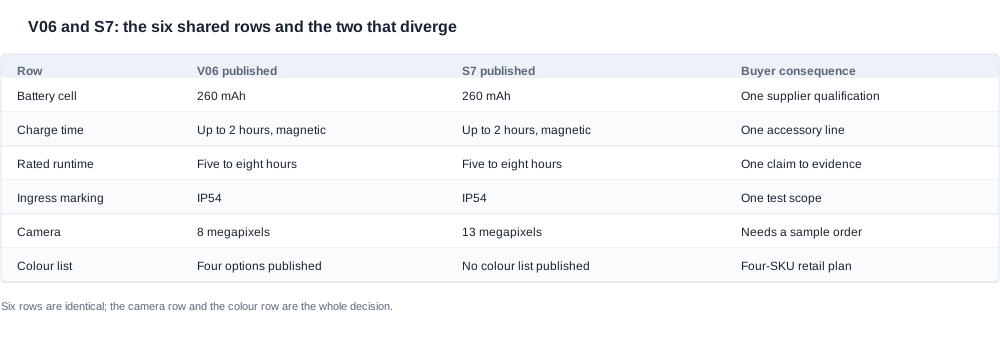
V06 smart glasses vs S7: what the two published rows actually share
Six rows are identical between the two models, and identical rows are the most commercially valuable thing in a range sheet. Same cell capacity at 260 mAh. Same magnetic charging at up to two hours. Same rated runtime band of five to eight hours. Same IP54 marking. Same ergonomic frame. Same detachable inner frame.
A brand running both has one platform to qualify, one technical file to assemble, one certification position to defend, one packaging system to tool, one firmware branch to maintain and one accessory line to hold in stock. That is the single largest cost saving available in any two-model decision, and it is invisible in the specification comparison because it does not appear on either row.
The same structure is available elsewhere in the family. The D17 publishes into the same sport group, and the comparison between those two is handled in the D17 against the V06 position. What matters for this pair is that the shared block is long enough to amortise a real amount of factory work: one production line, one quality control route, one set of incoming inspection criteria and one shipment consolidation plan.
Now the part most comparisons get wrong. Shared rows do not mean the two models will behave identically in the field, because the camera is the one row that is not shared and it is the row that draws the most current. A higher-resolution sensor is not free at the electrical level even when it is fitted in a frame of the same size. Our published documentation does not quantify that difference, and we are not going to invent a figure for it — which is precisely why the runtime band stays a band rather than a number.
What a buyer should take from this section: treat the shared six rows as an amortisation argument, and treat the camera row as the only variable that needs a sample order.
| Shared row | V06 published | S7 published | What it saves a buyer |
|---|---|---|---|
| Battery cell | 260 mAh | 260 mAh | One tooling and one supplier qualification |
| Charge time | Up to two hours, magnetic | Up to two hours, magnetic | One charging accessory line |
| Rated runtime | Five to eight hours | Five to eight hours | One listing claim to evidence |
| Ingress marking | IP54 | IP54 | One test scope, one file |
| Frame | Ergonomic | Ergonomic | One fit programme |
| Inner frame | Detachable | Detachable | One sizing strategy |

Colour is a range decision, not a specification decision
The V06 publishes four colour options: orange, white ice-blue, black and black ice-blue. Those are recorded as available configurations for the model rather than as part of its main specification row, which is worth understanding precisely because it means the options are specified and real rather than implied.
That is the cheapest range extension available to a brand in this category. Four colourways on one platform means four listings, four sets of product photography, four merchandising decisions and four retail price points you can set independently — with no new tooling, no new certification position, no new firmware branch and no new accessory line. In a category where the published specification sheet is six rows deep, colour is very often the only genuine differentiation left to take.
It also matches how the channel actually decides. A sport or outdoor brand's customer is buying eyewear first and electronics second, and colour is the decision made at the shelf, in the hand, in three seconds. The V06 is the model in this family that a customer can choose at the point of sale rather than after a specification conversation.
The corresponding fact about the S7 is that it publishes no colour list at all. Read that precisely: it is not a statement that the S7 is unavailable in colours, it is a statement that our documentation does not name any. A buyer who needs a colour choice on the higher-resolution model has to ask, and it is a reasonable question to put in the first email to the supplier. The answer you want is a colour schedule with codes and order quantities per code, not a photograph.
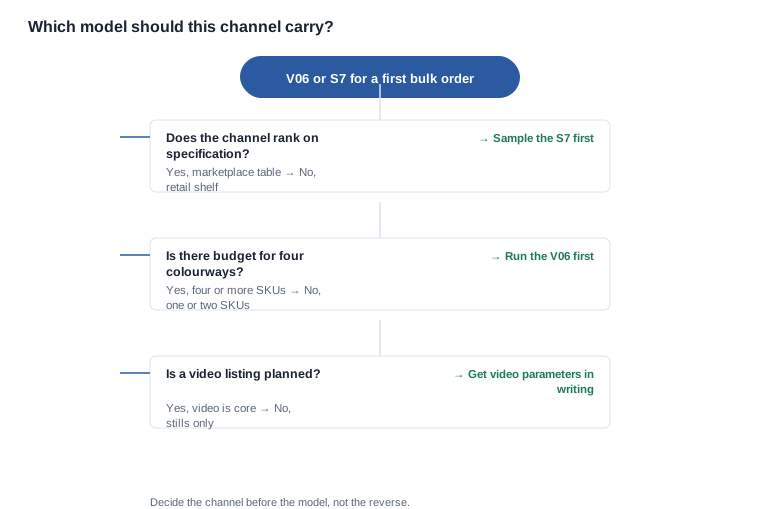
The trade-off to name explicitly when you negotiate: colour depth costs you shelf space, packaging variants and inventory carrying risk across four or more SKUs, while resolution depth costs you nothing operationally but gives you a claim you cannot yet evidence. Colour is a certain asset with a carrying cost. Megapixels are an uncertain claim with no carrying cost. A brand with predictable sell-through in a single market should usually take colour; a brand competing on a specification table in a marketplace should understand exactly what it is buying before it does.
The carrying cost is worth quantifying before you commit, because it is the part that quietly breaks a four-colour plan. Four colours means four sets of packaging artwork, four barcode and carton markings, four shipping carton configurations if sizes differ, and four separate demand forecasts that will be wrong by different amounts. It also means four reorder decisions rather than one, and reorder lead time is where a good plan goes bad. Ask the supplier for the MOQ per colourway and for whether mixed-colour orders can ship in one consignment; if the answer is that each colour runs on its own production window, your effective lead time is the longest of the four, not the average.
The commercial reason colour still wins is that it does not need a laboratory. A colour photograph can be taken in your own studio against your own background and checked against your own brand standard in an afternoon. A resolution claim needs a controlled comparison, a sample stage and a written test method before it can go on a page at all. For a brand buying its first bulk order of this category, the return on the colour decision arrives sooner and with less documentation overhead.
One more asymmetry worth naming: colour is reversible and the resolution claim is not. If a colourway underperforms you stop reordering it and nothing outside the business has changed. If you publish an unverified resolution advantage, the correction is public. That asymmetry is the strongest argument for running the colour story first and treating the specification story as something you earn later, with evidence.
Megapixels are a claim that needs a sample, not a table
The S7 publishes 13 megapixels against the V06's 8, and that number is the only imaging difference our documentation records between them.
Here is the honest position on that number, and it applies to every camera model in this range. No sensor model, no field of view, no video resolution, no frame rate, no aperture and no pixel size is published for either product. A 13-megapixel sensor with small pixels can produce a worse picture than an 8-megapixel sensor with large ones, particularly indoors, at dusk or in low ambient light, and a shopper comparing two specification tables will read the larger number as better without any way to check.
Our own documentation is explicit that a parameter comparison advantage of this kind should not be claimed externally until it has been verified against a competitor's unit in the hand. That is a sourcing rule, not a marketing preference, because a claim that cannot survive a customer's own test costs more in returns and in channel trust than a modest specification advantage earns.
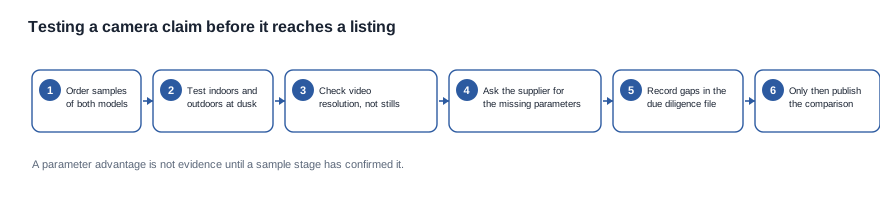
How to evaluate the difference, in order. First, hold a sample order of both models — not one, both, because a single unit tells you about manufacturing variance rather than about the specification. Second, test indoors and outdoors, because indoor performance is where pixel size matters most. Third, check the video path rather than the still path, since a resolution figure most often describes stills. Fourth, ask the supplier directly for the video resolution and frame rate, and write the answer into the purchase order if it matters to your listing.
If the supplier cannot supply those figures, that is not automatically a red flag, but it is a documented gap. Record it in your due diligence file, do not repeat the resolution number on a product page as if it were a tested result, and move on. The camera imaging guidance sets out the parameters that actually determine picture quality and is worth reading before you build any comparison claim on a megapixel figure.
There is a second-order effect that matters more than the picture. A camera in a frame is the component that most often drives the returned-unit rate in this category, and returns are a quality control problem before they are a marketing problem. If you cannot describe how your customer will use the camera, you cannot describe the failure modes you need your acceptance criteria to catch. Write the intended use into the purchase order — stills only, video only, or both — and make the incoming inspection route match it. A factory that quality-controls for stills will not catch a video fault, and a factory that quality-controls for video will spend inspection time your channel never uses.
The same logic applies to the runtime band. Five to eight hours is a band, not a figure, and bands usually mean two different test conditions are folded into one row. Ask which condition produces the low end and which produces the high end, and whether your volume order is tested against the low one. A listing that promises the high end when the factory tests the low end is a returns problem you will pay for twice, once in the shipment and once in the warranty claim. Our battery life guidance covers why a rated figure without a stated test condition is not a usable commercial claim.
Finally, be careful about which comparison you publish. The defensible version of this comparison is the shared-platform version: two models, six identical rows, one certification position, four colourways on one of them. The indefensible version is a single sentence claiming better imaging, because our documentation does not support it.

What neither row answers, and the questions to send instead
Both models share six rows and diverge on two. The twelve questions below are the ones our documentation cannot answer, and each one is a question you can send to the supplier before you commit a purchase order.
- Sensor model, field of view, video resolution and frame rate — not published for either model, and these are what would settle the resolution question in either direction.
- Frame weight, temple length and lens dimensions — not published for either, and physical dimensions are the largest single driver of returns in a product worn for hours.
- Whether the detachable inner frame is user-replaceable or factory-only — not published for either, and it decides whether the inner frame is a retail sizing strategy or a manufacturing feature.
- The IP54 test report behind the marking — the marking is published; the report, its test conditions and its laboratory are not.
- Certificate numbers, issuing bodies, validity periods and the model schedule each certificate covers — none are published, and a certificate that does not name your model is not a certificate for your model.
- MOQ per model and per colour — not published, and on a four-colour platform this is the number that decides whether the colour story is affordable.
- Lead time per colourway and whether colours run on the same production window — not published, and mixed colour schedules are where four-SKU plans usually fail.
- Warranty terms and the defect categories treated as warranty returns — not published, and this is the clause that determines your cost of ownership after landing.
Two more that belong in the quotation rather than the question list. Ask for the total cost at your actual volume, including packaging, and ask what the payment terms and deposit structure look like for a first order against a repeat order. A first order and a repeat order should not carry the same terms, and a supplier who offers them identically has not thought about your risk.
How to run those questions matters as much as the questions themselves. Put them in writing before the sample order rather than after it, because a supplier's answer to "what is the MOQ per colour" is very different before and after a purchase order exists. Ask for answers in the same document — a specification sheet, a price schedule and a compliance list — so that gaps are visible as gaps rather than distributed across three emails. The supplier evaluation and risk pages cover how to record the answers once you have them.
There is one red flag worth naming explicitly. If a supplier answers a missing-parameter question with a confident number that is not in their own documentation, the number did not come from a test. Confidence is not evidence, and the way to tell the difference is to ask what test it came from. Write the question back to them and see whether the answer survives a second round.
On the certification side specifically: our IP rating explanation covers what the marking means and what it does not, and the family-level compliance position is set out in V06 certification status. No certificate numbers, issuing bodies or validity periods are published in this comparison, and we will not imply otherwise.

Where the platform stands, and what to fix in writing
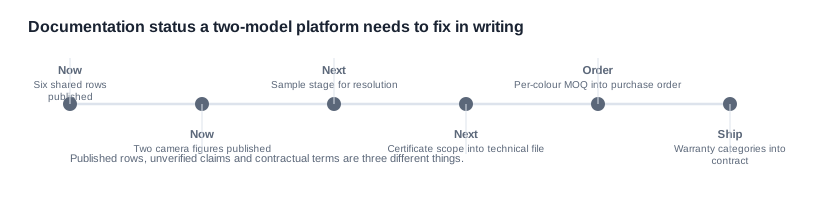
The useful way to hold this comparison is as a document with a timeline attached: what is published now, what is a claim awaiting evidence, and what you want written into the contract before the first shipment.
Published and usable today: both cell capacities, both charge times, both runtime bands, both ingress markings, both frame descriptions, the V06 colour list of four options, and the two camera figures.
Published but not independently verified: both camera megapixel figures, and the runtime bands, which are rated figures whose test conditions are not stated in our documentation.
Not published, and therefore a question rather than a specification: weight, temple length, lens dimensions, sensor and video parameters, inner frame replaceability, the ingress test report, certificate numbers and validity, MOQ, lead time, warranty terms, packaging specification, and unit pricing.
What to fix in writing before you commit. Put the colour schedule and the per-colourway MOQ into the purchase order. Put the agreed resolution and any video parameters into the technical file. Put the warranty categories and the defect remedy into the contract. Put the certificate scope into the technical file too — the model schedule matters more than the certificate existing. Our contract terms and certification checklist pages cover how these clauses are normally structured.
And do not skip the sample order. If you are going to publish a resolution comparison, the evidence has to come from a sample stage before mass production, not from the finished bulk order. The samples and factory audit stages exist for exactly this reason.
Two commercial terms are worth negotiating while the order is still small, because they get expensive to change later. The first is the acceptance criteria: what the goods are measured against when they arrive, written in the contract rather than agreed by email afterwards. The second is the remedy for a mismatch — replacement, credit or rework — because a supplier who will not name a remedy has effectively declined the claim. Both are easier to obtain on a first order than on the fourth, and both should be settled before the deposit goes out. The contract terms and payment terms pages set out the structure.
And a note on what to negotiate on. Lead time is the term buyers most often accept without reading. Ask what the lead time is measured from — deposit, artwork approval, sample confirmation or order entry — because a supplier quoting 25 days from artwork approval and a supplier quoting 25 days from deposit are quoting different products. Our lead time guidance covers the distinction. A four-colour platform multiplies whatever the real answer turns out to be.
The shortlist test, and what we will not claim
This pair is a genuinely good two-SKU platform, and the mistake is to read it as a specification upgrade. The V06 is the model a customer chooses from a shelf; the S7 is the model a customer chooses from a table. A brand that puts a megapixel figure next to a competitor's 8-megapixel model is making a claim the documentation does not support; a brand that puts four colourways on a shelf is making a claim it can honour at the reorder.
We will not present the resolution difference as a demonstrated image advantage, and we will not present the family's ingress marking as a tested result for either model.
The shortlist test, if you want one: if your channel rewards specification comparison, hold the S7 in sample and get the video parameters in writing before you list it. If your channel rewards retail conversion and sell-through, run the V06 across four colours and treat the S7 as an upsell. If you need both, the amortisation argument above is the reason it is cheap to run both — and the missing camera parameters are the reason the specification page needs a footnote.
Tell us the channel, the volume and the target market, and we will tell you whether running both models is the right structure for you. The family is on our sport smart glasses range page, and the higher tier's model-level detail sits in S7 compared, with the runtime rows broken out in V06 and S7 battery and charging.
Related reading
- The published rows behind the higher tier — S7 compared
- Runtime and charging, row by row — V06 and S7 battery and charging
- What the family feature list actually attributes — sport family questions
- How a camera claim should be tested — camera imaging


