
Two entries in this catalogue are both sold into sport contexts, and a buyer who wants to place them side by side on a single page or a single quotation has to start by establishing that they are not on the same published axis. The V06 is a camera model: it publishes a camera class of eight megapixels, a removable inner frame, an IP54 ingress marking and four colour names. The D17 is a sport model: it publishes a remote shutter row, a surround-sound row, a Type-C charging interface and a radio version of 5.4. One of them publishes a camera and the other publishes a shutter control; one of them publishes a colour programme and the other publishes nothing about colour; one of them publishes a cell of 260 milliampere-hour and the other a cell of 115 milliampere-hour.
The published record therefore does not support a single price ladder between them, and the question of how a buyer should handle the two together is not a question about levels. It is a question about quotation basis. This article sets out what each entry is made of, what each one asks of a supplier, and how a quote sheet has to be constructed when a single order or a single range contains both. Nothing here places one model above the other, because the published rows do not contain the information that would let anybody do that, and no price for either model appears in our documentation.
V06 smart glasses vs D17 price positioning: two catalogue rows that cannot be priced against each other
The first thing to settle is what "the sport group" contains, because the catalogue does not use that phrase as a single tier. Twenty-eight models are published, and they fall into eight audio models, three sport models and eleven camera models. The D17 sits among the three sport models. The V06 sits among the eleven camera models, even though its catalogue name carries a sport descriptor as well — a naming convention that makes it easy to place it in the wrong group when a range is being built from a spreadsheet rather than from the published tiers.
That distinction is not administrative. It is the reason the two entries behave differently in a quotation, in a listing and in a compliance file, and it is worth setting out how.
They publish different kinds of assertion on the same axes. The endurance figure for the V06 runs from five to eight hours, and the catalogue publishes no condition behind either end of it. The endurance figure for the D17 is an approximate seven hours, also published without a condition. A band and a point are not the same kind of number, and neither of them can be compared with the other without the condition behind each one. The same is true of the charge time: the V06 publishes a ceiling of two hours or less, and the D17 publishes an approximate one hour. Two models in this catalogue publish an approximate figure of about an hour — the D17 and the ZH12 — and every other entry publishes the two-hours-or-less ceiling. A comparison that writes "the D17 charges twice as fast" has compared a ceiling with an approximation and reached a conclusion the record cannot carry.
They disclose different things about the radio. The D17 publishes a radio version of 5.4. The version fitted to this model comes out of an assessment rather than out of a row, because no camera model in the range publishes one. This matters in practice because a channel that publishes a radio version on a product page for one model and not for another will be asked about the difference, and the answer for the camera model is a document request rather than a sentence.
They publish different feature rows, and the feature rows are the product. The V06 publishes rows for the ergonomics of the frame, for the endurance in general terms, for a removable inner frame, and for an IP54 ingress marking. The D17 publishes a remote control photo row and a surround-sound row. An ingress marking appears in the published rows of two models only — this one and the S7 — and the remote shutter row appears in the published rows of two models only — the D17 and the ZH12. Neither of those four-way facts is a ranking; they are statements about where each capability is documented, and they are the reason a buyer cannot construct one feature matrix in which the two entries are alternatives to each other.
They carry different configuration consequences. The V06 publishes four colour names, and the D17 publishes none. Only two models in the catalogue publish a colour row at all, this one with four names and the V03 Pro with three. A colour programme for the V06 is a published set of four options to plan tooling, artwork and packaging around; a colour programme for the D17 is a conversation with the factory in which nothing has been stated yet. In the same way, the removable inner frame on the V06 creates a second part and a parts question that the D17 does not have, because the D17's published rows describe no removable assembly.
They charge in different ways, and the difference is an accessory decision. The V06 charges magnetically, so the product in the carton needs a proprietary contact, a pad or a case. The D17 charges over Type-C, so the product in the carton can be charged with a cable the customer already owns. Nothing in the D17's published rows describes a charging case either, so the carton contents for that model are as undefined as they are for this one — but the two models reach that position by different routes, and the accessory strategy that suits one of them will not suit the other.
Neither model has a published weight. The catalogue publishes one weight anywhere in the range, and it belongs to a third model — 158 grams for the MT6 glasses body, and that number leaves out the folding charging case which that model carries. A weight belonging to another model cannot be used as a proxy, so the packed weight and therefore the freight class of either of these two entries is not computable from the documentation.
The result of working through all of this is not a conclusion about which of the two to stock. It is a conclusion about what a comparison between them can legitimately be used for. It cannot be used to establish a price ladder, because they sit on different published tiers, publish different assertion types and carry different configuration consequences. It can be used to establish that a range containing both has to be quoted against two separate configurations.

The camera model and the sport model, side by side on the published rows
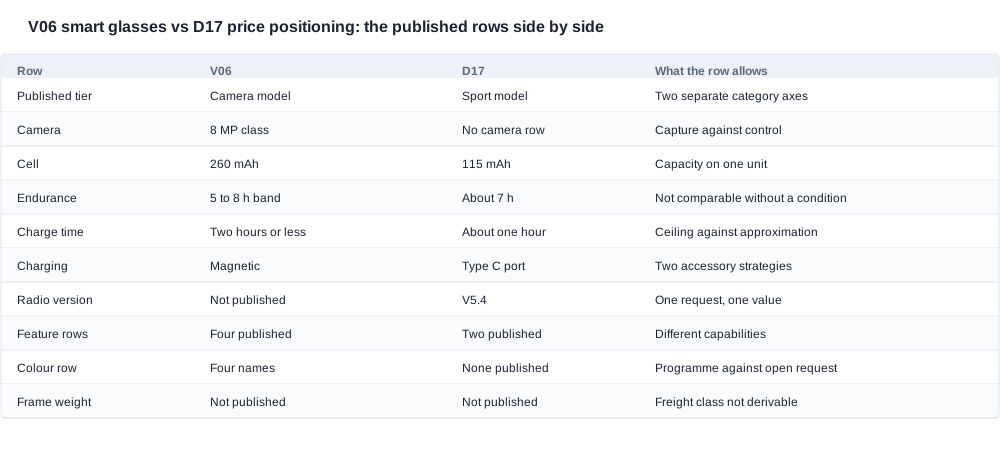
The table below sets the two entries against each other on the published rows, and the fourth column is the part that matters for procurement: what the row does and does not let a buyer do.
| Row | V06 | D17 | What the row lets a buyer do |
|---|---|---|---|
| Published tier | Camera model | Sport model | Places each on its own category axis |
| Camera | 8 MP resolution class | No camera row published | A capture product against a control product |
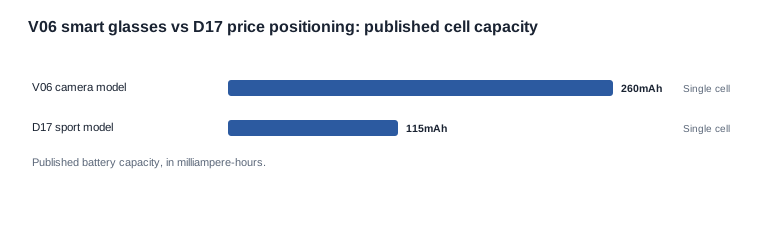
| Cell | 260 mAh | 115 mAh | A capacity comparison on the same unit |
| Endurance | 5 to 8 h band | About 7 h | Neither figure can be compared without the condition |
| Charge time | Two hours or less | About one hour | A ceiling against an approximate figure |
| Charging method | Magnetic | Type C | Two different accessory strategies |
| Radio version | Not published | V5.4 | One document request, one published value |
| Feature rows | Ergonomic design, long battery life, removable inner frame, IP54 | Remote control photo, surround sound | Different capabilities documented on each side |
| Colour row | Four names published | None published | A configuration programme against an open request |
| Frame weight | Not published | Not published | Neither freight class can be derived |
Three observations about the table are worth making explicitly, because each of them is the kind of thing that gets skipped and then costs a cycle.
The cell comparison is the one clean numeric comparison available, and it is still not a runtime comparison. Both figures are single-cell figures published on the same kind of row, so 260 milliampere-hour against 115 milliampere-hour is a legitimate statement about capacity. It says nothing about endurance, because the loads are different — a camera model draws power for capture, and the published band on the camera model is wide precisely because the capture state changes the figure. The published endurance figures, a band on one side and an approximate point on the other, are the least comparable numbers in the table.
The charging rows are not interchangeable in either direction. A buyer moving from a Type-C product to a magnetic one inherits an accessory decision, and a buyer moving from a magnetic product to a Type-C one inherits a customer expectation that the product charges with a cable in the box. Neither of those is a cost line in the catalogue; both of them are lines in a product page and in a customer-facing manual. The field handling of a magnetic contact, including what happens when a frame is seated slightly askew, is covered in the sport charging options record.
The absence of a weight on both sides is what stops the table from being a landed-cost comparison. A quotation comparison that reaches as far as freight needs a packed weight, and a packed weight needs a frame weight and an accessory weight, and neither is published for either of these two entries. That is the point at which a comparison has to leave the documentation and enter the quotation.

What each configuration is missing, and what each one asks of a supplier
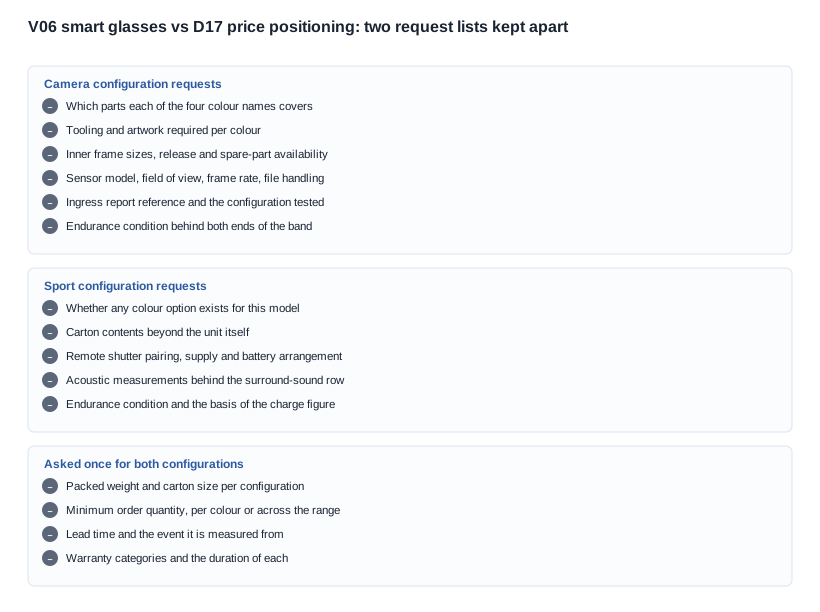
The two entries generate two different request lists, and the most useful thing a buyer can do is keep them separate rather than merging them into one message. A merged request produces a reply that answers the easier half in detail and the harder half in a sentence.
What the camera configuration asks for. The colour scope comes first, because four published colour names have to be resolved into a production programme: which parts each colour name covers, whether any of the four needs separate tooling, what artwork is required per colour, and whether the minimum order quantity applies per colour or across the range. The removable inner frame comes second, because it decides whether the business stocks a spare part or runs a service operation: the number of frames the box holds, the sizes the part is produced in, how it is released, whether a replacement can be ordered on its own, and whether the frames interchange with the other model that publishes the same row. The camera detail comes third, because a product sold for capture needs it and the catalogue gives only the resolution class: the sensor model, the field of view, whether video is recorded and in what format, the frame rate, the storage capacity and the overwrite behaviour. The ingress marking comes fourth: whether any test report exists for the marking, what reference it carries, which method was applied, which laboratory did the work, and which inner frame and colour were on the sample. and the conditions and acceptance criteria. The endurance condition comes fifth, because a band published without a condition is the row most likely to produce a customer expectation the product does not meet.
What the sport configuration asks for. The colour programme comes first, because nothing is published: whether colour options exist for this model, what they are, and whether any of them needs its own tooling and artwork. The carton contents come next, because a Type-C product may still be supplied with a cable, a case or nothing beyond the unit, and the published rows do not describe it. The remote shutter row needs a specification rather than a price: how the remote pairs, what it triggers, whether it is supplied in the carton, its battery arrangement, and how it is replaced. The surround-sound row needs a measurement set rather than a description, because a label without acoustic figures cannot be quoted in a comparison: the driver arrangement, the frequency response, the rated output, and the behaviour at volume and outdoors. The endurance condition and the charge-time basis come after that, asked in the same words as for the camera configuration so that the two answers can be compared.
What both configurations ask for, and should be asked once. The packed weight per configuration, the carton dimensions, the minimum order quantity, the lead time and the event it is measured from, the sample order quantity and cost, the warranty categories and their duration, the payment terms, the delivery term, and the compliance documentation scope for each destination market. These are the same lines for both entries, and asking them once, in one message, with the two configurations distinguished, is faster than asking them twice.

Putting two configurations on the same quote sheet
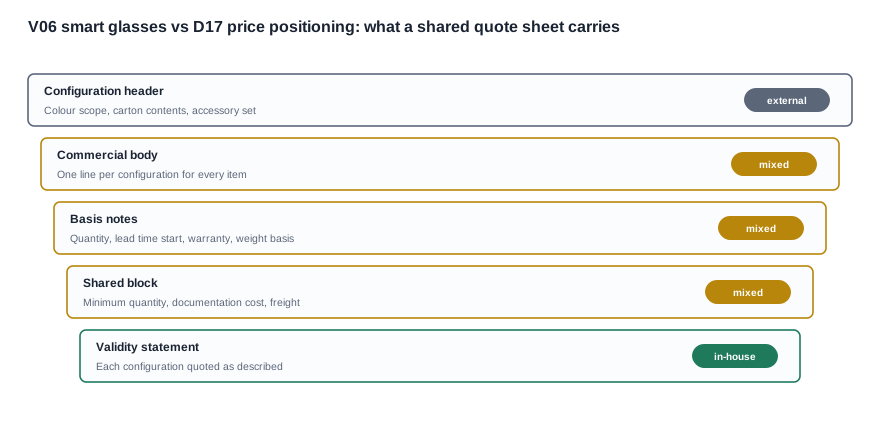
A quote sheet that contains both entries has to do one thing that a quote sheet for a single model does not have to do: describe the two configurations in a way that makes them separately priceable while still allowing them to be ordered together. Here is the structure that works, and the reason for each part of it.
Header: the configurations, described separately. The quote sheet states, for each entry, the colour range, the carton specification, the accessory package, the destination markets and the compliance scope that has been assumed. These are the same fields the two request lists produce, and they are the fields that make the rest of the sheet readable. A quote sheet with two configurations and no header is a quote sheet with two unrelated numbers on it.
Body: the commercial lines, with one line per configuration. The lines are the same for both entries, and they are the following list. The values differ, and keeping both configurations in one table makes the comparison of like with like a matter of reading across a row rather than of comparing two documents.
- Unit price, stated per unit and per configuration.
- Minimum order quantity, separately for each colour and for the range as a whole.
- Tooling and artwork, per colour configuration.
- Packaging, per colour configuration.
- Accessories, listed separately from the unit so that the two can be compared on either basis.
- Sample order quantity and the cost of a sample.
- Warranty categories and the duration of each.
- Compliance documentation, and whether it is charged per configuration or per model.
- Payment terms and the delivery term.
- Packed weight and carton size, per configuration, with the accessories included or excluded stated.
Notes: the basis of each number. The quantity each price assumes, the event the lead time starts from, the warranty categories, whether the price includes the accessory set, and whether the packed weight used for the freight estimate is measured with or without accessories. These are the notes that decide whether two numbers are on the same footing, and they are the ones most often omitted because each of them looks obvious to the person who wrote it.
A separate block for the shared lines. The minimum order quantity applies across a combined order or separately per configuration. The compliance documentation cost is shared or per configuration. The freight estimate is per carton or per consignment. Whether these are shared is a question with a commercial answer, and it belongs on the sheet rather than in an email.
A validity statement tied to the configuration. Each configuration is quoted as described in the header. A change to the colour scope, the carton contents or the destination markets invalidates the quotation for that configuration, and the sheet should say so, because a range that is adjusted by email after the fact is a range that nobody can re-order later.

How to build the comparison without building a ladder. The evaluation criteria here are structural rather than commercial, and they are worth applying before any figure is read. Does each entry sit in a tier where the rows are of the same kind? Are the assertion types the same — a band against a band, an approximation against an approximation, a ceiling against a ceiling? Are the configuration consequences the same, so that a colour programme on one side has a counterpart on the other? Is the carton defined on both sides? Are the compliance assumptions the same? Is the weight basis the same? A buyer who applies those criteria first has already established whether the two entries can be set against each other at all, and a buyer who reads the figures first will find a ladder that the documentation does not support. The checklist a shortlist should end up with is short: the tiers, the assertion types, the configuration consequences, the carton, the compliance scope and the weight basis. Asking what each of those is on both sides is the whole of the request, and a supplier who answers all six for both configurations has given a buyer everything the published record leaves open.
The boundary we hold to on this comparison is narrow, and we would rather set it out than leave it to be assumed. We publish the specification rows, the feature rows and the colour names for the V06 and the specification rows and the two feature rows for the D17, and we publish no price for either of them or for any other model in the range. We do not place the two entries on a price ladder, because they sit on different published tiers and publish different assertion types, and we do not convert an approximate charge figure into a comparison with a ceiling. We do not print the ingress marking as a tested result, we do not quote a weight or a packed weight that the documentation does not contain, and we do not read a camera row into a model that publishes none. What a buyer can take from the published record is a clear statement of what each configuration is made of and what each one asks of a supplier; the packaging and stock consequences of a multi-colour programme are covered in the sport packaging options material, the audio-side rows for the D17 are set out in the D17 specifications and features record, and the ladder inside the sport group is covered separately in the D17 and YKC02 price positioning article.


