

What causes delays in a smart glasses order is a question that procurement teams ask after the first late shipment, when the useful moment has already passed, and the answer is uncomfortable because most of the causes were visible on the purchase order before it was sent. This catalogue publishes no lead times, no production capacity, no minimum order quantity and no unit price for any of the twenty-eight entries, so it cannot tell you how long an order takes or when a schedule will slip. What it does publish is the specification set — cell capacity and count, charge time, rated runtime, charging method, resolution on the eleven camera models, an ingress marking on the V06 and the S7, colour on two models, a charging-case capacity on five camera models — and that set is enough to identify most of the causes, because each cause attaches to a specific decision that someone had to take and did not take.
The classification that matters is not by cause but by owner. A delay caused by a decision the buyer had not taken is a delay the buyer can remove from the next programme by writing the decision down earlier. A delay caused by a decision the supplier had not taken is a delay the buyer removes by setting the decision as a condition of the order. A delay caused by a third party — a forwarder, a laboratory, a market authority — is a delay the buyer removes by sequencing the request earlier. Blaming all three on one cause produces a complaint; separating them produces a plan. The five buyer-side causes, the four supplier-side causes and the seven causes that are already visible in this catalogue's own records are set out below, because the third group is the one a buyer can act on before placing an order at all.
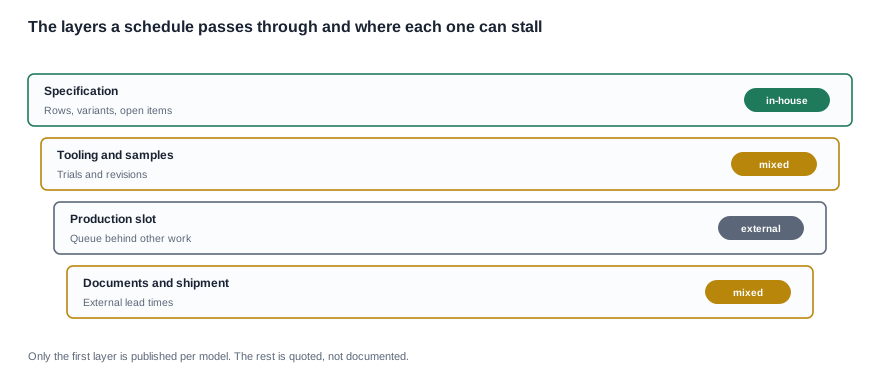
The honest starting point for any delay analysis is that this catalogue publishes the hardware and not the schedule. That means the questions in this article are about method and attribution rather than about dates, and it means the numbers that would normally be quoted — a standard lead time, a production window, a typical sample cycle — cannot be read anywhere in the published material and have to be requested for a specific configuration. The lead time factors note sets out the same point from the schedule side.
The causes that sit on the buyer's side
Five decisions in a smart glasses programme are routinely taken late, and each one produces a delay that arrives at the shipping dock rather than at the planning meeting. They are listed in the order in which they usually happen, because the earlier a decision is taken the cheaper it is to take.
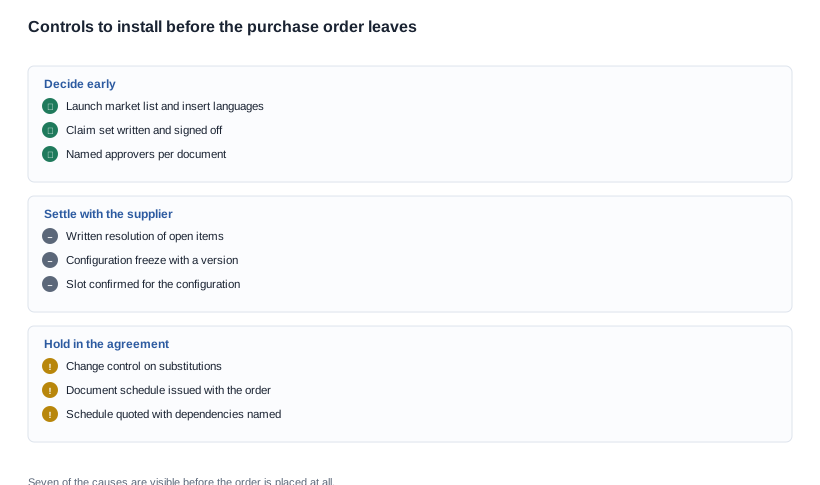
- The launch market list. A product sold into several markets usually needs different packaging content, different inserts and different labelling per market, and every one of those is a print cycle rather than a configuration switch. A market added after the artwork is approved does not join the existing print run; it starts a new one, and the new cycle lands in whichever week the goods were meant to ship. Deciding the market list in the requirements phase costs a meeting.
- The product claim set. The claims a brand intends to make about a model determine the files that have to exist, the evidence behind them and the labelling content. A claim added after the documentation has been assembled is a document cycle, and document cycles sit at the end of the schedule because they depend on everything else.
- The configuration freeze. A configuration is not a product name: it is a cell, a charging method, a case configuration, a colour and a set of features, and the catalogue publishes more than one published row for several of those. The freeze is the point at which all of them stop moving, and a freeze that happens after the first sample has been built means the sample was built against a different configuration from the one that ships.
- The sample evaluation script. A buyer who evaluates a sample against an impression will find something to change in every unit, and each round consumes a production slot that the schedule cannot recover. Writing the pass conditions before the sample is dispatched is the single highest-return item in this list, and it costs an afternoon.
- The approval path. Who signs what, in which order, and how long each approver is given. A single unnamed approver on a documentation file is a schedule item with an unknown duration, and it is usually discovered when the file is finished and nobody is available to sign it.
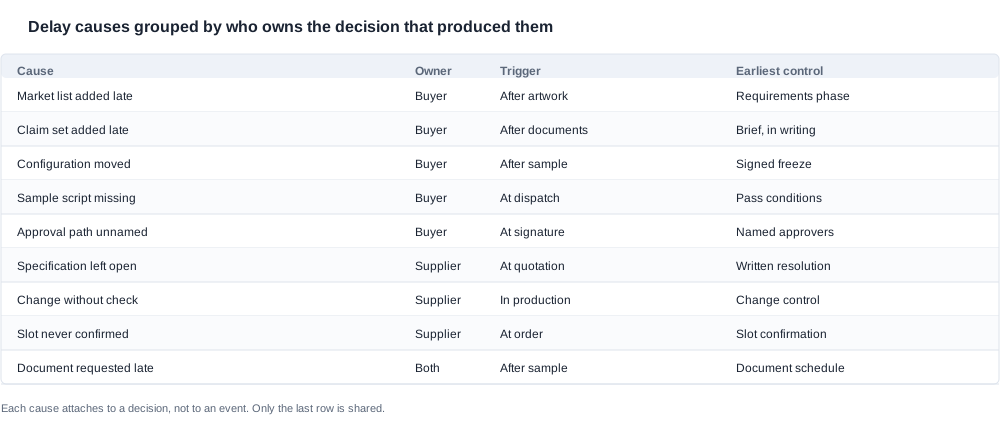
The pattern across all five is that they are decisions rather than events. A buyer cannot prevent a laboratory from taking as long as it takes, and cannot prevent a freight forwarder from being booked late. A buyer can decide the market list in week one instead of week six, and that is the difference between a print run that joins the programme and one that does not. The selection criteria for a schedule review are therefore simple and worth writing on the first page of the programme file: for every dated milestone, name the decision that produces it, name the party that takes that decision, and state the date by which it has to be taken. A milestone with no named decision behind it is the most reliable predictor of a late programme, and the check is cheap enough to run at every internal review.

The causes that sit on the supplier's side
Four supplier-side causes account for most of the remaining delay, and they are recognisable because the buyer's paperwork is complete when the delay still happens.
A specification that is open rather than settled. Where a published row carries two values, or a model carries two names, or a variant's relationship to another variant is not stated, the supplier has to resolve the specification before it can price, plan or build. The cost of that resolution is real work that nobody has been scheduled for, and it is the reason some quotations take longer than others for reasons that have nothing to do with quantity.
A change made without re-assessment. A component substituted for availability, a firmware build updated for a defect, a packaging insert reprinted with a different month: each of these is individually defensible and each of them breaks the link between the configuration that was tested and the configuration that ships. The delay appears later as a quality review rather than as a factory delay, which is why it is often misattributed.
A schedule queue that was never checked. A configuration with a queue joins it at the back. The buyer finds out when the delivery date moves, because nobody confirmed the slot when the order was placed.
A document that was requested late. The longest-lead documents in this category — the ones tied to the cell actually fitted, to the exact configuration, to the destination market — are requested after the sample stage by default, and they are the documents with the longest external lead time. A supplier that waits for a request to begin a document cycle is behaving reasonably; a programme that expects the document to exist is the one that is wrong.
None of these four is a reason to change supplier, and all four are reasons to write a condition. A change-control rule that names who may approve a substitution, what evidence has to accompany it and how the buyer is notified, removes the second cause entirely. A slot confirmation attached to the order acknowledgement removes the third. A document schedule issued with the purchase order removes most of the fourth.

The causes that are visible in the catalogue before you order
This is the part of the answer that surprises procurement teams, because it suggests that some delays are not caused by anything that happens during the programme at all. They are caused by open questions that already exist in the published record before the first enquiry is sent.
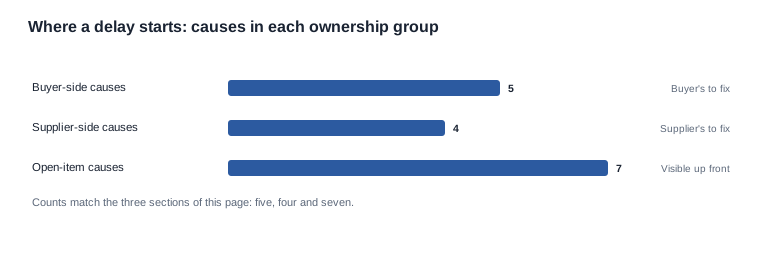
Seven items in the internal record for this range remain open, and each one is a delay waiting for a programme that touches it.
- The A05 and the A06 publish identical specifications. The two children's entries carry the same cell capacity, the same rated runtime, the same charge-time ceiling, the same charging method and the same six feature lines, and the difference between them is recorded as unconfirmed. A buyer ordering both, or a buyer who has assumed they are different because they sit on different catalogue pages, has an open specification question before the quotation stage begins.
- The L2 Utral publishes two names. The page carries two parallel names and gives no indication which is the base variant or whether one supersedes the other. A buyer who needs to know which of them is being quoted has to ask, and the answer may change the product listing, the artwork and the file.
- The L2 Utral publishes two case capacities in one row. The row reads 900/1400 mAh and the catalogue does not publish which name corresponds to which capacity. This is the single most consequential open item in the range for a buyer, because the case capacity changes what travels with the unit, what has to be declared in the transport paperwork and what the channel has to stock.
- The MT5 carries both a page-numbering anomaly and an unresolved product category. Whether the MT5 is a camera entry or a sport entry is recorded as uncertain, and the catalogue publishes it as a camera model with a 220 mAh cell, a case without a published capacity and a rated runtime of six to eight hours.
- The V06 and the S7 carry page-numbering anomalies in the catalogue's own index. Two of the best-specified models in the range — the V06 publishes an ergonomic design line, a long-runtime line, a removable inner frame, an IP54 marking and four colours, and the S7 publishes an ergonomic design line, a thirteen-megapixel resolution class, a removable inner frame and an IP54 marking — are indexed inconsistently, so a buyer working from the index rather than the product pages can pull the wrong document.
- Three entries are published without a formal model number. The AR entry, the electrochromic entry and the bone-conduction entry appear as products without a SKU, which means they cannot be quoted as a named item, ordered against a named item or tracked through a lot record.
- No entry in the range has published photographs, video or test reports. The record notes that all twenty-eight entries lack them, which means a buyer cannot do visual due diligence from published material and has to schedule a sample and a document request instead.
Seven open items is not a reason to avoid a product family, and it is not a judgement about the products. It is a description of where the documentation is thin, and thin documentation has a schedule cost that is easy to plan for and expensive to discover. Each item above can be closed with a written answer before the order is placed, and each one that is closed in advance removes a specific class of delay from the programme.
The handling matters as much as the list. A buyer who raises all seven at once, in a single enquiry, gets a general reply that closes none of them; a buyer who raises them against a named configuration gets an answer that can be filed. The practical form is a short schedule — one line per open item, each with the question, the configuration it touches and the date an answer is needed. Four of the seven touch configurations a buyer is unlikely to order, and those four can be closed once for the file rather than per programme, which is the cheapest way to remove them. The remaining items — the two entries that publish identical specifications and the one page that publishes two names and two case capacities — have to be closed against the exact configuration being quoted, because their answers change what is being bought. A buyer who treats an open item as a documentation nuisance rather than as a configuration question will order the wrong case.
The second point is about who holds the answer. Each of these items is held by a supplier-side record rather than by a laboratory, a forwarder or a market authority, which means the response time on them is short and the resolution is a decision rather than a test. That is worth establishing explicitly in the request, because a buyer who expects a laboratory turnaround for a naming question will plan for a delay that does not exist, and a buyer who assumes a naming question will resolve itself will discover the answer after the artwork has been approved.

How to assign a cause before it becomes a delay
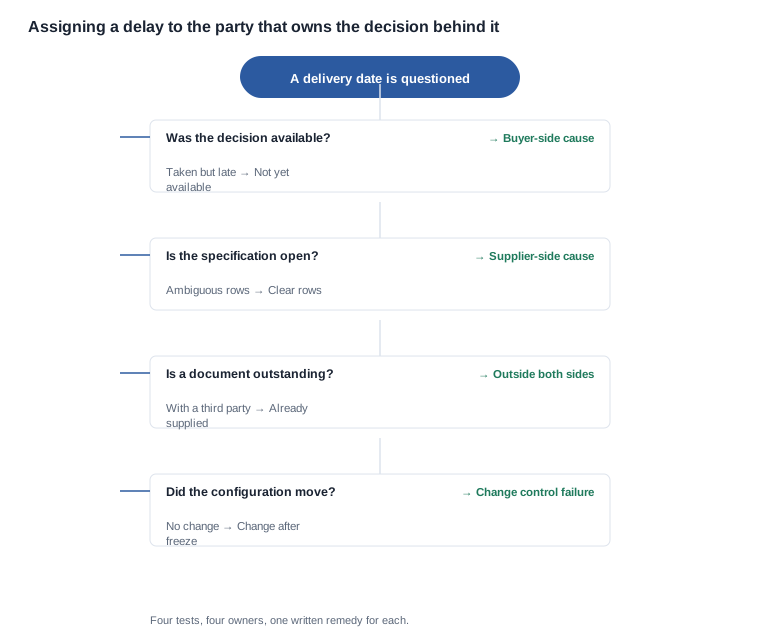
Attribution is a mechanical exercise once the categories are defined, and the value of doing it early is that it determines who has to act. Four questions separate the causes, and they can be asked at any point in the programme — including at the point where the first date is questioned.
Was the decision available to be taken at the time it was needed? If the answer is yes and it was not taken, the cause is on the buyer: a market list, a claim set, a configuration, a sample script, an approval path. If the decision was not yet available because something upstream had not been resolved, the cause moves down the chain to whoever held the unresolved item.
Is the specification open rather than settled? If a published row carries an unresolved alternative, an unconfirmed relationship or an uncategorised model, the cause is on the supplier's documentation, and the remedy is a written resolution attached to the order rather than a verbal reassurance.
Is a document outstanding with an external party? A laboratory, a certification body, a forwarder or a market authority sits outside both the buyer's and the supplier's direct control, and the remedy is sequencing: the request goes out at the stage where the lead time still fits inside the schedule rather than at the stage where it is needed.
Is a change being made after the configuration was fixed? If so, the cause is a change-control failure whichever side proposed it, and the remedy is a rule about what a change requires before it is approved.
This exercise is worth doing on a schedule rather than on a delivery date, because the cost of a delay rises with the stage it is discovered at. The same open item — an unconfirmed variant relationship, for example — costs a written question at the quotation stage, a re-quotation at the order stage and a re-print of the artwork and inserts at the shipping stage. The later the discovery, the more of the programme has to be redone, and at that point the delay stops being a schedule problem and becomes a cost problem.
Recording the attribution is what makes the exercise worth doing more than once. A delay log with four columns — the date, the cause, the owner and the remedy — turns a complaint into a pattern, and the pattern is usually clear within two or three events: a programme that keeps recording buyer-side causes has a specification problem, one that keeps recording supplier-side causes has a supplier diligence problem, and one that keeps recording third-party causes has a sequencing problem. Buyers who do not keep the log cannot tell those three apart, because the externally visible symptom is identical in all of them: a date that moves. A short log is a due-diligence artefact, and it is the evidence that converts a delay into a decision about the programme rather than into an argument with the supplier.
What causes delays: the three-part answer for a procurement file
Published: twenty-eight entries across seven categories, and a specification set that a schedule commitment can be built on. A schedule has to know which cell is fitted and how many of them, and that row is on every entry. It has to know how long a unit takes to charge and how long it runs, and both of those rows are on every entry too — a two-hour-or-less ceiling on twenty-six of them, about one hour on the D17 and the ZH12. It has to know the charging interface, and that row exists on twenty-four entries while four camera models are left blank, which is where the risk of an unquoted interface falls on the quotation rather than on the schedule. It has to know what the unit is, and the rows that answer that are a resolution class on the eleven camera models, an ingress marking on the V06 and the S7, a colour set on the V03 Pro and the V06, a case with a capacity on five camera models and a case without a figure on the KY06 and the MT5, with no case row at all for the V06 and the V03 Pro, and the V03 or the S7, the removable inner frames on the V06 and the S7, the removable temple on the G07, the slim temple on the YK12, the surround-sound lines on the YKC02 and the YK12, and the D11 and the D17, the stereo surround line on the ZH12, the remote shutter rows on the D17 and the ZH12, the flexible temple, the photochromic lens and the Type-C port on the V03 Pro, and the indicator light and the button control on the AR entry. A weight appears once, on the MT6. A Bluetooth version appears on fourteen entries. Not published: every schedule figure — lead time, production capacity, minimum order quantity, warranty period, unit price, certificate numbers and test report references — and seven open items in the record for the range itself. Ask the supplier: a schedule for a named model, configuration and volume with its dependencies named, the resolution of any open item that the configuration touches, and a document schedule issued with the order rather than after it.
The wording that survives a schedule review is narrower than the wording that survives a product review, and the difference is that a schedule claim is always a claim about a configuration rather than about a model. A programme may say that a lead time was quoted for a named configuration at a named volume, that the constraint was identified, and that the open items were closed in writing. A programme may not publish a standard lead time for the range, because no such figure appears in the catalogue and because a figure quoted for one configuration is wrong for the next one. The same applies to capacity and to the minimum order quantity: both are absent from the published material and both are per-configuration in practice.
For a buyer who has just lost a delivery date, our position is that the delay is a classification problem before it is a supplier problem. The catalogue publishes enough for the buyer to identify most causes before an order is placed, and the causes that are already visible in the record — two identical children's entries with an unconfirmed difference, one camera page with two names and two case capacities and no correspondence, one category recorded as uncertain, two index anomalies, three entries without a SKU, and no published photographs or test reports anywhere in the range — are all closable with a written answer. What we do not publish, and would not publish even if we could, is a standard schedule, because the number would be wrong for almost every configuration a buyer actually orders.
Related reading
- The same causes read from the schedule side — lead time factors and what moves them
- Where delays are recorded against the development process — common delays in development
- The checklist to run before the first order — lead time checklist for a first order
- Which customisation choices move the schedule — customisation and lead time
- The schedule terms to settle in the contract — standard OEM lead time terms
Send the model, the configuration, the volume and the date you are working back from, and the schedule can be quoted with the constraint named instead of a single date and no explanation.


